|
 Is deep freeze the latest sign climate change is accelerating? Extremes consistent with theories about how emissions could affect weather patterns, Guardian Jonathan Watts 2 Feb 2019 Is deep freeze the latest sign climate change is accelerating? Extremes consistent with theories about how emissions could affect weather patterns, Guardian Jonathan Watts 2 Feb 2019
Lake Michigan in the US has frozen over and is covered in snow as the polar vortex drives down temperatures in Chicago. Photograph: Kamil Krzaczyński/EPA
Hundreds of thousands of fish have choked during Australia’s hottest monthsince records began, swathes of the United States is colder than the north pole, new ruptures have been found in one of the Antarctic’s biggest glaciers and there are growing signs the Arctic is warming so fast that it could soon be just another stretch of the Atlantic.
And so the new year is carrying on where the old one left off, with growing signs climate disruption is accelerating at a more destructive rate than many scientists predicted.
The US deep freeze, which has plunged temperatures in Minnesotato -50C(-58F), may appear to have little in common with the searing heatwave that cooked Marble Bar, Australia, in 49.1C. But the extremes are consistent with theories about how increasing human emissions change major weather systems.
As carbon builds in the atmosphere, the planet warms and the ice caps melt, so the temperature gradient between the equator and the poles flattens out. Although the science is not yet conclusive, many scientists believe this is weakening the jet streams, which are important drivers of weather systems.
During the summer, this means high-pressure fronts linger for longer causing heatwaves such as those in parts of the northern hemisphere last May, June and July, and in the southern hemisphere over the past two months. During the northern winter, it loosens the polar vortex, which lets the warmer southern air in, causing the freakishly high Arctic temperatures recorded last winter, and allows the frozen air out, which is being seen in the US. This also manifested itself last year in Europe as “the Beast from the East”.
Despite seasonal ups and downs, the overwhelming global trend is towards higher temperatures. Last month, the Copernicus Climate Change Service, the European institute that gathers satellite data, was the latest institution to confirm the past four years have been the warmest recorded. “Dramatic climatic events like the warm and dry summer in large parts of Europe or the increasing temperature around the Arctic regions are alarming signs to all of us,” said Jean-Noël Thépaut, the head of Copernicus Climate Change Service. “Only by combining our efforts, can we make a difference and preserve our planet for future generations.”
In October, the United Nation’s top climate science body – the Intergovernmental Panel on Climate Change – warned that North America and Australia were among the areas likely to feel the impact of significant rises in extreme heat……..https://www.theguardian.com/environment/2019/feb/02/deep-freeze-latest-sign-climate-change-is-accelerating
|
|
February 4, 2019
Posted by Christina Macpherson |
2 WORLD, climate change |
Leave a comment

 150 Congressional Republicans Represent Fossil Fuel Companies Instead of Their Communities https://www.desmogblog.com/2019/01/30/150-congressional-republicans-climate-deniers-fossil-fuel-companies?utm_source=dsb%20newsletter
 ,
January 30, 2019 by ClimateDenierRoundup.Last week,
we mocked the fossil fuel industry’s use of an outlet it owns to brag about perverting democracy — but we didn’t actually call out the politicians in the industry’s pocket.
Lucky for us, the Center for American Progress Action Fund did just that this week. A new analysis from CAP tallies up the climate deniers in the 116th Congress. As it turns out, there are a lot: 150.
But that’s actually an improvement from last year, when there were 180. Of those 180, 47 are no longer serving: 22 were defeated in 2018, 16 retired, five resigned, and four went to other positions.
United States 150 out of 335 United States Members of Congress are climate deniers, collecting $68,359,582 in dirty money.
Top recipients
Mitch McConnell (R) – $3,018,793
Jim Inhofe (R) – $2,111,110
John Cornyn (R) – $3,444,515
Ted Cruz (R) – $3,372,000
Kevin Brady (R) – $1,753,762
The number of climate deniers receiving fossil fuel funding elected to the 116th Congress. Credit: Center for American Progress Action Fund
This may explain why the industry was so keen last week to assert the influence their money has. As it turns out, taking the cash may actually be a bad move for a candidate, since fossil-fuel funded candidates lost 30 seats in the 2018 elections (not factoring in the myriad of other factors at play, of course).
And make no mistake — it is the fossil fuel industry that demands denial, not average Americans. CAP Action Fund cites polling that shows a majority of Americans, including Republicans, know that climate change is real, that it is making weather more extreme, and that we should take action to reduce fossil fuel use.
Exact numbers obviously depend on the poll, but by and large it’s safe to say that a majority of all Americans, including some 55 percent to 66 percent of Republicans, support various types of climate action, including the policies in the Green New Deal.
What drives politicians to take positions opposed by the majority of people who vote for them? Well, money, of course. That’s why the report comes with a nifty interactive that shows you how many of each state’s members of Congress are in denial, as well as how much money they’ve received directly from the fossil fuel industry.
Mitch McConnell and Jim Inhofe top the list at $3 million and $2 million in dirty money over their careers, while the lifetime average among the 150 deniers is a scant $455,731 — which certainly sounds low. But that doesn’t include money spent on outside PACs and support.
The Kochs, for example, planned to spend $400 million on the 2018 election. That doesn’t include the additional money the Kochs spend bankrolling fake news operations like the Daily Caller. And even that’s hardly the only fossil fuel propaganda outlet! For example, there’s the Western Wire, where two of their writers, who also work as public relations strategists representing Exxon, recently posed as reporters to try and get information about one of the Exxon cases.
February 4, 2019
Posted by Christina Macpherson |
climate change, politics, USA |
Leave a comment
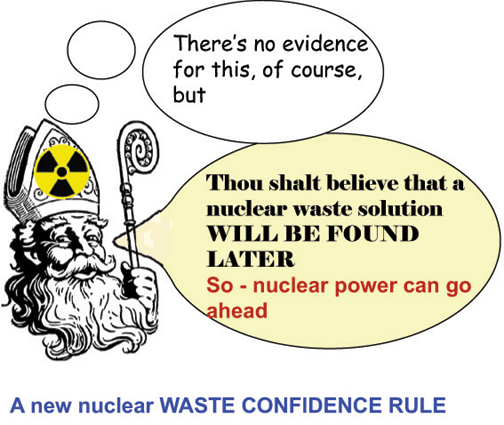
Nuclear waste burial fund grows to $43 billion, but DOE has not buried an ounce of spent fuel https://www.sgvtribune.com/2019/02/01/billions-pile-up-in-nuclear-waste-burial-fund-but-no-permanent-storage-solution-on-the-horizon/
Radioactive waste still stuck at San Onofre and other reactors across the nation By TERI SFORZA | tsforza@scng.com | Orange County Register, February 1, 2019 A U.S. Department of Energy fund to pay for the eventual disposal of nuclear waste has been earning $1.5 billion in interest each year — totaling a whopping $43.4 billion in 2018 — even as millions of pounds of radioactive waste pile up all over America in want of a permanent home.
The DOE piggy bank, dubbed the Nuclear Waste Fund, is invested in securities and earmarked for permanent disposal of spent fuel generated by commercial reactors such as San Onofre and Diablo Canyon. The fund’s most recent audit shows its value actually is down from 2016’s $46 billion.
That much money can buy a lot of things — except, apparently, permanent disposal of the nation’s nuclear waste.
For half a century, the fate of spent nuclear fuel has been marked by paralysis as officials squabble over what to do: build a deep geological repository at Yucca Mountain in Nevada, approve temporary private storage in New Mexico and Texas, or leave it at the 75 reactor sites where it was created.
The fight means mounting liabilities for taxpayers. The U.S. Government Accountability Office says delays in taking custody of commercial spent nuclear costs the federal government another $500 million every year.
The Nuclear Waste Fund was created in the last century, when nuclear power was viewed as the nation’s future. To encourage its development, the federal government passed the Nuclear Waste Policy Act of 1982, promising to accept and dispose of commercial nuclear fuel and high-level waste by Jan. 31, 1998.
In return, the utilities that owned the nuke plants would make quarterly payments into the disposal fund.
The utilities held up their end of the bargain — pumping about $750 million a year into the fund — but the DOE did not. And nearly 40 years on, it has not accepted an ounce of commercial nuclear waste for permanent disposal.
So the utilities operating nuclear plants found themselves stuck with this waste, and sued the DOE for breach of contract. Along the way, a federal judge said the DOE cannot charge for a service it not only isn’t providing, but won’t provide for many decades — and, in 2014, utilities all across America finally stopped paying into the Nuclear Waste Fund.
Their ratepayers probably didn’t much notice. The fee for consumers was tiny (about one-tenth of 1 cent for each nuclear-generated kilowatt hour), translating to some 20 cents a month on the average electric bill. But it added up.
Even after spending about $11 billion on the possibly dubious Yucca Mountain project, and even after fee collection ceased, the Nuclear Waste Fund continues to earn that $1.5 billion a year in interest.
And the government’s — and, thus, taxpayers’ — liabilities grow.
Costly delay
The DOE has paid out $6.9 billion to utilities for sticking them with the waste through 2017 — money that has been used to construct temporary storage on plant sites, such as the “concrete bunker” that has been so controversial at the shuttered San Onofre plant.
The DOE estimates it will pay another $28 billion or so for the storage debacle before it’s all over. The nuclear industry believes DOE’s bill will be much higher — closer to $50 billion.
None of that money comes from the Nuclear Waste Fund. Rather, it will come from the pockets of taxpayers, whether or not they got power from nuclear energy.
Grinding into action?
Two private companies are seeking federal licenses to open temporary storage sites in Texas and New Mexico for America’s commercial nuclear waste. The annual interest earned by the Nuclear Waste Fund — $1.5 billion — could be used to pay for private interim storage without further congressional appropriation, according to the Congressional Research Service.
But fierce opponents in New Mexico vow to keep the nation’s nuclear waste out of their backyards.
Meanwhile, the Nuclear Regulatory Commission issued the final volumes of its Yucca MountainSafety Evaluation Report and concluded that a deep geologic repository there would comply with safety and environmental standards once it’s permanently sealed.
But “scientific confidence about the concept of deep geologic disposal has turned out to be difficult to apply to specific sites,” the Congressional Research Service said. “Every high-level waste site that has been proposed by DOE and its predecessor agencies has faced allegations or discovery of unacceptable flaws, such as water intrusion or earthquake vulnerability, that could release unacceptable levels of radioactivity into the environment.
“Much of the problem results from the inherent uncertainty involved in predicting waste site performance for the 1 million years that nuclear waste is to be isolated under current regulations.”
And a newly elected congressman representing the San Onofre area has formed a new task force to push the issues of waste disposal and safety onto the front burner. The new group will feature some of the fiercest critics of Southern California Edison’s San Onofre Community Engagement Panel, a volunteer group advising Edison on the plant’s tear-down.
“We cannot allow the status quo to continue indefinitely,” said U.S. Rep. Mike Levin, D-San Juan Capistrano.
February 4, 2019
Posted by Christina Macpherson |
USA, wastes |
Leave a comment
Russia withdraws from Cold War-era nuclear weapons treaty with US https://www.abc.net.au/news/2019-02-02/russia-withdraws-from-cold-war-era-nuclear-weapons-treaty/10774536 Russia has suspended a Cold War-era nuclear weapons treaty, President Vladimir Putin said, after the United States accused Moscow of violations and said it would withdraw from the arms control pact.
 Key points:
- Russia will start work on new missiles, including hypersonic ones

- US and Russia both allege the other has violated the INF treaty
- China urges dialogue amid fears of nuclear arms race
The Intermediate-range Nuclear Forces (INF) Treaty prevents the two superpowers from possessing, producing or test-flying ground-launched nuclear cruise missiles with a range of 500 to 5,500 kilometres.
The United States announced it will withdraw from the INF treaty in six months unless Moscow ends what it says are violations of the pact, but Russia denied violating the treaty.
“The American partners have declared that they suspend their participation in the deal, we suspend it as well,” Mr Putin said during a televised meeting with foreign and defence ministers.
Mr Putin said Russia will start work on creating new missiles, including hypersonic ones, and told ministers not to initiate disarmament talks with Washington, accusing the United States of being slow to respond to such moves.
“We have repeatedly, during a number of years, and constantly raised a question about substantiative talks on the disarmament issue,” Mr Putin said.
“We see that in the past few years the partners have not supported our initiatives.”
The US alleges a new Russian cruise missile violates the important pact, signed by former leaders Ronald Reagan and Mikhail Gorbachev in 1987.
The missile, the Novator 9M729, is known as the SSC-8 by the North Atlantic Treaty Organisation (NATO).
Russia said the missile’s range put it outside the treaty, and accused the US of inventing a false pretext to exit a treaty it wants to leave anyway so it can develop new missiles.
Russia also rejected the demand to destroy the new missile.
During the meeting with Mr Putin, Russian Foreign Minister Sergey Lavrov accused the US of violating the INF and other arms deals, including the non-proliferation treaty.
Mr Putin said Russia would not deploy its weapons in Europe and other regions unless the US did so.
Fears of new arms race
The row over the INF treaty is yet another twist in Russia’s worsening relations with the United States and the West, with tensions over Russia’s annexation of Crimea from Ukraine as well as allegations of it meddling with the presidential election in the US and being behind a nerve agent attack in Britain.
The treaty’s suspension has drawn a strong reaction from Europe and China.
European nations fear the treaty’s collapse could lead to a new arms race with possibly a new generation of US nuclear missiles stationed on the continent.
In a statement, China’s Ministry of Foreign Affairs said the bilateral treaty was important to maintain “global strategic balance and stability”.
“China is opposed to US withdrawal action and urges the United States and Russia to handle their differences properly through constructive dialogue,” the statement said, warning that unilateral withdrawal could trigger “negative consequences”.
February 4, 2019
Posted by Christina Macpherson |
China, politics international, Russia, USA, weapons and war |
Leave a comment
With Putin and Trump in Charge, the Risk of Nuclear War Returns
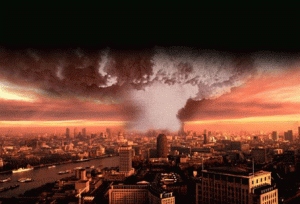 You thought the threat of global annihilation was history? Better think again. Hard. Bloomberg, By Peter Coy Jan 31 2018,
While the world’s attention is occupied by Brexit, Venezuela, and a hundred other concerns, an almost forgotten monster is raising its head: the threat of nuclear war.
Nuclear war gets surprisingly little attention considering there are enough nukes to end human civilization in hours. It feels like a relic of another era—of perestroika and glasnost and that famous walk in the woods. We’ve moved on to other concerns. Besides, what can anyone really do?
The reason to pay attention is that arms control—especially between the U.S. and Russia—has broken down. A fresh nuclear arms race appears to be taking shape. As for what anyone can do: Arms control moves forward in response to public pressure, when humanity speaks louder than arms merchants and bellicose world leaders. Sanity can prevail. It’s been more than 70 years since the U.S. detonated the first two atomic weapons in war, and not one has been used in combat since………
The Trump administration’s approach to a warlike Putin is essentially “peace through strength.” The president took the advice of John Bolton, his hawkish national security adviser, when he gave preliminary notice in October of his intent to pull out of the INF Treaty, which bars all nuclear and conventional ground-launched ballistic and cruise missiles with ranges of 500 to 5,500 kilometers (300 to 3,400 miles). ………
The death of arms control would benefit shareholders of Boeing, Honeywell International, Lockheed Martin, and Northrop Grumman, among others. “Great Power competition should be good for heritage defense contractors,” Byron Callan, an analyst for Capital Alpha Partners, wrote in a Jan. 24 note to clients, while cautioning that “the U.S. defense budget will be fiscally constrained.”
It would be less positive for the general public, of course. For decades, defense contractors and the Pentagon have offered the American people the following weirdly rational deal: You give us trillions of dollars, and we will use the money to build nuclear weapons that will never be used. A single Ohio-class nuclear submarine—a “
boomer”—can mete out 2,000 times the destructive power of the A-bombs that leveled Hiroshima and Nagasaki. If all goes well, it will prowl beneath the sea for decades and then go to the scrapyard without having fired as much as a harpoon in anger.
Mutual assured destruction—the balance of terror between the U.S. and Russia—kept the peace precisely because it was balanced. Arms control agreements ensured that neither side was able to gain an unbeatable advantage. The demise of arms control could lead not just to more weaponry but to more instability and uncertainty. The less each side knows about the other’s capabilities and intentions, the more likely it is that war will break out by accident. “The situation we face today relative to nuclear dangers is equal to the darkest days of the Cold War, and nobody seems to understand that,” says William Perry, 91, who was secretary of defense under President Bill Clinton. “Our policies don’t reflect it, either in the United States or in Russia.” https://www.bloomberg.com/news/articles/2019-01-31/with-putin-and-trump-in-charge-the-risk-of-nuclear-war-returns
J
February 4, 2019
Posted by Christina Macpherson |
2 WORLD, weapons and war |
Leave a comment
Sydney wins bid to host major climate conference for women in 2020, Brisbane Times, https://www.brisbanetimes.com.au/environment/climate-change/sydney-wins-bid-to-host-major-climate-conference-for-women-in-2020-20190203-p50vd2.html, By Peter Hannam 3 February 2019 Hundreds of climate leaders are expected to flock to Sydney next year after the City of Sydney won its bid to host a global conference for women.
The C40 group, representing 94 cities home to more than 700 million people, has selected Sydney to host its Women4Climate Conference in April 2020.
Lord Mayor Clover Moore said cities are responsible for a “staggering 75 to 80
per cent” of the world’s greenhouse gas emissions, making action in cities to cut carbon pollution crucial.
“Many of the world’s biggest cities are setting ambitious targets and policies to reduce
greenhouse gas emissions, proving effective action on climate change and strong
economic growth are compatible,” Cr Moore said.
“Shamefully, our own national government has a history of wilful negligence and Australian
politicians, both state and federal, are presiding over a climate disaster.”
Polling, including by the Lowy Institute, suggest concern about climate change is at the highest level since the end of the Millennium Drought.
Those numbers may well rise after a summer of extremes, from mass fish kills on the Darling River, raging fires in Tasmania, extensive flooding in Queensland and record heat for Australia in December and January.
The Women4Climate aims to empower young female leaders to take action to protect the environment, with a focus on mentoring, research and technology.
Lord mayor Moore, City of Sydney chief executive Monica Barone and the mayor’s chief of staff Shehana Teixeira will travel to Paris later this month to attend this year’s Women4Climate Summit.
Sydney Council is expected to endorse the proposal to host next year’s conference when it votes on the city’s budget on February 11, with Cr Moore’s Independent Team set to use its majority to support the plan.
February 4, 2019
Posted by Christina Macpherson |
AUSTRALIA, climate change |
Leave a comment

 Excerpt from radio interview, MARK BUTLER MP SHADOW MINISTER FOR CLIMATE CHANGE AND ENERGY
E&OE TRANSCRIPT, RADIO INTERVIEW, ABC RN BREAKFAST, 22 JANUARY 2019
KELLY: You’re listening to RN Breakfast; our guest is the Shadow Climate and Energy Minister, Mark Butler. Mark Butler, Tanya Constable who is the Chief Executive of the Minerals Council of Australia is today proposing in news.compapers that nuclear energy be allowed to be developed as a zero emissions fuel. She says Australia will only be catching up with the rest of the world, there are new technologies in this area ready to be deployable, they produce zero emissions and thirty other countries around the world use them. Is Labor prepared to exercise or even consider that option?
BUTLER: No, this is not a technology that has any opportunity for Australia. There are legal barriers to it, which we reindorsed at our National Conference just before Christmas as Labor Party policy. Where nuclear power is being explored, new nuclear power plants around the developed world in particular, for example the UK, it is extraordinarily expensive power as well. Rather than focus on these sorts of technologies that really are of no practical use to Australia, we want to focus on renewable energy which is going to bring down emissions, bring down power prices, and power thousands and thousands of jobs.
February 4, 2019
Posted by Christina Macpherson |
AUSTRALIA, politics |
Leave a comment
Nuclear arms control is increasingly strained as Russia steps back from treaty, Quartz, By John Detrixhe, February 3, 2019 The nuclear arms controls that have been in place since the end of the Cold War appear increasingly strained. The US said yesterday (Feb. 1) that it will withdraw from a landmark treaty for such weapons that it signed with the Soviet Union in 1987. Russia responded today by saying it will also suspend its obligations under the agreement.
The US is pulling back from the treaty with the backing of its NATO allies because officials say Russia has built a cache of missiles and refuses to destroy them. Vladimir Putin, who claims his county is in compliance, has likewise complained that the Americans are potentially in breach of the agreement, which banned the use of short- and medium-range missiles by both countries. The Russian president said his country will begin developing new missiles.
“Our American partners announced that they are suspending their participation in the treaty, and we are suspending it too,” Putin said, according to the BBC.
The breakdown follows several years of failed negotiations. Carl Bildt, co-chair of the European Council on Foreign Relations, said on Twitter that the end of the treaty would allow Russia to deploy cruise missiles from ground launchers that would quickly threaten Europe. He says both sides should commit to not deploying new weapons, then address Russia’s controversial 9M729 missile systems “in detail.”……..
Under the terms of the treaty, it will take six months for the agreement to dissolve. The US has given Russia six months to return to compliance with the treaty, and all parties should make the most of that window to find a resolution….https://qz.com/1541032/russia-withdraws-from-inf-treaty-amid-fears-of-nuclear-arms-race/
February 4, 2019
Posted by Christina Macpherson |
politics international, Russia, weapons and war |
Leave a comment

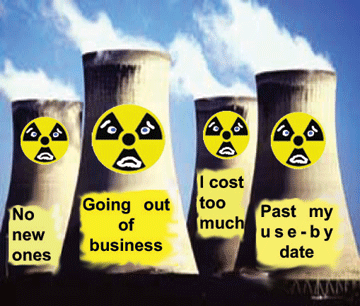
Fate of UK’s nuclear plants in doubt over ageing infrastructure, Guardian, Adam Vaughan, Energy correspondent@adamvaughan_uk, 4 Feb 2019
After 12% drop in generation, experts say existing nuclear plants are likely to close early Britain’s nuclear power stations recorded a 12% decline in their contributions to the country’s energy system over the past month, as outages raised concerns over how long the ageing plants will be able to keep operating.
A temporary closure of two of the country’s eight nuclear plants resulted in a double-digit drop in nuclear generation in January, compared to the same period last year.
Prospects for new nuclear projects have commanded headlines and government attention in recent weeks, with Hitachi and Toshiba scrapping their plans for major new plants.
But the fate of the existing plants, which usually provide about a fifth of the UK’s electricity supplies, has been pulled into focus by outages due to safety checks and engineering works running over schedule. Nuclear outages also push up carbon emissions because any capacity shortfall will typically be replaced by fossil fuel power stations
Seven of the power stations use an advanced gas reactor (AGR) design, the oldest of which is 43 years old and the youngest 30 years .
Most were built with a lifetime of about 35 years in mind. All are due to be closed in the 2020s after owner EDF Energy extended their lives, but there are now fears that ageing infrastructure may reduce their output or even lead them to shut early.
Iain Staffell, lecturer in sustainable energy at Imperial College, which compiled the nuclear output data, said: “Just as Toshiba and Hitachi have pulled out of building new reactors, we have one third of the existing nuclear capacity unavailable either for maintenance or because their maximum power has been reduced as they get older.
“Many of our reactors were built in the late 70s, and like your typical 40-year-old they aren’t in peak physical condition any more.”……… https://www.theguardian.com/environment/2019/feb/03/fate-of-uks-nuclear-power-stations-in-doubt-over-ageing-infrastructure
February 4, 2019
Posted by Christina Macpherson |
politics, UK |
Leave a comment
PRAGUE, Feb 3 (Reuters) – The Czech Republic is unlikely to be ready to hold a tender to build new nuclear reactors this year, given the financing structure has still not been decided, Industry Minister Marta Novakova said on Sunday.
The government and electricity producer CEZ, which is 70 percent owned by the state, have been locked in a debate over how to finance the construction of new nuclear units……..
Builders for nuclear power plants from countries including Russia, China and the United States are all set to vie for the Czech deal. (Reporting by Robert Muller; Editing by Susan Fenton) https://www.reuters.com/article/czech-uclear/czech-industry-minister-nuclear-reactor-tender-not-realistic-in-2019-idUSL5N1ZY0AN
February 4, 2019
Posted by Christina Macpherson |
EUROPE, politics |
Leave a comment
US Sen. Warren: Ban US first strike nuclear weapons option https://www.sfgate.com/news/article/US-Sen-Warren-Ban-US-first-strike-nuclear-13585408.php February 3, 2019 BOSTON (AP) — U.S. Sen. Elizabeth Warren wants to make sure the United States never uses nuclear weapons first.
The Massachusetts Democrat has introduced a bill with Democratic U.S. Rep. Adam Smith of Washington that would make it the official policy of the United States not to use nuclear weapons first.
The lawmakers say the United States currently retains the option to be the first to use nuclear weapons in a conflict, even in response to a non-nuclear attack.
They said banning the use of nuclear weapons for first-strike purposes would “reduce the chances of a nuclear miscalculation.”
Fellow Massachusetts Democratic U.S. Sen. Edward Markey and U.S. Rep. Ted Lieu, a California Democrat, have also sponsored a bill that would bar the president from launching a nuclear first strike without congressional approval.
February 4, 2019
Posted by Christina Macpherson |
politics, USA, weapons and war |
Leave a comment
 Should legislators help save Ohio nuclear plants? NO: FirstEnergy bailout would be crony capitalism at its worst Columbus Dispatch, 4 Feb 19, Crony capitalism is never acceptable and should be always met with public outrage. But more-covert pay-to-play schemes that affect Ohio’s long-term economic health are particularly egregious. Take for instance the campaign-contributions scheme from FirstEnergy Solutions over the past year. While transactions to more than a dozen of Ohio policymakers may seem normal to the average voter, recent activity in Columbus reveals a much more calculated operation that seemly puts FirstEnergy’s nuclear agenda ahead of Ohio’s future.
In April 2018, FirstEnergy Solutions filed for bankruptcy in the wake of massive financial problems arising from the company’s competitive power-generation fleet. The company announced it would shut down its Ohio nuclear plants over a three-year period because continued operation wasn’t profitable. FirstEnergy had been unsuccessfully pursuing bailouts from the Public Utilities Commission of Ohio since 2014 and seeking a nuclear subsidy in the legislature since 2016 without success.
So it scrambled desperately for a lifeline, hatching a plan to offer sizable campaign donations to candidates hoping to gather up political allies to support its demand for $300 million a year to keep its plants operational.
What did FirstEnergy cough up for its legislative lifeline? For starters, the company gave $172,000 in total to Ohio House candidates, many of whom had no legislative or energy-industry experience. It also donated $565,000 to the Republican Governors Association, an amount more than five times what the company gave to Governor Mike DeWine’s Democratic counterpart.
We can clearly see the pay, but what exactly was the play? Conveniently, on the first day of the new General Assembly a standing committee on power generation was established, setting the stage to justify passage of a nuclear bailout and help out FirstEnergy. Additionally, FirstEnergy recently announced a debt-restructuring agreement with its creditors. Not coincidentally, this surprise development came on the tails of securing state-lawmaker support to bail out FirstEnergy.
This situation is pay-to-play politicking at its worst, flying in the face of the new administration’s promises to be the most innovative administration in Ohio’s history. Part of an innovation agenda should include rejecting political favoritism toward uncompetitive and less technologically advanced nuclear power plants. Ohioans need to know that FirstEnergy’s attempt to influence a bailout for its failing nuclear plants isn’t just bad ethics. It’s also awful public policy.
Incidentally, natural gas is fueling jobs and consumer cost savings across America. This is especially true in Ohio, …………https://www.dispatch.com/opinion/20190203/column-should-legislators-help-save-ohio-nuclear-plants-no-firstenergy-bailout-would-be-crony-capitalism-at-its-worst
February 4, 2019
Posted by Christina Macpherson |
business and costs, politics, USA |
Leave a comment










 nuclear-news