Countries going into deep nuclear debt to Russia; Hungary the latest victim of this political blackmail
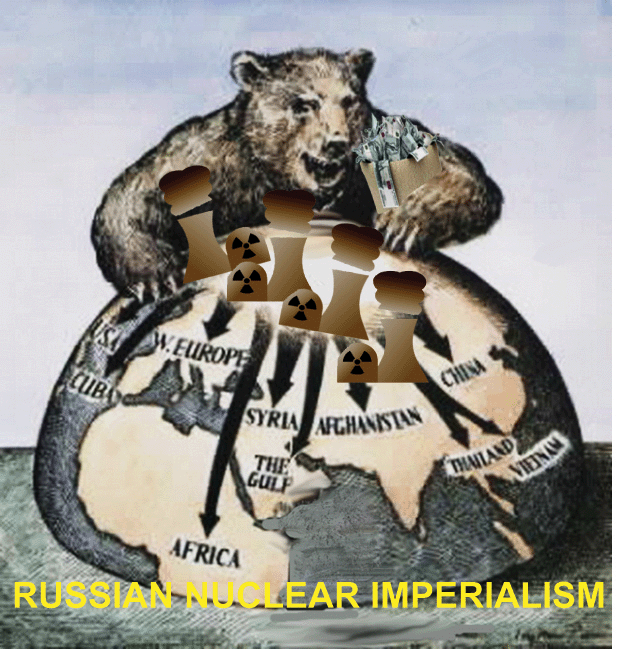
Hungary seeks to postpone loan payback to Russia for Nuclear power plant: What will the final cost be?Bellona February 1, 2019 by Charles Digges Budapest is seeking to modify the terms of a loan it must repay to Russia for building two new VVER-1200 type reactors that will eventually replace Hungary’s Paks nuclear power plant, according to a report from Reuters.
The reactors, which will constitute a plant called Paks II, will be built by Rosatom, Russia’s state nuclear power company, at a cost of 10 billion euro ($12 billion), and will replace the older Soviet-built nuclear plant that supplies half of the country’s electricity.
Rosatom’s construction contract, which includes the loan for Paks II, was the subject of a hotly-debated probe by the EU’s Organization for Economic Co-Operation and Development, which investigated whether the Russian bid violated European competition statutes.
At the time, EU officials and commentators viewed the deal as a Trojan Horse to help cement Moscow’s influence over the right-leaning, rabidly anti-globalist government of Hungarian Prime Minister Viktor Orban.
The EU eventually dropped its investigation in 2017 and granted Hungary permission to build the reactors – partly in an effort to entice Orban, who was insistent about contracting Rosatom, back into the democratic fold. Now Budapest is citing the delay caused by the competition review as reason to renegotiate when it begins paying Rosatom back.
Hungarian financial authorities plan to ask Moscow to postpone collecting on the debt until after the new reactors begin to generate electricity – but it is as yet unclear whether Rosatom will accept new terms. The plant’s construction, meanwhile, is running late. The build was supposed to begin last year………
While the terms of the Paks II loan remain in the shadows, other financing arrangements Moscow has made for building nuclear reactors in other countries suggest that the interest alone could prove to be very expensive for Budapest.
An $11.4 billion, 30-year agreement Rosatom signed with Bangladesh to build the Roopur nuclear plant will net Moscow $8 billion in interest. A $25 billion deal Rosatom is pursuing with Egypt to build that country’s Dabaa plant could, over the 35-year term of that loan, swell to $71 billion.
Another enormous $76 billion deal between Rosatom and South Africa was eventually thwarted by environmentalists when it was revealed the project had been secretly negotiated. Had the deal held it would have siphoned off a quarter of South Africa’s gross domestic product before the reactors even began operation.
Terms like this could spell trouble for Hungary in light of Moscow’s tendency to be a kneecapping creditor when it comes to energy projects – especially when Russia sours on the politics of its debtors.
In 2014, at the height of East-West tensions over Russia’s annexation of Crimea, Kremlin officials threatened to cut nuclear fuel supplies to Ukraine’s Soviet built reactors – which would have interrupted their chain reactions and likely caused a catastrophic accident.
Rosatom eventually walked the threat back. But the lurid message in Moscow’s head-fake toward igniting a second Chernobyl was clear: Russian-built reactors are a useful new tool for political blackmail………..
Many in Europe – Hungary included – subsequently sought to diversify their energy supply in favor of nuclear. Yet, in a devious twist, Rosatom has emerged as the most stable and eager nuclear builder on the international market.
For now, Rosatom can afford to offer risky loans thanks to the enormous state subsidies it receives. These subsidies can be funneled into more loans, and the loans then boost the company’s profits on paper. But for the past several years, it has become clear that these subsidies to the company will likely decrease or dry up altogether in 2020.
As a result, Rosatom is amassing so-called memorandums of understanding from any country vaguely interested in nuclear power. The company says is currently has dozens of these MOUs amounting to more than $130 billion in incoming business.
But that claim should be viewed skeptically, as many of the countries for which Rosatom is promising to build reactors – countries like Jordan, Algeria, Nigeria, the Republic of Congo and Bolivia – won’t have the infrastructure to support nuclear power for decades.
For now, it’s not difficult to imagine Moscow extending the terms of its loan to Hungary for as long as Budapest likes. It will, after all, remain profitable on paper. But in the end, Budapest will be left holding the bag for Rosatom’s over extended balance sheet. But so long as Orban’s government continues it rightward lurch, Moscow is unlikely to call in its marker. http://bellona.org/news/nuclear-issues/2019-02-hungary-seeks-to-postpone-loan-payback-to-russia-for-nuclear-power-plant-what-will-the-final-cost-be
No comments yet.
1 This Month
10 March A LIVE WEBINAR THE REAL EFFECTS OF NUCLEAR POWER
What the Industry Isn’t Telling Us
1:00 PM Mountain, 2 pm Central, 3 pm Eastern. Live on the Keepers of the Water Facebook page



18 March Webinar @ 1 PM EST: An Assessment of SMR Projects: The Case of Canada
register for the zoom:
https://us02web.zoom.us/webinar/register/WN_o8BIIOUvQ2ONJR1nta65DQ#/registration


of the week – STOP SMALL MODULAR REACTORS IN CANADA
To see nuclear-related stories in greater depth and intensity – go to https://nuclearinformation.wordpress.com
-
Archives
- March 2026 (109)
- February 2026 (268)
- January 2026 (308)
- December 2025 (358)
- November 2025 (359)
- October 2025 (376)
- September 2025 (258)
- August 2025 (319)
- July 2025 (230)
- June 2025 (348)
- May 2025 (261)
- April 2025 (305)
-
Categories
- 1
- 1 NUCLEAR ISSUES
- business and costs
- climate change
- culture and arts
- ENERGY
- environment
- health
- history
- indigenous issues
- Legal
- marketing of nuclear
- media
- opposition to nuclear
- PERSONAL STORIES
- politics
- politics international
- Religion and ethics
- safety
- secrets,lies and civil liberties
- spinbuster
- technology
- Uranium
- wastes
- weapons and war
- Women
- 2 WORLD
- ACTION
- AFRICA
- Atrocities
- AUSTRALIA
- Christina's notes
- Christina's themes
- culture and arts
- Events
- Fuk 2022
- Fuk 2023
- Fukushima 2017
- Fukushima 2018
- fukushima 2019
- Fukushima 2020
- Fukushima 2021
- general
- global warming
- Humour (God we need it)
- Nuclear
- RARE EARTHS
- Reference
- resources – print
- Resources -audiovicual
- Weekly Newsletter
- World
- World Nuclear
- YouTube
-
RSS
Entries RSS
Comments RSS
 nuclear-news
Leave a comment