NATO chief says ‘no real progress’ on nuclear treaty
‘We don’t want a new Cold War,’ says Jens Stoltenberg. ‘We don’t want a new arms race.’ Russia refused to give any ground during a meeting with NATO on Friday about its alleged violations of a nuclear treaty, leaving the landmark arms control agreement in “real jeopardy,” Secretary-General Jens Stoltenberg said.
NATO says Russia has deployed a new land-based missile, the Iskander 9M729, in violation of the Intermediate-range Nuclear Forces (INF) Treaty, which since 1988 has banned all missiles with a range of 500 to 5,500 kilometers. And U.S. President Donald Trump has said that he will begin withdrawing from the landmark nuclear accord on February 2 unless Russia takes steps to return to compliance.
Western allies urged Russia to return to compliance at the meeting on Friday of the Russia-NATO Council, but Stoltenberg said the session yielded no change in either side’s position……https://www.politico.eu/article/jens-stoltenberg-russia-nato-after-meeting-russians-chief-says-no-real-progress-on-nuclear-treaty/
A close call – a nuclear war just missed, 25 years ago
That day, a group of American and Norwegian researchers launched a Black Brant XII sounding rocket from the Arctic Circle island of Andøya in an effort to study aurora borealis (the northern lights).
The scientists had warned Russia, the US, and 28 other countries that they were planning a launch, as they knew there was a chance that the rocket would be mistaken for a nuclear first strike.
But someone forgot to tell Russian radar technicians. The technicians sent an alert to Moscow suggesting that an American first strike might be incoming.
Within minutes, President Boris Yeltsin was brought his black nuclear-command suitcase. For several tense minutes, while Yeltsin spoke with his defense minister by telephone, confusion reigned,” the Washington Post’s David Hoffman reported a few years after the incident. “Little is known about what Yeltsin said, but these may have been some of the most dangerous moments of the nuclear age.”
It was, Hoffman reported, the first time a Russian or Soviet leader had used a nuclear briefcase in response to an actual alert. Yeltsin concluded that it was not actually a first strike and did not retaliate.
For that, I thank him; I don’t know if a Russian second strike would have sent enough warheads to kill 4-year-old Dylan all the way up in New Hampshire, but I’m also glad we didn’t have to find out.
But, of course, the 1995 incident was hardly the only time in the nuclear area we came close to an accidental nuclear exchange.
On October 27, 1962, Vasili Arkhipov, a Soviet navy officer, was in a nuclear submarine near Cuba when US naval forces started dropping depth charges (a mild explosive meant to signal for the submarine to identify itself). Two senior officers on the submarine thought that a nuclear war had already begun and wanted to launch a nuclear torpedo at a US vessel. But all three senior officers had to agree for the missile to fire, and Arkhipov dissented, preventing a nuclear exchange.
On September 26, 1983, Soviet Lt. Col. Stanislav Petrov was watching the Soviet Union’s missile attack early warning system when it displayed, in large red letters, the word “LAUNCH”; Petrov’s computer terminal gradually indicated that one, then two, then three, and eventually a total of five American missiles were incoming. Petrov declined to report the strike, knowing that if he did, the likely response would be a full nuclear retaliation. And it was good he did, because the Minuteman missiles the detection system thought it saw were actually just the sun’s reflection off clouds.
Oh, and while we’re at it: The Air Force lost a nuclear bomb off the coast of Georgia in 1958, where it remains today. There’s also a nuclear weapon stuck in a field in Faro, North Carolina, because of another time the Air Force screwed up; that bomb came extremely close to detonating.
Also, in 1980, an intercontinental ballistic missile exploded in Damascus, Arkansas, while it had a 9-megaton nuclear warhead — with three times more explosive power than all the bombs of World War II combined — on top of it. The warhead didn’t detonate; if it did, Arkansas wouldn’t exist and you never would have heard of Bill or Hillary Clinton.
We can live safely in the knowledge that much or all of humankind won’t suddenly vanish due to a miscalculation by a radar officer in Russia or the US, and that people near missile sites won’t find themselves incinerated accidentally due to technician error. Or we can continue to have nuclear weapons. But we have to choose.
Shares slump for Europe’s biggest publicly traded power company, due to Czech Republic’s PM’s nuclear power dream
-
Government is revamping panel discussing reactor financing
-
Analysts say state is unlikely to force CEZ to foot the bill
-
Billionaire Prime Minister Andrej Babis’s ambition to build new nuclear reactors in the Czech Republic is denting CEZ AS’s shares well in advance of any deal actually being struck.
That’s particularly unfortunate for the investors in eastern Europe’s biggest publicly traded power company, who should under normal circumstances be benefiting from a rally in electricity prices to near a seven-year high. CEZ is lagging peers because politicians keep dragging their feet about deciding who’ll pick up the multibillion-dollar bill for new reactors that would be unprofitable even at today’s prices
This protracted saga is yet another example of how nuclear energy once seen as the main low-carbon alternative to fossil fuels is struggling to get off the ground because of mounting costs. Only last week, Japanese conglomerate Hitachi Ltd. took a $2.8 billion charge after scrapping a U.K. project even though the U.K. government put its most generous offer yet on the table to help fund the Wylfa plant in Wales. ……..
The unfavorable math forced CEZ to cancel a tender for new reactors in 2014, after years of price negotiations and legal disputes with potential suppliers.
With the cost of renewable technologies plummeting, making wind and solar plants even more attractive to nations phasing out fossil fuels, the surge in costs from contracts to completion for new nuclear plants in Finland and France is evidence of how the technology is falling behind competitors. https://www.bloomberg.com/news/articles/2019-01-25/nuclear-dream-of-billionaire-premier-is-spooking-cez-investors
Scrutiny on Energy Secretary Rick Perry’s decision to award funding to an advanced nuclear enrichment facility
The Department of Energy said this month it would award the contract to Centrus Energy, a former government-owned contractor that ceased enrichment operations in 2013 before declaring Chapter 11 bankruptcy.
In a letter to Perry this week, Sen. John Barrasso, R-Wyo., chairman of the Senate Environment and Public Works Committee, said the company had a Ohio is drawing scrutiny from Senate Republicans.The Department of Energy said this month it would award the contract to Centrus Energy, a former government-owned contractor that ceased enrichment operations in 2013 before declaring Chapter 11 bankruptcy
In a letter to Perry this week, Sen. John Barrasso, R-Wyo., chairman of the Senate Environment and Public Works Committee, said the company had a mixed history in fulfilling federal contracts for nuclear fuel and questioned whether the money it received would end up supporting the Russian state-owned firm TENEX, from which Centrus buys enriched uranium.
“This contract appears to use American taxpayer funding to bailout Centrus, an unsuccessful business that relies on commercial relationships with Russian state-owned corporations to stay in business,” Barrasso wrote. “Congress did not authorize or fund this project.”
Both the Department of Energy and Centrus declined to comment for this story…….https://www.chron.com/business/energy/article/115-million-nuclear-contract-draws-scrutiny-on-13562022.php
A financial necessity – UK’s nuclear industry to fall into China’s hands
Telegraph 24th Jan 2019, Britain’s nuclear industry is falling inexorably into Chinese hands. At
Hinkley Point in Somerset, after years of debate and delay concrete is now
finally being poured by EDF for the base of Britain’s first nuclear reactor
to be built since Sizewell B.
But plans to build a fleet of new reactors at
other sites where existing plants are due to be retired from service are
tumbling like nine-pins.
Will any more be built? It’s hard to say, but without giant dollops of Chinese cash it looks increasingly improbable.
Amid falling costs for renewable alternatives, Britain’s nuclear dreams are
foundering on the rocks of cold economic reality, just as they did under
Thatcher when a flood of North Sea gas arrived to reshape the nation’s
energy landscape.
EDF, which owns the UK’s existing reactor fleet, and its
Chinese partner CGN remain committed to developing three new nuclear
projects at Hinkley, Sizewell in Suffolk and another at Bradwell in Essex –
a Chinese-led scheme – quite how the £50 billion-odd cost of building them
will be met remains murky. With debts of over 31 billion euros (£27bn),
the French state-owned company is strapped for cash and looks increasingly
reliant on its Beijing-backed partner to get them built.
The dawning reality is that without Chinese money to prop up EDF the industry is a
busted flush. Amid mounting security fears, Britain will have to think hard
about the wisdom of handing over the keys to a large part of its nuclear
fleet to Beijing.
Meanwhile, there are other ways China might seek to boost
its stake in Britain’s nuclear fleet. For starters, CGN has approached the
UK government about developing Moorside, the site adjacent to Sellafield
which has been vacated by Toshiba, using its own technology. It could seek
to do something similar at Wylfa too. Moreover, Centrica is planning to
offload a 20 pc stake it holds in EDF’s existing fleet of UK reactors.
China could be a willing buyer if it is allowed to do so.
Whether or not any of this matters is of course another question, but amid growing
tensions with China over espionage and security, many figures within
Britain’s security establishment view the prospect as alarming.
https://www.telegraph.co.uk/technology/2019/01/24/britains-nuclear-industry-falling-inexorably-chinese-hands/
University of Wisconsin hosts nuclear propagandist
 Professor says nuclear energy is safest, most practical energy source, Waste from lifetime of nuclear energy use in US would fit in soda can, professor said, The Badger Herald, by COURTNEY ERDMAN · Jan 24, 2019 University of Wisconsin hosted an international relations professor Thursday, who argued nuclear energy was the safest, most practical power source, and the best one to transition the world away from fossil fuels. ……. Goldstein recognized that many people are also afraid of nuclear waste and how to dispose of it, but their fears are also unfounded.“The actual waste would fit in a soda can if you used your whole lifetime of American-style electricity from nuclear power,” Goldstein said. …….https://badgerherald.com/news/2019/01/24/professor-says-nuclear-energy-is-safest-most-practical-energy-source/
Hungary’s problems in financing new nuclear power plant
Hungary working to modify funding for Russian-built nuclear plant, Marton Dunai, BUDAPEST (Reuters) 26 Jan 19- Hungary is working to modify financing for a nuclear plant being built by Russia so it only starts repaying the loan once the two reactors begin supplying power, a Hungarian minister said, after an EU review of the plans contributed to delays in the project.
……..Hungary awarded Russia’s state-owned Rosatom a contract to build a similar-sized plant to replace the existing one, but construction has faced long delays, partly because of a European Union review of the project, including the way it was funded.
“Once we know the deadlines for the technical contract, we will modify this (financing) contract,” said Janos Suli, the minister in charge of the project, adding that this would meet procedures set by the EU executive……….https://www.reuters.com/article/us-hungary-nuclearpower-financing/hungary-working-to-modify-funding-for-russian-built-nuclear-plant-idUSKCN1PJ153
1 This Month
To see nuclear-related stories in greater depth and intensity – go to https://nuclearinformation.wordpress.com/
12 February – Webinar The Big Push: New Nuclear Projects in Canada
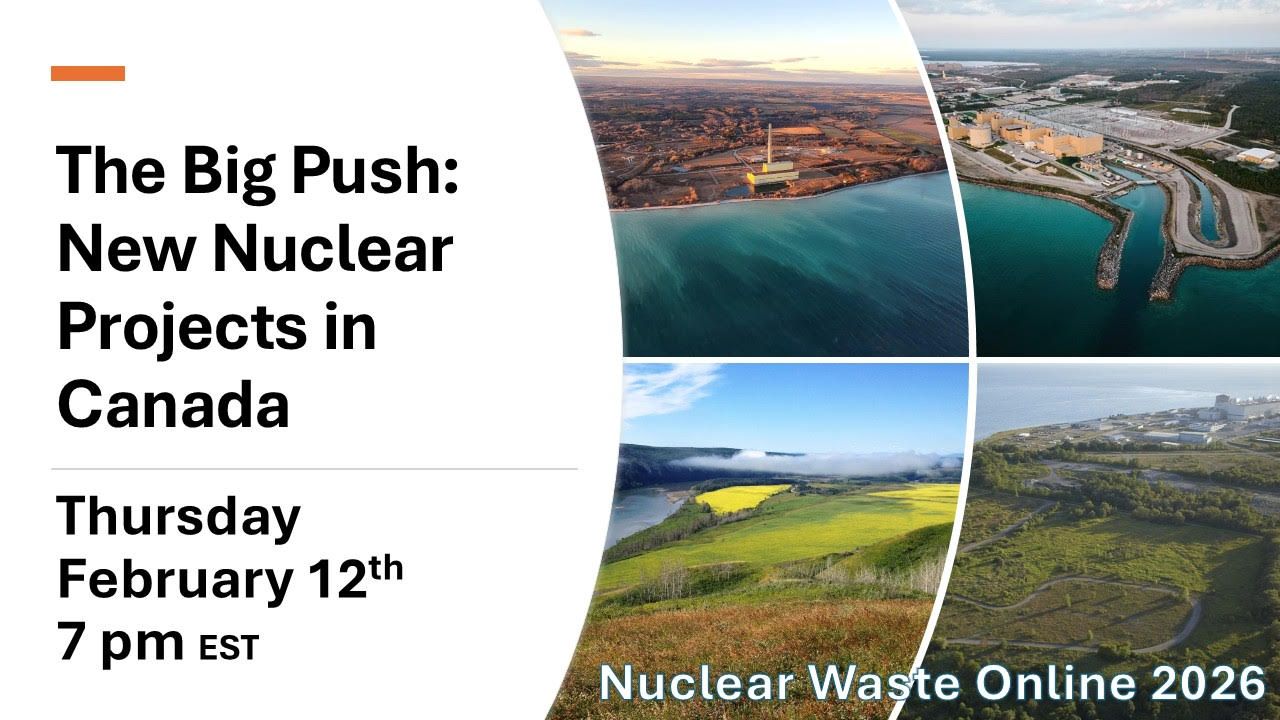
Thursday, February 12, 7 pm Eastern | 2nd of 4 sessions in the 2026 Nuclear Waste Online webinar series
Join a webinar on the push for new nuclear generation in Canada. Go to Northwatch.org to register or use the registration link https://us02web.zoom.us/webinar/register/WN_ZfWOf1GITqSRIZX8CB-A9w
-
Archives
- February 2026 (115)
- January 2026 (308)
- December 2025 (358)
- November 2025 (359)
- October 2025 (376)
- September 2025 (258)
- August 2025 (319)
- July 2025 (230)
- June 2025 (348)
- May 2025 (261)
- April 2025 (305)
- March 2025 (319)
-
Categories
- 1
- 1 NUCLEAR ISSUES
- business and costs
- climate change
- culture and arts
- ENERGY
- environment
- health
- history
- indigenous issues
- Legal
- marketing of nuclear
- media
- opposition to nuclear
- PERSONAL STORIES
- politics
- politics international
- Religion and ethics
- safety
- secrets,lies and civil liberties
- spinbuster
- technology
- Uranium
- wastes
- weapons and war
- Women
- 2 WORLD
- ACTION
- AFRICA
- Atrocities
- AUSTRALIA
- Christina's notes
- Christina's themes
- culture and arts
- Events
- Fuk 2022
- Fuk 2023
- Fukushima 2017
- Fukushima 2018
- fukushima 2019
- Fukushima 2020
- Fukushima 2021
- general
- global warming
- Humour (God we need it)
- Nuclear
- RARE EARTHS
- Reference
- resources – print
- Resources -audiovicual
- Weekly Newsletter
- World
- World Nuclear
- YouTube
-
RSS
Entries RSS
Comments RSS
 nuclear-news