I promised to find good news. It’s not that easy. But – Sir David Attenborough says ’Human activity has created a new era, yet climate change can be stopped. And, again, I am struggling with the reality that it is nearly, perhaps already is, too late, to stop the progress of global warming. Which makes climate change a more urgent problem than the nuclear threat.
Even if climate change is now irreversible, it’s no time to give up: the effort now must be to slow its progress, and to plan and adapt to its impacts.
Sir David Attenborough calls for ‘urgent’ climate change action
David Attenborough tells Davos: ‘The Garden of Eden is no more’Human activity has created a new era yet climate change can be stopped, says naturalist, Guardian, Graeme Wearden in Davos, Tue 22 Jan 2019 Last modified on Tue 22 Jan 2019 Sir David Attenborough has warned that “the Garden of Eden is no more”, as he urged political and business leaders from around the world to make a renewed push to tackle climate change before the damage is irreparable.Speaking at the start of the World Economic Forum (WEF) in Davos, Switzerland, the 92-year-old naturalist and broadcaster warned that human activity has taken the world into a new era, threatening to undermine civilisation.
“I am quite literally from another age,” Attenborough told an audience of business leaders, politicians and other delegates. “I was born during the Holocene – the 12,000 [year] period of climatic stability that allowed humans to settle, farm, and create civilisations.” …..
“The Holocene has ended. The Garden of Eden is no more. We have changed the world so much that scientists say we are in a new geological age: the Anthropocene, the age of humans,” he declared.
In a stark warning to the world leaders and business chiefs flocking to the WEF this week, Attenborough warned that the only conditions that humans have known are changing fast.
“We need to move beyond guilt or blame, and get on with the practical tasks at hand.”…..
Get it right, he argued, and humans can create a world with clean air and water, unlimited energy and sustainable fish stocks, but only if decisive action is taken now.
“Over the next two years there will be United Nations decisions on climate change, sustainable development and a new deal for nature. Together these will form our species’ plan for a route through the Anthropocene.
“What we do now, and in the next few years, will profoundly affect the next few thousand years,” he added.
My Turn: Martin Luther King’s quest to stop the nuclear arms race https://www.concordmonitor.com/KIngs-quest-to-stop-the-nuclear-arms-race-22786447By WILLIAM LAMBERS For the Monitor January 21, 2019, Civil rights champion Martin Luther King Jr. was also an activist for nuclear disarmament. Dr. King used his voice for peace during the Cold War nuclear arms race.
He can inspire us today to finish the journey of eliminating all nuclear weapons.
The year was 1958. The Soviet Union and the United States were developing and testing nukes at an alarming rate. In March, Dr. King received a letter from Norman Cousins and Clarence Pickett of the National Committee for a Sane Nuclear Policy. King was asked to support a statement urging an end to nuclear testing.
He joined the SANE movement right away. In April, Dr. King also signed an appeal by Protestant clergyman on halting nuke tests.
The public outcry against nuclear tests helped encourage President Dwight Eisenhower to start negotiations with the Soviets on a test ban treaty in 1958. In October, King joined a statement to the U.S. and Soviet negotiators in Geneva.
It read “an important beginning has to be made on one vital part of the problem of world peace, the permanent internationally inspected ending of nuclear weapons tests.”
Eisenhower proposed a suspension of nuclear tests during the talks. There were no nuclear tests by the U.S. or the Soviets from late 1958 into 1961. His successor President John F. Kennedy was able to produce a limited treaty with the Soviets in 1963 banning nuclear tests in the atmosphere, underwater and outer space. Underground tests did continue.
The 1996 Comprehensive Nuclear Test Ban Treaty, banning all tests including underground, has yet to be ratified by the U.S. Senate. President Donald Trump could ask the Senate to ratify this treaty and fulfill one of Dr. King’s goals of ending nuke tests forever.
Ending nuclear testing was seen as a critical step toward stopping the arms race. Dr. King understood the threat of nukes.
In 1957, in Ebony Magazine, King wrote “I definitely feel that the development and use of nuclear weapons of war should be banned. It cannot be disputed that a full-scale nuclear war would be utterly catastrophic. Hundreds and millions of people would be killed outright by the blast and heat, and by the ionizing radiation produced at the instant of the explosion.”
Dr. King recognized that spending on nuclear armaments robbed from society. King said, “A nation that continues year after year to spend more money on military defense than on programs of social uplift is approaching spiritual doom.”
The goal of eliminating nuclear weapons has been shared by successive leaders including presidents Ronald Reagan and Barack Obama. President Trump has yet to take action on eliminating nuclear weapons. Instead Trump has sought to scrap the Iran nuclear deal and the INF Treaty with Russia.
We have lost any momentum in reducing the nuclear danger. There are still close to 15,000 nukes worldwide, according to the Arms Control Association. Dr. King’s words can inspire us to jumpstart nuclear disarmament.
In his sermon “Loving Your Enemies” Dr. King said, “It is an eternal reminder to a generation depending on nuclear and atomic energy, a generation depending on physical violence, that love is the only creative, redemptive, transforming power in the universe.”
King wanted all people, all nations, to come together to work out their differences. Through what Dr. King called “a great fellowship of love” the world can achieve peace and nuclear disarmament.
Instead of nation’s wasting dollars on nukes we could feed the hungry, end disease and save the environment. As we celebrate Martin Luther King Day listen to his words and be inspired to take action for world peace.
(William Lambers is the author of “The Road to Peace” and “Ending World Hunger.”)
Greenland ice melting four times faster than in 2003, study finds, Southwest part of the island could be major contributor to sea level rise, EurekAlert, 21 Jan 19, OHIO STATE UNIVERSITY COLUMBUS, Ohio – Greenland is melting faster than scientists previously thought–and will likely lead to faster sea level rise–thanks to the continued, accelerating warming of the Earth’s atmosphere, a new study has found.
Scientists concerned about sea level rise have long focused on Greenland’s southeast and northwest regions, where large glaciers stream iceberg-sized chunks of ice into the Atlantic Ocean. Those chunks float away, eventually melting. But a new study published Jan. 21 in the Proceedings of the National Academy of Sciences found that the largest sustained ice loss from early 2003 to mid-2013 came from Greenland’s southwest region, which is mostly devoid of large glaciers.
“Whatever this was, it couldn’t be explained by glaciers, because there aren’t many there,” said Michael Bevis, lead author of the paper, Ohio Eminent Scholar and a professor of geodynamics at The Ohio State University. “It had to be the surface mass–the ice was melting inland from the coastline.”
That melting, which Bevis and his co-authors believe is largely caused by global warming, means that in the southwestern part of Greenland, growing rivers of water are streaming into the ocean during summer. The key finding from their study: Southwest Greenland, which previously had not been considered a serious threat, will likely become a major future contributor to sea level rise………https://www.eurekalert.org/pub_releases/2019-01/osu-gim011419.php
Nuclear-powered Royal Navy submarine in near-miss with ferry ITV News 21 Jan 19,A nuclear-powered Royal Navy submarine was involved in a near-miss with a large passenger ferry, it has emerged.
An investigation has been launched into the previously unreported incident, which occurred in the Irish Sea on November 6.
The ferry was Stena Superfast VII, which operates between Northern Ireland and Scotland.
It has a capacity for 1,300 passengers and 660 cars.
The submarine was submerged at the depth needed to extend its periscope above the surface of the water.
Nuclear strategy in ‘meltdown’ after Wylfa suspension, David Blackman, 21 January 2019, source edie newsroom
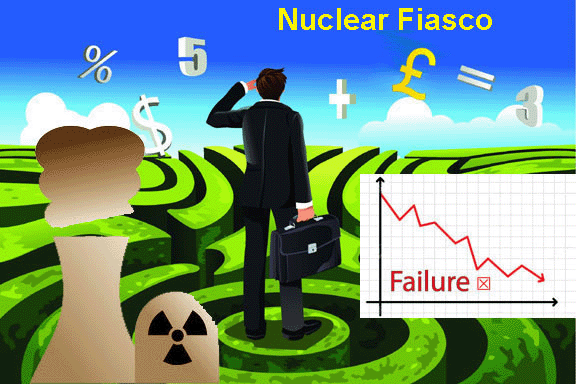
The government’s nuclear strategy is in “meltdown” following Hitachi’s announcement that it is halting work on its plans for a new UK atomic power plant in north Wales, Alan Whitehead has said. Labour’s energy spokesperson told the House of Commons yesterday (17 January) that Hitachi’s announcement, which also means a halt of work by the company’s UK nuclear arm Horizon on its other UK project at Oldbury in Gloucestershire, is a “significant blow” to the economy.
He said that the latest move, combined with Toshiba’s decision in November to scrap its plans for a three-reactor plant at Moorside, means that a total of 9.2GW of planned nuclear generation will not be delivered.
Whitehead also accused the government of reacting “far too slowly” to concerns about financing from its potential nuclear partners, including Hitachi’s arm Horizon, adding that government “dithering” had contributed to the axing of Moorside………..
Greg Clark, secretary of state for business and energy said that renewable technologies offer increasingly cost-effective and reliable options compared with nuclear, which is chiefly justified on the grounds that it replaces the baseload generating capacity currently supplied by higher emitting coal and gas plants: “We have also seen a strengthening in the pipeline of projects coming forward, meaning that renewable energy may now be just as cheap, but also readily available.
“In many ways, the challenge of financing new nuclear is one of falling costs and greater abundance of alternative technologies, which means that nuclear is being outcompeted.”
But he said the government remains committed to nuclear through the recently agreed sector deal with the industry, adding that it is considering a proposal from a Rolls-Royce led consortium for a “significant” joint investment in a small modular reactor project.
In addition, he said the Department for Business, Energy and Industrial Strategy is exploring the regulated asset base model for financing nuclear development, which EDF is keen to see used for its next such project at Sizewell, and will be setting out its proposals for this new approach in an energy white paper that is due to be published in the summer. https://www.edie.net/news/11/Nuclear-strategy-in–meltdown–after-Wylfa-suspension/
The European Commission said the subsidy scheme to be adopted for the project is in line with the EU state aid rules. The 40-year old Fessenheim nuclear plant has faced several safety issues over the decades.
JANUARY 21, 2019 EMILIANO BELLINIThe European Commission has given the green light to a tender mechanism the French government has conceived to enable the construction of solar plants with 300 MW of capacity at the Fessenheim nuclear power plant – the country’s oldest.
The commission said the project selected through the tender will receive a premium tariff under a 20-year contract, and the tender’s budget is approximately €250 million.
“The aid will be granted by the French state and will contribute to the French and European objectives of energy efficiency and energy production from renewable sources, in line with the EU’s environmental objectives, with possible distortions of competition state support being reduced to a minimum,” the commission stated.
The tender was announced by the French government in April. In July, France’s Directorate General for Energy and Climate – part of the Ministry for the Ecological and Inclusive Transition – revealed details of the tendering scheme. According to that announcement, 200 MW of the tendered capacity will be for ground-mounted PV ranging in size from 500 kW up to 30 MW, with the remaining 100 MW accounted for by rooftop projects larger than 8 MW in scale.
Potential tariffs estimated
The tender was to be implemented in three phases, starting late last year and continuing in the middle and latter stages of this year, and was set to comprise three groups of installations: the ground-mounted PV; rooftop systems on buildings, greenhouses, carports or agricultural buildings with an output of 500 kW to 8 MW; and rooftops with a capacity of 100-500 kW.
Projects selected among the first two categories will be entitled to a premium feed-in tariff while installations of the third and smallest category will have access to a regular FIT. The premium tariff for ground-mounted PV is expected to be €50-70/MWh, and that for larger rooftops €70-100/MWh. Smaller rooftop projects are expected to be granted €80-110/MWh.
The 40-year-old Fessenheim nuclear site, in the Haut-Rhin department of Alsace in northeastern France, is set to be decommissioned by next year. The plant has seen more than one temporary shutdown due to safety issues. One of the most high-profile issues occurred in April 2014, when Reactor 1 was shuttered. The French Nuclear Safety Authority reported at the time that internal flooding in the non-nuclear part of the reactor had damaged safety electrical systems. After being repaired, the reactor was reconnected to the grid in May the same year.
Green Alliance: UK must look to EU interconnection amid ‘crumbling’ nuclear plans, Business Green, Michael Holder, 21 January 2019
“……… New analysis by the environmental think tank highlights myriad benefits for the UK from trade in electricity with European countries, but warns leaving the EU – particularly under a ‘no-deal’ scenario – threatens to undermine opportunities to enhance cross-border interconnection.
Published on Friday, the analysis shows that a mix of increased electricity interconnection with the EU in addition to installing more renewable energy in the UK would help to keep consumer bills down, boost access to and trade in clean power, and also maintain energy security, in the face of on-going struggles to deliver planned new nuclear projects.
It follows Japanese firm Hitachi’s announcement last week that it has halted construction of the £16bn Wylfa nuclear project in Wales after failing to agree a funding support package with the government. Hitachi’s plans for another nuclear plant in Gloucestershire have also been shelved.
Green Alliance said trading power across borders with Europe could help reduce energy sector emissions in the short term without the need to build more capacity, and that interconnection could also help provide instant back up power when needed at peak times.
It also highlights the economic benefits of interconnection, with cross border trading delivering a combined value of £700m to UK markets in 2017, according to Friday’s analysis.
However, leaving the EU without a deal could cost the UK as much as £2.2bn per year at the current level of interconnection, the think tank warned.
Similar research by climate think tank E3G recently argued the merits of the UK maintaining membership of the EU internal energy market in order to fully realise the cost and carbon benefits of electricity interconnection with Europe.
At present, the UK is one of the least interconnected countries in Europe, and it therefore has the most to gain from improving its power connections with the rest of the continent, argued Chaitanya Kumar, senior policy adviser at Green Alliance……….
In the short term, Kumar suggested boosting interconnection could help strengthen the case for scaling up UK renewables capacity, and that negotiating continued participation in the EU’s internal energy market should therefore be a crucial part of the UK’s future relationship with the EU, particularly as the government’s nuclear energy plans “are crumbling”.
“Instead of doubling down on subsidised, expensive nuclear, the government should now be focusing on building cheaper alternatives in more renewables and electricity interconnection with Europe,” he said. “The UK’s climate ambitions are not under any immediate threat from the failed nuclear plans, but that can only be guaranteed if the existing alternatives are scaled up.”
The report follows news last week that plans for a new interconnector between Peterhead and the Norway took a step forward, after securing planning permission from Aberdeenshire Council.
The North Connect transmission link would see a 415-mile cable link Peterhead with the Norwegian Coast, providing up to 1.4GW of power between the two countries from 2023.
Secret Soviet Bunkers in Poland Hid Nuclear Weapons, Live Science, By Mindy Weisberger, Senior Writer | January 21, 2019 In the 1960s, the Soviet Union built massive bunkers in Poland. These bunkers didn’t appear on maps, and were carefully concealed to be invisible to spies from the air.
But now, these long-abandoned buildings are revealing some of the secrets of Russian military strategy during the Cold War.
Soviet documents from that time period described the sites as communications centers, though the buildings vanished from official records soon after they were built. Indeed, at the time, the Soviet Union denied having nuclear weapons cached anywhere in Poland.
Archaeologist Grzegorz Kiarszys, an adjunct professor at the Institute of History and International Relations in Poland, has conducted the first in-depth exploration of three of these nuclear warhead storage facilities. By delving into archives of declassified satellite images and analyzing building scans, Kiarszys is piecing together the role that these secret sites played on the global chessboard, at a time when the threat of nuclear war between the world’s biggest superpowers was all too real.
His findings were published online today (Jan. 21) in First View, a preview of the journal Antiquity‘s February 2019 issue.
Fifty years ago today, a nuclear meltdown occurred in Switzerland’s first experimental nuclear power station. Built in an underground chamber in Lucens in the western part of the country, it was the site of the worst nuclear accident in Swiss history.
The plant was opened in 1962, with the aim of not only producing energy, but also allowing Switzerland to develop a reactor bearing the “Made in Switzerland” label and enabling experiments with nuclear energy.
But these plans were pushed aside when disaster struck in the plant’s reactor cavity on January 21, 1969. A pressure tube burst which created a power surge leading to the reactor malfunctioning and an explosion. Luckily, a member of staff who was scheduled to be working on the reactor at the time was found safe and sound elsewhere. The plant’s underground design also prevented people and the environment from being harmed.
The accident’s severity registered at 5 out of a possible 7. The concentration of leaked cooling gas that was behind the door of the reactor cavity was lethal. It wasn’t even possible to measure the radioactivity because it was above the maximum level on the measuring instruments.
But the reactor cavern was not completely sealed: the radioactivity spread to the control room 100 metres away. In the machine cavern closest to the reactor, a team involved in shutting down the turbine had been exposed to radiation. A witness report said that since the decontamination showers had been out of order, the workers had to shower in a temporary facility without hot water.
The government ordered an inquiry into the incident and a report was eventually published ten years later. The Swiss Association for Atomic Energy found there had been no major negligence on the part of the plant’s managers. The cause of the incident was corrosion in a pressure tube, brought about by humidity.
Rolls-Royce in talks to supply Chinese nuclear plant in Essex, CGN hopes involvement of UK engineering group will allay security concerns concerns Jonathan Ford in London, Ft.com, 21 Jan 19
China’s largest state-backed nuclear company is in talks with Rolls-Royce about supplying equipment for the power plant it hopes to build in Essex as it seeks to allay national security concerns about the project. CGN is in discussions with the British engineering group over providing the control systems for the Hualong HPR1000 reactors the Chinese group plans to install at Bradwell on the Essex coast. Regarded as the central nervous system of a nuclear power plant, this technology not only drives the operation of the reactor, but allows it to be safely shut down should problems occur.
Using the British group’s equipment would be a significant concession by CGN. The Chinese group has developed its own control systems which it hopes to export along with its reactor technology. But the move is seen as a necessary sop to ease concerns about Chinese companies building critical national infrastructure in the UK. Britain’s nuclear programme is in disarray following Hitachi’s decision last week to shelve plans for a £20bn power station at Wylfa in Anglesey after financing plans for the scheme unravelled. That came two months after Toshiba pulled out of another project in Cumbria. The latest withdrawal leaves just EDF and CGN as potential bidders for new nuclear projects. The two companies are linked. The French group is building the Hinkley Point station in Somerset with financial backing from CGN.
Theresa May’s government has been less enthusiastic about Chinese investment than her predecessors, and Washington has raised concerns about Beijing taking civilian nuclear technology and transferring it to military uses. Various countries have barred Chinese suppliers from telecoms and energy markets over fears that “backdoors” could give the Chinese government access to data or control over the equipment. …….
Peter Atherton, an industry expert at consultancy Cornwall Energy, said the lack of bidders left the government with a dilemma. “On the one hand they want Chinese nuclear investment in order to provide competition to the French but on the other hand there are very obvious security issues,” he said. “If the government doesn’t trust China to build mobile telecom networks how on earth can they trust them to build nuclear power stations?”
CGN has appointed senior figures from the contracting and nuclear industry to its UK subsidiary. Its British advisory board is chaired by Sir Terry Morgan, the former chairman of Crossrail and the HS2 high speed rail project. He was dismissed from both roles after serious delays and overruns at the state-run Crossrail project. ………https://www.ft.com/content/4d2f2814-1b41-11e9-9e64-d150b3105d21
Britain badly needs a dose of nuclear realism. If it remains a strategic necessity, the UK must find a way to win more bang for its buck, Ft.com , JONATHAN FORD , 21 Jan 19
One thing British politicians have never lacked when making nuclear policy is optimism. When it comes to atomic energy, they leave Dr Pangloss in the shade. Take the last big nuclear programme back in the 1960s, whose purpose was to meet a fifth of the UK’s electricity needs. Rather than using proven (if US made) reactor technology, the government bet instead on a homegrown gas-cooled type. The minister of power, Fred Lee, confidently predicted the experimental design would be a world beater. Britain had “hit the jackpot”, he declared. The UK certainly hit something. But it wasn’t pay dirt. The AGR programme dragged on for more than two decades and was, in the words of the man who commissioned it, Arthur Hawkins of the Central Electricity Generating Board, “a catastrophe that must not be repeated”. ………
Once again, there is plenty of wishful thinking. Indeed, policy has been driven largely by a series of optimistic guesses. These include not just the cost of new reactors, but also the willingness of private capital to fund them without assistance from the state. …….
again there are multiple reactor types. Repurposing often almost untested equipment for UK safety rules means that each starts from scratch with its own prototype, learning as it goes along. Add the need to fund these “first of type” schemes with private capital and it’s not surprising that projects have been falling by the wayside. Toshiba pulled out in November and, last week, Hitachi shelved plans to install its boiling water reactor technology at a promising site in Anglesey, having spent £2bn just getting to the start line.
The result is that a decade in, Britain has just one project under way — at Hinkley Point in Somerset — for which the government has struck an eye-wateringly expensive contract. The owner, EDF of France, is now saying it could do subsequent projects cheaper, because it will have the Hinkley experience to draw on. But given the absence of competition (the only other participant left in is CGN of China, EDF’s partner at Hinkley), the government faces the unpalatable prospect of a series of potentially disadvantageous bilateral deals. The UK originally set a target of about 18GW of electricity coming from nuclear by the 2030s. This has since been reduced to about 12GW. With only Hinkley and an ageing Sizewell B likely to be in operation, just 4.4GW of that target is likely to be met. ……….
Removing complexity (and wishful thinking) doesn’t come without cost. The government would have to acquire the necessary sites and assist bidders to get them to the start line. (Abu Dhabi cut some corners the UK might balk at, such as accepting the supplier’s home country safety accreditation). It means the government acting as owner, committing to fund construction itself rather than going through complex contortions to attract just a sliver of risk-bearing equity. There may not be the political willpower.
Of course, Britain does not have to go ahead with nuclear. It can run the risk of relying on other zero-carbon technologies, such as renewables, and other countries by building interconnectors. It can legislate to change the carbon targets it has set itself. But if nuclear power remains a strategic necessity, the UK needs a realistic programme to meet it. Otherwise the country will end up building vanishingly little new capacity, and doing so only at extortionate cost. https://www.ft.com/content/5bc23eec-1caa-11e9-b2f7-97e4dbd3580d
Reuters 21st Jan 2019 French state-owned power company EDF said it would make further tests next
month on faulty weldings at its Flamanville nuclear reactor plant, which
has been plagued by technical problems. “EDF actively continues to
implement the action plan on welds of the main secondary system announced
on 25 July 2018. The ‘hot tests’ are now scheduled to commence during
the second half of February,” EDF said in a statement. EDF said it would
keep the targeted construction costs for Flamanville at 10.9 billion euros
($12.4 billion). https://uk.reuters.com/article/uk-edf-flamanville/french-utility-edf-to-make-further-tests-on-faulty-flamanville-weldings-idUKKCN1PF0JB?rpc=401&
Business Green 21st Jan 2019 New York has embraced the campaign for a ‘Green New Deal’, with Governor
Andrew Cuomo declaring last week he will launch a major programme to build
a zero carbon economy for the state.
New York’s Green New Deal was hailed
as a “nation-leading clean energy and jobs agenda” by the Governor’s
office, as it pledged to “aggressively put New York State on a path to
economy-wide carbon neutrality”. The plan includes doubling the state’s
solar capacity by 2025 and quadrupling its offshore wind capacity by 2035,
as part of a legally binding goal to deliver 100 per cent zero-carbon power
for the state by 2040. https://www.businessgreen.com/bg/news/3069581/new-york-unveils-green-new-deal-with-plan-to-build-net-zero-economy
BBC 21st Jan 2019 The project has helped businesses in Malawi to generate electricity from
solar power. A solar power project to connect villages in Malawi has had a
“life-changing” impact for rural communities.
The initiative, led by Strathclyde University researchers, has seen affordable energy supply
businesses set up in four villages. The partnership, which has been backed
by a £600,000 grant from the Scottish government, ensures locals own and
operate the equipment. It includes battery chargers and power connections
for other small businesses. Only 12% of Malawi’s 18 million population is
connected to the main electricity grid, which dips to 2% in rural areas.
For the vast majority the main energy source is open fires, which puts
pressure on the country’s forests.







 nuclear-news