Japan, the U.S. and France failing in their efforts to sell nuclear reactors overseas, (or at home)
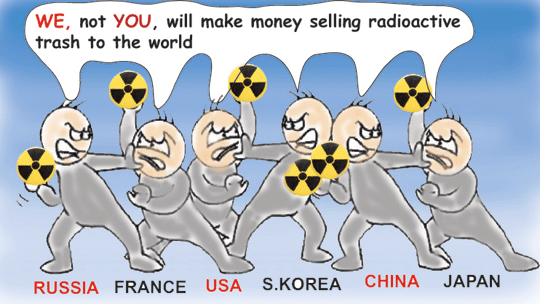 Japan’s Nuclear Export Struggles Narrow the Field of Suppliers, Only a handful of nations now seem capable of building new reactors, with the ability of the U.S. also in doubt. Greentech Media, JANUARY 10, 2019 Japan is struggling to find viable foreign buyers for its reactor technology in an expensive and competitive global nuclear market.
Only half a dozen nations currently have credible nuclear export capabilities. And besides Japan, the true export potential of at least two — the U.S. and France — is in doubt.
A recent report in the Japanese daily Mainichi Shimbun said a government strategy to export nuclear power technology had “run aground amid rising safety costs and deteriorating prospects for project profitability.” Proposed projects in Turkey and the United Kingdom had both hit roadblocks, the Mainichi Shimbun noted……..
Also, and perhaps more importantly, Japanese nuclear vendors are not state-owned like developers from China, Russia and South Korea. That puts Japanese firms at a disadvantage in terms of accessing finance and accepting risk.
These problems are not restricted to Japanese firms, though. They also apply to U.S. vendors.
Struggles in the U.S. nuke sector
While Japanese nuclear is at least enjoying something of a gradual recovery at home, with nine reactors back online after Fukushima and a further 17 looking to restart, in the U.S. the domestic sector is a mess.
This month saw Dominion Energy absorbing Scana Corporation after the latter failed to keep construction of two reactors at the Virgil C. Summer Nuclear Generating Station afloat.
A little over 100 miles away, Georgia state lawmakers have expressed concerns that a couple of new reactors at the Alvin W. Vogtle Electric Generating Plant, which are already half a decade behind schedule, could see further delays.
Six reactors out of a total of 104 have shut down across the U.S. since 2012, according to the Center for Climate and Energy Solutions, and a further 13 are due to close before 2025.
Meanwhile, a 2017 study by the Massachusetts Institute of Technology found two-thirds of U.S. nuclear power capacity could become unprofitable over the next few years.
When publicly owned U.S. nuclear developers do not even have a viable domestic market to play in, it is hard to see how they might compete overseas. There are efforts underway to revive the U.S. nuclear industry, but industry advocates say much more support is needed.
U.S. nuclear export prospects are thus beginning to look a lot like those in Japan — and also those in France, which has been struggling to launch its Evolutionary Power Reactor technology. Like the U.S. and Japan, France seemingly has little appetite to attach state guarantees to nuclear projects abroad……
No comments yet.
1 This Month
Chernobyl: The Lost Tapes – A good documentary on Chernobyl on SBS available On Demand for the next 3 weeks– https://www.sbs.com.au/ondemand/tv-program/chernobyl-the-lost-tapes/2352741955560

of the week–London Campaign for Nuclear Disarmament

Tell the Ukrainian Government to Drop Prosecution of Peace Activist Yurii Sheliazhenko
To see nuclear-related stories in greater depth and intensity – go to https://nuclearinformation.wordpress.com
-
Archives
- April 2026 (126)
- March 2026 (251)
- February 2026 (268)
- January 2026 (308)
- December 2025 (358)
- November 2025 (359)
- October 2025 (376)
- September 2025 (257)
- August 2025 (319)
- July 2025 (230)
- June 2025 (348)
- May 2025 (261)
-
Categories
- 1
- 1 NUCLEAR ISSUES
- business and costs
- climate change
- culture and arts
- ENERGY
- environment
- health
- history
- indigenous issues
- Legal
- marketing of nuclear
- media
- opposition to nuclear
- PERSONAL STORIES
- politics
- politics international
- Religion and ethics
- safety
- secrets,lies and civil liberties
- spinbuster
- technology
- Uranium
- wastes
- weapons and war
- Women
- 2 WORLD
- ACTION
- AFRICA
- Atrocities
- AUSTRALIA
- Christina's notes
- Christina's themes
- culture and arts
- Events
- Fuk 2022
- Fuk 2023
- Fukushima 2017
- Fukushima 2018
- fukushima 2019
- Fukushima 2020
- Fukushima 2021
- general
- global warming
- Humour (God we need it)
- Nuclear
- RARE EARTHS
- Reference
- resources – print
- Resources -audiovicual
- Weekly Newsletter
- World
- World Nuclear
- YouTube
-
RSS
Entries RSS
Comments RSS
 nuclear-news
Leave a comment