UAE energy minister says nuclear power project slightly delayed
https://uk.reuters.com/article/emirates-energy-nuclearpower/uae-energy-minister-says-nuclear-power-project-slightly-delayed-idUKB2N1YE024, ABU DHABI, Jan 9 (Reuters) – United Arab Emirates Energy Minister Suhail al-Mazrouei said on Wednesday that the country’s nuclear power plant project was slightly delayed.
“Nuclear is coming (but) there will be a bit of a delay,” he said at an event in Abu Dhabi. He did not provide a timeline.
The country’s nuclear regulator said last July the start-up of a reactor at the nuclear power plant, which was set to open in 2017, would depend on the outcome of further reviews of the project.
Reporting by Stanley Carvalho; writing by Alexander Cornwell; editing by Christian Schmollinger
EDF’s plans for construction of the Sizewell C twin-reactor will cause widespread disruption
East Anglian Daily Times 7th Jan 2019 ,Campaigners have been left furious over the latest plans for a new nuclear power plant on the Suffolk coast – and say EDF Energy is still not
listening to residents’ concerns. The construction of the Sizewell C
twin-reactor is expected to cause widespread disruption with concern over
hundreds of trucks using unsuitable roads, the impact on the local economy
and worries over the effect on RSPB Minsmere. A main concern is the use of
land near Eastbridge for a campus for 2,400 workers which campaigners say
are “substantially unchanged” from early designs. Alison Downes,
co-chairman of Theberton and Eastbridge Action Group on Sizewell (TEAGS),
was furious at the lack of consideration being taken of the villages as EDF
clamours to start construction.
https://www.eadt.co.uk/news/edf-energy-sizewell-plan-slated-by-theberton-middleton-eastbridge-activists-1-5840910
America’s male-dominated nuclear cognoscenti have tunnel vision, oblivious to proliferation risks, and to public demand for nuclear weapons abolition
|
The blinders on the US nuclear policy establishment, Bulletin of the Atomic Scientists, By Hugh Gusterson, January 8, 2019 If there is such a thing as a nuclear deep state, it was on full display at a crowded event at Washington’s Brookings Institution on Monday. Over 160 people, 90 percent of them men, packed into a room built for about 140 to hear the nuclear cognoscenti opine on the topic of whether “the politics of New START and strategic modernization” is falling apart. The panelists were a who’s who of nuclear weapons policy: Madelyn Creedon (a former assistant secretary of defense and deputy administrator of the National Nuclear Security Administration); John Harvey (formerly principal deputy assistant secretary of defense); Rebecca Hersman (a former deputy assistant secretary of defense now lodged at the Center for Strategic and International Studies); Matthew Kroenig (a Georgetown University professor who has advised the US Defense Department and is at the Atlantic Council); and Brian McKeon (a former staffer on the Senate Committee on Foreign Relations who went on to hold high positions in the Obama White House and Defense Department).
You might think that the point of having five panelists, especially at something that calls itself a “think tank,” is that they would have diverse opinions about which they would debate. If so, you would have been disappointed. The five panelists agreed about almost everything they discussed—a dazzling display of Washington consensus thinking in action, despite the partisan polarization said to govern American politics today. They agreed that, when President Obama took office, the nuclear weapons complex was “underinvested” (McKeon), “underfunded, particularly on the manufacturing side” (Creedon), and “a nuclear wasteland” (Harvey). They agreed that the Obama Administration was right to increase the nuclear weapons budget to roughly $1 trillion over the next thirty years. (No one asked whether other urgent national needs, such as green energy, might be more important, or brought up inefficiencies in the weapons complex, such as the $3 billion cost overrun for the National Ignition Facility at the Lawrence Livermore National Laboratory). They agreed that New START, the 2010 treaty to further reduce US and Russian nuclear arsenals, provides valuable strategic stability, and that it would have been impossible to win ratification of the treaty in the US Senate absent the resolution pairing it with large amounts of money for “nuclear modernization.” They had a lively debate, though, over the semantics of whether this pairing of nuclear modernization and arms control should be characterized as the product of a “consensus” or a “coalition.” New START (which limits the United States and Russia to 1,500 deployed warheads each) is set to expire in February 2021. If the treaty were renegotiated, it would have to be ratified again by the Senate—a tall order given the rightward lurch of the Republican Party since it was first ratified in 2010. However, the treaty can be extended as written for another five years by a simple agreement between Russian and American leaders. The panelists all agreed that this would be good, but that extension of the treaty is endangered by three things. The first is a US president and national security advisor who are, at best, indifferent to arms control. The second is a Russian leader who is poisoning the well of détente by breaching the terms of the Intermediate Nuclear Forces Treaty and pursuing a policy of expansionism in Ukraine. The third is the announced ambition of some Democrats—such as Washington State’s Adam Smith, the incoming chair of the House Armed Services Committee—to cut US nuclear weapons programs. Hersman likened such a cut to a risky move in the game Jenga, where you pull a supporting block out of a wobbly tower and hope the whole edifice does not collapse. It is hard to disagree with the panelists’ view that the United States will be more secure and the world more stable if New START is extended. But listening to this star panel that had drawn a standing-room-only crowd to hear about the future of arms control, I was struck by its inside-the-Beltway myopia, by the power of Washington to enforce tunnel vision on smart people.The panelists seemed more concerned with preserving the consensus in Washington than looking afresh at the problem of nuclear weapons…… The prospect of further nuclear proliferation—the possibility that more governments will obtain nuclear weapons than the current nine—was only mentioned obliquely, an astonishing failure of realist imagination. And no one talked about the fact that 69 countries have signed and 19 have ratified a treaty banning nuclear weapons altogether. As the panelists agreed among themselves that further reductions in nuclear stockpiles were unlikely for now, given the state of relations with Russia and Washington politics, no one thought it worth mentioning that over a third of all countries believe the weapons should be abolished altogether, and no one asked how these abolitionist nations (and others) might react to the collapse of the New START regime. Nor did anyone ask whether there might be a new urgency in addressing the problem of nuclear weapons in light of what we have learned from our experiment over the last two years of handing the nuclear launch codes—and thus the power to end all life on earth—to an egomaniacal, impulsive, immature, simple-minded narcissist who likes to threaten people. Twenty-five years after the end of the Cold War, while many countries are disturbed that the two largest nuclear powers are revitalizing their nuclear stockpiles, America’s nuclear elite framed the issue largely as a problem of factional politics inside the Beltway. As anyone who has studied the history of the Roman Empire, Spain, or Great Britain knows, as empires decline, they become more provincial. This is what imperial decline looks like: a global power, whose military bestrides the world, gazing at its own navel. https://thebulletin.org/2019/01/the-blinders-on-the-us-nuclear-policy-establishment/
|
|

Russia might revive its fearful automatic nuclear weapons launch system
Meet “Dead Hand”: This Might Be Russia’s Most Terrifying Nuclear Weapons Idea Yet https://nationalinterest.org/blog/buzz/meet-dead-hand-might-be-russias-most-terrifying-nuclear-weapons-idea-yet-40937
Perhaps the most terrifying was a Cold War doomsday system that would automatically launch missiles—without the need for a human to push the button—during a nuclear attack. But the system, known as “Perimeter” or “Dead Hand,” may be back and deadlier than ever, f Russia is now discussing Perimeter publicly, that’s reason for the rest of us to worry.
Russia has a knack for developing weapons that—at least on paper—are terrifying: nuclear-powered cruise missiles, robot subs with 100-megaton warheads .
Perhaps the most terrifying was a Cold War doomsday system that would automatically launch missiles—without the need for a human to push the button—during a nuclear attack.
But the system, known as “Perimeter” or “Dead Hand,” may be back and deadlier than ever.
This comes after the Trump administration announced that the United States is withdrawing from the 1987 Intermediate-Range Nuclear Forces Treaty, which eliminated the once-massive American and Russian stockpiles of short- and medium-range missiles. Donald Trump alleges that Russia has violated the treaty by developing and deploying new, prohibited cruise missiles.
This has left Moscow furious and fearful that America will once again, as it did during the Cold War, deploy nuclear missiles in Europe. Because of geographic fate, Russia needs ICBMs launched from Russian soil, or launched from submarines, to strike the continental United States. But shorter-range U.S. missiles based in, say, Germany or Poland could reach the Russian heartland.
Viktor Yesin, who commanded Russia’s Strategic Rocket Forces in the 1990s, spoke of Perimeter/Dead Hand during an interview last month in the Russian newspaper Zvezda [Google English translation here]. Yesin said that if the United States starts deploying intermediate-range missiles in Europe, Russia will consider adopting a doctrine of a preemptive nuclear strike. But he also added this:
Zvezda: “Will we have time to answer if the flight time is reduced to two to three minutes when deploying medium-range missiles near our borders? In this version, all hope is only on Perimeter. And for a retaliatory strike. Or was Perimeter also disassembled for parts?
It is not clear what Yesin meant when he said the system has been “improved,” or even exactly what he meant by “functioning.” Perimeter works by launching specially modified SS-17 ICBMs, which transmit a launch signal to regular nuclear-tipped ICBMs in their silos.
“Higher authority” would flip the switch if they feared they were under nuclear attack. This was to give the “permission sanction.” Duty officers would rush to their deep underground bunkers, the hardened concrete globes, the shariki. If the permission sanction were given ahead of time, if there were seismic evidence of nuclear strikes hitting the ground, and if all communications were lost, then the duty officers in the bunker could launch the command rockets. If so ordered, the command rockets would zoom across the country, broadcasting the signal “launch” to the intercontinental ballistic missiles. The big missiles would then fly and carry out their retaliatory mission.
There have been cryptic clues over the years that Perimeter still exists.
Which illustrates one of the curiosities of this system, which is that the Soviet Union kept its existence secret from the American enemy whom it was supposed to deter.What is unmistakable is that Perimeter is a fear-based solution. Fear of a U.S. first-strike that would decapitate the Russian leadership before it could give the order to retaliate. Fear that a Russian leader might lose his nerve and not give the order.
And if Russia is now discussing Perimeter publicly, that’s reason for the rest of us to worry.
Michael Peck is a contributing writer for the National Interest. He can be found on Twitter and Facebook.
USA Dept of Energy again confirms its plans to use SRS plutonium for nuclear weapons
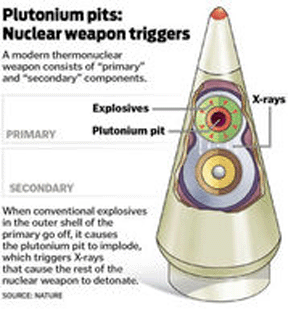
DOE reaffirms plans to use SRS plutonium for pit production in New Mexico https://www.aikenstandard.com/news/doe-reaffirms-plans-to-use-srs-plutonium-for-pit-production/article_59e7b02a-1291-11e9-bd1e-936df797de19.html, By Colin Demarest cdemarest@aikenstandard.com, Jan 7, 2019
The Nuclear Free Local Authorities (NFLA) will brief Scottish Parliament on Hunterston nuclear power plant
The National 8th Jan 2019 ,ANTI-nuclear campaigners will brief MSPs tomorrow on their concerns about the safety of two reactors at the Hunterston B nuclear power plant in North
Ayrshire. Reactors 3 and 4 have been offline since March and October
respectively after cracks were found during a routine inspection. Operators
EDF hope to gain approval for their re-opening in the spring.
The Nuclear Free Local Authorities (NFLA) will give the Scottish Parliament briefing,
which will be chaired by Green MSP Ross Greer. He said: “Long-running
safety and job concerns from the community around Hunterston have increased
significantly.”
https://www.thenational.scot/news/17341200.msps-to-meet-anti-nuclear-campaigners/
Vermont-based New England Coalition on Nuclear Pollution will participate in NRC conference on wastes regulation
NRC officials say the company made changes after discovering a loose “bolt” last March at the San Onofre nuclear power plant in California. The small threaded posts connect to the bottom of shims in the canister of the cask to create space between multiple aluminum shims and the bottom of the canister to keep the basket stabilized in each of the casks.
The nuclear watchdog group’s technical adviser, Raymond Shadis, along with and board member Clay Turnbull, plan to monitor and offer comments on the canisters.
The coalition twice intervened before Vermont’s public utilities commission on using the Holtec steel canister-in-a-concrete-cask design at the Vernon plant, where 58 spent-fuel casks are now in place awaiting eventual transfer to a federal repository. It says its involvement helped result in more frequent radiation and temperature reporting, more conservative cask spacing, a protective line-of-site barrier wall and prohibition of using corrosive de-icing salts.
The coalition, which has repeatedly advocated for partially buried cask or earthen berm protection for the shuttered Vermont plant’s spent fuel, also commented on a previous Holtec design change, which it says resulted in a more in-depth NRC staff safety analysis.
NRC spokesman Neil Sheehan said Holtec altered the cask design without a written evaluation, violating federal safety regulations.
Increasing major cracks in Hunterston nuclear reactors: call to close them permanently
 Ferret 9th Jan 2019 Pressure is mounting to keep two nuclear power reactors at Hunterston in
North Ayrshire closed after the company that runs them, EDF Energy, said it
had found more cracks and was again postponing plans to restart.
of reactor three and 200 cracks in the core of reactor four. Reactor three has been closed down since 9 March 2018, and reactor four since 2 October.
discovered in reactor three in breach of an operating safety limit, EDF
postponed restarting both reactors to January and February.
Hunterston for MSPs in the Scottish Parliament. Experts will call for the
reactors to stay closed rather than risking a nuclear accident, and for new
jobs to be created in Ayrshire. Nuclear policy consultant, Dr Ian Fairlie,
will argue that the increasing number of cracks in the ageing reactors
spelled their end. “There is only one thing you can do and that is close
them, as they cannot be repaired,” he told The Ferret.
https://theferret.scot/cracks-hunterston-reactors/
1 This Month
Chernobyl: The Lost Tapes – A good documentary on Chernobyl on SBS available On Demand for the next 3 weeks– https://www.sbs.com.au/ondemand/tv-program/chernobyl-the-lost-tapes/2352741955560

of the week–London Campaign for Nuclear Disarmament

Tell the Ukrainian Government to Drop Prosecution of Peace Activist Yurii Sheliazhenko
To see nuclear-related stories in greater depth and intensity – go to https://nuclearinformation.wordpress.com
-
Archives
- April 2026 (126)
- March 2026 (251)
- February 2026 (268)
- January 2026 (308)
- December 2025 (358)
- November 2025 (359)
- October 2025 (376)
- September 2025 (257)
- August 2025 (319)
- July 2025 (230)
- June 2025 (348)
- May 2025 (261)
-
Categories
- 1
- 1 NUCLEAR ISSUES
- business and costs
- climate change
- culture and arts
- ENERGY
- environment
- health
- history
- indigenous issues
- Legal
- marketing of nuclear
- media
- opposition to nuclear
- PERSONAL STORIES
- politics
- politics international
- Religion and ethics
- safety
- secrets,lies and civil liberties
- spinbuster
- technology
- Uranium
- wastes
- weapons and war
- Women
- 2 WORLD
- ACTION
- AFRICA
- Atrocities
- AUSTRALIA
- Christina's notes
- Christina's themes
- culture and arts
- Events
- Fuk 2022
- Fuk 2023
- Fukushima 2017
- Fukushima 2018
- fukushima 2019
- Fukushima 2020
- Fukushima 2021
- general
- global warming
- Humour (God we need it)
- Nuclear
- RARE EARTHS
- Reference
- resources – print
- Resources -audiovicual
- Weekly Newsletter
- World
- World Nuclear
- YouTube
-
RSS
Entries RSS
Comments RSS
 nuclear-news