Climate change brings a boom in jellyfish, and a threat to nuclear reactors

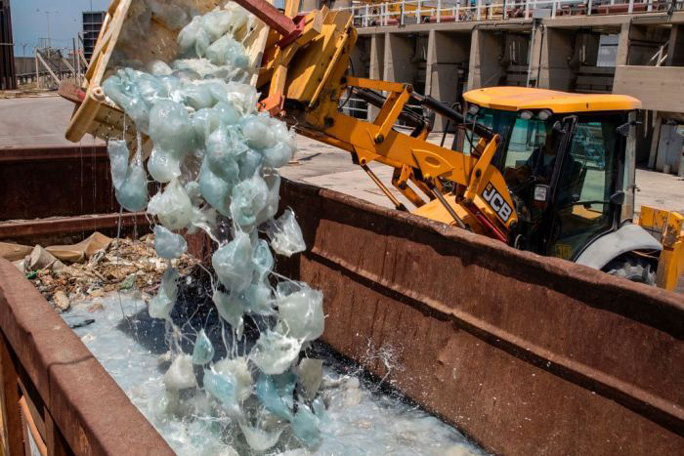
Jellyfish are causing mayhem as pollution, climate change see numbers boom, ABC, RN By Hong Jiang and Sasha Fegan for Late Night Live 6 Jan 19 Jellyfish have been around for at least 500 million years — they’re older than dinosaurs and even trees.Science writer Juli Berwald calls them “ghosts from the true garden of Eden”.
“An intelligence of a sort has allowed them to make it through the millennia,” she says.
And they’re not going anywhere.
In fact, the brainless, spineless, eyeless, bloodless creatures are booming in numbers — and causing mayhem around the world. Their propensity to breed fast and prolifically means jellyfish can disrupt ocean ecosystems in a flash.
And their effects aren’t contained to the sea.
In places like Sweden, Israel, the US and the Philippines, power plants have been affected by blooms of jellyfish.
“So many jellyfish were swept into the power system … that it shut down the power system through much of this one island in the Philippines,” Ms Berwald says. People thought that perhaps there was a coup going on, but there wasn’t, it was just the jellyfish.”
Jellyfish have also caused plants to shut down in Japan.
“One jellyfish scientist from Japan told me that the first threat to the electric system in Japan is earthquakes, but the second is jellyfish,” Berwald says.
“We are dealing with a ubiquitous creature.”
A human cause
Some scientists think jellyfish numbers are increasing as the climate changes — the creatures reproduce well in warmer waters.
Jellyfish also fare better than many other sea creatures in polluted waters, as they don’t need much oxygen.
Berwald says that can give them the upper hand over predators.
“They can sort of slip into polluted waters, into low oxygen waters, and hide from predation there better than a fish that has a higher oxygen demand,” she says…….. https://www.abc.net.au/news/2019-01-06/the-magic-and-mayhem-of-jellyfish/10377112
Donald Trump should negotiate with Kim Jong-un, who may be willing to limit nuclear production capability
 North Korea may be willing to begin denuclearization, and Donald Trump should make a deal. https://www.usatoday.com/story/opinion/2019/01/04/kim-jong-un-north-korea-donald-trump-denuclearization-offer-column/2473360002/
Kim Jon-Un indicated he would put nuclear production capability on the table as a bargaining chip, and Donald Trump should make that deal.
In his traditional New Year’s Day speech earlier this week, North Korean strongman leader Kim Jong-Un has just made an offer that, if serious, could present an opportunity for President Donald Trump to reach a historic breakthrough in the nuclear crisis on the Korean peninsula and record his greatest foreign-policy accomplishment as president.
Kim’s speech was not all sweetness and light. He warned that his patience is not infinite, and that in the absence of diplomatic progress, his country may resort to more confrontational tactics. Little has happened since the famous Singapore summit back in June between Kim and Trump; we seem no closer to a deal on North Korea’s threatening military capabilities now than we did six months ago. Meanwhile, Kim clearly resents and suffers from the tough international sanctions that the Trump administration has convinced the United Nations to impose these last two years, after North Korea’s big missile and nuclear tests of 2017. The latest statistics show that, despite sanctions evasion in multiple quarters, North Korean trade was down as much as half in 2018 compared to the year before.
But Kim held out an olive branch nonetheless. He seems to want a deal, and seems interested in another summit. He was much more specific than ever before about what he might offer in the course of such a tete-a-tete with Trump. So far, North Korea has only offered to place a moratorium on future nuclear and long-range missile tests, which has been a welcome development, but has only talked vaguely about “denuclearization” and has not stopped making more bombs. Now, apparently, Kim would put nuclear production capability on the table as a bargaining chip.
North Korea experts like Jonathan Pollack and Jung Pak have documented how unlikely Kim would be to give up all his nuclear bombs (U.S. intelligence estimates he has as many as 60 by now). They represent the collective accomplishments of a program that Kim’s grandfather and father prioritized when they led North Korea, so giving up all those bombs quickly would almost seem to dishonor the memory and legacy of his forefathers. And perhaps even more importantly, Kim as well as his generals remember the one cardinal mistake Saddam Hussein, Mohammar Quadhafi, and the Taliban all committed — leaving themselves vulnerable in war against the United States because of the lack of a nuclear deterrent. For Kim to give up the bomb, he would need a great deal of confidence that relations will remain peaceful.
There is an opportunity to compromise, relax
Yet there is still a big opportunity for compromise, if Kim is serious about ending production of more bombs. North Korea could stop expanding its nuclear arsenal, and we could relax, then lift some of the sanctions imposed on North Korea over the years, especially the U.N. sanctions that have really cut into North Korean trade with China and South Korea in the last couple years. The goal of complete denuclearization could await another day.
With this approach, the United States would keep enough sanctions in place to stay true to its principle that North Korea cannot be accepted as a nuclear-weapons state; before being fully welcomed into the community of nations, it will in fact have to honor its obligations under the Nuclear Non-Proliferation Treaty and give up all its bombs. Yet as a practical matter, that second stage of nuclear talks can wait for a number of months or years. That is ok. The world will be much safer if North Korea stops enlarging and improving its nuclear and long-range missile arsenals that could threaten not only South Korea and Japan (and the almost 300,000 Americans living in those two countries combined), but also eventually North America.
Trump should take what he can get for now
The real challenge is likely to be verification. We know where some, but not all, of North Korea’s nuclear infrastructure is located. As such, international inspectors would have to be allowed to return not only to the Yongbyon location where they have been before, and where North Korea has operated a nuclear reactor to make plutonium as well as centrifuges to enrich uranium. They would also need some degree of free reign to explore other suspicious sites around the country. On the one hand, this would not be an arrangement unique to North Korea; similar provisions are part of the Iran nuclear deal, for example. On the other hand, North Korea has shown extreme nervousness about such inspections in the past.
Another possible problem: John Bolton, Trump’s national security advisor, and Secretary of State Mike Pompeo may consider a deal that only freezes, rather than eliminates, North Korea’s nuclear arsenal inadequate for purposes of American and allied security. But they should reassess, or Trump should overrule them.
This compromise deal would go further than the Iran deal, in fact, if North Korea were willing to see its nuclear production facilities dismantled permanently. Yes, Kim would keep his nukes for a while. But he would have powerful economic and military reasons to behave himself. In this case, taking half a loaf is far more realistic than hoping for a complete denuclearization accord that just isn’t in the cards anytime soon. We should immediately engage in serious talks to see just how serious Kim really is about this intriguing and promising offer.
Michael O’Hanlon is director of research for the foreign policy program at the Brookings Institution. Follow him on Twitter: @MichaelEOHanlon
Renewables beating coal energy in Germany
The shift marks progress as Europe’s biggest economy aims for renewables to provide 65 percent of its energy by 2030 in a costly transition as it abandons nuclear power by 2022 and is devising plans for an orderly long-term exit from coal.
The research from the Fraunhofer organisation of applied science showed that output of solar, wind, biomass and hydroelectric generation units rose 4.3 percent last year to produce 219 terawatt hours (TWh) of electricity. That was out of a total national power production of 542 TWh derived from both green and fossil fuels, of which coal burning accounted for 38 percent.
Green energy’s share of Germany’s power production has risen from 38.2 percent in 2017 and just 19.1 percent in 2010.
Bruno Burger, author of the Fraunhofer study, said it was set to stay above 40 percent this year.
“We will not fall below the 40 percent in 2019 because more renewable installations are being built and weather patterns will not change that dramatically,” he said……….https://www.weforum.org/agenda/2019/01/renewables-overtake-coal-as-germanys-main-energy-source?utm_source=Facebook%20Videos&utm_medium=Facebook%20Video
Chinese state media boasts nuclear weapons escalation, in response to Trump
New Mexico could get more nuclear waste, and perhaps high level nuclear waste
 More nuclear waste could come to New Mexico, Santa Fe New Mexican, By Rebecca Moss | rmoss@sfnewmexican.co, Jan 5, 2019
UK’s legal battle over botched handling of the Magnox nuclear decommissioning contract.
 Former chiefs of UK’s nuclear body launch legal action over Magnox fiasco http://www.cityam.com/271148/former-chiefs-uks-nuclear-body-launch-legal-action-over, Jessica Clark, 5 Jan 19,
 Closer inspection of Peach Bottom nuclear plant following violation notice
 Peach Bottom nuclear plant issued violation notice, will come under closer scrutiny from regulators https://lancasteronline.com/news/local/peach-bottom-nuclear-plant-issued-violation-notice-will-come-under/article_a147a194-105e-11e9-8b99-a32817bc8be2.htmlAD CRABLE | Staff Writer, Jan 4, 2019
Historical cooling periods are still playing out in the deep Pacific
https://www.eurekalert.org/pub_releases/2019-01/hjap-hcp010419.php– 4 Jan 19, Whereas most of the ocean is responding to modern warming, the deep Pacific may be cooling, HARVARD JOHN A. PAULSON SCHOOL OF ENGINEERING AND APPLIED SCIENCES The ocean has a long memory. When the water in today’s deep Pacific Ocean last saw sunlight, Charlemagne was the Holy Roman Emperor, the Song Dynasty ruled China and Oxford University had just held its very first class. During that time, between the 9th and 12th centuries, the earth’s climate was generally warmer before the cold of the Little Ice Age settled in around the 16th century. Now, ocean surface temperatures are back on the rise but the question is, do the deepest parts of the ocean know that?
Researchers from the Woods Hole Oceanographic Institution and Harvard University have found that the deep Pacific Ocean lags a few centuries behind in terms of temperature and is still adjusting to the advent of the Little Ice Age. Whereas most of the ocean is responding to modern warming, the deep Pacific may be cooling.
The research is published in Science.
“Climate varies across all timescales,” said Peter Huybers, Professor of Earth and Planetary Sciences in the Department of Earth and Planetary Sciences and of Environmental Science and Engineering at the Harvard John A. Paulson School of Engineering and Applied Sciences and co-author of the paper. “Some regional warming and cooling patterns, like the Little Ice Age and the Medieval Warm Period, are well known. Our goal was to develop a model of how the interior properties of the ocean respond to changes in surface climate.”
What that model showed was surprising.
“If the surface ocean was generally cooling for the better part of the last millennium, those parts of the ocean most isolated from modern warming may still be cooling,” said Jake Gebbie, a physical oceanographer at Woods Hole Oceanographic Institution and lead author of the study.
The model is a simplification of the actual ocean. To test the prediction, Gebbie and Huybers compared the cooling trend found in the model to ocean temperature measurements taken by scientists aboard the HMS Challenger in the 1870s and modern observations from the World Ocean Circulation Experiment of the 1990s.
The HMS Challenger, a three-masted wooden sailing ship originally designed as a British warship, was used for the first modern scientific expedition to explore the world’s ocean and seafloor. During the expedition from 1872 to 1876, thermometers were lowered into the ocean depths and more than 5,000 temperature measurements were logged.
“We screened this historical data for outliers and considered a variety of corrections associated with pressure effects on the thermometer and stretching of the hemp rope used for lowering thermometers,” said Huybers.
The researchers then compared the HMS Challenger data to the modern observations and found warming in most parts of the global ocean, as would be expected due to the warming planet over the 20th Century, but cooling in the deep Pacific at a depth of around two kilometers depth.
“The close correspondence between the predictions and observed trends gave us confidence that this is a real phenomenon,” said Gebbie.
These findings imply that variations in surface climate that predate the onset of modern warming still influence how much the climate is heating up today. Previous estimates of how much heat the Earth had absorbed during the last century assumed an ocean that started out in equilibrium at the beginning of the Industrial Revolution. But Gebbie and Huybers estimate that the deep Pacific cooling trend leads to a downward revision of heat absorbed over the 20th century by about 30 percent.
“Part of the heat needed to bring the ocean into equilibrium with an atmosphere having more greenhouse gases was apparently already present in the deep Pacific,” said Huybers. “These findings increase the impetus for understanding the causes of the Medieval Warm Period and Little Ice Age as a way for better understanding modern warming trends.”
###
This research was funded by the James E. and Barbara V. Moltz Fellowship and National Science Foundation grants OCE-1357121 and OCE-1558939
US Congresswoman Haaland To Be “Advocate For Renewable Energy Jobs To Protect Our Land, Air & Water” — Mining Awareness +

US Congresswoman Deb Haaland is one of the two first Native American women to serve in the US Congress. Navajo solar carport US DOE Solar array Navajo home US DOE “Haaland Takes Historic Oath of Office, Becomes One of the First Native American Women in Congress January 3, 2019 Press Release WASHINGTON, D.C. – Today, […]
Palisades Nuclear Reactor On Lake Michigan Had To Be Manually Tripped Due To Turbine Governor Valve Problem — Mining Awareness +

Palisades Nuclear Reactor (Unit 1) had to be manually tripped due to cycling of a Turbine Governor Valve. A rapid cycling valve causes instability in a system which must be stable to ensure safety, as well as predictability and efficiency. It is mind-blowing that Entergy, with its headquarters in the “Big Easy” (New Orleans) through […]
January 6 Energy News — geoharvey

Opinion: ¶ “Meet Clean Energy Pioneers Hoping to Change the World” • Empowering rural women in the field of clean energy and providing electricity to more than 675,000 underprivileged people are just some of the feats achieved finalists for the Zayed Sustainability Prize. Winners will be announced during the Abu Dhabi Sustainability Week. [gulfnews.com] ¶ […]
1 This Month


Tell the Ukrainian Government to Drop Prosecution of Peace Activist Yurii Sheliazhenko

Petition to revoke the licensing of the Near Surface Nuclear Disposal Facility (NSDF) at Chalk River. https://www.ourcommons.ca/petitions/en/Petition/Details?Petition=e-7247


of the week – STOP SMALL MODULAR REACTORS IN CANADA
To see nuclear-related stories in greater depth and intensity – go to https://nuclearinformation.wordpress.com
-
Archives
- March 2026 (212)
- February 2026 (268)
- January 2026 (308)
- December 2025 (358)
- November 2025 (359)
- October 2025 (376)
- September 2025 (258)
- August 2025 (319)
- July 2025 (230)
- June 2025 (348)
- May 2025 (261)
- April 2025 (305)
-
Categories
- 1
- 1 NUCLEAR ISSUES
- business and costs
- climate change
- culture and arts
- ENERGY
- environment
- health
- history
- indigenous issues
- Legal
- marketing of nuclear
- media
- opposition to nuclear
- PERSONAL STORIES
- politics
- politics international
- Religion and ethics
- safety
- secrets,lies and civil liberties
- spinbuster
- technology
- Uranium
- wastes
- weapons and war
- Women
- 2 WORLD
- ACTION
- AFRICA
- Atrocities
- AUSTRALIA
- Christina's notes
- Christina's themes
- culture and arts
- Events
- Fuk 2022
- Fuk 2023
- Fukushima 2017
- Fukushima 2018
- fukushima 2019
- Fukushima 2020
- Fukushima 2021
- general
- global warming
- Humour (God we need it)
- Nuclear
- RARE EARTHS
- Reference
- resources – print
- Resources -audiovicual
- Weekly Newsletter
- World
- World Nuclear
- YouTube
-
RSS
Entries RSS
Comments RSS
 nuclear-news