Dreaming of a sustainable Christmas: How to reduce your ecological footprint this festive season
But the good news is that you can still live a little this festive season without having a big ecological impact.
Key points:
- Make sure your seafood is nice, not naughty — local fish is best
- Reduce or re-use plastic wrapping and decorations, or use paper alternatives
- Consider vouchers, jars of food or experiences as presents, rather than plastic gifts…….https://www.abc.net.au/news/2018-12-14/how-to-celebrate-a-sustainable-christmas/10617782
Concern that Hinkley Point C will have ‘devastating’ impact on sea fish numbers in Burnham
Burnham-on-Sea 13th Dec 2018 . Concern that Hinkley Point C will have ‘devastating’ impact on sea fish
numbers in Burnham. Proposals to scrap plans for an acoustic fish deterrent
system in the sea next to Hinkley Point C will have a ‘devastating’ impact
on fish stocks in the sea around Burnham-On-Sea and the Bristol Channel, it
has been predicted this week. Sea anglers in Burnham claim EDF’s plans
not to install a fish deterrent system around the cooling water intakes in
the channel will lead to “significant” numbers of fish being killed.
https://www.burnham-on-sea.com/news/concern-over-hinkley-point-c/
Explosion and fire at German Advanced Nuclear Fuels plant
Sortir du Nucleaire 6th Dec 2018 , An explosion followed by a major fire took place on 6 December 2018 at the
Advanced Nuclear Fuels plant in Lingen (Lower Saxony). This plant, located
near the Emsland nuclear reactor in northwestern Germany, is owned by
Framatome. Nuclear fuel elements are manufactured and sent to several
countries, including France. As a spokesman for the plant later confirmed
to the media Norddeutscher Rundfunk, the fire broke out in the laboratory
of a manufacturing workshop , where the quality of the uranium is tested
before shipment. This laboratory is located in the nuclear part of the
facility. Although quickly controlled, the fire required the intervention
of 150 firefighters from the area. The staff was evacuated. Since then, the
plant has been idling.
https://www.sortirdunucleaire.org/Allemagne-Lingen-Explosion-et-incendie-dans-l-usine-Framatome-de-fabrication-de-combustible-nucleaire1
PG and E needs $1.6 billion more to decommission Diablo Canyon — and it’ll come from your bill,
PG&E needs $1.6 billion more to decommission Diablo Canyon — and it’ll come from your bill Tribune BY KAYTLYN LESLIE 14 Dec 18 PG&E needs to collect $1.6 billion from ratepayers by 2025 to pay for Diablo Canyon nuclear power plant’s closure, according to new filings with the state.
For a typical residential customer, this would translate to about $1.98 more on your bill, though the exact amount would vary depending on usage.
In its Nuclear Decommissioning Cost Triennial Proceedings, filed on Thursday, the company said it expects the total cost of decommissioning Diablo Canyon to be about $4.8 billion — up from the $3.8 billion it estimated in its last triennial report in 2015. https://www.sanluisobispo.com/news/local/environment/article223058625.html
Global nuclear industry aggressively lobbying climate negotiators
 NIRS (accessed) 10th Dec 2018 , The nuclear industry is aggressively lobbying global climate negotiators to promote nuclear power as a solution to the climate crisis. Pro-nuclear organizations are petitioning the United Nations COP24 Global Climate Summit in Katowice, Poland, to write nuclear power into the rulebook that will be used to implement the Paris Climate Treaty.
http://org2.salsalabs.com/o/5502/p/dia/action4/common/public/?action_KEY=26593
The EU, Canada, New Zealand, and scores of developing countries to strengthen their climate change commitments
 Climate change talks result in renewed pledge to cut emissions, EU, Canada, New Zealand and developing countries to keep global warming below 1.5C Guardian, Fiona Harvey, Ben Doherty and Jonathan Watts in Katowice, 13 Dec 2018
The promise, which follows increasingly dire scientific warnings, was the most positive message yet to come from the ongoing talks in Poland.
The announcement came at the end of a day in which the UN secretary general made an impassioned intervention to rescue the talks, which have been distracted by US, Russian and Saudi moves to downgrade scientific advice.
“We’re running out of time,” António Guterres told the plenary. “To waste this opportunity would compromise our last best chance to stop runaway climate change. It would not only be immoral, it would be suicidal.”
The talks have centred on devising a rulebook for implementing the 2015 Paris agreement and raising countries’ level of ambition to counter climate change, but progress has been slow on several key issues and divisions have emerged between four fossil fuel powers – the US, Russia, Saudi Arabia and Kuwait – and the rest of the world.
The UN believes China could play a stronger role in the absence of leadership from the US. Sources said Guterres would make a telephone call to Xi to ask for his help in nudging talks forward.
The EU also wants China, which is a key member of the block of 77 developing countries, to step up to ensure that countries all follow the same rules in being transparent over their greenhouse gas emissions.
Campaigners praised the decision by the High Ambition Coalition group of countries, made up of the EU and four other developed countries, including Canada and New Zealand, as well as the large grouping of least developed countries and several other developing nations, to scale up their emissions-cutting efforts in line with a 1.5C temperature rise limit.
Wendel Trio, director of the Climate Action Network Europe, said: “The spirit of Paris is back. The statement will boost greater ambition at the crunch time of these so far underwhelming talks. For the EU this must mean a commitment to significantly increase its 2030 target by 2020, even beyond the 55% reduction some member states and the European parliament are calling for. We call upon the countries that have not signed the statement so far to stop ignoring the science.”
Guterres, in a pointed criticism aimed at the four countries that have been refusing to “welcome” the Intergovernmental Panel on Climate Change’s special report on 1.5-degree warming, said rejecting climate science was indefensible.
He added: “The IPCC special report is a stark acknowledgment of what the consequences of global warming beyond 1.5 degrees will mean for billions of people around the world, especially those who call small island states home. This is not good news, but we cannot afford to ignore it.”
Frank Bainimarama, the prime minister of Fiji and the outgoing chair of COP23, amplified Guterres’ message. He told delegates they risked going down in history as “the generation that blew it – that sacrificed the health of our world and ultimately betrayed humanity because we didn’t have the courage and foresight to go beyond our short-term individual concerns: craven, irresponsible and selfish”.
The former US vice-president Al Gore told delegates they faced “the single most important moral choice in history of humanity”.
Behind the scenes, delegates said there had been strong progress on finance thanks to a doubling of commitments by Germany and Norway to help poorer nations adapt to climate change and build institutions capable of monitoring emissions. Nicholas Stern, the author of a landmark review on the economics of climate change, praised “the level of ideas and cooperation”.
But others said there were still many disputed brackets in the negotiating text on transparency and other elements of the rulebook……..
“The window for action is closing fast. We need to do more and we need to do it now,” said the document, which would form part of the official statement from this conference. https://www.theguardian.com/environment/2018/dec/12/un-chief-antonio-guterres-attempts-to-revive-flagging-climate-change-talks
Global nuclear industry’s confidence is wobbling, as China loses enthusiasm for nuclear power
 China’s losing its taste for nuclear power. MIT Technology Review, Once nuclear’s strongest booster, China is growing wary about its cost and safety. by Peter Fairley,December 12, 2018
Most beautiful wedding photos taken at a nuclear power plant” might just be the strangest competition ever. But by inviting couples to celebrate their nuptials at the Daya Bay plant in Shenzhen and post the pictures online, China General Nuclear Power (CGN), the country’s largest nuclear power operator, got lots of favorable publicity.
A year later, the honeymoon is over.
For years, as other countries have shied away from nuclear power, China has been its strongest advocate. Of the four reactors that started up worldwide in 2017, three were in China and the fourth was built by Beijing-based China National Nuclear Corp. (CNNC) in Pakistan. China’s domestic nuclear generation capacity grew by 24% in the first 10 months of 2018.
The country has the capacity to build 10 to 12 nuclear reactors a year. But though reactors begun several years ago are still coming online, the industry has not broken ground on a new plant in China since late 2016, according to a recent World Nuclear Industry Status Report.
Officially China still sees nuclear power as a must-have. But unofficially, the technology is on a death watch. Experts, including some with links to the government, see China’s nuclear sector succumbing to the same problems affecting the West: the technology is too expensive, and the public doesn’t want it.
The 2011 meltdown at Japan’s Fukushima Daiichi plant shocked Chinese officials and made a strong impression on many Chinese citizens. A government survey in August 2017 found that only 40% of the public supported nuclear power development.
The bigger problem is financial. Reactors built with extra safety features and more robust cooling systems to avoid a Fukushima-like disaster are expensive, while the costs of wind and solar power continue to plummet: they are now 20% cheaper than electricity from new nuclear plants in China, according to Bloomberg New Energy Finance. Moreover, high construction costs make nuclear a risky investment.
And gone are the days when nuclear power was desperately needed to meet China’s soaring demand for electricity. In the early 2000s, power consumption was growing at more than 10% annually as the economy boomed and manufacturing, a heavy user of electricity, expanded rapidly. Over the past few years, as growth has slowed and the economy has diversified, power demand has been growing, on average, at less than 4%.
China’s disenchantment with nuclear power corresponds with an overall decline in nuclear generation elsewhere in the world. Utilities are retiring existing plants and have stopped building new ones. If China, too, gives up on nuclear, it could sound the death knell………
Within days of Fukushima, nuclear reactor construction in China was frozen. When building resumed months later, after a wave of inspections, Beijing insisted that future nuclear power projects adopt more advanced designs with extra safety features.
The damage to public confidence, however, had already been done. In 2013 over a thousand people assembled in Jiangmen, east of Hong Kong, to decry a planned uranium fuel plant. Within days the state-run project was scrapped. In 2016 local officials suspended preliminary work on a site in Lianyungang, in northeastern Jiangsu province, after an uproar caused by revelations that it might host a recycling plant for spent nuclear fuel. In the wake of that protest, China’s State Council amended its draft regulations on nuclear power management, requiring developers to hold public hearings before siting projects…………
Dwindling options
The government has lately said little about nuclear policy. Its official target, last updated in 2016, calls for 58 gigawatts of nuclear generating capacity to be installed by 2020 and for another 30 GW to be under construction. All experts agree China won’t reach its 2020 goal until 2022 or later, and pre-Fukushima projections of 400 GW or more by midcentury now look fanciful. Han says he is betting that after the country builds the 88 GW in its 2020 plan, it will move on to other energy sources. …….
If the Hualong One proves too expensive, China’s lingering nuclear hopes will be pinned to its advanced-reactor program—an effort to develop a new generation of technologies that include high-temperature gas-cooled reactors, designs cooled with sodium metal or salt, and smaller versions of pressurized-water reactors. These various designs are meant to be cheaper to build and operate—and much safer—than conventional reactors.
But so far there is little evidence that any of them will solve nuclear’s problems. A sodium-cooled reactor completed near Beijing in 2011 has had familiar technical glitches such as problems in its coolant systems. And the rising cost of a pair of high-temperature gas-cooled reactors nearing completion at Shandong Province’s Shidao Bay ended plans for a further 18 such reactors at the site.
There’s always the possibility of a breakthrough that would make nuclear safe and cheap enough to compete with renewables and coal. But even China’s nuclear giants are hedging their bets. Both CGN and the state-owned firm funding China’s AP1000 investments rank among the world’s top 10 renewable-power operators……..
Scientists warn about international inaction on climate change
Window is narrowing’: scientists urge action at UN climate talks, Guardian, Jonathan Watts in Katowice, Wed 12 Dec 2018Gilet jaunes protests cast shadow as concerns raised over backlash against rapid change Scientists have laid down the gauntlet for political leaders as the UN climate summit in Katowice, Poland, wrestles with the challenge of cutting emissions without sparking social tensions like those seen recently in France.The UN climate talks – known as COP24 and the most important since the Paris agreement was signed in 2015 – aim to set a new rulebook for governments to reduce greenhouse gases and to raise ambitions, after warnings of dire consequences if global warming rises more than 1.5C above pre-industrial levels.
The climate crisis is already here and the risks are growing, said Hoesung Lee, chair of the UN Intergovernmental Panel on Climate Change, who led a study by thousands of scientists on ways to avoid 1.5C of warming via accelerated transition from fossil fuels.
“The IPCC made a tremendous collective effort to bring you the best scientific knowledge on the subject. We tell you limiting warming to 1.5C is possible but the window is narrowing,” Lee told a plenary on Tuesday. “The scientific community has delivered, now it is up to governments to take action.”
There has been fierce debate about what to do with the study. All but four of the world’s governments want to formally welcome the 1.5C report to spur a more ambitious shift towards renewable energy. However, four oil producing nations – the US, Russia, Saudi Arabia and Kuwait – said the study should merely be “noted”.
This issue has overshadowed the past few days of the talks in Poland. Saudi Arabia has claimed there are “gaps and uncertainties” in the study. The US held a long-planned event promoting coal, gas, oil and nuclear power.
In a thinly veiled criticism of such tactics, Laurent Fabius, a former prime minister of France and president of the 2015 Paris climate talks, told the plenary that political leaders would play a negative role if they were “not only somnambulists but spoilers”.
He noted that global emissions rose by 2% this year, when they need to decline if warming is to be kept to a less dangerous level.
“Let us be clear, the real world is not on track. We need to do more and to do it faster,” Fabius said. “The IPCC 1.5C report shows the tremendous importance of every half degree and the disastrous consequences of missing that boundary.”……..https://www.theguardian.com/environment/2018/dec/11/the-window-is-narrowing-scientists-urge-action-at-un-climate-talks
How France multiplies hazardous nuclear waste.
 Reporterre 11th Dec 2018 Claiming to ” recycle ” used nuclear fuel, the reprocessing industry complicates the management of waste by increasing the amount of plutonium and hazardous materials.
According to the official communication, the reprocessing does not generate
contamination, only ” authorized discharges ” . They are spit by the
chimneys, dumped at the end of a pipe buried in the Channel.
authorized to reject 20,000 times more radioactive rare gases and more than
500 times the amount of liquid tritium that only one of the Flamanville
reactors located 15 km away. ” . It contributes ” almost half to the
radiological impact of all civilian nuclear installations in Europe ” .
https://reporterre.net/Comment-la-France-multiplie-les-dechets-nucleaires-dangereux
Degrading permafrost puts Arctic infrastructure at risk by mid-century
https://www.sciencedaily.com/releases/2018/12/181211113030.htm
- Date:
- December 11, 2018
- Source:
- University of Alaska Fairbanks
- Summary:
- Seventy percent of the current infrastructure in the Arctic has a high potential to be affected by thawing permafrost in the next 30 years. Even meeting the climate change targets of the Paris Agreement will not substantially reduce those projected impacts, according to a new study.
-
Seventy percent of the current infrastructure in the Arctic has a high potential to be affected by thawing permafrost in the next 30 years. Even meeting the climate change targets of the Paris Agreement will not substantially reduce those projected impacts, according to a new study published in Nature Communications.
“Much more needs to be done to prepare Alaska and Alaskans for the adverse consequences of coming changes in permafrost and climate,” said Vladimir Romanovsky, a scientist with the University of Alaska Fairbanks Geophysical Institute who has been monitoring permafrost across Alaska for 25 years.
Permafrost is ground that is frozen year-round for a minimum of two years. When it thaws, it can change from solid earth into mud. In many cases, the ground will slump, leading to destructive failure in any structures erected there.
“These observations have led me to believe that the global warming is not a ‘fake’ but the reality,” Romanovsky said. “And here, in Alaska, we are dealing already and will be dealing even more in the near future with this reality.”
Romanovsky is one of the study’s authors, along with researchers from Finland, Norway, Russia and Michigan. The research is the first to explicitly show the amount of fundamental infrastructure across the Northern Hemisphere that is at risk of structural failure from permafrost thaw caused by climate change.
- The paper reports that by 2050, about three-quarters of the population now living on permafrost, about 3.6 million people, will be affected by damage to infrastructure from permafrost thaw. In Alaska, about 340 miles of the trans-Alaska oil pipeline traverses ground where near-surface permafrost may thaw by 2050.
“The results show that most fundamental Arctic infrastructure will be at risk, even if the Paris Agreement target is achieved,” the authors write. However, after 2050, attaining the Paris Agreement goals would make a clear difference in potential damage to infrastructure.
The authors looked at measurements of ground temperature, annual thaw depth and other data to make their projections. They note that because of the uncertainties, the amount of infrastructure at risk from permafrost thaw is probably not much smaller than their estimate, but could be substantially larger.
Damage to industrial facilities such as pipelines could lead to major ecosystem disruption if it results in spills. Energy supplies, national security and general economic activity could be adversely affected as well, the authors write. The Yamal-Nenets region in northwestern Siberia is the source of more than one-third of the European Union’s pipeline imports of natural gas, for example.
Many parts of the Arctic’s infrastructure have relatively short lifespans. Planners and engineers need to know in detail where permafrost is most likely to thaw as they plan for replacements, upgrades and maintenance. This study mapped such areas at a resolution of 0.6 miles, allowing them to target mitigation where it is most needed.
REPLACING NUCLEAR WITH RENEWABLES WOULD SAVE FRANCE $44.5 BILLION

 Futurism, 13 Dec 18 The French government just announced a plan to power 95 percent of the country with solar and wind energy by 2060. And by doing so, the government would spend about $44.5 billion (39 billion euros) less than it would if it maintained its current energy infrastructure.
To get there, the government would need to cancel plans to construct 15 new nuclear power plants, and instead replace its aging nuclear reactors with renewable infrastructure over the next several decades, according to a new report published Monday by the French environmental agency.
The report details how France could increase its dependence on solar and wind energy over time, gradually shutting down nuclear power plants to make room for renewables.
But doing so will still be costly: the report suggests that developing these new power plants as well as the necessary infrastructure to support them will cost the government $1.45 trillion (1.28 trillion euros) over the next 42 years. That’s a huge investment, but it’s still much cheaper than maintaining the status quo and replacing the country’s aging nuclear power plants with more modernized reactors…….. https://futurism.com/the-byte/nuclear-plants-renewable-energy-france
Environmentalists fear that reclassifying some nuclear wastes means abandoning clean-ups
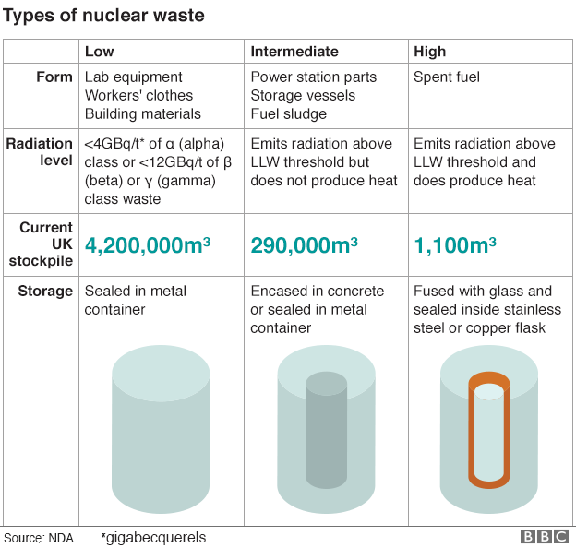
Energy Department Plan to Reclassify Nuclear Waste Worries Environmentalists https://weather.com/science/environment/news/2018-12-10-energy-department-reclassify-nuclear-waster
At a Glance
-
- The U.S. Department of Energy wants to reclassify some of the waste that meets highly technical conditions.
- The agency says the change could save the federal government $40 billion in cleanup costs at nuclear sites across the nation.
- About 56 million gallons of radioactive and hazardous chemical wastes are stored in tanks in Washington state.
- Environmentalists fear a U.S. Department of Energy proposal to reclassify some radioactive waste left from the production of nuclear weapons is simply a way to abandon the cleanup of places like the Hanford Nuclear Reservation in Washington state.The Trump administration proposal to lower the status of some high-level radioactive waste would make disposal cheaper and easier. Reclassifying the material to low-level could save the agency billions of dollars and decades of work by essentially leaving the material in the ground, critics say.
- The proposal joins a long list of Trump administration efforts to loosen environmental protections. Just last week, the Environmental Protection Agency acted to ease rules on the sagging U.S. coal industry.Tom Carpenter of Hanford Challenge, a nuclear watchdog group, said it wants a thorough cleanup of the Washington state nuclear site, which is half the size of Rhode Island. That includes building a national repository somewhere else to bury the waste once it has been stabilized.
- “The cleanup of the site is really at stake,” Carpenter said about the proposed change.
He noted that Hanford is located in an environmentally sensitive site adjacent to the Columbia River and susceptible to earthquakes, volcanoes and flooding.
- Hanford was established by the Manhattan Project in World War II to make plutonium, a key ingredient in the atomic bomb dropped on Nagasaki, Japan. The plant went on to produce most of the plutonium for the nation’s nuclear arsenal.As a result, the site also contains the nation’s largest collection of nuclear waste. The most dangerous is stored in 177 aging underground tanks, some of which have leaked. The tanks hold some 56 million gallons of radioactive and hazardous chemical wastes waiting to be treated for permanent disposal.Cleanup efforts at Hanford have been underway since the late 1980s and cost about $2 billion a year.
Current law defines high-level radioactive waste as resulting from processing irradiated nuclear fuel that is highly radioactive. The Energy Department wants to reclassify some of the waste that meets highly technical conditions.
The agency says the change could save the federal government $40 billion in cleanup costs across the nation’s entire nuclear weapons complex, which includes the Savannah River Plant in South Carolina and Idaho National Laboratory.
- Environmental groups and the state of Washington, which has a legal commitment with the Energy Department to oversee the Hanford cleanup, said the proposal is a concern.”They see it as a way to get cleanup done faster and less expensively,'” said Alex Smith of the Washington state Department of Ecology.Carpenter said there “is not much point in doing much else if they don’t clean up the high-level waste.”
At the request of U.S. Sen. Ron Wyden, an Oregon Democrat, the agency extended the public comment period on the proposal to Jan. 9. The agency can make the change without the approval of Congress.
“No one disputes the difficulty of retrieving and treating high-level waste from Hanford’s aging storage tanks,” Wyden wrote to the DOE. “However, lowering the bar for level of protection of future generations and the environment by changing the definition of what has always been considered high-level waste requiring permanent disposal is a significant change.”
Mayor of London has plan to tackle the climate emergency

 London mayor unveils plan to tackle ‘climate emergency’https://www.theguardian.com/uk-news/2018/dec/11/london-mayor-sadiq-khan-city-climate-emergency, – Matthew Taylor, Sadiq Khan accuses government of dragging its feet and calls for investment to avert catastrophe London’s mayor, Sadiq Khan, has declared a climate emergency and urged the UK government to do more to avert an ecological breakdown that he says poses an existential threat to future generations.
Speaking as City Hall outlined its new climate change plan, Khan said he was implementing measures to protect people from floods, fires and the political upheaval caused by climate change. He accused central government of “dragging its feet” on dealing with these issues.
“We are in the midst of a climate emergency which poses a threat to our health, our planet and our children and grandchildren’s future,” Khan told the Guardian. “City Hall is doing everything in our power to mitigate the risk in London but the stark reality is that we need urgent government action and funding.”
The acknowledgement of the scale and nature of the ecological crisis by the leader of one of the world’s major cities comes amid growing concern about the impact of climate change. A succession of scientific reports have laid bare the scale of the unfolding disaster, including one from the UN that said there were only 12 years left to avert the most extreme consequences of climate breakdown.
On Sunday 100 academics, philosophers and authors wrote to the Guardian to back a new civil disobedience group – Extinction Rebellion – and called for people around the world to rise up and organise against the “paralysis” of political leaders.
Khan’s intervention follows that of civic leaders in the UK and around the world. Last month Bristol declared a climate emergency and set a goal of becoming carbon neutral by 2030, while Manchester said it would become “carbon zero” by 2038. Both are more ambitious than the UK’s national target of an 80% reduction in emissions by 2050. It follows similar moves by several US cities.
London’s existing plan, unveiled by Khan in May, was for the city to be carbon neutral by 2050. But last week the London Assembly passed a motionsaying that target should be brought forward to 2030 and called on Khan to draw up “a specific emergency plan”.
Caroline Russell from the Green party, who proposed the motion, said it was crucial Khan backed a more radical target and called on the government to give him the appropriate powers and funding.
“Catastrophic climate breakdown might be as little as 12 years away,” she said. “This would have profound impacts on every aspect of our lives in London from flooding and overheating in summers, disruption in our food supply chains as well as in the wider natural world.
“The mayor needs to be at the forefront of this challenge, declaring a climate emergency and an urgent updating of his carbon reduction targets to make London carbon neutral by 2030, decades ahead of his current plans, setting a precedent for other major and world cities.”
Khan said he had already introduced a series of measures to tackle climate breakdown – from investing £500m in low carbon technologies to divesting pension funds from fossil fuels.
But he said a City Hall analysis due to be published on Wednesday showed London would need a huge programme of investment as well as new powers to bring forward its zero-carbon target to 2030. The cash would be used to:
• Retrofit hundreds of thousands of homes and offices to make them more energy efficient.
• Decarbonise the national grid.
• Install low-carbon heating systems, such as heat pumps.
• Move private and public transport away from diesel and petrol, and towards electric.
Khan said: “My message to ministers is clear – stop dragging your feet and gambling with our future and give London and cities across the UK the real powers and funding needed to protect our future generations.”
The Green party welcomed Khan’s move and backed his call for more help from central government. But Russell said there was more that could be done now. “Sadiq should start this mission by cancelling the Silvertown road tunnel and fighting harder against things that will make the climate crisis worse.
“He should call right now for a halt to climate-wrecking aviation expansion, including at Gatwick, and ask his C40 [global green city network] counterparts to join him.”
Maine watchdogs keep close eye on Trump’s bid to change nuclear waste storage rules
|
https://bangordailynews.com/2018/12/12/news/midcoast/maine-watchdogs-keep-close-eye-on-trumps-bid-to-change-nuclear-waste-storage-rules/ • December 12 2018, A new proposal by President Donald Trump’s administration to reclassify some high-level nuclear waste to reduce cleanup costs will not affect the 550 metric tons of spent nuclear fuel stored in more than 60 airtight steel canisters near the former Maine Yankee nuclear reactor in Wiscasset. The new proposal focuses on waste generated by nuclear weapons, not power plants. But Mainers tasked with advocating for safe handling of atomic waste voiced concern that it could foretell changes that would affect the Maine Yankee waste.
“Safety costs money; environmental protection costs money,” said Edgecomb resident Ray Shadis, technical adviser to the New England Coalition on Nuclear Pollution in Brattleboro, Vermont, and founder of the group Maine’s Friends of the Coast that eventually got Maine Yankee shut down. “I think that’s the next shoe. This initiative at the weapons’ facilities is very likely the first step.” The U.S. Department of Energy has proposed reclassifying some high-level radioactive waste in various U.S. locations to low-level, allowing the department to leave the waste buried in the ground and save $40 billion in cleanup costs, the Associated Press reported Tuesday. Per the Atomic Energy Act of 1954 and the Nuclear Waste Policy of 1982, high-level radioactive waste is currently defined as waste resulting from processing irradiated nuclear fuel that is highly radioactive. Shadis said the proposal would not affect waste at the former Maine Yankee plant, which closed in 1996. Trump’s current proposal would only affect high-level radioactive waste generated by nuclear weapons production — currently stored in South Carolina, Idaho, Washington and New York — not waste generated by civilian nuclear production. “The terms ‘highly radioactive’ and ‘sufficient concentrations’ are not defined in the [Atomic Energy Act] or the [Nuclear Waste Policy Act],” the proposal states. It goes on to argue that “Congress left it to [Department of Energy] to determine when these standards are met. Given Congress’ intent that not all reprocessing waste is [high-level waste], it is appropriate for DOE to use its expertise to interpret the definition of [high-level waste], consistent with proper statutory construction, to distinguish waste that is non-HLW from waste that is HLW.” According to Shadis, industry officials and regulators have insisted since the beginning of the nuclear age that civilian nuclear production and weapons production for defense have nothing to do with each other. They are not integrated in any way and are handled separately. In fact, waste generated by civilian nuclear reactors is regulated by the U.S. Nuclear Regulatory Commission. Eric Howes, spokesman for Maine Yankee, said Tuesday he is not aware of any proposals to reclassify waste stored at Maine Yankee. Nevertheless, Shadis said, “I will say that we could simply wait for the other shoe to drop, because the Trump administration has rushed to the rescue of commercial power plants, which are shutting down all over the country because they are no longer competitive … it’s one way of fixing the game. One way of adjusting the cost of nuclear is to be more lenient when it comes to environmental regulations, including regulations regarding nuclear waste.” “That’s completely outrageous,” Don Hudson, chairman of the Maine Yankee Community Advisory Panel, said of the proposal. “They couldn’t have done that with a straight face. But it doesn’t affect Maine Yankee’s waste.” A federal judge has already awarded Maine Yankee $24.6 million in a decision based on the federal government’s failure to remove and dispose of the spent nuclear fuel. But Hudson said again on Tuesday there is no viable solution for the waste in Wiscasset, although “there are a couple of potential projects that might get built sometime in the next decade for above-ground storage near Carlsbad, New Mexico, and west Texas.” Previous administrations have said “stranded” nuclear waste — hazardous materials stored where there is no operating nuclear plant such as Maine Yankee, Yankee Rowe in Massachusetts and several others — would be the first to be removed, according to Hudson. But he said he isn’t holding his breath. “The impasse on the nuclear waste issue continues,” Howes said. “Congress to date has not provided any funding in the fiscal year 2019 budget for consolidated interim storage or the Yucca Mountain license application process. Maine Yankee and many others are urging Congress to provide fiscal year 2019 funding for nuclear waste management during this lame duck session of Congress.” “I hate to sound cynical, but I’m not going to believe it’s going to happen until I actually hear there’s a bulldozer on the ground,” Hudson said. “It’s really dangerous stuff, and it needs to be taken care of … depending on who you ask, it’s going to be multi tens of thousands of years before you could assign just casual care of this waste.” |
|
UK’s “nuclear revival”?Japanese company Hitachi may walk away from Wylfa project
 Times 11th Dec 2018 , Doubts over Britain’s planned nuclear revival increased yesterday amid
fears that the Japanese company developing a new plant on Anglesey may be
preparing to scrap the project. Shares in Hitachi rose by as much as 2.9
per cent at one point after Japanese media reported that it was considering
abandoning work on the proposed Wylfa plant because of rising costs.
at which the fate of Horizon, the subsidiary developing the £15
billion-plus project, will be discussed.
the British government over financial support for Wylfa and is understood
to want a deal by the middle of next year or else could walk away. TV
Asahi, the Japanese broadcaster, reported that a decision was likely to be
taken by the end of the business year in March.
https://www.thetimes.co.uk/article/b6c04dec-fcbc-11e8-9a88-fa81ced0c139
1 This Month

of the week – Shut Down Drone Warfare!


Tell the Ukrainian Government to Drop Prosecution of Peace Activist Yurii Sheliazhenko

Petition to revoke the licensing of the Near Surface Nuclear Disposal Facility (NSDF) at Chalk River. https://www.ourcommons.ca/petitions/en/Petition/Details?Petition=e-7247
To see nuclear-related stories in greater depth and intensity – go to https://nuclearinformation.wordpress.com
-
Archives
- April 2026 (44)
- March 2026 (251)
- February 2026 (268)
- January 2026 (308)
- December 2025 (358)
- November 2025 (359)
- October 2025 (376)
- September 2025 (257)
- August 2025 (319)
- July 2025 (230)
- June 2025 (348)
- May 2025 (261)
-
Categories
- 1
- 1 NUCLEAR ISSUES
- business and costs
- climate change
- culture and arts
- ENERGY
- environment
- health
- history
- indigenous issues
- Legal
- marketing of nuclear
- media
- opposition to nuclear
- PERSONAL STORIES
- politics
- politics international
- Religion and ethics
- safety
- secrets,lies and civil liberties
- spinbuster
- technology
- Uranium
- wastes
- weapons and war
- Women
- 2 WORLD
- ACTION
- AFRICA
- Atrocities
- AUSTRALIA
- Christina's notes
- Christina's themes
- culture and arts
- Events
- Fuk 2022
- Fuk 2023
- Fukushima 2017
- Fukushima 2018
- fukushima 2019
- Fukushima 2020
- Fukushima 2021
- general
- global warming
- Humour (God we need it)
- Nuclear
- RARE EARTHS
- Reference
- resources – print
- Resources -audiovicual
- Weekly Newsletter
- World
- World Nuclear
- YouTube
-
RSS
Entries RSS
Comments RSS
 nuclear-news