Environmentalists fear that reclassifying some nuclear wastes means abandoning clean-ups
Energy Department Plan to Reclassify Nuclear Waste Worries Environmentalists https://weather.com/science/environment/news/2018-12-10-energy-department-reclassify-nuclear-waster
At a Glance
-
- The U.S. Department of Energy wants to reclassify some of the waste that meets highly technical conditions.
- The agency says the change could save the federal government $40 billion in cleanup costs at nuclear sites across the nation.
- About 56 million gallons of radioactive and hazardous chemical wastes are stored in tanks in Washington state.
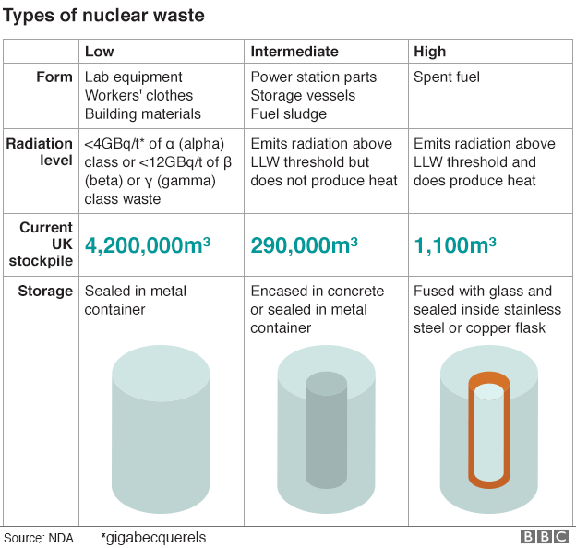
- Environmentalists fear a U.S. Department of Energy proposal to reclassify some radioactive waste left from the production of nuclear weapons is simply a way to abandon the cleanup of places like the Hanford Nuclear Reservation in Washington state.The Trump administration proposal to lower the status of some high-level radioactive waste would make disposal cheaper and easier. Reclassifying the material to low-level could save the agency billions of dollars and decades of work by essentially leaving the material in the ground, critics say.
- The proposal joins a long list of Trump administration efforts to loosen environmental protections. Just last week, the Environmental Protection Agency acted to ease rules on the sagging U.S. coal industry.Tom Carpenter of Hanford Challenge, a nuclear watchdog group, said it wants a thorough cleanup of the Washington state nuclear site, which is half the size of Rhode Island. That includes building a national repository somewhere else to bury the waste once it has been stabilized.
- “The cleanup of the site is really at stake,” Carpenter said about the proposed change.
He noted that Hanford is located in an environmentally sensitive site adjacent to the Columbia River and susceptible to earthquakes, volcanoes and flooding.
- Hanford was established by the Manhattan Project in World War II to make plutonium, a key ingredient in the atomic bomb dropped on Nagasaki, Japan. The plant went on to produce most of the plutonium for the nation’s nuclear arsenal.As a result, the site also contains the nation’s largest collection of nuclear waste. The most dangerous is stored in 177 aging underground tanks, some of which have leaked. The tanks hold some 56 million gallons of radioactive and hazardous chemical wastes waiting to be treated for permanent disposal.Cleanup efforts at Hanford have been underway since the late 1980s and cost about $2 billion a year.
Current law defines high-level radioactive waste as resulting from processing irradiated nuclear fuel that is highly radioactive. The Energy Department wants to reclassify some of the waste that meets highly technical conditions.
The agency says the change could save the federal government $40 billion in cleanup costs across the nation’s entire nuclear weapons complex, which includes the Savannah River Plant in South Carolina and Idaho National Laboratory.
- Environmental groups and the state of Washington, which has a legal commitment with the Energy Department to oversee the Hanford cleanup, said the proposal is a concern.”They see it as a way to get cleanup done faster and less expensively,'” said Alex Smith of the Washington state Department of Ecology.Carpenter said there “is not much point in doing much else if they don’t clean up the high-level waste.”
At the request of U.S. Sen. Ron Wyden, an Oregon Democrat, the agency extended the public comment period on the proposal to Jan. 9. The agency can make the change without the approval of Congress.
“No one disputes the difficulty of retrieving and treating high-level waste from Hanford’s aging storage tanks,” Wyden wrote to the DOE. “However, lowering the bar for level of protection of future generations and the environment by changing the definition of what has always been considered high-level waste requiring permanent disposal is a significant change.”
No comments yet.
1 This Month
Chernobyl: The Lost Tapes – A good documentary on Chernobyl on SBS available On Demand for the next 3 weeks– https://www.sbs.com.au/ondemand/tv-program/chernobyl-the-lost-tapes/2352741955560

of the week–London Campaign for Nuclear Disarmament

Tell the Ukrainian Government to Drop Prosecution of Peace Activist Yurii Sheliazhenko
To see nuclear-related stories in greater depth and intensity – go to https://nuclearinformation.wordpress.com
-
Archives
- April 2026 (139)
- March 2026 (251)
- February 2026 (268)
- January 2026 (308)
- December 2025 (358)
- November 2025 (359)
- October 2025 (376)
- September 2025 (257)
- August 2025 (319)
- July 2025 (230)
- June 2025 (348)
- May 2025 (261)
-
Categories
- 1
- 1 NUCLEAR ISSUES
- business and costs
- climate change
- culture and arts
- ENERGY
- environment
- health
- history
- indigenous issues
- Legal
- marketing of nuclear
- media
- opposition to nuclear
- PERSONAL STORIES
- politics
- politics international
- Religion and ethics
- safety
- secrets,lies and civil liberties
- spinbuster
- technology
- Uranium
- wastes
- weapons and war
- Women
- 2 WORLD
- ACTION
- AFRICA
- Atrocities
- AUSTRALIA
- Christina's notes
- Christina's themes
- culture and arts
- Events
- Fuk 2022
- Fuk 2023
- Fukushima 2017
- Fukushima 2018
- fukushima 2019
- Fukushima 2020
- Fukushima 2021
- general
- global warming
- Humour (God we need it)
- Nuclear
- RARE EARTHS
- Reference
- resources – print
- Resources -audiovicual
- Weekly Newsletter
- World
- World Nuclear
- YouTube
-
RSS
Entries RSS
Comments RSS
 nuclear-news
Leave a comment