Australia: Bushfires, Climate Change, and Nuclear Sites
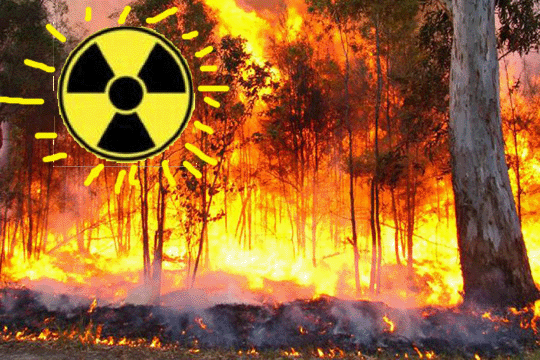
Bushfires in Queensland have ushered in the “new normal” of superfires in Australia. California has already experienced this new normal. It means that these fires are now catastrophic. They encroach on human habitation. Fire behaviour has changed. Their intensity is greater. Their severity is greater: their flames are higher. Fires last longer, and come with increasing frequency. They spread at higher rates, and jump gaps such as roads, rivers and fire breaks. .
These fires now do long -term damage to the ecosystem. The earth underneath is affected, habitat destroyed, killing all the normal bacteria and inhabitants of the soil. Many are fires that are impossible to put out.
The background to these new superfires is climate change. Climate change has brought higher temperatures and drought – resulting in drier trees and other vegetation – meaning that tinder-dry fuel is ready for ignition.
Australia is uniquely vulnerable, as the driest continent, with its prevailing eucalypt forests.
In California, the authorities are trying hard to cover up the reality that the wildfires started at an abandoned and still radioactively contaminated, nuclear facility . The fire would undoubtedly have caused radioactive ash to be blown about. (The fact that it’s not measured doesn’t mean that it is non existent)
Australia is vulnerable to a similar radioactive threat. Last year, bushfires went uncomfortably close to the Lucas Heights nuclear reactor. Plans to transport Lucas Height nuclear waste 1700 km across Australia to Flinders Ranges area mean that this radioactive trash would be at risk of accident, and one of the worst risks would be bushfires.
Australia must face up to the climate change threats – floods (as more water vapour, due to heat, will come down as flooding) , sea level rise, and super bushfires. Lucas Heights nuclear reactor should be closed, and ANSTO’s nuclear dream prevented from becoming Australia’s climate-nuclear nightmare.
The Age of Super Fires
No comments yet.
1 This Month


Tell the Ukrainian Government to Drop Prosecution of Peace Activist Yurii Sheliazhenko

Petition to revoke the licensing of the Near Surface Nuclear Disposal Facility (NSDF) at Chalk River. https://www.ourcommons.ca/petitions/en/Petition/Details?Petition=e-7247


of the week – STOP SMALL MODULAR REACTORS IN CANADA
To see nuclear-related stories in greater depth and intensity – go to https://nuclearinformation.wordpress.com
-
Archives
- March 2026 (212)
- February 2026 (268)
- January 2026 (308)
- December 2025 (358)
- November 2025 (359)
- October 2025 (376)
- September 2025 (258)
- August 2025 (319)
- July 2025 (230)
- June 2025 (348)
- May 2025 (261)
- April 2025 (305)
-
Categories
- 1
- 1 NUCLEAR ISSUES
- business and costs
- climate change
- culture and arts
- ENERGY
- environment
- health
- history
- indigenous issues
- Legal
- marketing of nuclear
- media
- opposition to nuclear
- PERSONAL STORIES
- politics
- politics international
- Religion and ethics
- safety
- secrets,lies and civil liberties
- spinbuster
- technology
- Uranium
- wastes
- weapons and war
- Women
- 2 WORLD
- ACTION
- AFRICA
- Atrocities
- AUSTRALIA
- Christina's notes
- Christina's themes
- culture and arts
- Events
- Fuk 2022
- Fuk 2023
- Fukushima 2017
- Fukushima 2018
- fukushima 2019
- Fukushima 2020
- Fukushima 2021
- general
- global warming
- Humour (God we need it)
- Nuclear
- RARE EARTHS
- Reference
- resources – print
- Resources -audiovicual
- Weekly Newsletter
- World
- World Nuclear
- YouTube
-
RSS
Entries RSS
Comments RSS
 nuclear-news
Leave a comment