
Nuclear Advocates Set Sights on Advanced Reactors for Puerto Rico
With big push of meetings with key officials, nuclear industry hopes to be part of Puerto Rico’s energy future, Morning ConsultBY JACQUELINE TOTH November 19, 2018
- Supporters are highlighting the energy, climate and safety benefits of advanced reactor concepts.
- Puerto Rico’s House of Representatives passed a resolution to study nuclear energy.
- Details are sparse this early in the discussions, and Puerto Rico has no concrete plans for nuclear, instead focusing on other sources.
Nuclear industry professionals have launched a long-term bid to convince Puerto Rico they may have the solution for the island’s energy woes. ………
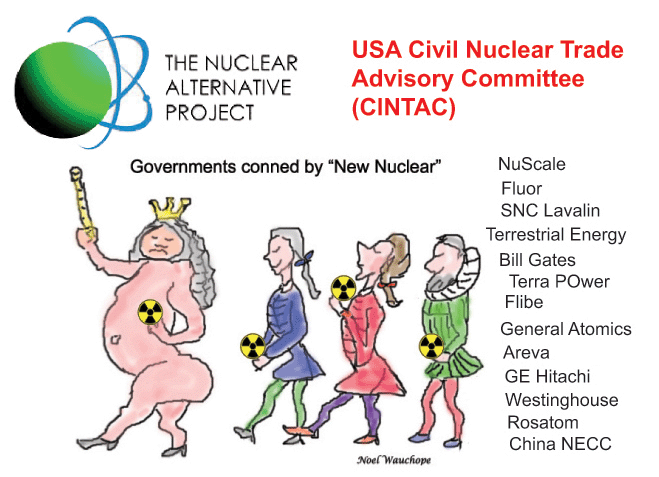
A group of nuclear industry professionals, who have formed The Nuclear Alternative Project nonprofit organization, recently hosted a group of nuclear executives to meet with Puerto Rican lawmakers and officials to discuss new nuclear concepts.
“We were in Puerto Rico for four days, and we were able to take the conversation from, ‘You guys are nuts,’” to something Puerto Ricans would consider if it would lower their energy bills, said Jesabel Rivera, the nonprofit’s community impact and engagement consultant.
But a host of questions over when, where, how and at what cost these reactors would be deployed and operated in Puerto Rico remains unanswered at this early stage. Some groups have also raised environmental concerns.
Officials from companies that included small modular reactor and micro-reactor developers NuScale Power LLC, X-Energy LLC, Westinghouse Electric Co. and GE-Hitachi Nuclear Energy Inc., attended the meetings on the island.
“A lot of folks didn’t know anything about nuclear other than what they had kind of seen in movies,” said Jose Reyes, chief technology officer of NuScale, who attended the trip. “One person mentioned Homer Simpson.”
Another participant was Donald Hoffman, president and chief executive of nuclear consultancy EXCEL Services Corp., founder of the United Nuclear Industry Alliance, a former adviser to now-President Donald Trump and a member of the Commerce Department’s Civil Nuclear Trade Advisory Committee.
Several of the recent tour’s other participants are CINTAC members.
After the tour, Puerto Rico’s House of Representatives on Nov. 7 approved a resolution that calls on the House Government Commission to investigate the need for nuclear energy reactors on the island and report back within 180 days.
SMRs are billed as faster-to-construct, safer technologies with longer refueling cycles compared to older nuclear reactors, though no U.S. designs have yet undergone construction. The U.S. SMR furthest along in the Nuclear Regulatory Commission licensing process is NuScale, which has completed phase one of design review……
But discussions are at a nascent stage.
“There’s not enough detail yet. There’s no site,” design or cost determination for nuclear in Puerto Rico, Carlos Fernández-Lugo, chairman of the environmental, energy and land use practice group at law firm McConnell Valdés LLC, said during an Oct. 30 public panel discussion on nuclear energy held at the Mayagüez campus of the University of Puerto Rico.
It also remains unclear whether the customer for a nuclear plant would be the Puerto Rico Electric Power Authority, the struggling government-owned utility that is undergoing restructuring.
The Nuclear Alternative Project is looking for funding to move forward with a feasibility study, Rivera said.
On Friday, however, a spokeswoman from the Department of Energy said the department does not have plans for a study on advanced nuclear in Puerto Rico at this time.
Puerto Rico does not currently have any operating nuclear reactors, but it once had the Boiling Nuclear Superheater Reactor Facility, an experimental reactor in Rincón, which operated at full power in 1965 but stopped about three years later due to technical difficulties and the resulting expensive changes that would be required. It was decommissioned, and decontamination work continued into the early 2000s.
https://morningconsult.com/2018/11/19/nuclear-advocates-set-sights-advanced-reactors-puerto-rico/
November 19, 2018
Posted by Christina Macpherson |
marketing, spinbuster, USA |
Leave a comment

Delay in Dalgety Bay radiation remediation work ‘due to Brexit’, Courier UK by Aileen RobertsonNovember 19 2018 A further delay in the project to contain radiation at Dalgety Bay has been blamed on Brexit.
It was hoped remediation work to contain radioactive particles at the contaminated shore would be complete by the end of next summer.
But it has been revealed the work will not even be started in 2019 after the UK Government took longer than expected to give the plans final approval.
“I think every government department is focused on Brexit, and I think that’s potentially the problem,” said Labour councillor Bobby Clelland.
David Barratt, SNP councillor for Inverkeithing and Dalgety Bay, said: “It’s extremely disappointing that an entirely avoidable delay is now likely to occur and even more frustrating that this may be down to it sitting in someone’s inbox.
“I am writing to Lesley Laird as the MP for Dalgety Bay to express this frustration and to ask her to seek answers on why such a delay occurred in seeking ministerial approval.”
Radioactive particles were first discovered at the headland near Dalgety Bay Sailing Club in 1990.
The particles were found to contain radium-226 which was in paint used to make aircraft dials luminous. Studies of the coastline suggest incinerated radioactive waste was dumped prior to 1959, when the nearby airbase HMS Merlin was decommissioned.
After years of refusing to accept liability, the Ministry of Defence (MoD) was named as the polluter by the Scottish Environment Protection Agency more than two decades after the radiation was found.
The MoD has drawn up an action plan, including removing some of the contaminated debris and containing the rest by building a wall and new slipway, which is with UK ministers for approval.
Stephen Ritchie from the MoD’s Defence Infrastructure Organisation (DIO) told South and West Fife Area Committee the delay was “very frustrating for everybody”……….. https://www.thecourier.co.uk/fp/news/local/fife/766779/delay-in-dalgety-bay-radiation-remediation-work-due-to-brexit/
November 19, 2018
Posted by Christina Macpherson |
environment, politics, UK |
Leave a comment
 Book Review: Sayonara Nukes ~The Case for Abolishing Nuclear Energy and Nuclear Weapons, BY DENNIS RICHES http://www.cnic.jp/english/?p=4174 BY CNIC_ENGLISH · CAITLIN STRONELL, CNIC AUGUST 2, 2018
Center for Glocal Studies, Seijo University I first came across Dennis Riches’ blog about a year after 3.11 when I was in India studying anti-nuclear movements. I read it avidly for its rich perspectives and home truths. Dennis was offering cultural, psychological, socio-economic explanations for the innumerable crises that the Fukushima Daiichi meltdowns had unleashed. Many of my friends at the time were focused on technical explanations, which although of course vitally important, didn’t answer the really big questions for me, such as: How can the nuclear industry still be telling the same lies? How can TEPCO still be allowed to operate as a company? What are the structures we have to change here? His blog described the stark reality that we were facing in a matter-of-fact way but with strong undercurrents of extreme passion, which somehow seemed to me exactly what was needed.
His recently released book is a compilation of these blog posts, divided into three parts: Articles that relate nuclear issues to works of literature, cinema and popular music; articles primarily about nuclear energy; and articles primarily about nuclear weapons.
The first section connects nuclear issues to figures as wide apart as Don Quixote and Bob Dylan, and compares the situation in Japan immediately after the Fukushima Daiichi disaster to a sci-fi drama called LOST. Although I have never seen this drama, Dennis’s comparison of the traumatized victims in the drama who somehow find themselves in an island paradise that has been transformed by technology and their dazed befuddlement and denial of reality, or perhaps inability to even grasp what had happened to them, and the situation in Japan in the nuclear disaster aftermath, make a lot of sense. We are reminded that in times when we feel utter disbelief, it is often the arts that offer the best explanation as to how and why we find ourselves in this predicament. This section also includes other film and book reviews and discussions.
The other two sections also contain book reviews as well as reports of conferences that Dennis attended, including the 2015 Pugwash Conference in Nagasaki (which he is quite critical of) as well as a report of a presentation on India’s nuclear program by Kumar Sundaram given in 2014 when he was in Tokyo. Articles on the devastating affects of the nuclear industry on citizens of various countries around the world, including the US, the Pacific Islands and Dennis’s native Canada are described with a focus on the voices of the victims. More abstract ideas such as the ‘institutional self-deception’ of the nuclear industry as well as an article titled ‘Commucapitalism’ about how ‘plutonium cities’ in both of the superpowers adopted the same political and social values despite their opposing national ideologies.
Many of the articles are 10-20 pages long and this allows Dennis to present many details, but also articulate overarching ideas and arguments. Each article is followed by copious endnotes and in many cases further reading lists providing a wealth of information on a wide variety of topics. Although this may sound a little academic, the articles are very easy to read and draw you in with their forthrightness and slight sarcastic edge.
The time period covered is from immediately after 3.11 through to more recent articles on the Trump administration. I would have liked to have known the actual date that the original blog was published as I think this might give some indication of the phases that Dennis, and perhaps many of us, went through and the way our thoughts developed post 3.11.
The book is published by Seijo University’s Center for Glocal Studies and is available in pdf form, free of charge at
www.seijo.ac.jp/research/glocal-center/publications/english-study-series/index.html
November 19, 2018
Posted by Christina Macpherson |
resources - print |
Leave a comment
https://www.hulldailymail.co.uk/news/hull-east-yorkshire-news/nuclear-bomb-threat-yorkshire-village-2228206
It was, understandably, opposed by residents By Alex Grove 18 NOV 2018
It is a quaint rural hamlet on the coast of East Yorkshire with around 600 people and a few small amenities.
Life in Skipsea is peaceful, sleepy and quiet, but a controversial proposal put forward by scientists 65 years ago threatened to effectively wipe out the village from existence and change the face of the seaside village forever.
In 1953, almost 240 miles away from Skipsea in another similarly small Berkshire village called Aldermaston, scientists at the Atomic Research Establishment seriously considered detonating a nuclear weapon next to Skipsea.
At the time it had a medieval church and the remains of a Norman castle but not much else, and its close proximity to the RAF base at Hull made it an ideal spot to explode an atomic bomb.
In the midst of the Cold War, the UK wanted to find a coastal site for an above-ground atomic bomb explosion after detonating under the sea off a group of islands near Australia in 1952.
They first opted for a Scottish beauty spot called Duncansby Wick near Caithness in the Highlands of Scotland, but this plan was halted by the damp.
They turned their attention to Donna Nook in Lincolnshire before settling on Skipsea.
However, the people of the small East Riding village were not going to relinquish their hamlet without a fight. Unsurprisingly, community leaders rallied to protest against the idea arguing the site chosen was too close to bungalows and beach huts. The area’s MPs encouraged the government to reconsider the radical plan and with opposition to the idea too fierce, the government backed down and secured Skipsea’s future with the bomb test carried out at Emu Field – a desert area in South Australia.
The village was still used later on by The Royal Observer Corps as a site for a Cold War observation post on the east coast of England. The site remained active from October 1959 until its decommissioning in September 1991. It gathered dust for years before being restored by an enthusiast ten years ago.
People may not think there is much to do in Skipsea with the village home to a couple of churches and post offices, a village hall a pub and a few shops.
However, this tale of old will just make you appreciate the fact that this quiet, sleepy village even exists at all.
November 19, 2018
Posted by Christina Macpherson |
history, UK, weapons and war |
Leave a comment
 Saudi Arabia’s Investigation of Jamal Khashoggi’s Murder Is a Tragic Farce, New Yorker, By Robin Wright, November 16, 2018
 Despite six weeks of ferocious denials by Saudi Arabia, U.S. intelligence has concluded that the kingdom’s ambitious young crown prince, Mohammed Bin Salman, personally ordered the execution of journalist Jamal Khashoggi, who was killed in Istanbul last month, the Washington
Postreported late Friday. The U.S. assessment was reportedly based on a growing array of hard data as well as a psychological study of the thirty-three-year-old prince. The most damning and specific intelligence was provided by Turkey, including audio recordings of the murder inside the Saudi consulate and a call from the diplomatic mission back to Saudi Arabia immediately afterwards. Turkey shared both with the C.I.A. director Gina Haspel. But the United States also had its own electronic intercepts of conversations, some retrieved in a search of its electronic archives after Khashoggi’s murder on October 2nd, the
Post reported. One was reportedly between the crown prince’s brother Khalid, who was the Saudi Ambassador to Washington at the time, and Khashoggi, who was told to go to Istanbul to get official papers proving his divorce so he could remarry.
The C.I.A. assessment contradicts the Saudi version of events, which was released just a day earlier.
With a straight face, the Saudi foreign minister, Adel al-Jubeir, explained the murder of Jamal Khashoggi to a group of journalists on Thursday by saying, dismissively, “Sometimes mistakes happen.” The kingdom wrapped up its investigation by charging eleven men—five face the death penalty—and offering yet a fourth (or is it now the fifth?) version of the Washington Postcolumnist’s execution. The Saudis initially claimed that Khashoggi left the Saudi consulate alive. It later admitted that he’d died—but only after he initiated a fistfight and succumbed to a choke hold meant simply to subdue him. At the time, al-Jubeir insisted that Khashoggi’s body had been rolled up in a carpet and taken out of the consulate in one piece. The government later admitted that he’d been dismembered. Now it’s claiming that Khashoggi was tied up and injected with an overdose of a sedative that accidentally killed him.
“May Allah rest his soul,” the Saudi investigation concluded.
The announcement generated more questions than answers. The suspects were not named. The kingdom still claims not to know where Khashoggi’s body is, since its agents gave his remains to a “local collaborator” whose name it allegedly does not know. (It said it provided a rough “sketch” to Turkish officials.) It offered no explanation of why one of the fifteen men—the same height and girth as Khashoggi—donned the journalist’s clothing after his death and walked around Istanbul, then switched back to his clothing in a public restroom, after which he tossed what appeared to be Khashoggi’s trousers and jacket into a dumpster. And then there is the inconvenient issue of the bone saw revealed in a security X-ray of the Saudis’ luggage.
The kingdom’s investigation is increasingly becoming a farce. Reading between the lines, the report seemed determined most of all to counter a widespread suspicion that Saudi Arabia’s young de facto ruler, Crown Prince Mohammed, or M.B.S. as he’s popularly known, was behind the operation……..https://www.newyorker.com/news/news-desk/saudi-arabias-investigation-of-jamal-khashoggis-murder-is-a-tragic-farce?mbid=nl_Daily%20111618&CNDID=35537674&utm_source=nl&utm_medium=email&utm_campaign=Daily%20111618&utm_content=&utm_brand=tny&utm_mailing=Daily%20111618&hasha=4b5cd80c0ff359f3043679dfee3a5e07&hashb=d9177a4afc21a296a46a8d1268a8277000d132ab&spMailingID=14634830&spUserID=MTMzMTgzNzUxNjAwS0&spJobID=1521277836&spReportId=MTUyMTI3NzgzNgS2
November 19, 2018
Posted by Christina Macpherson |
Reference, Saudi Arabia, secrets,lies and civil liberties |
Leave a comment
 Mind-blowing’: Hazards to multiply and accumulate with climate change, https://www.brisbanetimes.com.au/environment/climate-change/mind-blowing-hazards-to-multiply-and-accumulate-with-climate-change-20181119-p50gx7.html, By Peter Hannam
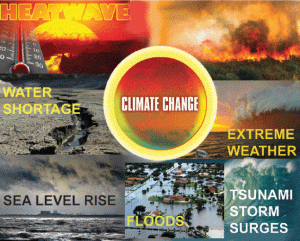
20 November 2018 — Humanity is already enduring cumulative effects from climate change and damages will continue to mount along with carbon emissions, a new study has found. Tropical coastal regions will be the most exposed to multiple hazards.
The research – which involved analysis of 3280 research papers and was published on Tuesday by Nature Climate Change – identified 467 pathways that populations were already being hit by a warmer climate. Those impacts will likely increase and intensify unless aggressive efforts are taken to curb greenhouse gas pollution.
“We never stopped being surprised by how many impacts had already happened to us,” said Camilo Mora, an associate professor at the University of Hawaii and lead author of the paper. (An interactive can be seen here.)
“It was also mind-blowing that we just refuse to wake up about how serious this is,” he said.
Examples of impacts cited ranged from famine deaths triggered by droughts and the increased spread of diseases in a warming world, to worsening heavy metal contamination in lakes after wild fires and a poor Russian wheat harvest amid heatwaves in 2010 that led to a doubling of world prices for the commodity.
The tendency towards more extreme weather includes accelerated evaporation rates as temperatures rise, worsening droughts and contributing to more severe wildfires – a combination currently being played out in California, Professor Mora said.
Similarly, with the atmosphere holding about 7 per cent more moisture for each degree of warming, the potential for more intense rain events increases.
About 20-40 per cent of the rainfall from the record wet Hurricane Harvey that soaked Houston in 2017 has been attributed to climate change, Professor Mora said.
Coastal regions were already being exposed to overlapping hazards from both the land and the ocean, making them particularly vulnerable locations now and in the future.
If carbon emissions continued to rise unabated at their current rate, tropical coastal areas such as in Southeast Asia could face as many as six climate hazards concurrently, the paper said.
These included rising sea level and the increased acidity of oceans as they absorb more carbon from the atmosphere.
Top-down limitations
While societies often relied on top-down approaches to dealing with emissions, the result was often a fragile policy set-up.
“One person can come along and reverse the whole thing,” Professor Mora said.
“We need to build the solution for climate change from the bottom up,” he said, citing a project currently being tested in Hawaii to make the US state fully carbon neutral by tree planting and other efforts.
November 19, 2018
Posted by Christina Macpherson |
2 WORLD, climate change |
Leave a comment
RF Safe Public Awareness Campaign: Study Shows Smartphone Radiation Triggers Memory Loss In Right-handed Teenagers https://markets.businessinsider.com/news/stocks/rf-safe-public-awareness-campaign-study-shows-smartphone-radiation-triggers-memory-loss-in-right-handed-teenagers-1027737591
Figural memory is mainly located in the right brain hemisphere, and the association with cell phone radiation exposure was more pronounced in adolescents using the mobile phone on the right side of the head. “This may suggest that indeed RF-EMF absorbed by the brain is responsible for the observed associations, ” said Martin Röösli, Head of Environmental Exposures and Health at Swiss TPH.
It took just one year’s worth of cell phone radiation exposure to damage the part of the brain that interprets images and shapes — and right-handed teens are worse affected.
Swiss radiation expert Martin Röösli studied the phone habits of 700 adolescents between the ages of 12 and 17, before making them do memory tests.
The conclusion of the study states, “Our findings for a cohort of Swiss adolescents require confirmation in other populations but suggest a potential adverse effect of RF-EMF brain dose on cognitive functions that involve brain regions most exposed during mobile phone use.”
According to John Coates, CEO of RF Safe Corporation, “RF Safe headsets with air tube technology are designed to keep potentially harmful radiation away from your head. Using an air-tube to conduct the sound to your head, there are NO electrical components conducting sound to your head. Much like a Doctors stethoscope, only an air tube is used to conduct sound to the earpiece.”
“It is important parents recognize that children have smaller brains, thinner skulls, softer brain tissue, and a higher number of rapidly dividing cells, which makes them more susceptible to damage from cell phone exposure than adults,” Coates, said.
RF Safe has a focus that supports forward progress of the wireless industry and governmental agencies in standardization for safer cell phones with a goal of accelerating the pace that cell phone users are properly informed and able to attain safer wireless technologies “at the point of sale.”
ABOUT RADIO FREQUENCY SAFE – CELL PHONE RADIATION SAFETY
RF SAFE is a world-leading provider of cell phone radiation protection accessories and informational safety data. Since 1998 RF (Radio Frequency) Safe has been dedicated to evolving the wireless industries safety standards, by engaging in the business of design, testing, manufacture, and sale of safety technologies to mitigate harmful effects of cell phone radiation. SOURCE RF Safe Markets Insider and Business Insider Editorial Teams were not involved in the creation of this post.
November 19, 2018
Posted by Christina Macpherson |
2 WORLD, children |
Leave a comment
The Ferret 18th Nov 2018
The Ferret 18th Nov 2018 The Ministry of Defence (MoD) has recorded more than 500 safety mishaps
with nuclear submarines on the Clyde since 2006 – half of them in the
last four years. UK defence minister, Stuart Andrew MP, has disclosed that
there have been 259 “nuclear site event reports” for Trident submarines
based at Faslane over the last 12 years. Over the same period there have
been 246 safety events on nuclear-powered but conventionally-armed
“hunter-killer” submarines berthed or docked at the naval base. Overall
23 incidents were categorised as having a “high potential” for leaking
radioactivity into the environment or within a submarine or building. Some
148 incidents were said to have a “moderate potential for future release
or exposure”.
https://theferret.scot/faslane-500-nuclear-safety-incidents/
November 19, 2018
Posted by Christina Macpherson |
general |
Leave a comment
International Panel on Fissile Materials 18th Nov 2018 Martin Forwood: The UK government announced on 14 November 2018 that the THORP reprocessing plant at Sellafield has started its planned shutdown. A
Sellafield Stakeholder committee was told that by 11 November 2018, THORP would have chopped up (sheared) its last batch of spent fuel, bringing to an end almost a quarter century of operation.
Based on the officially published ‘annual throughput’ figures (tons reprocessed per year) collated
by the environmental group Cumbrians Opposed to a Radioactive Environment (CORE) since the plant opened in 1994, THORP has failed to meet its operational targets and schedules by a large margin. Just 5,045 tons were
reprocessed in the first 10 years of operation–the 7,000 tons only being completed on 4 December 4 2012–over nine years late. Not once during the Baseload period (1994-2003) was the nominal throughput rate of 1,000 tons
per year achieved. http://fissilematerials.org/blog/2018/11/sellafields_thorp_reproce.html
November 19, 2018
Posted by Christina Macpherson |
business and costs, reprocessing, UK |
Leave a comment
Putin mulls Russian response to US exit from nuclear pact http://www.wmcactionnews5.com/2018/11/19/putin-mulls-russian-response-us-exit-nuclear-pact/ November 19 MOSCOW (AP) — Russian President Vladimir Putin has gathered his top military officials to discuss a response to the planned U.S. withdrawal from a key nuclear arms pact.
U.S. President Donald Trump declared last month that he intends to opt out of the 1987 Intermediate-Range Nuclear Forces Treaty, or INF, over alleged Russian violations. Russia has denied breaching the pact.
Putin told the top military brass Monday that the U.S. withdrawal from the treaty “wouldn’t be left without an answer from our side.” He noted that Russia has responded to the U.S. missile defense program by developing new weapons that he said are capable of piercing any prospective missile shield.
While warning of a possible Russian retaliation, Putin voiced hope that Moscow and Washington could engage in arms control talks to reduce tensions.
November 19, 2018
Posted by Christina Macpherson |
politics international, Russia |
Leave a comment
Sputnik News, 18 Nov 18 The former NSA contractor, who faces capital punishment in the US for leaking classified information on numerous US secret surveillance programmes, voiced his support for the WikiLeaks founder after it came to light that US authorities are apparently poised to indict Julian Assange.
Edward Snowden, who has been granted political asylum in Russia, has voiced his concern about the dangerous precedent for stifling press freedom which could emerge from the US Justice Department’s alleged plans to prosecute WikiLeaks founder Julian Assange.
The Freedom of the Press Foundation, where Snowden is a board member, also issued a statement condemning the possible indictment of Julian Assange, whose website published a classified Iraqi dossier revealing that the US killed civilians during the country’s 2003 invasion and subsequent occupation. Trevor Timm, executive director of Freedom of the Press Foundation, cited a profound threat to press freedom if any charges are brought against WikiLeaks for their publishing activities.
“Whether you like Assange or hate him, the theories used in a potential Espionage Act prosecution would threaten countless reporters at the New York Times, Washington Post, and the many other news outlets that report on government secrets all the time. While everyone will have to wait and see what the charges detail, it’s quite possible core First Amendment principles will be at stake in this case,” his statement reads.
Earlier this week, it came to light through what is believed to be an accident that there’s a sealed complaint against Assange, as the US Department of Justice is gearing up to prosecute the whistleblower. It is now “optimistic” about the prospect of securing his release to US authorities, a new report suggests. According to the Wall Street Journal, prosecutors have weighed several types of charges against the journalist, who has resided in self-imposed exile at the Ecuadorian Embassy in London since 2012……….https://sputniknews.com/us/201811171069890725-snowden-assange-whistleblower-prosecution/
November 19, 2018
Posted by Christina Macpherson |
civil liberties, USA |
Leave a comment
 Public Citizen, SEED ask for input on nuclear waste site https://www.oaoa.com/news/business/article_85d89190-e9f6-11e8-a78f-fbf0d8a1b844.html N ovember 16, 2018 By Royal McGregor rmcgregor@oaoa.com Members of Public Citizen and Sustainable Energy and Economic Development have encouraged the public to voice their opinion on nuclear waste traveling through the state of Texas and being dumped in Andrews County.
In 2017, the Nuclear Regulatory Commission accepted Waste Control Specialists’ application to begin an interim storage facility for nuclear waste at an Andrews County dump.
The public can submit their opinion to the NRC at nonuclearwaste.org. The deadline for comments is midnight on Monday.
WCS initially hoped to break ground in 2020, but that timeline has been pushed back due to a change in ownership. The license decision from the NRC could be made as early as 2020 and according to NRC spokesperson David McIntyre, the NRC is currently working on an environmental safety and security reviews that won’t be completed until the fall of 2019.
In March, Orano, a French company specializing in nuclear power and renewable energy, and WCS formed a joint venture to license the interim storage facility.
Public Citizen and SEED have intervened in that license application citing a variety of hazards in transporting and storing that nuclear waste. Seven of the eight radioactive waste sites that have been proposed over the last 40 years in Texas have been stopped — the only one to pass is in Andrews County.
“There’s no benefit to Texas taking the nation’s high-level radioactive waste,” said Tom “Smitty” Smith, who was the former director of Public Citizen. “This is waste that nobody else wants that other states have said, ‘We don’t want it in our borders.’ It’s waste that people who live around nuclear reactors have organized to politically to send it somewhere else.
“Here in Texas it’s believed because of former governor (Rick) Perry and because Andrews County said, ‘we would like bring this waste to us,’ that somehow we have expressed consent. More than five million people that live in cities have expressed their opposition.”
SEED Director Karen Hadden said one of the reasons behind submitting opinions online is due to the lack of public meetings by the NRC. There was one meeting in Andrews that took place in 2017, one public meeting in Hobbs, N.M. and two meetings were in Rockville, Md.
McIntyre said after the environmental safety and security reviews is completed in 2019, the NRC will return to Texas for the public to voice opinions and concerns.
The interim storage facility could hold up to 40,000 tons of irradiated nuclear reaction fuel over the life of the 40-year permit. There are no restrictions on how many times WCS could renew its permit.
Hadden is concerned the interim nuclear waste site could stay permanently.
“We risk the waste could stay forever,” Hadden said.
The current application states the nuclear waste would be transported by railroads.
Yet, Dallas, San Antonio and Midland have already opposed the transport of nuclear waste in and around the city
Activist attorney Terry Lodge, who resides in Toledo, Ohio, said over the phone there’s an interim storage already in place — onsite storage.
Lodge continued to explain on a daily basis, it’s overseen by the NRC. It means there’s an alternative that’s taking place instead of the plan to ship everything to the middle of the desert — in some instances thousands of miles — through cities and risk accident, sabotage or terrorism.
“A lengthy petition has been filed to intervene rising 14 various technical points including objections to the legality and odd financing scheme that’s being proposed by WCS when there’s no federal law even allows it,” Lodge said.
The concern also arises when the nuclear waste is transported through neighbors.
Adrian Shelley, current Public Citizen director, said over last several weeks the company used EJSCREEN to look at communities along Class I rail routes across Texas. EJSCREEN can see age, race, education level, income level and language along rail routes.
Shelley said some of the urban areas along those routes have as high as 90 percent of minority residents and in other areas that number is closer to 70 percent. A majority of the people that live along these rail routes don’t speak English, Spanish being the most common.
Lodge said there are also safety concerns for thousands of trips — 3,000 minimum — and there are some Department of Energy policies under consideration that would double, triple or quadruple the number of shipments because of the need to reload the fuel rods into smaller canisters, so they could ultimately be disposed in a geological repository.
“It’s a massive transportation campaign, increasing risk with the number of trips and potential for a serious accident in transit that could have effects according to federal agencies as far as 50 miles downwind,” Lodge said.
Smith added that a 10-year survey from the U.S. Department of Transportation website discovered there have been more than 10,000 railroad accidents in Texas. Many of those involved hazardous cargos. During that 10-year period of time, 25 of the cars carrying hazardous materials had some sort of rupture or leak.
Smith said a report submitted that’s part of the Yucca Mountain licensing process stated an accident could cost $3.5 to $45 billion if the casks were penetrated, but not perforated. If there was a sabotage event and the casks were fully perforated, the cleanup costs could be somewhere between $300 and $648 billion dollars.
“The risk of a train accident is not insignificant,” he said.
November 19, 2018
Posted by Christina Macpherson |
USA, wastes |
2 Comments
The Christian Vacation Camp Where Kids Are Taught by Notorious Climate Science Deniers, DESMOG, By Graham Readfearn • Tuesday, November 13, 2018 –Each morning at
Camp Constitution’s summer camp, the kids and parents go off to classes while staff members do a room inspection.
“What we look for is not just cleanliness, but a patriotic and Godly theme,” says camp director Hal Shurtleff in a
video of the 2016 camp.
“We are looking for creativity — are they learning what we are teaching them?”
And what are they being taught? Conspiracy theories about the United Nations (UN) and how climate change is a hoax, and they’ve drafted in two of the world’s most notorious climate science denialists to do the job.
The rooms — named after “places of refuge in the old testament” — are covered with U.S. nationalistic garlands and flags. A “Make America Great Again” (MAGA) hat is perched on a wooden bunk post.
Children take quotes they’ve learned from classes, and turn them into posters. One encourages the United Nations to keep out.
Another lists “buzzwords” including CO2, climate change, environmental justice, and endangered species.
“You hear these buzzwords and you know the bad guys are behind the scenes,” says a commentating Shurtleff.
Shurtleff is a former regional director of the John Birch Society — the UN-hating, right-wing conservative group known for, among other things, pushing a conspiracy that the UN’s promotion of environmental sustainability was in fact a sinister plot to install a world government.
But as well as learning about the evils of sensible resource use, the kids at this summer’s Camp Constitution attended classes by climate science deniers Lord Christopher Monckton and Dr. Willie Soon………..
Research from Greenpeace and the Climate Investigations Center has shown Soon’s work to be heavily funded by fossil fuel industry interests, including more than $1 million from ExxonMobil, Southern Company, American Petroleum Institute, and Charles G. Koch Foundation.
Also on the agenda was former John Birch Society president John “Jack” McManus, who told the youngsters, some who stay with their parents, how the U.S. should “Get Us Out of the United Nations” while explaining his full anti-UN “world governement” conspiracy theory. He even sold them a booklet for the discounted price of $2.
Eccentric British climate science denier, Lord Christopher Monckton, was also at the camp to regale the kids with tales of how climate change science is one big con-job. …….https://www.desmogblog.com/2018/11/13/christian-vacation-camp-climate-science-deniers-monckton-soon?utm_source=dsb%20newsletter
November 19, 2018
Posted by Christina Macpherson |
climate change, secrets,lies and civil liberties, USA |
Leave a comment
Euractiv 15th Nov 2018 Spain will close the last of its nuclear reactors and coal power plants
before 2030, according to State Secretary for Energy José Dominguez, who
made the announcement shortly after Madrid pledged to work towards a
completely renewable electricity system. Dominguez said on Thursday (15
November) that the current socialist government does not plan to extend the
lifespan of any of its nuclear reactors beyond their current 40-year
shelf-life. Spain’s oldest reactor is more than 37 years old, so
according to current plans will shut up shop in 2021, while its newest just
celebrated its third decade of operation, and will go offline in 2028.
https://www.euractiv.com/section/energy/news/spain-to-nix-nuclear-and-coal-power-by-2030/
November 19, 2018
Posted by Christina Macpherson |
politics, Spain |
Leave a comment
Channel News Asia, 19 Nov 18 Iran is still hopeful that its 2015 nuclear deal with major powers can be saved despite the withdrawal of the United States, a foreign ministry spokesman said on Monday. DUBAI: Iran is still hopeful that its 2015 nuclear deal with major powers can be saved despite the withdrawal of the United States, a foreign ministry spokesman said on Monday.
“There are some ambiguities on implementation of the EU’s mechanism to protect trade with Iran from America’s sanctions … But we remain hopeful that the Europeans can save the deal,” Bahram Qasemi told a news conference broadcast live on state TV.
Other signatories trying to salvage the deal since May, when U.S. President Donald Trump abandoned it. Washington restored sanctions targeting Iran’s oil, banking and transportation sectors this month.
The European Union has been trying to establish a Special Purpose Vehicle (SPV) for non-dollar trade with Iran to save the deal, under which most sanctions were lifted in 2016 in exchange for Tehran curbing its nuclear programme……… (Writing by Parisa Hafezi; editing by Darren Schuettler and John Stonestreet)
Read more at https://www.channelnewsasia.com/news/world/iran-hopeful-that-europe-can-salvage-nuclear-deal—foreign-ministry-10946216
November 19, 2018
Posted by Christina Macpherson |
EUROPE, Iran, politics international |
Leave a comment




 nuclear-news