Solar and wind fuels emit no carbon, but “low carbon” nuclear fuel- it’s a lie! theme for November 18
Solar and wind energy both flow directly to the generating system.

Not only are these fuels carbon-free, but, unlike nuclear, they leave no wastes
Only one step in that uranium-nuclear chain is low emission – though all nuclear lobbyists claim that this step is “no emission” – the reactor’s operation. BUT – Carbon-14 is produced in coolant at boiling water reactors (BWRs) and pressurized water reactors (PWRs). It is typically released to the atmosphere in the form of carbon dioxide at BWRs, and methane at PWRs.
Donald Trump in convenient denial over Crown Prince Bin Salman’s role in the murder of Khashoggi
| Trump’s Utter Denial About Saudi Arabia and Its Crown Prince, New Yorker, By Robin Wright,November 20, 2018
So much for American justice. In a statement both stunning and coldhearted, President Trump on Tuesday gave Saudi Arabia a pass on the grisly murder and dismemberment of journalist Jamal Khashoggi in the name of U.S. national security. He blithely rejected a U.S. intelligence assessment as well as damning physical evidence provided by Turkey indicating that the kingdom’s de-facto ruler, Crown Prince Mohammed bin Salman, authorized the Saudi dissident’s execution, in Istanbul, on October 2nd. The President of the United States sounded more like a defense attorney—or lobbyist—for the oil-rich kingdom than a protector of American values. “It could very well be that the Crown Prince had knowledge of this tragic event—maybe he did and maybe he didn’t!” Trump said in a two-page statement. He condemned the Khashoggi assassination as an “unacceptable and horrible crime,” but then said Saudi Arabia was too important a purchaser of U.S. weaponry, an exporter of oil, and an ally in “our very important fight against Iran” to take punitive action. “The United States intends to remain a steadfast partner of Saudi Arabia to ensure the interests of our country,” Trump said. “Very simply,” he concluded, “it is called America First!” The President’s statement was riddled with falsehoods and contradictions. He embraced the “vigorous” denials from King Salman and his tempestuous young heir, Prince Mohammed—even though several members of the fifteen-man hit squad that killed Khashoggi worked for the crown prince, who is known by his initials, M.B.S. Trump based his justification on what he claimed was the kingdom’s promise to invest or spend four hundred and fifty billion dollars, including a hundred and ten billion dollars in arms purchases, in the United States. Last month, however, Politifact concluded that Trump’s claim earned a “pants on fire” rating. “Orders on that scale don’t exist” and are only a “mirage,” it said. “There is no data behind the $450 billion, and the $110 billion is a blend of smaller deals in progress, old offers”—from the Obama era—“that have not come through, and speculative discussions that have yet to move forward.” Saudi Arabia, in fact, has only followed through so far on fourteen and a half billion dollars in arms and aircraft, the State Department acknowledged last month. Other deals are merely vague memorandums of understanding that cover the next decade, not this year. On Tuesday, a new report by the Center for International Policy also called Trump’s claims “wildly exaggerated”—and noted that many of the jobs created from the arms sales are in Saudi Arabia, not the United States. Washington is also far from dependent on Riyadh’s oil wealth. Rather, the Center for International Policy’s new report detailed the kingdom’s “extreme dependence” on the United States. With the U.S.-Saudi relationship under scrutiny after Khashoggi’s murder, “it’s important to remember that the United States has substantial leverage over Saudi behavior,” William Hartung, the director of the center’s Arms and Security Project, wrote. “The Saudi military depends on U.S. arms, spare parts and maintenance to carry out its brutal war in Yemen and could not prosecute that war for long without that support.” The President’s comments, which flouted a C.I.A. assessment that M.B.S. likely ordered Khashoggi’s death, provoked scorn, dismay, and outrage from human-rights groups, politicians, and foreign-policy experts. Joseph Cirincione, the president of the Ploughshares Fund, a global-security foundation, told me, “This is, without a doubt, the most uninformed, toady, poorly written, categorically untrue statement I have ever seen a President of the United States make. His statement has provoked such a strong, overwhelmingly negative reaction for good reason: it raises serious questions about the President’s fitness for office.” Sarah Leah Whitson, the executive director of the Middle East division of Human Rights Watch, told me that Trump’s statement “isn’t just immoral, it’s reckless and will come back to haunt and hurt U.S. interests.” She said the crown prince has proved to be “an impulsive, sadistic, unhinged leader” who has destabilized the region, most notably by launching the deadly war in Yemen, in 2015. “This only signals to tyrants around the world that it’s open season on journalists and critics, wherever they are, so long as they’re cozy with Trump.” The former U.N. Ambassador Samantha Power, who won the Pulitzer Prize for her book on efforts to halt genocide and other war crimes, tweeted that the President’s remarks were “an abomination that will define the ignorance, corruption, cruelty and recklessness of this presidency for generations to come.” The former nato Ambassador Nicholas Burns, a career diplomat who is now at Harvard’s Belfer Center, called Trump’s seven-paragraph statement “beyond embarrassing. It is shameful. He cites uncritically the MBS smear that Khashoggi was a traitor. He argues the U.S. can’t afford to alienate Riyadh due to oil+Iran. He is silent on our most important interest—Justice.”……. Trump, apparently, believes that his policies could be endangered if he spurns Prince Mohammed, who has amassed authoritarian powers. The Prince is now gaming his own rehabilitation, which Trump’s statement will help. The Saudi press recently reported that M.B.S. will represent the kingdom at the annual G20 summit of the world’s twenty most important economies, which is next week in Buenos Aires. Trump is |
Saudi Arabia’s crown prince Mohammed bin Salman – wanting a nuclear bomb?
|
Saudis Want a U.S. Nuclear Deal. Can They Be Trusted Not to Build a Bomb? NYT, By David E. Sanger and William J. Broad, Nov. 22, 2018, WASHINGTON — Before Saudi Arabia’s crown prince, Mohammed bin Salman, was implicated by the C.I.A. in the killing of Jamal Khashoggi, American intelligence agencies were trying to solve a separate mystery: Was the prince laying the groundwork for building an atomic bomb?The 33-year-old heir to the Saudi throne had been overseeing a negotiation with the Energy Department and the State Department to get the United States to sell designs for nuclear power plants to the kingdom. The deal was worth upward of $80 billion, depending on how many plants Saudi Arabia decided to build.
But there is a hitch: Saudi Arabia insists on producing its own nuclear fuel, even though it could buy it more cheaply abroad, according to American and Saudi officials familiar with the negotiations. That raised concerns in Washington that the Saudis could divert their fuel into a covert weapons project — exactly what the United States and its allies feared Iran was doing before it reached the 2015 nuclear accord, which President Trump has since abandoned. Prince Mohammed set off alarms when he declared earlier this year, in the midst of the negotiation, that if Iran, Saudi Arabia’s fiercest rival, “developed a nuclear bomb, we will follow suit as soon as possible.” His negotiators stirred more worries by telling the Trump administration that Saudi Arabia would refuse to sign an agreement that would allow United Nations inspectors to look anywhere in the country for signs that the Saudis might be working on a bomb, American officials said. Asked in Congress last March about his secret negotiations with the Saudis, Energy Secretary Rick Perry dodged a question about whether the Trump administration would insist that the kingdom be banned from producing nuclear fuel. Eight months later, the administration will not say where the negotiations stand. Now lurking behind the transaction is the question of whether a Saudi government that assassinated Mr. Khashoggi and repeatedly changed its story about the murder can be trusted with nuclear fuel and technology. Such fuel can be used for benign or military purposes: If uranium is enriched to 4 percent purity, it can fuel a power plant; at 90 percent it can be used for a bomb. Privately, administration officials argue that if the United States does not sell the nuclear equipment to Saudi Arabia someone else will — maybe Russia, China or South Korea. They stress that assuring that the Saudis use a reactor designed by Westinghouse, the only American competitor for the deal, fits with Mr. Trump’s insistence that jobs, oil and the strategic relationship between Riyadh and Washington are all far more important than the death of a Saudi dissident who was living, and writing newspaper columns, in the United States. Under the rules that govern nuclear accords of this kind, Congress would have the opportunity to reject any agreement with Saudi Arabia, though the House and Senate would each need a veto-proof majority to stop Mr. Trump’s plans. “It is one thing to sell them planes, but another to sell them nukes, or the capacity to build them,’’ said Representative Brad Sherman, Democrat of California and a member of the House Foreign Affairs Committee. Following Mr. Khashoggi’s death, Mr. Sherman has led the charge to change the law and make it harder for the Trump administration to reach a nuclear agreement with Saudi Arabia. He described it as one of the most effective ways to punish Prince Mohammed. “A country that can’t be trusted with a bone saw shouldn’t be trusted with nuclear weapons,” Mr. Sherman said, referring to Mr. Khashoggi’s brutal killingin the Saudi Consulate in Istanbul last month. Nuclear experts said Prince Mohammed should have been disqualified from receiving nuclear help as soon as he raised the prospect of acquiring atomic weapons to counter Iran. “We have never before contemplated, let alone concluded, a nuclear cooperation agreement with a country that was threatening to leave the nonproliferation treaty, even provisionally,” said William Tobey, a senior official in the Energy Department during the Bush administration who has testified about the risks of the agreement with Saudi Arabia. He was referring to the crown prince’s threat to match any Iranian nuclear weapon — a step that would require the Saudis to either publicly abandon their commitments under the nonproliferation treaty or secretly race for the bomb. The Trump administration declined to provide an update on the negotiations, which were intense enough that Mr. Perry went to Riyadh in late 2017. Within the last several months, a senior State Department official engaged in further discussions over the deal in Europe. ……..The core challenge for the Trump administration is that it has declared that Iran can never be trusted with any weapons-making technology. Now, it must decide whether to draw the same line for the Saudis. The United States’ own actions may be helping to drive the Saudis’ nuclear thinking. Now that the Iran agreement, brokered with world powers, is on the edge of collapse after Mr. Trump withdrew the United States, analysts are worried that the Saudis may be positioning themselves to create their own nuclear program in response. The kingdom has extensive uranium deposits and five nuclear research centers. Analysts said Saudi Arabia’s atomic work force was steadily growing in size and sophistication — even without producing nuclear fuel. Saudi leaders saw a political opening when Mr. Trump was elected. In its early days, the administration spent considerable time discussing ways that Saudi Arabia and other Arab states could acquire nuclear reactors. Michael T. Flynn, who briefly served as Mr. Trump’s national security adviser, backed a plan that would have let Moscow and Washington cooperate on a deal to supply Riyadh with reactors — but not the ability to make its own atomic fuel. As a precondition, American economic sanctions against Russia would have been dropped to allow Moscow to join the effort. Mr. Flynn was fired in early 2017 as questions swirled around his conversations with Russia’s ambassador to the United States, including about ending the trade restrictions. At his Senate confirmation hearing in November 2017, Christopher A. Ford, the assistant secretary of state for international security and nonproliferation, called the safeguards a “desired outcome.” But he equivocated on whether the United States would insist on them. Senator Edward J. Markey, a Massachusetts Democrat who sits on the Senate Foreign Relations Committee, described the administration’s approach as “a recipe for disaster.”…….The crown prince made headlines in March by shifting the public discussion over Riyadh’s intentions from reactors to atomic bombs. In a CBS News interview, he said that if Iran acquired nuclear arms, Saudi Arabia would quickly follow suit. …….Mr. Falih, the energy minister, raised concerns about the outcome of negotiations with Washington by insisting publicly that Riyadh would make its own atomic fuel. ………https://www.nytimes.com/2018/11/22/world/middleeast/saudi-arabia-nuclear.html |
|
Russia to give up its policy of ‘no first use’ of nuclear weapons
Russia rewrites nuclear rule book to fire first, The Times, 23 Nov 18 President Putin would have the power to launch nuclear first strikes under plans approved by the Russian parliament.
Senators in the Federation Council, the upper house, have recommended tearing up the military doctrine that forbids initial use of weapons of mass destruction. It comes after Mr Putin said that Moscow would retaliate if the United States withdrew from a landmark Cold War missile treaty.
Russia
The revision would allow the president to order nuclear strikes in response to enemy use of conventional weapons, a significant departure from the military doctrine that prohibits first use unless Russia is threatened by weapons of mass destruction or if its “very existence is in jeopardy” ……. (subscribers only) https://www.thetimes.co.uk/article/russia-rewrites-nuclear-rule-book-to-fire-first-r9gg2mpqm
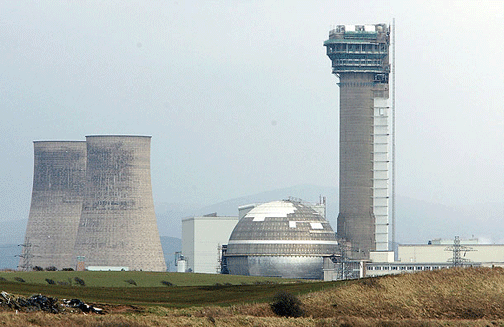
Sellafield – a nuclear misuse of public funds – and Hinkley Point C will be the next

|
There are strong parallels between THORP and the proposed £20bn Hinkley Point C nuclear power plant. Powerful arguments were put forward against the construction of both plants, but the Government and the Nuclear Industry continued to stubbornly pursue these massively expensive and dangerous projects.
Most major projects at Sellafield are still significantly delayed, with expected combined cost overruns of £913 million. The NDA has not systematically reviewed why these projects keep running into difficulties, or analysed properly the constraints it says prevent them from making faster progress. Until this work is completed, the Committee will remain sceptical about the long-term strategy to decommission Sellafield. And despite this Committee’s recommendation nearly five years ago, the Department for Business, Energy & Industrial Strategy has still not decided what to do with the plutonium stockpile currently stored at Sellafield. Given the scale and unique challenges at Sellafield, the NDA must have a firm grip of the work that takes place on the site. This was not the case with the NDA’s recently failed contract to decommission its Magnox sites. PAC Deputy Chair, Sir Geoffrey Clifton-Brown MP said: “The Government’s oversight of the NDA’s performance could and should be much better, The Committee’s findings make yet more dreary reading for the UK taxpayer says Cumbrians The site currently receives some £2bn of public money every year and, over the next 100+ years The PAC report reveals the following: Major projects are expected to cost over £900 million more than originally budgeted and be subjected to delays of over 13 years. The NDA has cancelled three projects since 2012 after spending £586 million of taxpayers’ money on them. Two of the above projects – the silo direct encapsulation project and the box transfer facility were cancelled after the NDA projected a combined cost increase of £2.1 billion and a combined delay of nine years . The NDA’s programme to deal with the plutonium stockpile in the near term is late and its costs are increasing. The concerning discovery last year (NAO report 20.6.18) that some plutonium canisters have been decaying faster than expected is made worse by the fact that the NDA’s project to repackage these canisters is at least two years late and expected to cost over £1.5 billion, £1 billion more than it first expected . The series of contingency arrangements to manage these decaying canisters are shortterm fixes for a long-term problem and BEIS has yet to set out clearly what its strategy is and the associated costs to the taxpayer. BEIS has still not decided between the two plutonium management options available – its long-term storage prior to final disposal as waste in a geological disposal facility (GDF) that has yet to be located or constructed, or its reuse as fuel in new nuclear power stations – but has told the PAC Committee that ‘it is not comfortable with any of the potential options for managing plutonium other than disposing it in the GDF’ (2) Meanwhile the controversial Thermal Oxide Reprocessing Plant (THORP) at Sellafield has started work on processing its final batch of waste fuel after operating for only 24 years. (3) THORP opened in 1994 to reprocess spent fuel from the UK’s newer reactors – like Hinkley Point B – and overseas customers. Reprocessing is a chemical process which separates out plutonium and unused uranium from spent nuclear fuel. There are strong parallels between THORP and the proposed £20bn Hinkley Point C nuclear power plant. Powerful arguments were put forward against the construction of both plants, but the Government and the Nuclear Industry continued to stubbornly pursue these massively expensive and dangerous projects. This Stop Hinkley Campaign briefing asks whether there are any lessons we can learn from the THORP experience to help us to evaluate the merits of continuing to build Hinkley Point C. Currently, the ground-works for Hinkley Point C aren’t even finished so, in theory, it should be straightforward not to go ahead with the project, if it looks like full construction and operation would be a mistake. In fact not going ahead with the plant could save electricity consumers between £27bn and £50bn over the 35 years that the plant would have operated. (4) The construction of THORP was very controversial and was the subject of a Public Inquiry in 1977, which ran for one hundred days. It was argued that the Inquiry would be a way of rationally weighing up all the evidence in order to come up with the correct decision on whether or not to give the plant the go-ahead. However, Professor Brian Wynne has argued that the Inquiry was in fact a charade, meant only to give the impression of rational decision making. (5) At the Inquiry it was argued that THORP would be needed to supply plutonium for a new type of reactor – the Fast Breeder Reactor. Justice Parker, the Inquiry Inspector, concluded that THORP should go ahead and the Government agreed. It was built in the 1980s and switched on in the 1990s. Within a week of THORP starting up, the prototype Fast Reactor at Dounreay in the north of Scotland was shut down – ending the whole UK Fast Breeder programme. (6) By 1992 the original rationale for THORP had all but disappeared before it even opened so the Government decided to commission the consulting firm Touche Ross to examine the financial implications of THORP’s operation or abandonment. It concluded that the economic benefit of operating THORP versus not operating it were £1.81bn for BNFL and £950m for the UK (7). In 1994, after a long and agonised debate, the Government decided to allow the plant to operate and the first waste spent fuel was ‘sheared’ – the outer cladding taken off – as the first step in the reprocessing process, in March of that year (8). Another raison dêtre for THORP was quickly found, with construction work of the Sellafield MOX Plant beginning a few weeks later in April 1994. This was meant to produce plutonium fuel for ordinary reactors rather than Fast Breeders. The Sellafield MOX Plant was expected to generate £400m; instead it cost £2.2 Billion. THORP was originally expected to reprocess 7,000 tonnes of spent fuel in its first ten years of operation. By the time it closes it will probably have reprocessed around 9,300 tonnes of spent fuel. If the plant had been working to its design capacity it should have completed 9,300 tonnes ten years ago in 2008 (9). THORP’s throughput was never reliable, nor to specification The cost of building THORP steadily rose from £300m at the time of the public inquiry in 1977 to £1.8bn on completion in 1992. With the additional cost of associated facilities this figure rose to £2.8bn. The operator at the time – British Nuclear Fuels Ltd (BNFL) received advance payments from its customers of £1.6bn which largely covered the construction costs. The net result, according to BNFL was that over the first ten years the income would not only cover all building operating and future decommissioning costs, but would produce a profit of £500m. One economic analysis in 1993 pointed out that at a projected profit of only £50m per year, the economics of the project looked extremely vulnerable to unforeseen events, and British electricity consumers would be paying £1.7bn more than necessary to have British spent fuel reprocessed at THORP (10). This analysis turned out to be prophetic – there have certainly been plenty of unforeseen events since 1994. With THORP operating around a decade behind schedule, any notional profit originally expected must have long since been completely wiped out. A report for the Government by management consultants Arthur D Little predicted in 2001 that the Sellafield MOX Plant would earn the UK more than £200m in foreign currency by exporting MOX fuel to Japan and several other countries. After the plant opened it was plagued by production problems due to its faulty design and layout. Instead of producing 120 tonnes of MOX a year, it managed less than 14 tonnes in eight years. The plant was closed in August 2011. (11) The plant is thought to have cost British taxpayers about £2.2bn in capital, operating and decommissioning costs since it was built. An internal report concluded that the facility was “not fit for purpose” and its performance over a decade was “very poor”. (12) The economics of THORP and subsequently the Sellafield MOX Plant (SMP) depended on the constructors and operators being able to build and operate the facilities according to the specification. But nuclear facilities being built in the west have suffered from delays and almost always tended to have large cost overruns. Recent ones have ALL suffered horrendous cost overruns – in the USA (4), France (1) and Finland (1). Yet otherwise sensible, financial analysts have, in the past produced reports to justify building facilities at Sellafield and Hinkley which seem to ignore this fact and assume construction and operation will proceed precisely on target. The prospects of avoiding a Sellafield-scale financial disaster with Hinkley Point C do not look good. As Emeritus Professor Steve Thomas has pointed out: “Hinkley Point C would use a technology unproven in operation – the EPR – which has run into appalling problems of cost & time overruns in the 3 projects using it. It would be supplied by Areva NP, which is in financial collapse and might not be saveable and has been found to be falsifying quality control records for safety critical items of equipment for up to 50 years – a bizarre situation.” Time to cancel Hinkley Point C now while the cancellation costs are relatively low. Leaving things any longer risks yet another Sellafield-scale financial disaster. http://www.no2nuclearpower.org.uk/wp/wp-content/uploads/2018/11/NuClearNewsNo113.pdf
|
|
UK customers to pay in advance for Hinkley nuclear power, AND cop the financial risk?
 EDF’s EDF seeks to charge customers upfront for UK nuclear plants, Ft.com , 23 Nov 18, Financing scheme modelled on London’s ‘super sewer’ aims to cut cost of power from reactors Jonathan Ford in London NOVEMBER 22, 2018 EDF is pushing a plan to finance nuclear investment in Britain that it claims would cut the cost of power from new reactors to levels competitive with gas and renewable energy. The French state-backed power utility wants to use a technique commonly used in utilities such as water, airports and power distribution. This allows companies to charge customers upfront for new infrastructure. It is being used in the £4.2bn project to build a “super sewer” under London’s river Thames. But the mechanism has never been tried for a project as technically complicated and lengthy as a nuclear power station, which can take a decade to build. This and other challenges mean any gains are not assured.
Why nuclear revival is struggling to take hold EDF’s proposal comes at a time when Britain’s much touted nuclear renaissance is in danger of shorting out. The first deal — which will see the French group and its Chinese partners build a £20bn station at Hinkley Point in Somerset — was struck in 2016 at a guaranteed strike price of £92.50 per megawatt hour (MWh) in 2012 prices, indexed for 35 years and worth about £105 in current terms. Heavily criticised for being excessive, it was at least similar in headline terms to the prices required for renewables, nuclear’s main zero carbon competitor. However, renewable costs have since fallen sharply, with some deals for offshore wind farms being signed for as little as £55-60 per MWh with 15 year contracts. ……….
Tourists and U.S. citizens unaware of the contamination and illness history of Hanford nuclear site

Contaminated US nuclear plant Hanford Site Plutonium supplier for the atomic bomb on Nagasaki, Deutschlandfunk Kultur. By Nicole Markwald 21 Nov 18 [machine translation] The nuclear complex Hanford Site in the US state of Washington supplied plutonium since 1943 – also for the atomic bomb on Nagasaki. Leaky tanks on the contaminated terrain make headlines. But in the reactor tours tourists learn nothing of it……
Hanford Site – today a national memorial
The site was declared a National Memorial three years ago, along with Oak Ridge, Tennessee and Los Alamos, New Mexico. At these three sites, the atomic bomb was developed during the Second World War – under the code name Manhattan Project.
“We’re gonna start today by giving you the backstory of the Manhattan Project.”………
 The shock is to see it: We are on a heavily contaminated terrain with a total of nine reactors, all of which are now switched off. The area is about twice as large as the urban area of Hamburg. The danger lurks underground, radioactive waste is stored in huge underground tanks – sirens, which is clear to every visitor, can not mean anything good. But the situation quickly relaxes – it’s one Thursday, 10:15 am – once a month the emergency systems are tested, the tour guide thinks…….
The production started in September 1944, after a good six weeks the first plutonium could be won. The intended use: Fat Man, the nuclear weapon that was dropped on August 9, 1945 over the Japanese city of Nagasaki.
David Anderson is one of today’s visitors to the B reactor. He seems thoughtful – in the place that has brought so much suffering over Japan.
“We have become numb when it comes to the Second World War. We have been at peace with us for so long. We can no longer understand the violence and much else that was happening back then. It makes me sad to know what happened back then. Why? … Why?”
But that’s not an issue in the B reactor tour. And not that Hanford Site today is an oversized atomic dump.
Scientists estimate that the waste stored here still contains around 190 kilograms of plutonium. That would be enough for 23 bombs like the one that was killing Nagasaki and killing at least 70,000 people at once.
The nuclear danger lurks everywhere
But no one knows how much atomic waste is actually stored on the huge area. Exact records from the early days on introduced quantities and their composition or pumping actions between different tanks does not exist. And outside of Washington State or the neighboring state of Oregon, little or nothing is known about Hanford Site and the dangers lurking in the ground……..
Americans know little about Hanford Site
Holly Barker holds an anthropology lecture at the University of Washington in Seattle. Topic today: Hanford site and the threats to the environment and workers. As a young woman, Barker was involved in the volunteer service Peace Corps. This work led them to the Marshall Islands in Oceania, where the United States performed many atomic bomb tests between 1946 and 1958. No, she says, whoever does not live in Washington State probably knows little about Hanford.
“That’s one reason why I offer this course. I think that as citizens we have a duty to know more about it in order to change anything at all. The problems are so enormous and complex that we need the brilliance of the young people in my lecture, the next generation to set about addressing this complicated inheritance. “
Probably the biggest cleaning action in the world
Over the next two hours, she talks in the storied lecture theater about the secrecy with which the project was driven, how it was advised, what quantities of workers could be exposed, and what kind of health problems some of them were carrying. She also tells about the world’s largest cleaning operation, which has been going on for years in Hanford to dispose of radioactive waste safely. After the lecture, Barker tells in her small office in the basement that Hanford Site rarely makes it into the news:
“At least when, as recently, a tunnel collapses and workers have been exposed to higher radiation levels. There are other tunnels that are unstable – if you hear anything about Hanford, it’s just bad. “
“In another developing story at emergency what declared today at the Hanford Nuclear Reservation in Washington State, a vast storage facility in the Eastern part of that state, part of a tunnel, used to transport radioactive waste collapsed.”
In 2017, a tunnel collapsed
In May 2017, a storage tunnel collapsed, a six-by-six-meter off-road area had collapsed. At the time there were 5,000 workers on the site, a security alarm was triggered. The Department of Energy explained that there were eight wagons of nuclear waste in the tunnel, and that radioactive material should not have leaked out………
 Increased radiation as a cause of cancer?
……..There are several studies that deal with the cancer rates around Hanford. With different results. Only in one, the studies are unanimous: It is really dangerous for the workers in Hanford site, who clean the grounds.
2060 should be completed decontamination
The decontamination and disposal works have been running since the mid-80s, they are expected to be completed in 2060. There are 177 tanks in the ground, with at least 50 million gallons of garbage in them. Included: 1500 different, easily evaporating chemicals, many highly toxic. And they regularly quit and injure workers, as Attorney General of Washington State lists Bob Ferguson.
“You have a headache, the skin is burning, your lungs are sometimes completely damaged and there are cancer cases.”
In September 2019, the workers involved in cleaning up the nuclear waste were able to celebrate an important success. Washington State, Hanford Challenge, and a union group had sued the Department of Energy for safer working conditions in 2015. Hanford Site is under the Ministry. A court in Seattle has now, after three years, the plaintiffs right. The ministry has been sentenced to over $ 900,000 in fines and must provide better protection for workers.
“Workers have been getting sick for years, but energy, and there’s no way to sugarcoat this, they did not take it seriously.”
Workers have been ill for years
Bob Ferguson says the Energy Department did not take the problem seriously, although workers had been ill for years. Next to him was Tom Carpenter, managing director of the Hanford Challenge interest group………..
“Years pass and it still looks the same. This lack of progress frustrates people. Here, so much money flows in here. But you do not hear that it goes ahead. Because it does not.
One of the main problems: where to go with the destructive stuff? an official final deposit does not exist in the US either.
“We do not even have a place to put this waste once we get it out of these high-level nuclear waste tanks.”
Cleaning costs: up to $ 200 billion
And yet there is no alternative for Tom Carpenter:
“Cleaning Hanford will cost up to $ 200 billion. Nothing – compared to the cost of the atomic bomb. We have to do it, we have no choice. To protect our resources, our people and future generations. It would be an incredible crime on the environment not to dispose of this material. “
Washington State also depends on the financial drip. Each year, $ 2 billion goes to the state for the so-called ‘clean up effort’. There is not much in the region except some farming – and workers are well worth a job with a minimum income of $ 60,000 a year. As absurd as it is, the contaminated land is lucrative for Washington State.
Hanford Site is a place of extremes. Once a flagship project in the Cold War, today the bearer of a frightening title: the radioactively most contaminated site in the Western Hemisphere.
Anthropologist Holly Baker:
“I think the challenge Hanford is too big to be understood by a single person. One would have to be a physicist – I know too little about water, radiation, engineering – one would need to have the knowledge of each of these issues associated with Hanford. No single person can do it. And maybe that’s not why Hanford has yet to be solved – because it’s such a complex place where so many different things overlap. ” https://www.deutschlandfunkkultur.de/verseuchte-us-nuklearanlage-hanford-site-plutoniumlieferant.979.de.html?dram:article_id=433666
Uncertainty and delay, as UK struggles with plans for dealing with radioactive trash
|
Writing on the GDF Watch website before the cancellation, Roy Payne said “there’s no doubting the commitment in Whitehall to try and finalise GDF siting policy before Christmas. But if you ask about timing, you get the same silent stoic smiles revealing the lack of certainty across Whitehall about getting Ministerial decisions on anything at the moment”. He says it’s likely that it will be many months after the policy is launched before we see any sign of active community participation. (2) The Committee on Radioactive Waste Management (CoRWM) which advises BEIS on dealing with nuclear waste, has recently published a paper in response to calls during the most recent consultation exercise to select a site for a Geological Disposal Facility (GDF) based on the ‘best geology’ CoRWM says RWM, the UK’s delivery body for a GDF, has developed generic environmental safety cases (gESC) for the three rock types: hard rocks (metamorphic and igneous rocks), soft rocks (clays and mudstones) and evaporites (salt deposits). CoRWM says the recognition that three very different rock types can provide for a safe GDF highlights the difficulty associated with selecting a ‘best’ geology as each rock type have their own advantages and disadvantages. For example, from the technical assessment carried out to support CoRWM’s initial work: “Strong indurated1 rocks can provide repository concepts at depth that could provide long pathways and isolation from human intrusion. Weak indurated rocks could provide hydrogeological isolation but be constrained by depth limitations. Evaporites could provide hydrogeological isolation and low gas permeability. Excavations of some evaporites would be difficult to maintain over long time periods.” CoRWM concludes that geologic attributes or parameters cannot be compared across rock types, and the concept of a site which scores ‘highest’ on all parameters’ simply cannot occur. The different and various roles played by geological settings proposed for GDFs across the world highlight this issue. CoRWM says it recommended against geological screening in 2014 because the level of knowledge of the geology of much of the UK at the depths under consideration is too rudimentary to support a ‘screening out/in’ process. This position could only be changed by introducing, country-wide, a level of geological investigation, including investigative boreholes. This would clearly be unsupportable on both economic and public acceptability grounds. (3) Cumbria Trust believes CoRWM’s paper calls into question their independence. They are supposed to act as an independent body, but some of their recent actions suggest to us that they are too close to BEIS and failing to adequately perform their advisory function and to challenge poor decision-making. Cumbria Trust has written to CoRWM expressing its concerns. The letter says: “We feel that you are using an over-literal interpretation in responding to stakeholder consultation replies which advocated a search for the best geology, by taking this to mean the single best site in England and Wales. While a few stakeholders may have intended that in its very narrowest sense, which is clearly incompatible with voluntarism, we believe that the majority did not. By confining your response to this narrow interpretation, you have missed the opportunity to examine a more realistic and widely-held view. It is quite possible to combine the principle of voluntarism in site selection, which we accept, with some level of geological pre-selection. Cumbria Trust advocates actively seeking volunteers from areas which have promising geology, as recommended by many experts including the Lead Inspector of the Nirex Inquiry, Chris McDonald.” The Trust also refers to a statement made in 2013 by Professor Yardley, who subsequently became RWM’s Chief Geologist, in which he pointed out that due to the UK’s extensive programme of spent fuel reprocessing there is a significant amount of carbon-14 present in the UK inventory. This poses a particular risk to a GDF project and increases the need for an effective gas barrier to prevent radioactive methane, amongst other gases, from escaping. This is a further reason why a clay host rock may well be preferable for the UK. (4) 1 in a million CoRWM also points out that: A Geological Disposal Facility must isolate the waste it contains from people and the environment such that the risk levels to individuals that are most susceptible is kept within 1 in 1 million (10-6) into the very distant future. This is assured by developing a Safety Case which models the behaviour of the repository system. The Environment Agency (EA) has set a limit on the risk that may be caused by the burial of radioactive wastes of 10-6 (i.e. one in a million). (5) However, the NDA Disposability Assessment Report for waste arising from new EPR reactors states: “…a risk of 5.3 x 10⁻⁷ per year for the lifetime arisings of a fleet of six EPR reactors each generating a lifetime total of 900 canisters is calculated” (6) This is more than half the total risk of 10-6 allowable for a GDF for 9.6GW of new capacity. If the Government succeeds in persuading the nuclear industry to go ahead with 18GW of new capacity clearly this will exceed the risk targets set by the EA. Two ways round this have been suggested. Firstly there could be two repositories, but although both dumps might share the same access shaft, there would be a sufficient distance between two separate groups of disposal chambers so that you have in effect two dumps giving a potential dose to two different populations. The second excuse seems to be that if the probability of such an outcome is very low then the Environment Agency may allow a risk higher than 10-6. This kind of ‘make-it-up as you go along’ technique of risk assessment will not go down well with communities surrounding a proposed GDF http://www.no2nuclearpower.org.uk/wp/wp-content/uploads/2018/11/NuClearNewsNo113.pdf |
|

Calls for permanent shutdown of Hunterston nuclear reactor 3, with its 350 cracks

 The National 22nd Nov 2018 NUCLEAR experts have warned of a Chernobyl-like “catastrophic accident”
after more than 350 cracks were discovered in the power reactor at the
Hunterston plant in North Ayrshire. This breaches the Government’s agreed
safety limit and has prompted calls for a permanent shutdown. Hunterston’s
operator, EDF Energy, insist the reactor is safe.
electricity in 1976, and is the oldest in the UK. It was closed in March
this year to allow inspectors to probe for cracks.
postponed as more cracks have been found. EDF is now hoping for permission
from the UK government’s Office for Nuclear Regulation (ONR) to fire up the
reactor on 18 December. It follows a long-running investigation by the
Ferret website. In April they revealed that new cracks had been discovered
in the reactor, but at the time neither EDF nor the ONR would say how many.
In May, EDF said that 39 cracks had been found and they were “happening at
a slightly higher rate than modelled”. But yesterday, the website reported
that more than 350 cracks had been discovered.
https://www.thenational.scot/news/17239354.nuclear-expert-warns-of-chernobyl-like-disaster-at-scottish-plant/
IAEA Director General Amano says Iran is abiding by nuclear deal, says North Korea should re-admit inspectors
IAEA calls on North Korea to re-admit nuclear inspectors, Money control , 23 Nov 18
IAEA inspectors were expelled from North Korea in 2009 but Director General Yukiya Amano said the agency continues to prepare for their possible re-admittance. The head of the UN’s atomic watchdog has called on North Korea to allow inspectors back into the country to monitor its nuclear program………
On the other hand, Amano told board members that Iran continues to abide by the deal reached in 2015 with major world powers that aimed at preventing Tehran from building atomic weapons in exchange for economic incentives.
He reiterated the agency’s findings in a report distributed to member states earlier this month that “Iran is implementing its nuclear-related commitments under the Joint Comprehensive Plan of Action.”
The issue has grown more complicated since the US withdrew unilaterally in May from the deal and then re-imposed sanctions. Iran’s economy has been struggling ever since and its currency has plummeted in value.
The other signatories to the deal — Germany, Britain, France, Russia and China — are continuing to try to make it work. Amano stressed that “it is essential that Iran continues to fully implement” its commitments.
In its full report, the IAEA said its inspectors continue to have access to all sites in Iran that it needs to visit and that inspectors confirmed Iran has kept within limits of heavy water and low-enriched uranium stockpiles.
“The agency continues to verify the non-diversion of nuclear material declared by Iran under its safeguards agreement,” Amano said. “Evaluations regarding the absence of undeclared nuclear material and activities in Iran continue.https://www.moneycontrol.com/news/world/iaea-calls-on-north-korea-to-re-admit-nuclear-inspectors-2-3213921.html
Japan’s Nuclear Regulation Authority concerned about risks of radioactive leaks from facility near Tokyo
 Low-level radioactive waste stored at Tokai research facility near Tokyo may leak, agency says, Japan Times,
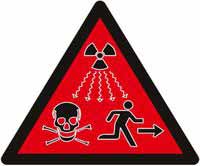
KYODO, 23 Nov 18 The Japan Atomic Energy Agency said Wednesday that some of the low-level radioactive waste stored underground at a facility near Tokyo may leak from its containers due to inadequate disposal procedures.
The government-backed agency keeps 53,000 drums of low-level radioactive waste, or about 10,600 kiloliters, in a concrete pit in the basement of a building of the Nuclear Research and Science Institute in the village of Tokai, Ibaraki Prefecture.
Some of the waste did not undergo the proper water removal process when placed in the pit, and leakage and corroded containers in the pit were found during inspections between 1987 and 1991, according to the agency.
The nuclear research body planned to inspect the drums over the next 50 years to check for leakage. But the Nuclear Regulation Authority said at a meeting Wednesday that the agency needs to check them more quickly……..https://www.japantimes.co.jp/news/2018/11/22/national/low-level-radioactive-waste-stored-tokai-research-facility-near-tokyo-may-leak-agency-says/#.W_hm2IczbGg
Bulgaria’s Belene Nuclear Power Plant project unlikely to ever be built, now needs EU approval
Julian Assange at risk, as changes occur in Ecuadorian Embassy
Will shake-up at London embassy leave Assange out in the cold?, By Claudia Rebaza and Lauren Said-Moorhouse, CNN, November 23, 2018 London The Ecuadorian government has removed its ambassador to the UK, sparking speculation over Julian Assange’s future at the diplomatic mission there.
Czechs consider nuclear power options: would require tax-payer funding
Prague weighs replacement options for nuclear plants, Ft.com, 23 Nov 18
The Czech decision is being watched by neighbours considering investments in reactors “……..
The reactors, which are owned by CEZ, the state-controlled energy group, are due to expire in 2035. Given the long lead time for nuclear projects, government and company officials have spent the past year debating whether — and how — to finance their replacement. With another plant run by CEZ in Temelin, the Dukovany reactors accounted for about two-fifths of Czech energy needs last year, making how to deal with their expiry one of the most important, and potentially one of the most expensive, decisions facing Mr Babis’s government. Analysts estimate that building new reactors would cost at least 100bn Czech koruna (€3.8bn) each — or about a third of CEZ’s market capitalisation.
Given the huge costs of building new reactors, CEZ’s leadership has been reluctant to embark on such a project without state guarantees, while minority shareholders are opposed to the idea of CEZ building new nuclear plants on its own, as they fear it will hit their dividend payments. ……https://www.ft.com/content/26cced6c-c8be-11e8-86e6-19f5b7134d1c
Doubts on future of South Africa’s nuclear research reactors, with glut of medical isotopes, and with particle accelerator production
The facility is the main supplier of medical nuclear radio-isotopes such as Molybdenum-99 in Africa, and one of only four such facilities globally. As a result of safety procedure lapses, the plant was shut down in November 2017, which lasted almost a full year. Several attempts had been made in the interim to restart the plant, but without success.
The process of rectifying shortcomings and bringing the operating and safety procedures in line with the requirements of the NNR has been marred by what appears to be conflict between NTP and its parent company, the Necsa……..
An investigation was held which resulted in the suspension of a number of NTP staff. Following a number of further senior executive and staff replacements, suspensions and reinstatements, Necsa placed its own employees in charge of the plant, who then attempted to rectify the problems and restart the production facility.
………Several incidents occurred which caused restarts to be halted or abandoned. One example that has been cited is the institution of various changes to parameters which were unrelated to the cause of problems. The reasons for Necsa’s actions in this regard are unclear……
following an announcement during the recent Brics Summit in Sandton of a cooperation agreement in the field of nuclear medicine between NTP and Rusatom, the nuclear medical subsidiary of Russian state-owned nuclear company Rosatom, there are some questions as to whether a second or replacement nuclear research reactor will be built.
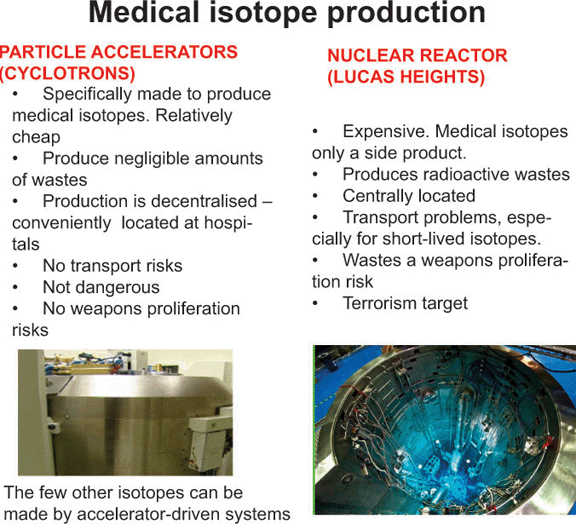
NTP said that the current global production over-capacity of medical radio-isotopes does not justify a second nuclear research reactor, since the Safari-1 reactor at Pelindaba still has between 15 and 20 years of life, and this could be extended still further. The Safari-1 nuclear reactor produces medical nuclear radio-isotopes by bombarding target plates of low-enriched uranium with neutrons.
Furthermore, medical nuclear radio-isotopes can also be produced by particle accelerators such as cyclotrons, which could make the consDtruction of second or replacement nuclear research reactor unnecessary, the company said.
There are also concerns regarding the financial health of Necsa. The Auditor-General has raised ongoing concerns about inadequate financial provisions by Necsa for decommissioning and dismantling costs for the Safari-1 reactor end-of-life.
1 This Month

of the week – Shut Down Drone Warfare!


Tell the Ukrainian Government to Drop Prosecution of Peace Activist Yurii Sheliazhenko

Petition to revoke the licensing of the Near Surface Nuclear Disposal Facility (NSDF) at Chalk River. https://www.ourcommons.ca/petitions/en/Petition/Details?Petition=e-7247
To see nuclear-related stories in greater depth and intensity – go to https://nuclearinformation.wordpress.com
-
Archives
- April 2026 (57)
- March 2026 (251)
- February 2026 (268)
- January 2026 (308)
- December 2025 (358)
- November 2025 (359)
- October 2025 (376)
- September 2025 (257)
- August 2025 (319)
- July 2025 (230)
- June 2025 (348)
- May 2025 (261)
-
Categories
- 1
- 1 NUCLEAR ISSUES
- business and costs
- climate change
- culture and arts
- ENERGY
- environment
- health
- history
- indigenous issues
- Legal
- marketing of nuclear
- media
- opposition to nuclear
- PERSONAL STORIES
- politics
- politics international
- Religion and ethics
- safety
- secrets,lies and civil liberties
- spinbuster
- technology
- Uranium
- wastes
- weapons and war
- Women
- 2 WORLD
- ACTION
- AFRICA
- Atrocities
- AUSTRALIA
- Christina's notes
- Christina's themes
- culture and arts
- Events
- Fuk 2022
- Fuk 2023
- Fukushima 2017
- Fukushima 2018
- fukushima 2019
- Fukushima 2020
- Fukushima 2021
- general
- global warming
- Humour (God we need it)
- Nuclear
- RARE EARTHS
- Reference
- resources – print
- Resources -audiovicual
- Weekly Newsletter
- World
- World Nuclear
- YouTube
-
RSS
Entries RSS
Comments RSS
 nuclear-news