Success of Exxon and the fossil fuel industries in developing climate change denialism
The strategy of muddling the public’s impression of climate science has proved to be highly effective. In 2017, polls found that almost ninety per cent of Americans did not know that there was a scientific consensus on global warming.
What is certain is that the industry’s campaign cost us the efforts of the human generation that might have made the crucial difference in the climate fight
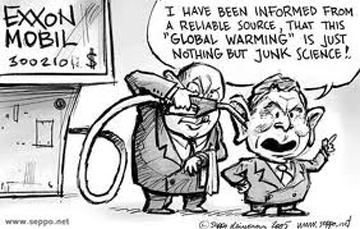 How Extreme Weather Is Shrinking the Planet, New Yorker, by Bill McKibben November 18, 2018 “………The climatologist James Hansen testified before Congress about the dangers of human-caused climate change thirty years ago. Since then, carbon emissions have increased with each year except 2009 (the height of the global recession) and the newest data show that 2018 will set another record. Simple inertia and the human tendency to prioritize short-term gains have played a role, but the fossil-fuel industry’s contribution has been by far the most damaging. Alex Steffen, an environmental writer, coined the term “predatory delay” to describe “the blocking or slowing of needed change, in order to make money off unsustainable, unjust systems in the meantime.” The behavior of the oil companies, which have pulled off perhaps the most consequential deception in mankind’s history, is a prime example.
As journalists at InsideClimate News and the Los Angeles Times have revealed since 2015, Exxon, the world’s largest oil company, understood that its product was contributing to climate change a decade before Hansen testified. In July, 1977, James F. Black, one of Exxon’s senior scientists, addressed many of the company’s top leaders in New York, explaining the earliest research on the greenhouse effect. “There is general scientific agreement that the most likely manner in which mankind is influencing the global climate is through carbon-dioxide release from the burning of fossil fuels,” he said, according to a written version of the speech which was later recorded, and which was obtained by InsideClimate News. In 1978, speaking to the company’s executives, Black estimated that a doubling of the carbon-dioxide concentration in the atmosphere would increase average global temperatures by between two and three degrees Celsius (5.4 degrees Fahrenheit), and as much as ten degrees Celsius (eighteen degrees Fahrenheit) at the poles.
Exxon spent millions of dollars researching the problem. It outfitted an oil tanker, the Esso Atlantic, with CO2 detectors to measure how fast the oceans could absorb excess carbon, and hired mathematicians to build sophisticated climate models. By 1982, they had concluded that even the company’s earlier estimates were probably too low. In a private corporate primer, they wrote that heading off global warming and “potentially catastrophic events” would “require major reductions in fossil fuel combustion.”
An investigation by the L.A. Times revealed that Exxon executives took these warnings seriously. Ken Croasdale, a senior researcher for the company’s Canadian subsidiary, led a team that investigated the positive and negative effects of warming on Exxon’s Arctic operations. In 1991, he found that greenhouse gases were rising due to the burning of fossil fuels. “Nobody disputes this fact,” he said. The following year, he wrote that “global warming can only help lower exploration and development costs” in the Beaufort Sea. Drilling season in the Arctic, he correctly predicted, would increase from two months to as many as five months. At the same time, he said, the rise in the sea level could threaten onshore infrastructure and create bigger waves that would damage offshore drilling structures. Thawing permafrost could make the earth buckle and slide under buildings and pipelines. As a result of these findings, Exxon and other major oil companies began laying plans to move into the Arctic, and started to build their new drilling platforms with higher decks, to compensate for the anticipated rises in sea level.
The implications of the exposés were startling. Not only did Exxon and other companies know that scientists like Hansen were right; they used his nasaclimate models to figure out how low their drilling costs in the Arctic would eventually fall. Had Exxon and its peers passed on what they knew to the public, geological history would look very different today. The problem of climate change would not be solved, but the crisis would, most likely, now be receding. In 1989, an international ban on chlorine-containing man-made chemicals that had been eroding the earth’s ozone layer went into effect. Last month, researchers reported that the ozone layer was on track to fully heal by 2060. But that was a relatively easy fight, because the chemicals in question were not central to the world’s economy, and the manufacturers had readily available substitutes to sell. In the case of global warming, the culprit is fossil fuel, the most lucrative commodity on earth, and so the companies responsible took a different tack.
A document uncovered by the L.A. Times showed that, a month after Hansen’s testimony, in 1988, an unnamed Exxon “public affairs manager” issued an internal memo recommending that the company “emphasize the uncertainty” in the scientific data about climate change. Within a few years, Exxon, Chevron, Shell, Amoco, and others had joined the Global Climate Coalition, “to coordinate business participation in the international policy debate” on global warming. The G.C.C. coördinated with the National Coal Association and the American Petroleum Institute on a campaign, via letters and telephone calls, to prevent a tax on fossil fuels, and produced a video in which the agency insisted that more carbon dioxide would “end world hunger” by promoting plant growth. With such efforts, it ginned up opposition to the Kyoto Protocol, the first global initiative to address climate change.
In October, 1997, two months before the Kyoto meeting, Lee Raymond, Exxon’s president and C.E.O., who had overseen the science department that in the nineteen-eighties produced the findings about climate change, gave a speech in Beijing to the World Petroleum Congress, in which he maintained that the earth was actually cooling. The idea that cutting fossil-fuel emissions could have an effect on the climate, he said, defied common sense. “It is highly unlikely that the temperature in the middle of the next century will be affected whether policies are enacted now, or twenty years from now,” he went on. Exxon’s own scientists had already shown each of these premises to be wrong.
On a December morning in 1997 at the Kyoto Convention Center, after a long night of negotiation, the developed nations reached a tentative accord on climate change. Exhausted delegates lay slumped on couches in the corridor, or on the floor in their suits, but most of them were grinning. Imperfect and limited though the agreement was, it seemed that momentum had gathered behind fighting climate change. But as I watched the delegates cheering and clapping, an American lobbyist, who had been coördinating much of the opposition to the accord, turned to me and said, “I can’t wait to get back to Washington, where we’ve got this under control.”
He was right. On January 29, 2001, nine days after George W. Bush was inaugurated, Lee Raymond visited his old friend Vice-President Dick Cheney, who had just stepped down as the C.E.O. of the oil-drilling giant Halliburton. Cheney helped persuade Bush to abandon his campaign promise to treat carbon dioxide as a pollutant. Within the year, Frank Luntz, a Republican consultant for Bush, had produced an internal memo that made a doctrine of the strategy that the G.C.C. had hit on a decade earlier. “Voters believe that there is no consensus about global warming within the scientific community,” Luntz wrote in the memo, which was obtained by the Environmental Working Group, a Washington-based organization. “Should the public come to believe that the scientific issues are settled, their views about global warming will change accordingly. Therefore, you need to continue to make the lack of scientific certainty a primary issue in the debate.”
The strategy of muddling the public’s impression of climate science has proved to be highly effective. In 2017, polls found that almost ninety per cent of Americans did not know that there was a scientific consensus on global warming. Raymond retired in 2006, after the company posted the biggest corporate profits in history, and his final annual salary was four hundred million dollars. His successor, Rex Tillerson, signed a five-hundred-billion-dollar deal to explore for oil in the rapidly thawing Russian Arctic, and in 2012 was awarded the Russian Order of Friendship. In 2016, Tillerson, at his last shareholder meeting before he briefly joined the Trump Administration as Secretary of State, said, “The world is going to have to continue using fossil fuels, whether they like it or not.”
It’s by no means clear whether Exxon’s deception and obfuscation are illegal. The company has long maintained that it “has tracked the scientific consensus on climate change, and its research on the issue has been published in publicly available peer-reviewed journals.” The First Amendment preserves one’s right to lie, although, in October, New York State Attorney General Barbara D. Underwood filed suit against Exxon for lying to investors, which is a crime. What is certain is that the industry’s campaign cost us the efforts of the human generation that might have made the crucial difference in the climate fight.…..https://www.newyorker.com/magazine/2018/11/26/how-extreme-weather-is-shrinking-the-planet?mbid=nl_Daily%20111718&CNDID=53818310&utm_source=nl&utm_medium=email&utm_campaign=Daily%20111718&utm_content=&utm_brand=tny&utm_mailing=Daily%20111718&hasha=8c9f4

Closure of UK’s Sellafield Thermal Oxide Reprocessing Plant – a commercial failure
15th Nov 2018 On the morning after the Financial Times has called on the UK Government to reassess its long-term energy plans following the demise of Toshiba’sMoorside nuclear project, the Stop Hinkley Campaign has published a briefing about lessons we can learn from the Sellafield Thermal Oxide Reprocessing Plant which is in the process of closing after only 24 years of operation and a very chequered performance.
The “Lessons for Hinkley from Sellafield” briefing says: The cost of building THORP increased from
£300m in 1977 to £1.8bn on completion in 1992. With the additional cost of associated facilities this figure rose to £2.8bn. Originally expected to reprocess 7,000 tonnes of spent fuel in its first ten years, it has managed only around 9,300 in 24 years.
The original rationale for THORP ended with the closure of the UK’s fast reactor programme in 1994. The new rationale – to produce plutonium fuel for ordinary reactors – was a disaster costing the taxpayer £2.2bn.
Stop Hinkley Spokesperson Roy Pumfrey said: “The rationale for building the THORP plant at Sellafield had disappeared before it even opened. The lesson for 2018 is that we should scrap Hinkley C now before costs escalate. The cancellation costs are small relative to the £50billion extra we’ll have to pay for Hinkley’s electricity, if it ever generates any. If we wait any longer to scrap it,
we risk heading for another Sellafield-scale financial disaster.” http://www.stophinkley.org/PressReleases/pr181115.pdf
Millstone Nuclear Power Plant uses the ‘zero carbon’ claim to try to qualify as ‘renewable’
 Connecticut utility regulators say Millstone Nuclear Power Plant ‘at
 risk’ of closing, New Haven Register, By Luther Turmelle A tentative ruling by state utility regulators may boost efforts by the owner of the Millstone Nuclear Power Plant to have the electricity it produces considered in ‘zero carbon’ auction that the state’s Department of Energy and Environmental Protection conducts to procure power.
Commissioners with Connecticut’s Public Utilities Regulatory Authority ruled that the Waterford-based power plant “is at risk of retirement.” Dominion Energy, the Virginia-based company that owns Millstone, has claimed for several years that economic conditions in the nation’s energy markets are making it difficult for the utility to keep operating the plant if it not allowed to compete for lucrative long-term contracts that are awarded to the winners of the zero-carbon auction.
“This interim decision does not reach the issue of whether a purchase power agreement with Millstone should be selected by DEEP or approved,” the tentative ruling says in part. “But (it) addresses solely the basis on which such a bid may be evaluated.”
Dominion officials release a statement Friday following PURA’s ruling say they are pleased with the decision made by regulators.
“They have been given access to our confidential information, have done their own analysis, and reached their own conclusion, Millstone is at risk,” the statement says in part. “We are now focused on the zero carbon procurement at the Department of Energy & Environmental Protection. We made numerous offers that would both ensure Millstone’s continued operations and provide benefits to Connecticut ratepayers ranging from the hundreds of millions of dollars to billions of dollars.”
DEEP officials are expected to announce the winners of the zero carbon auction by the end of the year. PURA’s determination that Millstone is at risk of closing will be a factor that DEEP officials will take into account as they try to determination the winners of the auction from a field of dozens of renewable energy sources that submitted proposals earlier this year……….
Joel Gordes, a West Hartford-based energy industry consultant, said PURA’s commissioners erred in their draft ruling.
“To treat nuclear power as it were a renewable resource is completely inappropriate,” Gordes said. “Real renewable resources don’t produce a deadly byproduct that has to be guarded for an eternity.” https://www.nhregister.com/news/article/Conn-utility-regulators-say-Millstone-at-13401695.php
Turkish environmentalists go to the Supreme Court to stop construction of nuclear power station
|
Anti-nuclear power plant activists turn to Turkey’s highest court , Ahval, Ezgi Karataş
Turkish environmentalists are deeply concerned about the ongoing construction of the country’s first nuclear power plant and plan to bring their case to Turkey’s highest court. In the past year, environmental groups have brought up many legal cases against the plant, which is being built in Akkuyu, near Mersin, on the Mediterranean coast. Scientists have argued that the plant will adversely impact the regional ecology and economy, undermining the livelihoods of people who rely on the marine ecosystem and tourism. Last month, an appeals court upheld a local court’s decision to accept the Turkish government’s environmental impact assessment, even though several news reports said some scientists’ signatures on the report were forged.Following the appeals court’s decision, environmentalists say they plan to petition the Constitutional Court. Sevim Küçük, a lawyer and vocal member of the Mersin Anti-Nuclear Platform, believes Turkish President Recep Tayyip Erdoğan influenced the appeals court’s decision. “The president issued instructions to speed up the work one day before the hearing at the appeals court,” she said. “The judiciary was pressured by the executive. As a result, we were not expecting a just decision.” Küçük says their appeal to the Constitutional Court does not automatically indicate a motion to stay. Plant construction, which began in April 2018 with a ceremony attended by Russian President Vladimir Putin and Turkish President Recep Erdoğan via video conference, is expected to continue during the proceedings. “Lower courts did not issue a motion to stay either, so the construction was continuing during all our legal battles as well,” says Küçük. Küçük says that government assessment is out of line with scientific evidence and based on falsified expert reports. She believes the report was copy-pasted from falsified expert reports, and that the court, in its decision, copy-pasted the same reports as well. A key concern of the environmental group is the storage of nuclear waste, which the assessment does not adequately address. “While Europe, Japan, America are trying to close down their nuclear power plants, why is our government so determined to build one?” asks Küçük. “As locals we are worried that the plant will store its nuclear waste in our neighbourhoods.” Dr. Ful Uğurhan, another member of the anti-nuclear group, says that The location of Akkuyu is not suited to build a nuclear power plant, argues Ful Uğurhan, another member of the anti-nuclear group. Uğurhan says that the seawater temperatures in Akkuyu are high, which not only means spending more energy to cool down the reactors, but the process will further increase the seawater temperatures and upset the ecological balance. An active geological fault line near Akkuyu means additional risk. “Considering the effects of global climate change, it’s not safe to build a nuclear power plant anywhere,” says Uğurhan. “Storms, earthquakes, tsunamis all increase the risk involved in building a nuclear power plant, instead of ecologically safe electricity production plants.” ………https://ahvalnews.com/akkuyu/anti-nuclear-power-plant-activists-turn-turkeys-highest-court |
|
1 This Month

of the week – Shut Down Drone Warfare!


Tell the Ukrainian Government to Drop Prosecution of Peace Activist Yurii Sheliazhenko

Petition to revoke the licensing of the Near Surface Nuclear Disposal Facility (NSDF) at Chalk River. https://www.ourcommons.ca/petitions/en/Petition/Details?Petition=e-7247
To see nuclear-related stories in greater depth and intensity – go to https://nuclearinformation.wordpress.com
-
Archives
- April 2026 (79)
- March 2026 (251)
- February 2026 (268)
- January 2026 (308)
- December 2025 (358)
- November 2025 (359)
- October 2025 (376)
- September 2025 (257)
- August 2025 (319)
- July 2025 (230)
- June 2025 (348)
- May 2025 (261)
-
Categories
- 1
- 1 NUCLEAR ISSUES
- business and costs
- climate change
- culture and arts
- ENERGY
- environment
- health
- history
- indigenous issues
- Legal
- marketing of nuclear
- media
- opposition to nuclear
- PERSONAL STORIES
- politics
- politics international
- Religion and ethics
- safety
- secrets,lies and civil liberties
- spinbuster
- technology
- Uranium
- wastes
- weapons and war
- Women
- 2 WORLD
- ACTION
- AFRICA
- Atrocities
- AUSTRALIA
- Christina's notes
- Christina's themes
- culture and arts
- Events
- Fuk 2022
- Fuk 2023
- Fukushima 2017
- Fukushima 2018
- fukushima 2019
- Fukushima 2020
- Fukushima 2021
- general
- global warming
- Humour (God we need it)
- Nuclear
- RARE EARTHS
- Reference
- resources – print
- Resources -audiovicual
- Weekly Newsletter
- World
- World Nuclear
- YouTube
-
RSS
Entries RSS
Comments RSS
 nuclear-news