nuclear-news

The News That Matters about the Nuclear Industry Fukushima Chernobyl Mayak Three Mile Island Atomic Testing Radiation Isotope

Trump administration heads for the dodgy science of the radiation sceptics

Is a Little Radiation Good For You? Trump Admin Steps Into Shaky Science, Discover Magazine, By Nathaniel Scharping | October 5, 2018 

For decades, studies have shown that even low doses of radiation are harmful to humans.

This week, the Associated Press reported that the Trump administration may be reconsidering that. The Environmental Protection Agency seemed to be looking at raising the levels of radiation considered dangerous to humans based on a controversial theory rejected by mainstream scientists. The theory suggests that a little radiation might actually be good for our bodies. In April, an EPA press release announced the proposal and included supporting comments from a vocal proponent of the hypothesis, known as hormesis. It prompted critical opinion pieces and sparked worry among radiation safety advocates.

EPA’s decision to move away from the radiation dose model widely accepted by the scientific mainstream. But by Friday, the EPA backed away from Calabrese’s stance in comments to Discover.

The debate cuts to the heart of the debate over the effects of low doses of radiation and reveals how difficult it is to craft clear guidelines in an area where scientific evidence is not clear cut.

Radiation Debate

When radiation damages our DNA, the body steps in to make repairs. Hormesis suggests that hitting the body with a little more radiation should kick our defensive mechanisms into overdrive. According to proponents of the theory, this results in the production of anti-oxidants and anti-inflammatory compounds that reduce our risk for cancer and heart disease, among other things. That’s why hormesis backers want the EPA to raise the level of acceptable radiation, pointing out that it would also save millions in safety costs.

It sounds convincing, and proponents have dozens of studies to point to that they say back up their claims. But, there’s never been a large-scale human study of hormesis. And while studies of low-dose radiation are very hard to do, so far, most suggest that radiation is indeed bad for us, at any dose.

“Large, epidemiological studies provide substantial scientific evidence that even low doses of radiation exposure increase cancer risk,” says Diana Miglioretti, a professor in biostatistics at the University of California, Davis in an email. “Risks associated with low-doses of radiation are small; however, if large populations are exposed, the evidence suggests it will lead to measurable numbers of radiation-induced cancers.”

Long-term studies of Hiroshima and Nagasaki bombing survivors show higher cancer risks. Marshall Islanders exposed to radiation from atomic bomb tests suffered a higher risk of thyroid disease. And patients who get CT scans, which deliver a dose of radiation equal to thousands of X-rays, saw cancer risks go up afterward. Researchers also found that radiation from childhood CT scans can triple the risk of leukemia and, at higher doses, triple the risk of brain cancers as well. Another found that low-dose radiation increased the risk of breast cancer among some some women.

And large-scale reviews of the evidence for hormesis find that it is decidedly lacking. Two studies, one in 2006 by the National Research Council, and another in 2018 by the National Council and Radiation Protection and Measurements looking at 29 studies of radiation exposure find no evidence for hormesis, and reiterate that the evidence points toward radiation being bad for us even at low doses.

Scientific Uncertainty

It’s difficult to study low doses of radiation, though, and that’s where much of the controversy comes from. At doses below a few hundred millisieverts (mSv), a radiation unit that accounts for its effects on the body, it becomes extraordinarily hard to separate out the effects of radiation from other things like lifestyle or genetics. Research on the effects of these small radiation doses often use data sets involving thousands of people to compensate for the minimal effect sizes, but even then it’s often not enough to be certain what’s happening.

“Data collected at low doses (defined by the scientific community [as] exposures less than 100 mSv) suffers from a ‘signal to noise’ problem which limits our ability to conclusively state effects one way or another,” says Kathryn Higley, head of the school of nuclear science and engineering at Oregon State University in an email.

A single CT scan delivers anywhere from 1 to 15 mSv, but some patients need many scans during the course of their treatment, increasing the total dose. Workers cleaning up after the Fukushima meltdown received radiation doses above 100 mSv in some cases. And current U.S. standards limit radiation workers to no more than 50 mSv of exposure per year.

Many studies indicate that there are dangers at that level, but it’s often an assumption. Those studies base their suppositions on what’s called the linear no-threshold model, which extrapolates more reliable data from studies of higher doses of radiation to lower doses. Though it may be an educated guess, for decades large-scale studies have indicated this is true.

……….. The EPA in recent days appeared to back away from the suggestion that it supported hormesis. The agency released a statement in response to the APstory affirming that it intends to continue using the linear no-threshold model when constructing radiation guidelines, something that contradicts Calabrese’s comments in the April press release.

“The proposed regulation doesn’t talk about radiation or any particular chemicals. EPA’s policy is to continue to use the linear-no-threshold model for population-level radiation protection purposes which would not – under the proposed regulation that has not been finalized – trigger any change in that policy,” said an EPA spokesman in response to a request for comment.

Radiologist Rebecca Smith-Bindman says the vast bulk of the evidence suggests even small amounts of radiation are harmful. We shouldn’t base our policies on an unproven theory, she adds.

“There is extensive evidence that ionizing radiation will cause cancer,” says Smith-Bindman, a professor of radiology at the University of California, San Francisco in an email exchange. “These data come from a range of different sources, including epidemiological data (such as studies of patients who have received diagnostic and therapeutic radiation and from environmental exposures and accidents), from animal studies and from basic science studies. While it is more difficult to precisely quantify the exposures — which will vary by many factors, such as age at exposure, and source of radiation, etc. — there is no uncertainty among the scientific community that radiation will cause cancer.”

She says that pointing to issues with the linear no-threshold model misses the point. Though it may not be totally accurate at very low doses, she says it’s unfair to use that uncertainty to cast doubt on data about radiation where there’s solid evidence.

…….. Miglioretti says “Based on the large body of evidence to date, I believe that revising the regulations to increase allowable radiation exposure limits will lead to an increase in the number of radiation-induced cancers in this country.”

That’s in line with what multiple experts Discover contacted believe — that radiation can harm even at low doses and raising limits would endanger the public, though the increase in risk would likely be small.

It’s not clear at the moment whether the EPA proposal to raise limits will pass, though it does follow in the footsteps of other Trump administration proposals to weaken safety standards. At the moment, it’s unclear what the effects on the public if the EPA raises radiation limits.

“Perhaps it might make nuclear power plants less expensive to build. It might lower the cost of cleanup of radioactively polluted sites,” says David Brenner, director of the Center for Radiological Research at Columbia University in an email. “But [it] begs the question of whether cleanup to a less rigorous standard is desirable.” http://blogs.discovermagazine.com/crux/2018/10/05/epa-trump-administation-radiation-guidelines/#.W99ZFtIzbGg


November 5, 2018 Posted by | radiation, Reference, spinbuster, USA | Leave a comment

“Climate change, nuclear power, and the adaptation–mitigation dilemma”

“Climate change, nuclear power, and the adaptation–mitigation dilemma”  https://nuclearexhaust.wordpress.com/2018/11/04/climate-change-nuclear-power-and-the-adaptation-mitigation-dilemma/ Natalie Kopytko and JohnPerkins The University of York, Heslington, York YO10 5DD, UK The Evergreen State College, 1806 24th Avenue NW, Olympia, WA 98502, USA, Available online 30 October 2010.

https://www.sciencedirect.com/science/article/pii/S0301421510007329?via%3Dihub

Abstract
Many policy-makers view nuclear power as a mitigation for climate change. Efforts to mitigate and adapt to climate change, however, interact with existing and new nuclear power plants, and these installations must contend with dilemmas between adaptation and mitigation. This paper develops five criteria to assess the adaptation–mitigation dilemma on two major points:

(1) the ability of nuclear power to adapt to climate change and

(2) the potential for nuclear power operation to hinder climate change adaptation.

Sea level rise models for nine coastal sites in the United States, a review of US Nuclear Regulatory Commission documents, and reports from France’s nuclear regulatory agency provided insights into issues that have arisen from sea level rise, shoreline erosion, coastal storms, floods, and heat waves. Applying the criteria to inland and coastal nuclear power plants reveals several weaknesses.

Safety stands out as the primary concern at coastal locations, while inland locations encounter greater problems with interrupted operation. Adapting nuclear power to climate change entails either increased expenses for construction and operation or incurs significant costs to the environment and public health and welfare. Mere absence of greenhouse gas emissions is not sufficient to assess nuclear power as a mitigation for climate change.

Research Highlights
►The adaptation-mitigation criteria reveal nuclear power’s vulnerabilities. ►Climate change adaptation could become too costly at many sites. ►Nuclear power operation jeopardizes climate change adaptation. ►Extreme climate events pose a safety challenge.     end quote of abstract. see original link above.

November 5, 2018 Posted by | 2 WORLD, climate change, Reference | Leave a comment

2020 Olympics as PR for the global nuclear industry? Fukushima to start the events

Abe and IOC chief to visit Fukushima Olympics venue
Disaster-stricken prefecture will host first event of the 2020 games https://asia.nikkei.com/Politics/Abe-and-IOC-chief-to-visit-Fukushima-Olympics-venue

November 05, 2018 TOKYO (Kyodo) — Japanese Prime Minister Shinzo Abe and International Olympic Committee President Thomas Bach plan to visit the venue in Fukushima for the 2020 Tokyo Olympics later this month, a government source said Sunday.With a “reconstruction Olympics” being one of the fundamental themes of the Summer Games, the government hopes the visit planned for Nov. 24 will increase momentum toward the recovery of the country’s northeastern region, devastated by the 2011 earthquake, tsunami and ensuing crisis at the Fukushima Daiichi nuclear power plant.

Bach will visit Japan to attend a two-day general assembly meeting of the Association of National Olympic Committees starting Nov. 28, followed by an IOC Executive Board session, both to be held in Tokyo.

The Olympic torch relay will start in Fukushima Prefecture on March 26, 2020, with the flame scheduled to be lit in the ancient Greek city of Olympia on March 12 the same year, a day after the ninth anniversary of the 2011 disaster.

The city of Fukushima will host six softball games including a match played by the Japan team on July 22 as the first event of the Olympic Games.

November 5, 2018 Posted by | Japan, spinbuster | Leave a comment

Extreme weather and nuclear power plants

 https://nuclearexhaust.wordpress.com/2018/11/04/extreme-weather-and-nuclear-power-plants/

https://www.researchgate.net/publication/289163143_Extreme_weather_and_nuclear_power_plants_EXWE_EXWE_summary_report

see also download at :http://safir2014.vtt.fi/finalseminar/Day_2/TR5_8_4_EXWE_SAFIR2014.pd   fKirsti Jylhä
32.05Finnish Meteorological Institute, Hanna M. Mäkelä, 24.69Finnish Meteorological Institute, Ari Venäläinen
34.18Finnish Meteorological Institute, Milla Johansson, 19.57Finnish Meteorological Institute

“This research comprehensively described the occurrence of extreme weather and climate events and aspects of sea level rise that are relevant from the view point of safety of nuclear power plants.

Studies about the frequency, intensity, and spatial and temporal variation of the extreme weather events and their combinations were carried out utilising instrumental meteorological observations, a 1 200-year long preindustrial control simulation and future climate model simulations.

In addition to the role of natural climate variability, the study clarified the influence of human-induced climate change on extreme weather events and sea level values. The longest future climate and sea level projections extend to the end of the 21st century.

According to them, the daily maximum temperatures and the length of the longest hot spells will clearly increase in Finland. The largest changes, however, are projected for the wintertime minimum temperatures. During summer there will be more intensive precipitation events and during winter more frequent precipitation days. The mean sea level is projected to rise, the change depending on the location along the Finnish coastline. Uncertainty ranges in the mean sea level scenarios are large mainly due to uncertainties in the future behaviour of the continental ice sheets.” end quote. Please see original link above.

November 5, 2018 Posted by | climate change, Finland | Leave a comment

The Twin Threats of Climate Change and Nuclear Annihilation- new documentary with Noam Chomsky

New Documentary by ChomskySpeaks.org with Noam Chomsky Challenges Establishment over Twin Threats of Climate Change and Nuclear Annihilation https://www.prnewswire.com/news-releases/new-documentary-by-chomskyspeaksorg-with-noam-chomsky-challenges-establishment-over-twin-threats-of-climate-change-and-nuclear-annihilation-300743226.html

Renowned public intellectual calls out Democrats and Republicans for escalating nuclear dangers and decries Republican Party “dedicated to the destruction of life”  NEWS PROVIDED BY
ChomskySpeaks.org 

Nov 02, 2018 BOSTONNov. 2, 2018 /PRNewswire/ — Executive Producer Randall Wallace and Director Patrick Jerome launch the online documentary, “Noam Chomsky: Internationalism or Extinction” on the website: http://ChomskySpeaks.org. Based on a lecture by the public intellectual who is often described as the “most quoted living intellectual,” the documentary brings both the activist energy and desperate concerns of climate change and nuclear escalation that are causing mass extinctions.

Against these dire realities, Noam Chomsky surveys “the internationalism” of inter-state cooperation and social movements as solutions. He notes the complicity of both Democratic and Republican parties in escalating nuclear tensions and nuclear proliferation.  At the same time, he condemns the Republican Party for profit-driven policies leading to climate-altering, carbon pollution. The documentary is a compelling and urgent warning explaining such ideas and tools as “the Anthropocene,” “the Doomsday Clock,” “species extinction,” “internationalism,” “denialism,” “non-proliferation,” “NATO expansion,” “climate accords,” and “climate debt” among many others.

Many non-partisan organizations collaborated in organizing the original lecture upon which the documentary is based; several also supported the production of the documentary as a starting point for further analysis. These included peace movement organizations in collaboration with the Boston-based movement-building center, encuentro5 (http://encuentro5.org) and the democracy movement’s Liberty Tree Foundation for the Democratic Revolution (http://LibertyTreeFoundation.org). The video adds to their efforts at expanding the public conversation about vital issues of the day. A grant from the Wallace Action Fund supported the documentary.

Chomsky concludes his lecture with sober reflection on the urgent challenges facing humanity: “The tasks ahead are daunting and they cannot be deferred.” Media Contact:

Suren Moodliar 
617-968-0880 
204337@email4pr.com   SOURCE ChomskySpeaks.org, Related Links   http://chomskyspeaks.org

November 5, 2018 Posted by | climate change, politics, Resources -audiovicual, USA, weapons and war | Leave a comment

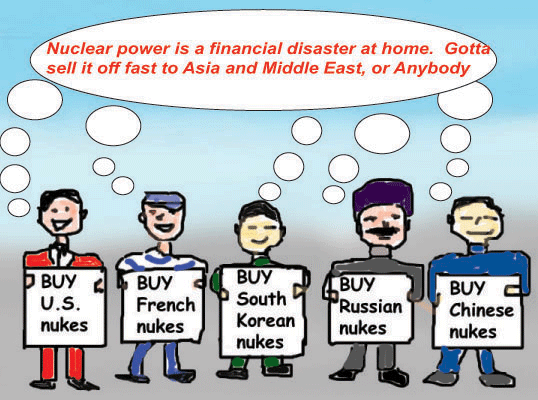
South Korean firm KEPCO keen to get $20 billion by selling nuclear reactors to Saudi Arabia

Kepco is still working to land Saudi nuclear power deal,  Korea JoongAng Daily   BY LEE HO-JEONG [lee.hojeong@joongang.co.kr], 2 Nov 18, GWANGJU – The CEO of Korea Electric Power Corporation (Kepco) said it still hopes to be picked for a $20 billion nuclear power plant project in Saudi Arabia that is expected to be decided by the end of next year. …….

“We are trying to show that we are working to become Saudi’s long-term partner,” Kim said

In July Korea was put on the shortlist for the Saudi nuclear project along with the U.S., China, Japan and Russia.

The Saudi government is planning to build two nuclear power plants with a 2.8 gigawatt capacity by 2030. The country has plans to build a total of 16 nuclear power plants in the next 20 to 25 years. …….

Kim said earnings from overseas could make it easier for Kepco not to raise domestic electricity bills. ……..http://koreajoongangdaily.joins.com/news/article/article.aspx?aid=3055054

November 5, 2018 Posted by | marketing, Saudi Arabia, South Korea | Leave a comment

U.S. Supreme Court upholds right of 21 young people to sue federal government about climate change inaction

Independent 4th Nov 2018 , The Supreme Court has refused to halt a novel lawsuit filed by young
Americans that attempts to force the federal government to take action on
climate change, turning down a request from the Trump administration to
stop it before trial.

The suit, filed in 2015 by 21 young people who argue
that the failure of government leaders to combat climate change violates
their constitutional right to a clean environment, is before a federal
judge in Oregon. It had been delayed while the Supreme Court considered the
emergency request from the government.
https://www.independent.co.uk/news/world/americas/climate-change-lawsuit-trump-us-young-people-children-supreme-court-allows-julia-olsen-a8616136.html

November 5, 2018 Posted by | climate change, legal, USA | Leave a comment

NuGen nuclear power project in Moorside, Cumbria, UK, soon to bite the dust?

Sunday Times 4th Nov 2018 Plans to build a nuclear power station to provide up to 7% of the
country’s electricity could be ditched within days after talks with a
potential buyer stalled.

The planned NuGen plant in Moorside, Cumbria, has
been in trouble since financial problems emerged in 2016 at the owner,
Toshiba, and its nuclear subsidiary Westinghouse Electric filed for
bankruptcy protection.

Toshiba has been trying to sell the project.
However, talks with South Korea’s state-owned Korean Electric Power
Corporation (Kepco) have yet to lead to a deal, and Kepco was stripped of
preferred bidder status in August.

It is thought that Toshiba’s board is
set to meet in Tokyo on Thursday, when directors will decide whether to
continue trying to find a buyer or to wind up the project, which is
believed to have been costing millions of pounds a month.

Winding up NuGen— seen as the likely outcome — would deal a big blow to the
government’s energy strategy. NuGen had been due to start powering about
6m homes from 2025. The private equity firm Brookfield, which bought
Westinghouse, was also in talks with Toshiba over the deal but it is
believed these have collapsed. China’s CGN has also been interested.
https://www.thetimes.co.uk/edition/business/crunch-talks-to-rule-on-cumbria-nuclear-plant-gvtg2ztrh

November 5, 2018 Posted by | business and costs, UK | Leave a comment

UK’s Ministry of Defence (MoD) reprimanded for nuclear safety breaches

The Ferret 4th Nov 2018 , The Ministry of Defence (MoD) has been formally reprimanded by its internal
safety regulator for five nuclear safety breaches, according to documents
seen by The Ferret.

The Defence Nuclear Safety Regulator (DNSR) served MoD
nuclear agencies with one safety improvement notice in 2017, two in 2016
and two in 2010. The notices alleged a series of serious safety failings
with submarines stationed on the Clyde and at Trident bomb bases.

The DNSR accused the MoD of “a failure of safety culture”, “inadequate
resourcing” and “continued non-compliance”. In 2010 DNSR expressed
concern that “that future nuclear reactor programme safety may be
compromised.”

Green MSP and environment spokesperson, Mark Ruskell said
“It is time for Trident to be decommissioned, and the money, resources
and skills connected to Faslane redeployed towards sustainable progressive
infrastructure projects.”
https://theferret.scot/ministry-defence-nuclear-breaches/

November 5, 2018 Posted by | general | Leave a comment

UK could be running solely on zero carbon renewable in summer months 2050.

Business Green 2nd Nov 2018 The UK power market will be able to withstand huge volumes of new renewable
generation coming on line according to new research, which suggests the
country could be running solely on zero carbon power during the summer
months by 2050.
The paper, released today by Aurora Energy Research,
explores what happens to the UK power market as it transitions to a high
level of renewable power. Aurora modelled a 2050 scenario where power
demand has risen by two-thirds from today, thanks to the rise of EVs, and
the grid now boasts 130GW of nuclear, wind and solar generation capacity.
Low power demand and a seasonal spike in renewables generation could
effectively lead to zero-carbon summers for the UK electricity grid under
this scenario, according to Aurora. But such large volumes of renewable
power would also “fundamentally alter” the workings of the power market,
with price crashes in the summer months as green power generation soars.
https://www.businessgreen.com/bg/news/3065602/aurora-er-uk-could-enjoy-zero-carbon-summer-power-by-2050

November 5, 2018 Posted by | renewable, UK | Leave a comment

Fukushima’s fishing industry threatened by plans to dump radioactive water

Radioactive water threatens Fukushima fishery’s fragile gains, Plant operator plans to dump contaminated water into the ocean, Nikkei Asian Review, TAKUMI SASAKI, Nikkei staff writer  November 04, 2018, TOKYO — Since a catastrophic nuclear accident seven years ago, Fukushima fishermen have made painstaking efforts to rebuild their livelihood, assiduously testing the radioactivity levels of their catches to ensure safety. Now, rapidly accumulating wastewater from the crippled power plant is again threatening this hard-won business recovery.

Faced with the prospect that there will be no more space to store tanks containing radioactive water leaking from the Fukushima Daiichi nuclear power plant, operator Tokyo Electric Power Co. Holdings and the Japanese government are considering diluting the water and dumping it into the ocean.

Even though Fukushima’s fishery has been recovering, the haul throughout the entire prefecture amounted to about 3,300 tons last year, just 10% of the average prior to the 2011 disaster. And even reaching there has not been easy.

Fish markets in the prefecture now house testing rooms filled with equipment. Staff members mince seafood caught every morning to screen for radioactivity. Such painstaking efforts gradually enabled fishermen to return to the sea, with all fishing and farming operations resuming in February this year.

But the trend could reverse if the government goes through with plans to release nuclear wastewater into the sea.

Tepco has been cooling down the molten fuel cores by pumping water into the ruined reactors. The tainted water is later taken out and treated, but the system in place does not filter out tritium, a radioactive hydrogen isotope.

The tritium-laced water is currently stored in tanks within the premises of Fukushima Daiichi, but space is due to run out within five years……..https://asia.nikkei.com/Economy/Radioactive-water-threatens-Fukushima-fishery-s-fragile-gains


November 5, 2018 Posted by | Japan | Leave a comment