Hearing on failed VC Summer Nuclear Project begins in South Carolina
 https://www.wjbf.com/news/csra-news/hearing-on-failed-vc-summer-nuclear-project-begins-in-south-carolina/1567635123, By: Shawn Cabbagestalk Nov 01, 2018 SOUTH CAROLINA (WJBF) – A stroke of a pen signed it into law back in 2007. It’s blamed for higher rates you’ve paid on projects not yet completed.
One veteran’s story of radiation effects of participating in nuclear bomb testing
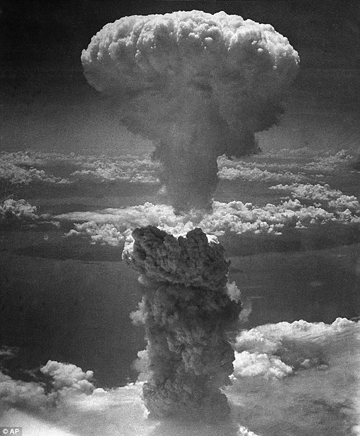 Wigan veteran reveals radiation exposure horror, https://www.wigantoday.net/news/wigan-veteran-reveals-radiation-exposure-horror-1-9425139 ANDREW NOWELL 02 November 2018
“I’ve nothing against the forces. I would have stayed in but I couldn’t because I was medically unfit. “I enjoyed every minute I was in the military. The only bad thing was Christmas Island.”
Electromagnetic radiation from cell-phones is a cancer causer to rats
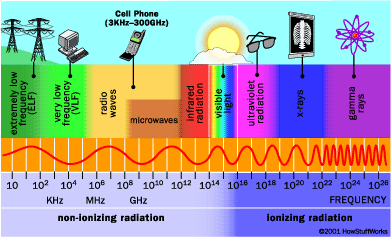
‘Clear evidence’ of mobile phone radiation link to cancers in rats, US health agency concludes
Uncertainty remains about risk to humans who experience much lower radio wave doses, Independent, Alex Matthews-King, Health Correspondent 2 Nov 18, A long-running US study on the effects of radio wave radiation, the sort emitted by mobile phones, has found “clear evidence” of high levels of exposure and heart cancers in male rats.
Some evidence of links to brain and adrenal gland tumours was also found in male rats, but in female rodents and male mice signs of cancer weren’t clear, the National Toxicology Programme (NTP) concluded in its final report on Thursday.
The programme is run by the US Department of Health and Human Services and was tasked with reviewing the toxicity of mobile phone radiation in response to the devices’ near ubiquity in modern life.
Radiation exposure in the trial was well above the levels most humans would experience, but researchers said the findings show the link between radio frequencies and tumours – at least for rats – “is real”.
“In our studies, rats and mice received radio frequency radiation across their whole bodies. By contrast, people are mostly exposed in specific local tissues close to where they hold the phone.
“In addition, the exposure levels and durations in our studies were greater than what people experience.”………..
Proposal to drill near a former nuclear weapons plant at Rocky Flats
Oil-gas wells proposed near Rocky Flats ex-nuclear weapons site, https://www.thedenverchannel.com/news/politics/oil-gas-wells-proposed-near-rocky-flats-ex-nuclear-weapons-site, Associated Press, Nov 1, 2018 DENVER (AP) — An oil and gas company is asking for state permits to drill near a former nuclear weapons plant in Colorado, but it’s unclear whether any of the wells would extend under the site.
Spiralling costs of Britain’s Sellafield nuclear site
costs and project delays that have plagued the Sellafield nuclear site,
located on the far side of the Irish Sea on the Cumbrian coast,
approximately 170 km (112 miles) from the northeast coast of Ireland, just
128 miles from Dublin. The UK’s Public Accounts Committee (PAC) said in a
report that some decommissioning projects had already been delayed by more
than a decade. It said estimated budget overruns had climbed to nearly
£1bn.
https://afloat.ie/port-news/dun-laoghaire-news/item/40975-sellafield-british-government-warned-to-get-a-grip-on-irish-sea-site
French hypocrisy in decision to cancel decree of closure of Fessenheim NPP
Council of State, Thursday, October 25, to cancel the decree of closure of
the nuclear power plant Fessenheim reveals, according to the speaker of
this forum, the hypocrisy of an energy system on which the political power
has no hold.
https://reporterre.net/Fessenheim-est-le-symbole-de-l-hypocrisie-energetique-francaise
€45 billion renewables investment opportunity in France, with its new energy policy
Radioactive waste disposal in four words: “We do not know”.
Energy Transition 30th Oct 2018 Nuclear
waste will remain dangerous for more than 100,000 years – so what are
countries and producers doing to deal with this problem? Passing the buck,
apparently: so far, not a single facility to safely store spent nuclear
fuel has been created in Europe, or the world for that matter.
https://energytransition.org/2018/10/radioactive-waste-disposal-in-four-words-we-do-not-know/
1 This Month

of the week – Shut Down Drone Warfare!


Tell the Ukrainian Government to Drop Prosecution of Peace Activist Yurii Sheliazhenko

Petition to revoke the licensing of the Near Surface Nuclear Disposal Facility (NSDF) at Chalk River. https://www.ourcommons.ca/petitions/en/Petition/Details?Petition=e-7247
To see nuclear-related stories in greater depth and intensity – go to https://nuclearinformation.wordpress.com
-
Archives
- March 2026 (251)
- February 2026 (268)
- January 2026 (308)
- December 2025 (358)
- November 2025 (359)
- October 2025 (376)
- September 2025 (257)
- August 2025 (319)
- July 2025 (230)
- June 2025 (348)
- May 2025 (261)
- April 2025 (305)
-
Categories
- 1
- 1 NUCLEAR ISSUES
- business and costs
- climate change
- culture and arts
- ENERGY
- environment
- health
- history
- indigenous issues
- Legal
- marketing of nuclear
- media
- opposition to nuclear
- PERSONAL STORIES
- politics
- politics international
- Religion and ethics
- safety
- secrets,lies and civil liberties
- spinbuster
- technology
- Uranium
- wastes
- weapons and war
- Women
- 2 WORLD
- ACTION
- AFRICA
- Atrocities
- AUSTRALIA
- Christina's notes
- Christina's themes
- culture and arts
- Events
- Fuk 2022
- Fuk 2023
- Fukushima 2017
- Fukushima 2018
- fukushima 2019
- Fukushima 2020
- Fukushima 2021
- general
- global warming
- Humour (God we need it)
- Nuclear
- RARE EARTHS
- Reference
- resources – print
- Resources -audiovicual
- Weekly Newsletter
- World
- World Nuclear
- YouTube
-
RSS
Entries RSS
Comments RSS
 nuclear-news