60,000 tons of dangerous radioactive waste sits on Great Lakes shores Keith Matheny, Detroit Free Press Oct. 19, 2018 “……… Fukushima and ‘The Devil’s Scenario’
On March 11, 2011, following a magnitude-9.0 earthquake and an ensuing, 50-foot tsunami, the Fukushima Daiichi nuclear power plant in Japan lost cooling capabilities for four of its six reactors. The cores became damaged and radiation was released into the atmosphere, making it the world’s second-worst nuclear power industry accident after Chernobyl.
But it’s what happened — or almost happened — at the plant’s Unit 4 spent-fuel pool that gives nuclear watchdogs nightmares.
A hydrogen explosion four days into the disaster left the building housing the Unit 4 spent-fuel pool in ruins. The pool was seven stories up in a crumbling, inaccessible building.
It “was so radioactive, you couldn’t put people up there,” von Hippel said. “For about a month after Fukushima, people didn’t know how much water was in the pool. They were shooting water up there haphazardly with a hose, trying to drop it by helicopter.”
Two weeks after the earthquake and tsunami, the Japanese Atomic Energy Commission secretly conducted a worst-case scenario study of the ongoing disaster. The biggest fear that emerged: that a self-sustaining fire would start in the Unit 4 spent fuel pool, spreading to the nearby, damaged reactors. That, they found, would release radiation requiring evacuations as far away as 150 miles, to the outskirts of Tokyo and its more than 13.4 million residents.
“That was the devil’s scenario that was on my mind,” Chief Cabinet Secretary Yukio Edano said during a special commission’s 2014 investigation of the accident.
“Common sense dictated that, if that came to pass, then it was the end of Tokyo.”
The worst-case-scenario report was not released for nearly a year. “The content was so shocking that we decided to treat it as if it didn’t exist,” the Japan Times quoted a senior Japanese government official as saying in January 2012.
What kept the spent fuel rods covered with water in Unit 4 was a miraculous twist of fate: The explosion had jarred open a gate that typically separated the Unit 4 spent fuel pool from an adjacent reactor pool.
 “Leakage through the gate seals was essential for keeping the fuel in the Unit 4 pool covered with water,” a 2016 report on the Fukushima accident by the U.S. National Academies of Sciences, Engineering and Medicine concluded.
“Had there been no water in the reactor well, there could well have been severe damage to the stored fuel and substantial releases of radioactive material to the environment.”
It’s a startling “very near-miss,” said Gordon Thompson, executive director of the Institute for Resource and Security Studies in Cambridge, Massachusetts.
“Given wind directions that are common in Japan, they could have been looking at removing the population of Tokyo for decades, or centuries,” he said. “You’re talking tens of millions of people that would have to relocate. That’s the bullet that Japan dodged.”……..https://www.freep.com/story/news/local/michigan/2018/10/19/nuclear-waste-great-lakes/1417767002/
October 20, 2018
Posted by Christina Macpherson |
incidents, Japan |
3 Comments
 60,000 tons of dangerous radioactive waste sits on Great Lakes shores, THE EFFECTS OF A WORST-CASE SCENARIO — FROM A NATURAL DISASTER TO TERRORISM — COULD CAUSE UNTHINKABLE CONSEQUENCES FOR THE GREAT LAKES REGION, Keith Matheny, Detroit Free Press, Oct. 19, 2018 More than 60,000 tons of highly radioactive spent nuclear fuel is stored on the shores of four of the five Great Lakes — in some cases, mere yards from the waterline — in still-growing stockpiles.
“It’s actually the most dangerous waste produced by any industry in the history of the Earth,” said Gordon Edwards, president of the nonprofit Canadian Coalition for Nuclear Responsibility.
The spent nuclear fuel is partly from 15 current or former U.S. nuclear power plants, including four in Michigan, that have generated it over the past 50 years or more. But most of the volume stored along the Great Lakes, more than 50,000 tons, comes from Canadian nuclear facilities, where nuclear power is far more prevalent.
It remains on the shorelines because there’s still nowhere else to put it. The U.S. government broke a promise to provide the nuclear power industry with a central, underground repository for the material by 1998. Canada, while farther along than the U.S. in the process of trying to find a place for the waste, also doesn’t have one yet.
The nuclear power industry and its federal regulator, the U.S. Nuclear Regulatory Commission, point to spent nuclear fuel’s safe on-site storage over decades. But the remote possibility of a worst-case scenario release — from a natural disaster, a major accident, or an act of terrorism — could cause unthinkable consequences for the Great Lakes region.
Scientific research has shown a radioactive cloud from a spent fuel pool fire would span hundreds of miles, and force the evacuation of millions of residents in Detroit, Chicago, Cleveland, Toronto or other population centers, depending on where the accident occurred and wind patterns.
It would release multiple times the radiation that emanated from the Fukushima disaster in Japan in 2011 — a disaster that led to mass evacuations, no-go zones that exist to this day, and a government ban on fishing in a large, offshore area of the Pacific Ocean because of high levels of radioactive cesium in the water and in fish. The fishing industry there has yet to recover, more than seven years later.
“The Mississippi and the Great Lakes — that would be really bad,” said Frank von Hippel, senior research physicist and professor of public and international affairs emeritus at Princeton University.
Added Jim Olson, environmental attorney and founder of the Traverse City-based nonprofit For Love of Water, or FLOW: “The fact that it’s on the shorelines of the Great Lakes takes that high consequence that would be anywhere and paints it red and puts exclamation marks around it.”
Spent nuclear fuel is so dangerous that, a decade removed from a nuclear reactor, its radioactivity would still be 20 times the level that would kill a person exposed to it. Some radioactive byproducts of nuclear power generation remain a health or environmental hazard for tens of thousands of years. And even typically harmless radioactive isotopes that are easily blocked by skin or clothing can become extremely toxic if even small amounts are breathed in, eaten or drank, making their potential contamination of the Great Lakes — the drinking water supply to 40 million people — the connected Mississippi River and the prime agricultural areas of the U.S. a potentially frightening prospect. ……….
For five years, Michigan residents, lawmakers, environmental groups and others around the Midwest have, loudly and nearly unanimously, opposed a planned Canadian underground repository for low-to-medium radioactive waste at Kincardine, Ontario, near the shores of Lake Huron.
Meanwhile, spent nuclear fuel, vastly more radioactive, sits not far from the shores of four Great Lakes — Michigan, Huron, Erie and Ontario — at 15 currently operating or former nuclear power plant sites on the U.S. side. In Michigan, that includes Fermi 2; the Donald C. Cook nuclear plant in Berrien County; the Palisades nuclear plant in Van Buren County, and the former Big Rock Point nuclear plant in Charlevoix County, which ceased operation in 1997 and where now only casks of spent nuclear fuel remain.
Neither the U.S. nor the Canadian government has constructed a central collection site for the spent nuclear fuel. It’s not just a problem in the Great Lakes region — more than 88,000 tons of spent nuclear fuel, an amount that is rising, is stored at 121 U.S. locations across 39 states…….
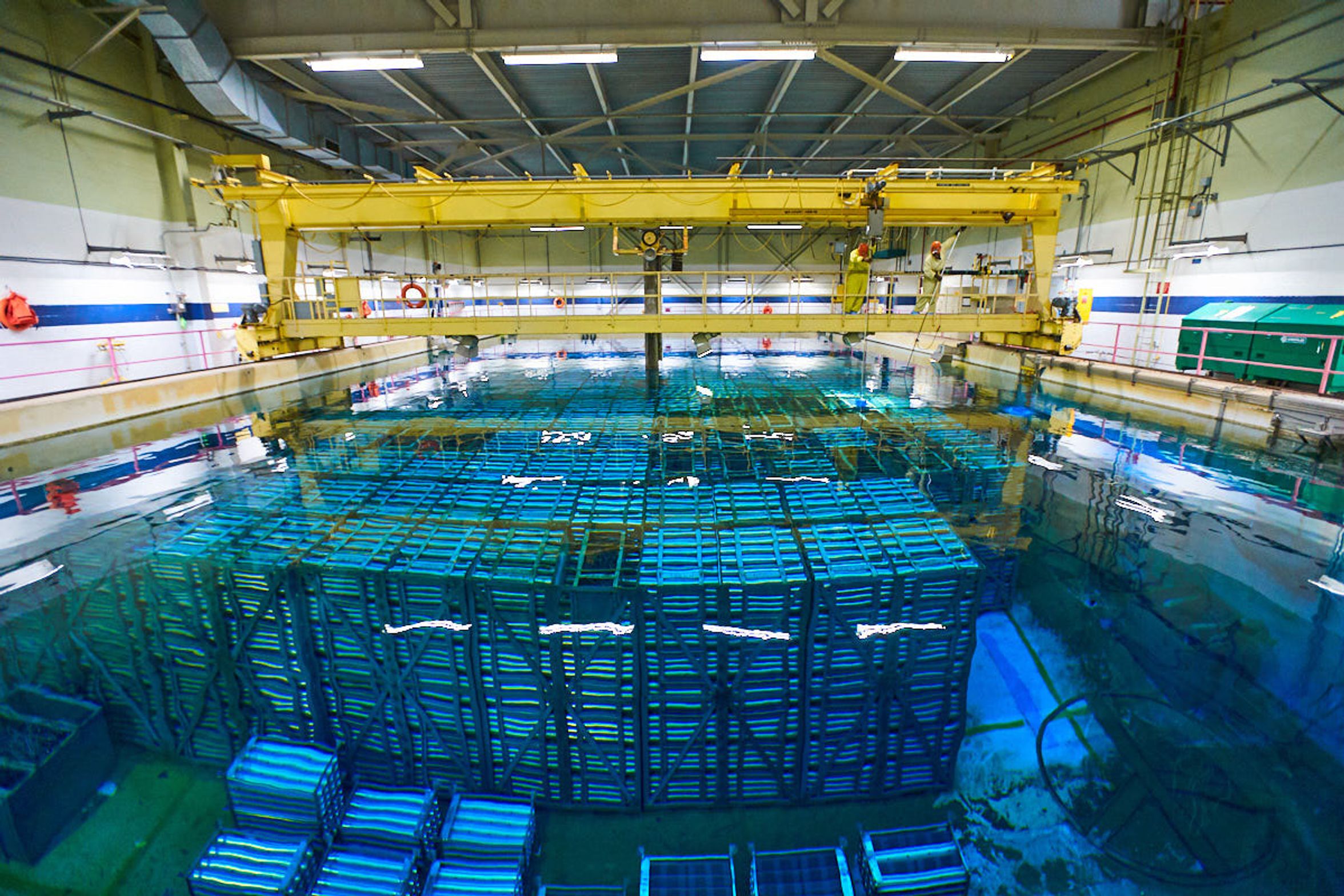
Spent nuclear fuel isn’t only radioactive, it continues to generate heat. It requires storage in pools with circulating water for typically five years before it can be moved into so-called dry-cask storage — concrete-and-steel obelisks where spent fuel rods receive continued cooling by circulating air.
In practice, however, because of the high costs associated with transferring waste from wet pools to dry casks, nuclear plants have kept decades worth of spent fuel in wet storage. Plant officials instead “re-rack” the pools, reconfiguring them to add more and more spent fuel, well beyond the capacities for which the pools were originally designed.
“The prevailing practice in the United States is you re-rack the pools until they are just about as dense-packed as the nuclear core,” von Hippel said.
Only in recent years have nuclear plants stepped up the transition to dry cask storage because there’s no room left in the wet pools. Still, about two-thirds of on-site spent nuclear fuel remains in wet pools in the U.S.
That’s a safety concern, critics contend. A catastrophe or act of terrorism that drains a spent fuel pool could cause rising temperatures that could eventually cause zirconium cladding — special brackets that hold the spent fuel rods in bundles — to catch fire.
Such a disaster could be worse than a meltdown in a nuclear reactor, as spent nuclear fuel is typically stored with nowhere near the fortified containment of a reactor core.
“The long-term land-contamination consequences of such an event could be significantly worse than those from Chernobyl,” a 2003 research paper by von Hippel and seven other nuclear experts stated.
The reference is to the worst nuclear power disaster in world history, the April 1986 reactor explosion at the Chernobyl Nuclear Power Plant in the former Soviet Union, now a part of the Ukraine, where 4,000 to 90,000 are estimated to have died as a result of the radiation released. A study by the University of Exeter in Great Britain, released this June, found that cow’s milk from farms about 125 miles from the Chernobyl accident site still — more than 30 years later —- contains the radioactive element cesium at levels considered unsafe for adults and at more than seven times the limit unsafe for children.
Allison Macfarlane, a professor of public policy and international affairs at George Washington University, served as chairman of the NRC during the Obama administration from July 2012 until December 2014.
“What I think needs more examination is the practice of densely packing the fuel in the pool,” she said.
The NRC does not regulate how much fuel can be in a pool, in what configuration it’s placed, and how old the fuel is, Macfarlane said. ……….
In a Great Lakes region where magnitude-9.0 earthquakes and tsunamis aren’t a potential threat to stockpiles of spent nuclear fuel, terrorism remains possible………
In a Great Lakes region where magnitude-9.0 earthquakes and tsunamis aren’t a potential threat to stockpiles of spent nuclear fuel, terrorism remains possible.
“The NRC’s position on beyond design basis threats is essentially that this is a matter for the national security apparatus — it’s not our job, so somebody else will take care of it,” he said. “But if you look at the Pentagon, Homeland Security, I think you will look in vain to find any part of that apparatus that is addressing that area that the NRC says is not its job.”……….
Welcome to Zion, nuclear waste dump ………..
Canada’s Yucca Mountain
Because nuclear power is much more widely used in Canada — the province of Ontario alone has 20 nuclear reactors at three plants — it also generates much more nuclear waste.
In Ontario, nearly 52,000 tons of spent nuclear fuel is stored on-site at nuclear plants along Lakes Huron and Ontario.
“There’s a huge amount of high-level, radioactive waste stored right along the water,” said Edwards, the president of the nonprofit Canadian Coalition for Nuclear Responsibility……… . https://www.freep.com/story/news/local/michigan/2018/10/19/nuclear-waste-great-lakes/1417767002/
October 20, 2018
Posted by Christina Macpherson |
Canada, wastes |
1 Comment
As we might have expected, the de facto abandon of the Intermediate-Range Nuclear Forces Treaty (INF Treaty) – concluded between Washington and Moscow at the end of the Cold War – has now rebooted the competition. Except that this time, it’s even more complicated, since the United States violated the Treaty first, while they were already violating the Non-Proliferation Treaty (NPT). Meanwhile, Russia has discreetly forged ahead with its technological progress while pretending to allow the problem to drag on.
VOLTAIRE NETWORK | ROME (ITALY) | 19 OCTOBER 2018 he B61-12, the new US nuclear bomb which replaces the B-61 deployed in Italy and other European countries, will begin production in less than a year. The announcement was made officially by the National Nuclear Security Administration (NNSA). It reveals that the revision of the final project has now been completed with success, and the qualification stage will begin this month at the Pantex Plant in Texas. Production will be authorised to begin in September 2019.
In March 2020, the first unit of production will begin fabricating a series of 500 bombs. As from that time, in other words in about a year and a half, the United States will begin the anti-Russian deployment in Italy, Germany, Belgium, Holland and probably certain other European countries, of the first nuclear bomb in their arsenal with a precision guidance system. The B61-12 is designed with penetrating capacity, built to explode underground in order to destroy bunkers housing command centres.
Since Italy and the other countries, in violation of the Non-Proliferation Treaty, are offering the USA the bases, the pilots and the aircraft for the deployment of the B61-12, Europe will soon be exposed to a greater risk as the front line of the developing nuclear confrontation with Russia.
An even more dangerous situation appears at the same moment – the return of the Euromissiles, meaning the nuclear missiles which are similar to those deployed in Europe in the 1980’s by the USA, with the official aim of defending against Soviet missiles. This category of ground-based nuclear missiles of intermediate range (between 500 and 5,500 km) were eliminated with the INF Treaty of 1987. But in 2014, the Obama administration accused Russia of having experimented with a cruise missile (# 9M729) whose category was forbidden by the Treaty. Moscow denied that the missile violated the INF Treaty and, in turn, accused Washington of having installed in Poland and Romania launch ramps for interceptor missiles (elements of the « shield »), which could be used to launch cruise missiles bearing nuclear warheads.
The accusation aimed by Washington at Moscow, which is not supported by any evidence, enabled the USA to launch a plan aimed at once again deploying in Europe ground-based intermediate-range nuclear missiles. The Obama administration had already announced in 2015 that « faced with the violation of the INF Treaty by Russia, the United States are considering the deployment of ground-based missiles in Europe ». This plan was confirmed by the Trump administration – in fiscal year 2018, Congress authorised the financing of a « programme of research and development for a cruise missile which could be launched from a mobile road base ».
The plan is supported by the European allies of NATO. The recent North-Atlantic Council, at the level of Europe’s Defence Ministers, which was attended for Italy by Elisabetta Trenta (M5S), declared that the « INF Treaty is in danger because of the actions of Russia », which it accused of deploying « a disturbing missile system which constitutes a serious risk for our security ». Hence the necessity that « NATO must maintain nuclear forces which are stable, trust-worthy and efficient » (which explains why the members of the Alliance rejected en bloc the United Nations Treaty for the prohibition of nuclear weapons).
So the grounds are being laid for a European deployment, on the borders of Russian territory, of ground-based intermediate-range US nuclear missiles. It’s as if Russia were deploying in Mexico nuclear missiles pointed at the United States. Manlio Dinucci
Translation
Pete Kimberley
Source
Il Manifesto (Italy)
October 20, 2018
Posted by Christina Macpherson |
EUROPE, USA, weapons and war |
Leave a comment
Wales Online 19th Oct 2018 David Lowry: The article by Westminster Energy Minister Claire Perry
to mark Green GB week is hypocritical, especially as in the same week
fracking was allowed to restart in Lancashire. She talks about windfarms
and solar farms in Anglesey, but makes no mention of the massively
expensive (£20 billion-plus) new nuclear plant on Ynys Mon at Wylfa
Newydd, which the Westminster government’s new financing plans mean
electricity bill-payers in Wales will have to subsidise in advance.
Also, in south Wales, people living near the coastline from Newport to Swansea
have had their health put in danger by the dumping of radioactively
contaminated mud from just off the Hinkley Point nuclear plant in Somerset.
The mud has been dredged to make channels for barges bringing equipment and
building materials to build the new £25bn reactor at Hinkley C. I find it
extraordinary that such a dangerous policy has been permitted by the Welsh
Labour Government, to assist the economically illiterate nuclear policies
of the Conservative Westminster government, whose policies are almost
entirely economically hostile to Wales. As a Welsh person from Neath
watching from afar, these absurd energy decisions are incomprehensible.
https://www.walesonline.co.uk/news/local-news/western-mail-letters-friday-october-15300307
October 20, 2018
Posted by Christina Macpherson |
politics, UK |
Leave a comment

 New Civil Engineer 19th Oct 2018 , Auditors question government handling of Hinkley Point C. Public spending
watchdog the National Audit Office (NAO) has questioned the government’s
decision to remove the Hinkley Point C nuclear power station from its Major
Projects Portfolio.
https://www.newcivilengineer.com/latest/auditors-question-government-handling-of-hinkley-point-c/10036371.article
NAO 19th Oct 2018 , Monitoring of the UK’s biggest and riskiest projects has improved, but
the Infrastructure and Projects Authority (the Authority) and government
departments need to do more to increase transparency about what benefits
are delivered to ensure taxpayers secure maximum value, according to
today’s report by the National Audit Office (NAO).
In 2016 the Authority introduced a process for deciding when projects should leave the Portfolio,
addressing concerns raised by the NAO and the Committee of Public Accounts
in 20163. Although it has increased transparency about whether projects
have delivered their objectives, this is not happening consistently,
meaning the government can’t be sure projects are leaving when they
should.
The NAO has raised concerns about whether accountability is diluted
at the point at which projects leave the Portfolio. For example, some
projects delivered by a third party and which have a limited departmental
role have been removed from the Portfolio before they have completed, such
as the project to enable investment in the Hinkley Point C nuclear power
station, which left when the department responsible identified investors
and signed a construction contract.
Yet, the department remains the project sponsor, responsible for continuing oversight of the developer and has
risks to manage. The NAO recommends that the Authority and HM Treasury
require all projects to have a business case which is kept up to date to
reflect any changes to a project’s scope, and work together to deliver
intended benefits, keep costs within budget and select the right projects
for future funding. Government departments should also manage the delivery
of major projects until it is clear what benefits they have achieved and
publish evaluations on projects when they complete to help departments
learn lessons. https://www.nao.org.uk/press-release/projects-leaving-the-government-major-projects-portfo
October 20, 2018
Posted by Christina Macpherson |
Uncategorized |
Leave a comment





 nuclear-news