The world is in danger, as Donald Trump and John Bolton just don’t ‘get it’about nuclear treaties
 WHAT TRUMP AND JOHN BOLTON DON’T UNDERSTAND ABOUT NUCLEAR WAR, WHAT TRUMP AND JOHN BOLTON DON’T UNDERSTAND ABOUT NUCLEAR WAR, 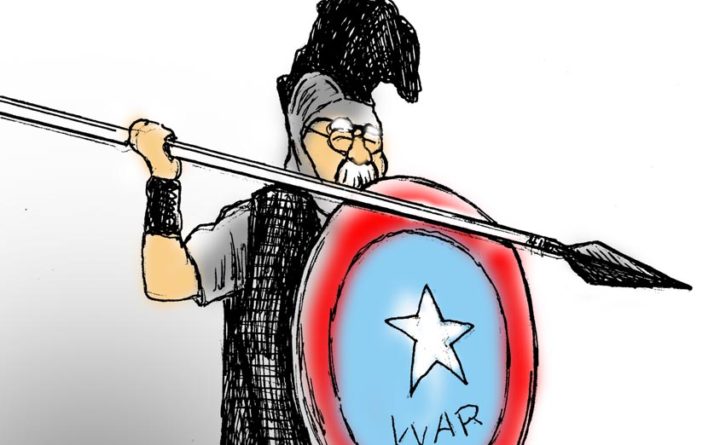 The Intercept, Jon Schwarz, PRESIDENT DONALD TRUMP’S announcement on October 20 that he intends to pull the United States out of the Intermediate-Range Nuclear Forces Treaty was, if nothing else, appropriately timed. On that date exactly 56 years before, President John F. Kennedy abruptly cut short a midterm campaign trip to Illinois because, the White House said, he had a cold. In fact, Kennedy was returning to Washington to address the Cuban missile crisis — the closest humanity has ever come to obliterating itself with a nuclear war.The INF treaty was signed in 1987 by President Ronald Reagan and Soviet General Secretary Mikhail Gorbachev. It required both countries to forgo any land-based missiles, nuclear or otherwise, with ranges between 500 and 5,500 kilometers. The Intercept, Jon Schwarz, PRESIDENT DONALD TRUMP’S announcement on October 20 that he intends to pull the United States out of the Intermediate-Range Nuclear Forces Treaty was, if nothing else, appropriately timed. On that date exactly 56 years before, President John F. Kennedy abruptly cut short a midterm campaign trip to Illinois because, the White House said, he had a cold. In fact, Kennedy was returning to Washington to address the Cuban missile crisis — the closest humanity has ever come to obliterating itself with a nuclear war.The INF treaty was signed in 1987 by President Ronald Reagan and Soviet General Secretary Mikhail Gorbachev. It required both countries to forgo any land-based missiles, nuclear or otherwise, with ranges between 500 and 5,500 kilometers.
In concrete terms, the treaty was a huge success. The U.S. destroyed almost 1,000 of its own missiles, and the Soviets destroyed almost 2,000 of theirs. But arms control treaties are never about weapons and numbers alone. They can help enemy nations create virtuous circles, both between them and within themselves. Verification requires constant communication and the establishment of trust; it creates constituencies for peace inside governments and in the general public; this reduces on both sides the power of the paranoid, reactionary wing that exists in every country; this creates space for further progress; and so on. The long negotiation of the INF treaty, and the post-signing environment it helped create, was part of an extraordinary collapse of tensions between the U.S. and the Soviet Union during the 1980s. When Reagan took office, the Soviets genuinely believed that the U.S. might engage in a nuclear first strike against them. This, in turn, led to two separate moments in 1983 in which the two countries came terrifyingly close to accidental nuclear war — closer than at any time since the Cuban missile crisis. Instead, the INF treaty was part of an era of good feelings that contributed to one of the most remarkable events of the past 100 years: the largely peaceful implosion of the Soviet Empire. Empires generally do not go quietly, and the dynamics of imperial collapse often contribute to huge conflagrations. Think of the Austro-Hungarian Empire, the Ottoman Empire, and World War I; or the British Empire and World War II. The Soviet fall was an incredible piece of good fortune for the world; if it had happened in the early 1980s, instead of a few years later, it plausibly would have been catastrophic…….. exiting the treaty will do more than just lead to an arms race in which all three countries throw themselves into building new weapons. It will also create an atmosphere in which any rational modus vivendi between the U.S. and Russia, or the U.S. and China, will be far more difficult. This is the prize for Bolton and his allies, who can imagine only one world order: One in which they give orders, and everyone else submits. Bolton has the standard self-perception of his genre of human: In his memoir, “Surrender Is Not an Option,” he explains that he cares about “hard reality,” in contrast to the “dreamy and academic” fools who support arms control. But in fact, it is Bolton who is living inside of a dream. The hard reality is that our species almost committed suicide on October 27, the most dangerous moment of the Cuban missile crisis, later dubbed Black Saturday by the Kennedy administration. Even with comparative doves in charge of the U.S. and the Soviet Union, we came close to ending human civilization, thanks to mutual incomprehension. And we avoided it, as then-Defense Secretary Robert McNamara later said, not by talent or wisdom, but pure luck. Then, we created a false history of what happened, one which allows terrifying fantasists like Bolton to reach, and thrive within, the highest levels of power……… Shortly after midnight, in the early morning of Black Saturday, the U.S. informed NATO that it “may find it necessary within a very short time” to attack Cuba. At noon, a U-2 flight over Cuba was shot down, killing the pilot. On all sides, war — potentially nuclear war — seemed likely, if not inevitable. But that night, Kennedy made the most important presidential decision in history: He accepted an offer from Soviet leader Nikita Khrushchev to remove the U.S. missiles in Italy and Turkey in return for the removal of the Soviet missiles in Cuba. But the U.S. part of the bargain was kept secret from Americans. The administration maintained that Kennedy had forced the Soviets to give in, giving them nothing. That was, of course, more than frightening enough. But here’s the rest of the story. ON OCTOBER 27, A U.S. Navy ship participating in the blockade dropped depth charges on a Soviet submarine. It was only discovered years later that not only was the submarine armed with nuclear torpedoes, but also was out of radio contact with the Soviet government and believed that the war had begun. The captain wanted to use the torpedoes, which almost certainly would have led to the U.S using nuclear weapons in response. However, according to Soviet protocol, the torpedoes could only be launched with the approval of all three officers aboard. One of them refused. ……… what we can be sure of is that if people like Trump and Bolton had been in charge in 1962, then today there would be no discussion of the INF treaty — because there would be no treaty and no one to discuss it. It’s also certain that on our current trajectory, the day will come when the world will face a similar crisis. That time we won’t get the same roll of the dice. The hard reality of the Cuban missile crisis is that, as Blight and Lang put it, “either we put an end to nuclear weapons, or they will put an end to us.” https://theintercept.com/2018/10/27/trump-inf-treaty-cuban-missile-crisis-nuclear-war/ |
|
No comments yet.
1 This Month

of the week – Shut Down Drone Warfare!



Tell the Ukrainian Government to Drop Prosecution of Peace Activist Yurii Sheliazhenko

Petition to revoke the licensing of the Near Surface Nuclear Disposal Facility (NSDF) at Chalk River. https://www.ourcommons.ca/petitions/en/Petition/Details?Petition=e-7247

of the week – STOP SMALL MODULAR REACTORS IN CANADA
To see nuclear-related stories in greater depth and intensity – go to https://nuclearinformation.wordpress.com
-
Archives
- March 2026 (222)
- February 2026 (268)
- January 2026 (308)
- December 2025 (358)
- November 2025 (359)
- October 2025 (376)
- September 2025 (258)
- August 2025 (319)
- July 2025 (230)
- June 2025 (348)
- May 2025 (261)
- April 2025 (305)
-
Categories
- 1
- 1 NUCLEAR ISSUES
- business and costs
- climate change
- culture and arts
- ENERGY
- environment
- health
- history
- indigenous issues
- Legal
- marketing of nuclear
- media
- opposition to nuclear
- PERSONAL STORIES
- politics
- politics international
- Religion and ethics
- safety
- secrets,lies and civil liberties
- spinbuster
- technology
- Uranium
- wastes
- weapons and war
- Women
- 2 WORLD
- ACTION
- AFRICA
- Atrocities
- AUSTRALIA
- Christina's notes
- Christina's themes
- culture and arts
- Events
- Fuk 2022
- Fuk 2023
- Fukushima 2017
- Fukushima 2018
- fukushima 2019
- Fukushima 2020
- Fukushima 2021
- general
- global warming
- Humour (God we need it)
- Nuclear
- RARE EARTHS
- Reference
- resources – print
- Resources -audiovicual
- Weekly Newsletter
- World
- World Nuclear
- YouTube
-
RSS
Entries RSS
Comments RSS
 nuclear-news
Leave a comment