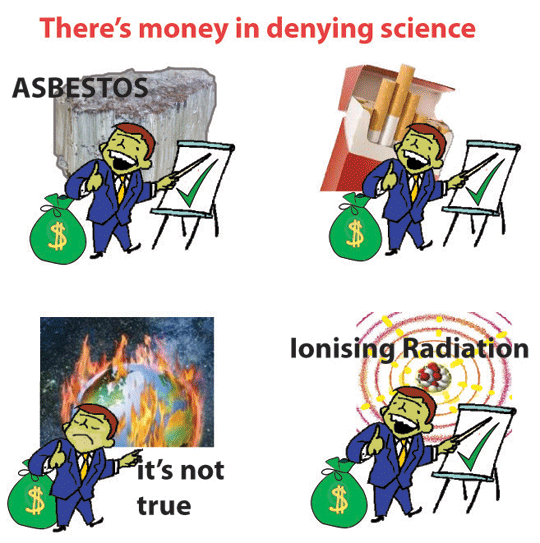
There’s money in denying the science about ionising radiation – it’s useful nuclear lobby spin
 radiation-protection-experts-are-concerned-over-epa-proposal-104895
 When the Associated Press reported that the Trump administration’s Environmental Protection Agency solicited the advice of a controversial toxicologist, Edward Calabrese, to consider changes to how it regulates radiation, it sent shock waves through the radiation protection community. Calabrese is well known for his unconventional and outlying view that low-dose radiation is not dangerous.It is important to note that the health effects of high doses of radiation are well established. We all know about the horrific effects based on studies of the populations of Hiroshima and Nagasaki after the atomic bombs were dropped. Then there was also the recent case of Russian defector Alexander Litvenenko who quickly sickened and died 23 days after being poisoned with the radioactive isotope polonium-210 in 2006.However, the effects of low doses of radiation are not well understood. Part of the reason is that these low doses are difficult to measure.
There have been questions as to whether the LNT model is appropriate for measuring cancer risk from low doses of radiation. That’s because when the radiation-induced cancer rate is low, and the sample size is small, there is more statistical uncertainty in the measurement. This allows more wiggle room in putting forward alternative dose- response models such as Calabrese’s, which have little scientific backing but that promise financial benefits for regulated industries.
Also, not being able to determine the effect of a low dose of radiation is a problem in measurement, not in the underlying linear threshold model. As doses of radiation decrease, fewer cases of radiation-induced cancers occur, making it more difficult to identify those specific cases.
This is especially true given that cancer is already a common occurrence, making it nearly impossible to disentangle radiation exposure from many other potential cancer risk factors. This is where the analogy with Takata air bags fails, because it is not possible to prove that a specific cancer death is due to ionizing radiation, but this does not make it any less real or significant.
Who profits if radiation guidelines change
The EPA issues guidance and sets regulations to “limit discharges of radioactive material affecting members of the public” associated with the nuclear energy industry. The EPA defines what radiation levels are acceptable for a protective cleanup of radioactive contamination at Superfund sites. It also provides guidance on the levels of radiation exposure that would trigger a mass evacuation. It is not surprising that certain stakeholders would welcome modifications in EPA assessment of low-dose radiation exposure given the high costs involved in preventing or cleaning up sites and in compensating victims of such exposure.
Recently, the National Council on Radiation Protection and Measurements (NCRP) – scientists who provide guidance and recommendations on radiation protection under a mandate from Congress – supported the LNT model. NCRP analyzed 29 epidemiological studies and found that the data was “broadly supportive” of the LNT model and that “no alternative dose-response relationship appears more pragmatic or prudent for radiation protection purposes.”
In fact, the National Academies’ Nuclear and Radiation Studies Board, the International Council on Radiation Protection, and other international bodies and regulators all use the LNT model for guidance and radiation protection.
From my perspective, as someone who has worked with radioactive sources, the EPA should be cognizant of the warning by the late Harvard sociologist Daniel Yankelovich that just because an effect can’t be easily quantified does not mean it is not important or does not exist.
No comments yet.
1 This Month

of the week – Shut Down Drone Warfare!


Tell the Ukrainian Government to Drop Prosecution of Peace Activist Yurii Sheliazhenko

Petition to revoke the licensing of the Near Surface Nuclear Disposal Facility (NSDF) at Chalk River. https://www.ourcommons.ca/petitions/en/Petition/Details?Petition=e-7247
To see nuclear-related stories in greater depth and intensity – go to https://nuclearinformation.wordpress.com
-
Archives
- April 2026 (103)
- March 2026 (251)
- February 2026 (268)
- January 2026 (308)
- December 2025 (358)
- November 2025 (359)
- October 2025 (376)
- September 2025 (257)
- August 2025 (319)
- July 2025 (230)
- June 2025 (348)
- May 2025 (261)
-
Categories
- 1
- 1 NUCLEAR ISSUES
- business and costs
- climate change
- culture and arts
- ENERGY
- environment
- health
- history
- indigenous issues
- Legal
- marketing of nuclear
- media
- opposition to nuclear
- PERSONAL STORIES
- politics
- politics international
- Religion and ethics
- safety
- secrets,lies and civil liberties
- spinbuster
- technology
- Uranium
- wastes
- weapons and war
- Women
- 2 WORLD
- ACTION
- AFRICA
- Atrocities
- AUSTRALIA
- Christina's notes
- Christina's themes
- culture and arts
- Events
- Fuk 2022
- Fuk 2023
- Fukushima 2017
- Fukushima 2018
- fukushima 2019
- Fukushima 2020
- Fukushima 2021
- general
- global warming
- Humour (God we need it)
- Nuclear
- RARE EARTHS
- Reference
- resources – print
- Resources -audiovicual
- Weekly Newsletter
- World
- World Nuclear
- YouTube
-
RSS
Entries RSS
Comments RSS
 nuclear-news
Leave a comment