Shikoku Electric Power Company submits plans for dismantling nuclear reactor
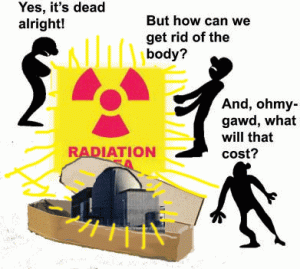
 Shikoku outlines plans for decommissioning Ikata 2, WNN, 17 October 2018
According to the plan, decommissioning of Ikata 2 will take about 40 years and will be carried out in four stages. The first stage, lasting about ten years, will involve preparing the reactor for dismantling (including the removal of all fuel and surveying radioactive contamination), while the second, lasting 15 years, will be to dismantle peripheral equipment from the reactor and other major equipment. The third stage, taking about eight years, will involve the demolition of the reactor itself, while the fourth stage, taking about seven years, will see the demolition of all remaining buildings and the release of land for other uses.
During the first stage, all fuel is to be removed from the unit. This includes 316 used fuel assemblies that will be sent for reprocessing and 102 fresh fuel assemblies that will be returned to the fuel fabricator.
Ikata 2 became the ninth operable Japanese reactor to be declared for decommissioning since the Fukushima Daiichi accident.
In mid-March 2015, the Ministry of Economy, Trade and Industry’s Agency for Natural Resources and Energy revised the accounting provisions in the Electricity Business Act, whereby electric power companies can now calculate decommissioning costs in instalments of up to ten years, instead of one-time as previously. This enhanced cost recovery provision was to encourage the decommissioning of older and smaller units.
Shikoku decided in March 2016 to decommission unit 1 of the Ikata plant, also a 538 MWe PWR, which began commercial operation in September 1977. That unit had been taken offline in September 2011 for periodic inspections. Upgrades costing more than JPY170 billion (USD1.5 billion) would have been needed at the unit in order for it to operate beyond 40 years.
The NRA approved Shikoku’s decommissioning plan for Ikata 1 in June 2017. That plan also sees the unit being decommissioned in four stages over a 40-year period.
Unit 3 at the Ikata plant was given approval by the NRA to resume operation in April 2016, having been idle since being taken offline for a periodic inspection in April 2011. Shikoku declared the 846 MWe pressurised water reactor back in commercial operation on 7 September 2016. However, in December 2017, a Japanese high court ordered the suspension of the unit’s operation. The injunction was effective until the end of last month. The Hiroshima High Court in late September accepted Shikoku’s appeal and cancelled the injunction, allowing the utility to begin the process of restarting the reactor. http://world-nuclear-news.org/Articles/Shikoku-outlines-plans-for-decommissioning-Ikata-2
No comments yet.
1 This Month


Tell the Ukrainian Government to Drop Prosecution of Peace Activist Yurii Sheliazhenko

Petition to revoke the licensing of the Near Surface Nuclear Disposal Facility (NSDF) at Chalk River. https://www.ourcommons.ca/petitions/en/Petition/Details?Petition=e-7247


of the week – STOP SMALL MODULAR REACTORS IN CANADA
To see nuclear-related stories in greater depth and intensity – go to https://nuclearinformation.wordpress.com
-
Archives
- March 2026 (204)
- February 2026 (268)
- January 2026 (308)
- December 2025 (358)
- November 2025 (359)
- October 2025 (376)
- September 2025 (258)
- August 2025 (319)
- July 2025 (230)
- June 2025 (348)
- May 2025 (261)
- April 2025 (305)
-
Categories
- 1
- 1 NUCLEAR ISSUES
- business and costs
- climate change
- culture and arts
- ENERGY
- environment
- health
- history
- indigenous issues
- Legal
- marketing of nuclear
- media
- opposition to nuclear
- PERSONAL STORIES
- politics
- politics international
- Religion and ethics
- safety
- secrets,lies and civil liberties
- spinbuster
- technology
- Uranium
- wastes
- weapons and war
- Women
- 2 WORLD
- ACTION
- AFRICA
- Atrocities
- AUSTRALIA
- Christina's notes
- Christina's themes
- culture and arts
- Events
- Fuk 2022
- Fuk 2023
- Fukushima 2017
- Fukushima 2018
- fukushima 2019
- Fukushima 2020
- Fukushima 2021
- general
- global warming
- Humour (God we need it)
- Nuclear
- RARE EARTHS
- Reference
- resources – print
- Resources -audiovicual
- Weekly Newsletter
- World
- World Nuclear
- YouTube
-
RSS
Entries RSS
Comments RSS
 nuclear-news
Leave a comment