“Transparency”- the Trump administration’s dirty trick to strangle access to reputable science on nuclear radiation
 Yes, radiation is bad for you. The EPA’s ‘transparency rule’ would be even worse. The Trump
 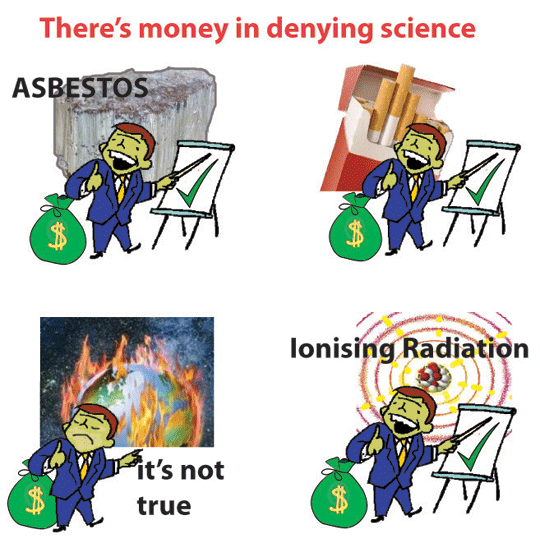 administration wants to strangle access to reputable science. https://www.washingtonpost.com/outlook/2018/10/08/yes-radiation-is-bad-you-epas-transparency-rule-would-be-even-worse/?noredirect=on&utm_term=.b7e530a79729 By Audra J. Wolfe, 8 Oct 18 Audra J. Wolfe is a Philadelphia-based writer, editor, and historian. She is the author of Freedom’s Laboratory: The Cold War Struggle for the Soul of Science.
Last Tuesday, a headline from the Associated Press sparked outrage in the ordinarily quiet world of science policy. The Environmental Protection Agency, the story suggested, was considering relaxing guidelines for low-dose ionizing radiation, on the theory that “a bit of radiation may be good for you.” Within hours, the AP had issued a correction. As it turned out, the EPA was not, after all, endorsing hormesis, the theory that small doses of toxic chemicals might help the body, much like sunlight triggers the production of vitamin D.
Instead, the EPA was doing something much scarier: It was holding hearings on the “Transparency Rule,” which would restrict the agency to using studies that make a complete set of their underlying data and models publicly available. The rule is similar to an “Open Science” order issued by the Interior Department last month, and incorporates language from the HONEST Act, a bill that passed in the House in 2017 but later stalled in the Senate. The HONEST Act originally required that scientific studies provide enough data that an independent party could replicate the experiment — which is simply not realistic for large-scale longitudinal studies.
Although these rules cite the need to base regulatory policy on the “best available science,” make no mistake: They aim to strangle access to reputable studies.
The Transparency Rule continues the Trump administration’s pattern of anti-science policies. The White House’s Office of Science and Technology Policy is a ghost town, with most of the major positions, including the director’s post, vacant since January 2017. Agencies and departments across the board, including the State Department and the Agriculture Department, are dropping their science advisers and bleeding scientific staff. It’s getting harder and harder for federal rulemakers to access expertise.
Understanding what’s wrong with “transparency,” at least as defined by these policies, requires a closer look at how scientists work. Let’s say you’re trying to understand the health effects of a one-time, accidental release of a toxic chemical. This incident might be epidemiologists’ only chance to investigate how this particular chemical interacts with both the air and the humans who breathe it, at varying doses, over a period of time. No matter how careful your approach, your study would fall short of the replicability standard.
You wouldn’t have baseline health information for the specific people who happened to be in the area. You might not have information on which residents had air filtration systems installed in their homes, or which residents were working outside when the incident took place. Your early results would, by definition, reflect only short-term health outcomes, rather than long-term effects. And you couldn’t replicate the study (with better controls) without endangering the health of thousands of people. In such cases, scientists have to extrapolate from existing, sometimes imperfect, data to protect the public.
Epidemiologists have community standards, including peer review, to evaluate these kinds of studies. A careful, peer-reviewed study of this hypothetical incident might well represent the “best available science” on this particular chemical. Regulators might rely on this study to establish the permissible levels of this chemical in the air we breathe. But now, let’s also say that this study took place 30 years ago. The leading scientists involved are dead, and no one kept their files. The raw data are, effectively, lost. Should scientists at the EPA be blocked from using the study?
Despite what made last week’s headlines, the EPA’s Oct. 3 hearing went beyond radiation. In fact, its lead witness, University of Massachusetts toxicologist Edward Calabrese, barely mentioned his theory of radiation hormesis. Instead, his testimony argued that the EPA should no longer rely on linear no-threshold (LNT) models for any number of hazards, including toxic chemicals and soil pollutants. In toxicology, LNT models assume that the biological effects of a given substance are directly connected to the amount of the exposure, with no minimum dose required. Radiation protections standards are based on LNT models; so are basic regulations involving ozone, particulate pollution, and chemical exposure.
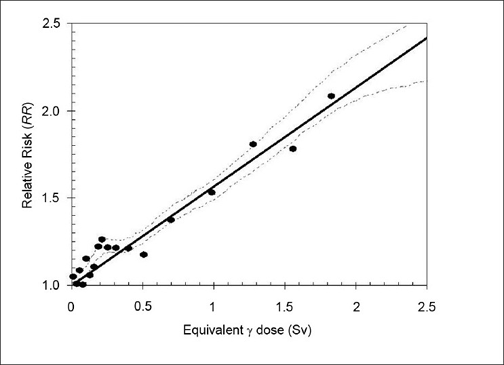
The original studies asserting a LNT model for low-dose ionizing radiation were conducted in the 1950s. Like our hypothetical epidemiologist investigating a toxic chemical release, the geneticists who tried to understand the biological effects of atomic radiation were working with imperfect data, much of which is no longer available. The concept of a “comprehensive data management policy” simply did not exist in 1955. These particular studies were primarily based on survivors of the atomic bombing of Hiroshima and Japan. The scientists also extrapolated from high-dose exposure data in fruit flies and mice and from unethical high-dose experiments conducted on humans.
These studies are imperfect, but focusing on their limitations misses the broader scandal. These studies took place during the heyday of atmospheric nuclear weapons testing, an era when both the United States and the Soviet Union were pumping the atmosphere full of radioactive nucleotides. Some of the areas near the testing zones received so much radiation that they are still uninhabitable today. The tests coated the entire planet with a scrim of radiation. The Atomic Energy Commission, the agency in charge of the United States’ nuclear weapons program, didn’t even attempt to investigate the potential health effects of this constant, low-dose exposure to ionizing radiation on the world’s population. Studies of low-dose radiation were expensive, inconvenient, and politically risky, potentially jeopardizing the weapons testing program and therefore the United States’ ability to fight the Soviet Union. From the government’s perspective, it was better not to know.
This week, a sensational headline distracted us from a broader crisis. Without government support for research of environmental hazards, the public’s health is left to either the whims of industry researchers, who have a strong incentive to play down their dangers, or to public advocacy groups, which are too easily smeared with charges of anti-industry bias. The “transparency” movement supposedly resolves this crisis of authority by giving the public access to the underlying data on which science is based, but it ignores the power dynamics that determine which research questions get asked, and why and how they’re answered.
In the past, Americans looked to their federal science agencies and science advisers to resolve these sorts of disputes. But a few weeks ago, the EPA announced that it, too, would be eliminating its Office of the Science Adviser. With the science offices empty, who will decide?
There is one bright spot in all of this: On Sept. 28, bipartisan legislation authorized the Energy Department to restart its low-dose radiation research program. But what about the other pollutants that the EPA supposedly regulates? Who will produce the kinds of science deemed acceptable under the “transparency” rule?
“Transparency” has become another way to cultivate institutional ignorance. Americans deserve better from the agencies that are supposed to protect them. In the case of environmental hazards, what you don’t know can hurt you.
US Secretary of State Mike Pompeo says that North Korea is ready to allow inspection of key nuclear site
|
North Korea is ready to allow inspection of key nuclear site, Pompeo says https://edition.cnn.com/2018/10/08/politics/pompeo-north-korea-nuclear-inspectors-intl/index.html, By Angela Dewan and James Griffiths, CNN October 8, 2018 US Secretary of State Mike Pompeo said Monday that North Korean leader Kim Jong Un is ready to allow international inspectors into a key nuclear testing site, signaling a step forward in Pyongyang’s commitment to denuclearizing the Korean Peninsula.
|
|
Nuclear corruption: former South African government planned to conceal costs on nuclear plan
 State was willing to lie to SA over costs of Zuma’s nuclear plan, City Press News 24
Cabinet also decided to go ahead with the nuclear power deal on the grounds of hopelessly incorrect and over optimistic “facts” that the energy department presented to Cabinet – such as an assumption that the exchange rate would stay at R10 a dollar.
A top secret Cabinet notice and accompanying memorandum – which have now been declassified and were handed to the state capture commission last week, revealed for the first time how close South Africa was on the edge of an economic crisis, and how desperate Zuma and his cronies were to push through the nuclear power deal.
Last week, Finance Minister Nhlanhla Nene told the commission investigating the extent of state capture how Zuma chastised him because he wasn’t making quick enough progress over the nuclear deal.
During a state visit to Russia in July 2015, then minister of energy Tina Joemat-Pettersson wanted Nene to sign a one-page agreement.
It was a letter addressed to the Russian authorities, Nene said, adding that he couldn’t remember the precise details of the letter but he remembered that it effectively gave a guarantee to the Russian authorities over the nuclear programme, if they agreed to finance it.
Nene refused to sign it because it would have been catastrophic for the country, he said.
Zuma wasn’t impressed, because he wanted to be able to present something to President Vladimir Putin when they met.
A few months later, Joemat-Pettersson’s department was still forging ahead with the project, despite warnings from Treasury.
On December 9 2015, the day Cabinet approved the nuclear deal, Nene recalled been summoned into a meeting with then president Zuma. It lasted less than five minutes and he was informed that he was being removed from his role as finance minister.
He was replaced by Des van Rooyen, which set off a spiral of uncertainty for the markets.
The secret Cabinet notice showed that the government wanted to downplay the cost implications of the deal. Prices should not be communicated prior to the procurement process being completed, it said, and if any communication was to be done around the costs of the programme, it was decided to talk about the low end of the range……..
The numbers show that nuclear would have ruined South Africa
A nuclear engineer from a large Western nuclear power company, who also tendered for the project, told Rapport that the numbers were completely unrealistic.
The number of $2500 a kilowatt was from nuclear power stations being built in Asia – mainly China and Korea. It would be unrealistic to think that it would be possible to build a nuclear power station in South Africa at such a low price, he said.
“In South Africa, if everything goes according to plan, you could bank on it costing about $5000 per kilowatt,” he said.
Both the engineer and Serfontein said that, under the best circumstances, the project would cost more than R1 trillion.
If Cabinet had gone ahead with this binding agreement, it would have ruined South Africa financially, they both said………
At that time it was widely known that the Russian state-owned nuclear power company, Rosatom, would be the preferred bidder because Joemat-Pettersson had signed a framework agreement with Rosatom more than a year before, on September 22 2014, that would make the Russians the sole supplier for South Africa’s nuclear power programme.
Last year, the High Court set aside this agreement and framework agreements with other countries. https://city-press.news24.com/News/state-was-willing-to-lie-to-sa-over-costs-of-zumas-nuclear-plan-20181008
We can avoid catastrophic climate change, but it’s going to be really, really hard.
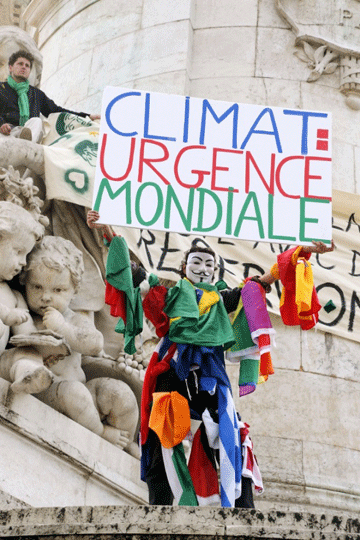 Independent 8th Oct 2018 , It’s easy to become numb to stories about climate change. The headlines
become more and more dramatic, the conclusions more terrifying, but it’s
such a big, unwieldy topic, and who has time to be constantly worried about
environmental Armageddon?
Hailed by the scientific community as a true game
changer, a moment for the history books, a new climate report from the UN
may have what it takes to pierce through this climate apathy. It’s not
because the conclusions are particularly new.
As the report is based on thousands of existing scientific studies, followers of environmental news
will already be familiar with stories of coral dying, sea ice melting and
Pacific islanders forced from their ancestral homes.
But the conclusions of this report seem particularly hard-hitting. Firstly because everything –
from melting ice to dying animals – is presented in one place, but secondly
because the outcome is so straightforward.
We can avoid catastrophic climate change, they say, but it’s going to be really, really hard. The
report has essentially come about because despite being a regarded as an
impressive feat of international diplomacy, the 2015 Paris climate
agreement is a bit vague. It set a target of limiting global warming to
“well below 2C above pre-industrial levels” while also “pursuing efforts”
for more ambitious reductions of 1.5C.
https://www.independent.co.uk/environment/climate-change-ipcc-report-un-global-warming-heatwaves-paris-agreement-donald-trump-a8573226.html
$2.4 Trillion Fossil Fuel Shift – better than climate apocalypse
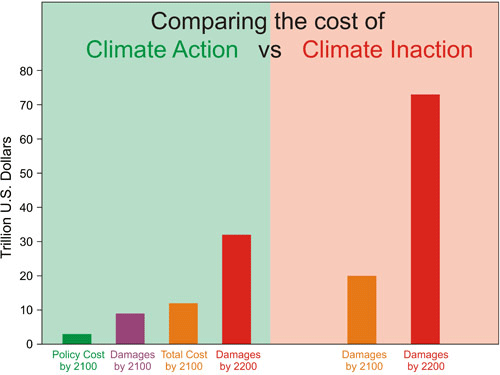
THE IPCC REPORT ALSO RECOMMENDED THAT BY 2050:
Coal’s share of electricity supply should be cut to 2 percent or less.
Renewables should supply 70 percent to 85 percent of power generation.
| Climate Crisis Spurs UN Call for $2.4 Trillion Fossil Fuel Shift https://www.bloomberg.com/news/articles/2018-10-08/scientists-call-for-2-4-trillion-shift-from-coal-to-renewables?srnd=climate-changed, By Reed Landberg, Chisaki Watanabe, and Heesu Lee, October 8, 2018, World on track to warm 3 degrees, overshooting 2015 Paris goal
·UN panel releases report on capping warming at 1.5 degrees The world must invest $2.4 trillion in clean energy every year through 2035 and cut the use of coal-fired power to almost nothing by 2050 to avoid catastrophic damage from climate change, according to scientists convened by the United Nations. Continue reading |
Rising sea levels will mean flooding of vulnerable cities- e.g: London, Jakarta, Shanghai and Houston
 Edie 5th Oct 2018, London, Jakarta, Shanghai and Houston and other global cities that are
already sinking will become increasingly vulnerable to storms and flooding
as a result of global warming, campaigners have warned ahead of a landmark
new report on climate science.
The threat to cities from sea level rises is increasing because city planners are failing to prepare, the charity
Christian Aid said in the report. Some big cities are already subsiding –
the ground beneath Shanghai, for instance, is being pressed down by the
sheer weight of the buildings above – and rising sea levels resulting
from global warming will make the effects worse.
https://www.edie.net/news/9/From-London-to-Shanghai–world-s-sinking-cities-face-devastating-floods/
Hunterston B-7 UK nuclear reactor closed since March, offline till Dec 18
| EDF Energy extends Hunterston B-7 UK nuclear outage until Dec. 1 LONDON (Reuters) 8 Oct 18– EDF Energy has extended an outage at its Hunterston B-7 nuclear reactor in Britain until Dec. 18, it said on Monday.
The reactor, which can produce enough electricity to power more than 800,000 homes, has been offline since March when cracks were found in its core during a routine inspection. It was initially scheduled to return to service on Nov. 17, but EDF Energy said it had extended the outage to allow the company more time to demonstrate a safety case, needed before Britain’s nuclear regulator will allow the unit to resume service…….. https://uk.reuters.com/article/uk-britain-nuclear/edf-energy-extends-hunterston-b-7-uk-nuclear-outage-until-dec-18-idUKKCN1MI19D
|
Federal indictment alleges that Russian military targeted USA nuclear company Westinghouse
|
Indictment: Russian military targeted Pa. nuclear power company, witf news, by Amy Sisk/StateImpact Pennsylvania | Oct 8, 2018 (Pittsburgh) — A federal indictment filed this week alleges Russian hackers targeted a nuclear power company near Pittsburgh beginning in 2014, in addition to anti-doping agencies throughout the world.The hackers, who are intelligence officers for the Russian military, tried to breach the network of Westinghouse Electric Company by sending emails to employees intending to trick them into entering login credentials on a webpage spoofing the company’s own network, according to the indictment.
Although the indictment says the hackers stole some credentials before redirecting the workers to the company’s actual network, Westinghouse and federal officials said the hacking attempt was unsuccessful. ………The indictment names seven Russian intelligence officials, who face charges ranging from conspiracy to wire fraud to aggravated identity theft. …..Brady said he believes all the defendants named in the indictment are now in Russia. The United States does not have an extradition treaty with Russia, so it’s unclear if the alleged hackers will come to Pittsburgh to face charges…….http://www.witf.org/news/2018/10/indictment-russian-military-targeted-pa-nuclear-power-company.php |
|
Despite its anti-nuclear ordinance, Oakland City Council to increase a contract with nuclear weapons maker AECOM
Nuclear Weapons Maker to Receive Extra $420,600 to Help Repair Oakland Bridge https://www.eastbayexpress.com/SevenDays/archives/2018/10/08/nuclear-weapons-maker-to-receive-extra-420600-to-help-repair-oakland-bridge
In addition to managing US nuclear labs, AECOM does billions in business building overseas military bases and maintaining Air Force drones.
The Oakland City Council is considering increasing an existing contract by $420,600 for a total of $1.25 million to repair the 23rd Avenue Bridge, but the modified contract is with AECOM, an engineering company that has been involved in designing and manufacturing nuclear weapons components, and in the past, helped manage a desert test site where nuclear weapons experiments were conducted.
Oakland has an anti-nuclear ordinance that usually bars companies involved in designing and building nukes from doing business with the city. But city staffers are recommending that the council waive the prohibition for AECOM due to the fact that the company, and its URS subsidiary, have been involved with the 23rd Avenue Bridge project since 2003 and finding another firm to do the technical work would be difficult.
AECOM bought URS in 2014 and as a result became a partner in the nuclear labs’ management company. Three months ago, the federal government selected a new team to manage the Los Alamos lab, dropping AECOM as one of the firms involved there. But AECOM is still part of the Livermore Lab group.
Prior to this, AECOM helped manage the Nevada National Security Site where nuclear weapons are tested in “subcritical” experiments that don’t result in fission or fusion explosions.
AECOM has billions of dollars worth of other contracts with the U.S. military, doing everything from building overseas bases to maintaining drone weapons systems. As a result of its nuclear weapons contracts, AECOM was one of several companies that Norway’s sovereign fund put on an investment blacklist last January.
Russia challenges US compliance with nuclear arms treaty
MOSCOW https://www.kwtx.com/content/news/Russia-challenges-US-compliance-with-nuclear-arms-treaty-495949041.html?ref=041 (AP) 8 Oct 18— Russia on Monday challenged the U.S. claim that it has fulfilled its obligations under a pivotal nuclear arms deal, a new argument that could further fuel tensions between Moscow and Washington.
The Russian Foreign Ministry said it “can’t confirm” the latest U.S. State Department data indicating that the U.S. has complied with the thresholds set by the 2010 New START treaty. It limits each country to no more than 1,550 deployed nuclear warheads and 700 deployed missiles and bombers.
The ministry said the U.S. removed 56 Trident II submarine-launched intercontinental ballistic missiles and 41 B-52H strategic bombers from its count of nuclear arsenals after re-equipping them to carry conventional weapons.
But it argued that the U.S. had failed to let Russia verify the move in line with the treaty, and failed to list four land-based missile silos converted for training purposes — a move Russia said didn’t conform to the treaty.
The ministry said the perceived U.S. breach of the treaty’s limits was “unacceptable,” adding that it expects Washington to “show a constructive approach to settling that acute issue.”
The tough statement marked the first time Russia raised the issue of the alleged U.S. non-compliance with the pact signed by President Barack Obama and then-Russian President Dmitry Medvedev amid a brief thaw in Russia-U.S. ties. The New Start came into effect in 2011 and is to expire in 2021 unless the two countries extend it.
Officials in both Russia and the U.S. have given mixed signals about the pact’s future.
Russia-U.S. ties have sunk to their lowest levels since the Cold war times over the Ukrainian crisis, the war in Syria, the allegations of Russian meddling in the 2016 U.S. presidential election and alleged Russian hacking of world anti-doping bodies, athletes, plane investigations and chemical weapons probes, among other disputes.
In the arms control sphere, Moscow and Washington also have been at loggerheads over another arms control treaty — the 1987 Intermediate-range Nuclear Forces Treaty.
The U.S. has accused Russia of deploying a new type of missile in violation of the pact that bans an entire class of weapons — all nuclear and conventional ground-launched ballistic and cruise missiles of intermediate range. Russia has rejected the accusations.
Jeremy Corbyn gives a vision of a smarter, cleaner, more secure and equitable future
 Morning Star 6th Oct 2018, Alan Simpson: If there are seminal
  moments in politics, Jeremy Corbyn’s speech at the 2018 Labour conference will go down as one of them.
Labour’s “programme of investment and transformation, to achieve a 60
per cent reduction in emissions by 2030, will create over 400,000 skilled
jobs.” Pretty unequivocal stuff. But that is just the start. Shadow
chancellor John McDonnell was no less uncompromising. The next government
will have to deliver carbon reductions of 15 per cent per year. To do so,
Britain will need a much more circular economics — not one that makes do
with less but one that certainly wastes and pollutes less.
economics will be rooted. For most people, a more circular economy would
deliver real improvements in their quality of life — from the air we
breathe, the food we eat, the homes we live in to the jobs and skills the
country needs.
renewable energy but in using less energy in the first place. Tackling the
scandal of “cold homes” will save lives as well as cutting carbon.
Clean transport systems offer the same opportunities. These are a world
away from the triple absurdity of the GMB trade union sharing a platform
with the Taxpayers Alliance at the Tory Party conference in support of
fracking.
Corbyn vision of a smarter, cleaner, more secure and equitable future or
just “shop till we drop” with the Tories. The choice is still ours …
but only just.
https://morningstaronline.co.uk/article/labour%E2%80%99s-vision-smarter-cleaner-future
Britain’s Nuclear Decommissioning Authority’s (NDA) Nuclear and Caithness Archive in Scotland – central site for British nuclear records
Wired 8th Oct 2018 Seventy years of British nuclear history lie behind these concrete, stone
and aluminium walls. Since opening in February 2017, Nucleus, the UK
Nuclear Decommissioning Authority’s (NDA) Nuclear and Caithness Archive,
near Wick, Scotland, has been gathering thousands of records, images and
plans about the UK’s civil nuclear industry.
More documents are being transferred from 17 archives across the UK, as the NDA plans to house them
all in this single purpose-built location. The archive contains documents
dating back to the 1950s, and some are classified as Top Secret. Records
are kept in triplicate: a copy on paper, a microfilm and a PDF version, to
reduce wear on the originals.
https://www.wired.co.uk/article/nucleus-archive-uk-nuclear
Dubious claim from Russia, about bacteria “neutralising nuclear waste”
Russian Scientists Discover Bacteria That Neutralizes Nuclear Waste https://sputniknews.com/science/201810081068701682-nuclear-waste-neutralizing-bacteria/ The unique bacteria, discovered in a nuclear waste storage site in Siberia, shows promise as a tool for the creation of a natural barrier to the spread of radionuclides.
Researchers from the Moscow-based Frumkin Institute of Physical Chemistry and the Russian Academy of Sciences’ Federal Research Center for Biotechnology have been able to isolate microorganisms which can be used to safeguard the surrounding environment from liquid radioactive waste.
Scientists made the discovery while conducting microbiological studies of the groundwater at the Seversky deep radiation burial site in Seversk, Tomsk region, Siberia, where liquid radioactive waste from the Siberian Chemical Combine, which supplies and reprocesses low enriched uranium for nuclear fuel, is stored.
Their research, recently published in Radioactive Waste, a Russian scientific journal, suggests that the bacteria is capable of converting radionuclide ions, including those found in uranium and plutonium, into sedentary forms, thereby preventing the spread of dangerous radiation into the surrounding environment. Through lab experimentation, the scientists were able to fine tune the conditions necessary for the bacteria to carry out its useful work.
The researchers say their findings are a first step in creation a biogeochemical barrier for radionuclides for use in deep burial sites containing liquid radioactive waste.
Research into microbiological tools to limit the effects of nuclear waste have been conducted since the 1980s, with scientists from around the world saying microbial processes must be taken into account in projects to bury and store nuclear waste which can otherwise decay over a period of millions or even billions of years.
1 This Month
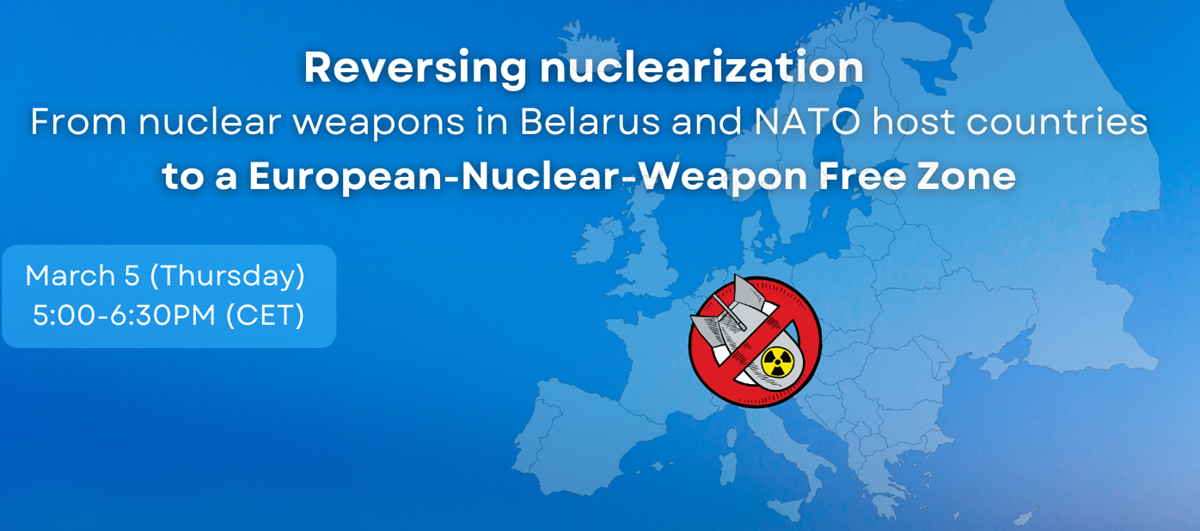
5 March -Online – Reversing nuclearization:
From nuclear weapons in Belarus and NATO host countries to a European-Nuclear-Weapon Free Zone
11am-12:30pm Eastern Time USA / 5pm-6:30pm CET

of the week – Advocating for a
nuclear free beach – https://www.samuellawrencefoundation.org/
The Samuel Lawrence Foundation advocates for a Nuclear Waste Free Beach at San Onofre, join us and take action!

10 March A LIVE WEBINAR THE REAL EFFECTS OF NUCLEAR POWER
What the Industry Isn’t Telling Us
1:00 PM Mountain, 2 pm Central, 3 pm Eastern. Live on the Keepers of the Water Facebook page

18 March Webinar @ 1 PM EST: An Assessment of SMR Projects: The Case of Canada
register for the zoom:
https://us02web.zoom.us/webinar/register/WN_o8BIIOUvQ2ONJR1nta65DQ#/registration

of the week – STOP SMALL MODULAR REACTORS IN CANADA
To see nuclear-related stories in greater depth and intensity – go to https://nuclearinformation.wordpress.com
-
Archives
- March 2026 (51)
- February 2026 (268)
- January 2026 (308)
- December 2025 (358)
- November 2025 (359)
- October 2025 (376)
- September 2025 (258)
- August 2025 (319)
- July 2025 (230)
- June 2025 (348)
- May 2025 (261)
- April 2025 (305)
-
Categories
- 1
- 1 NUCLEAR ISSUES
- business and costs
- climate change
- culture and arts
- ENERGY
- environment
- health
- history
- indigenous issues
- Legal
- marketing of nuclear
- media
- opposition to nuclear
- PERSONAL STORIES
- politics
- politics international
- Religion and ethics
- safety
- secrets,lies and civil liberties
- spinbuster
- technology
- Uranium
- wastes
- weapons and war
- Women
- 2 WORLD
- ACTION
- AFRICA
- Atrocities
- AUSTRALIA
- Christina's notes
- Christina's themes
- culture and arts
- Events
- Fuk 2022
- Fuk 2023
- Fukushima 2017
- Fukushima 2018
- fukushima 2019
- Fukushima 2020
- Fukushima 2021
- general
- global warming
- Humour (God we need it)
- Nuclear
- RARE EARTHS
- Reference
- resources – print
- Resources -audiovicual
- Weekly Newsletter
- World
- World Nuclear
- YouTube
-
RSS
Entries RSS
Comments RSS
 nuclear-news