In the Anthropocene, the day of peak consumption of stuff will eventually come
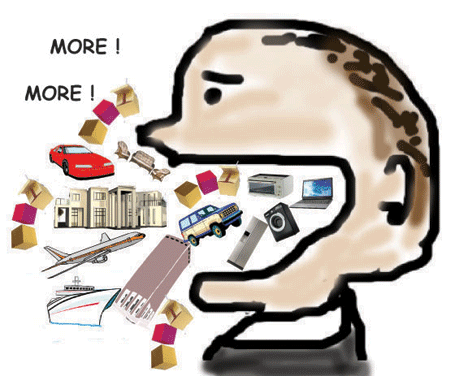 Are We Approaching Peak Stuff?, Almost imperceptibly, we are stepping off the consumption treadmill Anthropocene, By Fred Pearce, 11 Sept 18 Are We Approaching Peak Stuff?, Almost imperceptibly, we are stepping off the consumption treadmill Anthropocene, By Fred Pearce, 11 Sept 18
Twenty years ago, Beijing was a city of bicycles. They queued by the thousands at traffic lights on roads where cars were rare, next to grocer stalls piled high with winter cabbages. Today, it is the bicycles that are rare in Beijing. Five million cars swirl around eight ring roads that encircle the metropolis, which chokes in smog for much of the year. Quaint old “hutong” pedestrian neighborhoods have been replaced in the city’s suburbs by high-rise apartments and shopping malls. With money building in their bank accounts, residents now can afford meat instead of cabbages. And so goes the rest of this Asian giant. The industrialization of China has driven a quarter-billion people from dirt-poor rural villages into modern megacities, whose breakneck construction and galloping consumption by a burgeoning middle class are transforming the planet as a whole. Trends here—and in other fast-growing nations such as India—have economists debating when, or even whether, the flow of materials around the planet will peak and start to decline, as it must for there to be any hope of humanity reaching a sustainable equilibrium with the environment. On the one hand, the numbers from China are discouraging. The country now has more cars on its roads than America does. Two-thirds of all the skyscrapers erected in the world in 2016 went up here. China consumed roughly 50 percent more cement just between 2011 and 2013 than the United States did during the entire twentieth century. The nation now uses 60 percent of the world’s cement, 50 percent of its iron ore and coal, and 40 percent of its lead, zinc, and aluminum. This extraordinary appetite for the materials of the Earth reflects, in part, the rest of the world’s enjoyment of stuff made in China. The workshop of the world produces three-quarters of our air conditioners, two-thirds of our cellphones and photocopiers, and one-third of our cars and TVs. But domestic demand is growing as well, with economic output soaring at annual compound rates of 6.5 percent or more and a blossoming retail market that is expected to displace America’s as the biggest in the world this year. Which version of modernity is set to triumph on our increasingly crowded planet? Is it the orgy of construction and consumption ripping up China or the dematerializing society glimpsed in the UK? On the other hand, the example of the United Kingdom inspires more optimism. Two centuries ago, the UK topped the world in manufacturing; it mined 80 percent of the world’s coal and most of its iron. British wealth and population have only grown since then. Yet Britain’s consumption of materials peaked in 2001, according to government statistics, and is today a third less than it was 20 years ago. Not coincidentally, the UK now pollutes less, too, with greenhouse-gas emissions down 38 percent since 1990. The UK story gives some economists hope that, once a country has completed construction of its major infrastructure and attained a high standard of living, its citizens can become increasingly efficient in their use of materials. Britons are still getting richer, but they are spending more of their income on yoga classes, fitness trainers, and nice restaurants—and more of their working and leisure hours online, consuming only electricity. So the question for the twenty-first century, and perhaps for the future of humanity, is: Which version of modernity is set to triumph on our increasingly crowded planet? Is it the orgy of construction, consumption, and manufacturing now ripping up China—trashing the water and air, destabilizing the climate, and degrading the ecosystems on which our global civilization ultimately relies? Or is it the dematerializing society now glimpsed in Britain and some other parts of the industrialized world, where innovations in technologies such as 3-D printing, robotics, and hydroponics allow standards of living to continue rising while consumption of material goods falls? Could technology give developing nations a shortcut past the environmentally ruinous road to riches taken by their predecessors? ………………… With population growth slowing, experts have focused more attention on the second factor in Ehrlich’s equation: consumption per capita. That trend is easiest to study in rich countries that have detailed and reliable economic data, such as the US and the UK. And in those advanced economies, analysts—including some who have a record of environmental concern—have found reasons for optimism……….. Peak stuff in countries like China and India is probably still two or three decades away. Though scholarly debate over decoupling of resource use from GDP in rich nations rages on, there is no question that consumption in the developing world has been rising quickly. Global steel production in 2016 was 92 percent higher than in 2000. Cement use soared 160 percent in that period. Such trends are unlikely to end while most of the world’s households still await their first fridge, washing machine, and car, says Julian Allwood, a resource analyst at Cambridge University. He expects global materials consumption to double between 2010 and 2050. “As long as the E.U. and North America [are] the example for China, India, and Africa, then you can have another century of massive material growth,” Smil concurs. “Hundreds of millions of people are still at the very beginning of that global consumption rise.” “Peak stuff in countries like China and India is probably still two or three decades away,” Ausubel allows. But he professes faith that “it will happen.” Sooner is preferable to later, obviously. Some of the optimists hang their hope for salvation on the third element in Ehrlich’s equation. Advances in clean production technology that dramatically cut the environmental impact of each bit of stuff produced, they say, can change everything. Our best shot at reaching a sustainable plateau in stuff is to find ways for people in low- and middle-income regions to leapfrog over the cheap-and-dirty phase of industrialization—or at least to accelerate their way through it—to reach the consumption summit quickly. Is There a Shortcut to Sustainability? One key to bypassing the dirty phase that all now-rich nations passed through on their way to affluence is to recognize how wasteful and unpleasant it is. Huge centralized factories may offer economies of scale. But they require costly transportation infrastructure, factory towns, and low-cost energy—much of which gets spent moving materials and products around. And they concentrate pollution to levels that are toxic to people and other species. A succession of revolutions in digital computing, telecommunications, and automated manufacturing has opened the door to far more decentralized, efficient, and less harmful approaches. As Nathanael Johnson describes in This is Roquette Science, hydroponic farms and “food computers” could dramatically cut the use of water, land, and pesticides in food production while minimizing food lost to shipping and spoilage. Additive manufacturing, which “prints” final products as big and complex as rocket engines layer by layer, can trim wasted materials by up to 80 percent. New technologies also promise to reshape the production of textiles and clothing. And for other products, such as cement, we may not need to reduce their use if we can reinvent them to be more environmentally benign. As Akshat Rathi describes in The Race to Reinvent Cement, material scientists think it may be possible to transform cement from one of the biggest sources of greenhouse-gas emissions into a carbon sink. To make fast progress on these fronts, governments and investors will need to back pioneers pursuing ambitious, untested ideas with money and a greater tolerance for risk and failure. Done right, emerging economies could actually lead the way toward a future where life continues to get better—for people and for the planet. http://www.anthropocenemagazine.org/2018/09/are-we-approaching-peak-stuff/
|
|

No comments yet.
1 This Month

of the week – Shut Down Drone Warfare!


Tell the Ukrainian Government to Drop Prosecution of Peace Activist Yurii Sheliazhenko

Petition to revoke the licensing of the Near Surface Nuclear Disposal Facility (NSDF) at Chalk River. https://www.ourcommons.ca/petitions/en/Petition/Details?Petition=e-7247
To see nuclear-related stories in greater depth and intensity – go to https://nuclearinformation.wordpress.com
-
Archives
- April 2026 (114)
- March 2026 (251)
- February 2026 (268)
- January 2026 (308)
- December 2025 (358)
- November 2025 (359)
- October 2025 (376)
- September 2025 (257)
- August 2025 (319)
- July 2025 (230)
- June 2025 (348)
- May 2025 (261)
-
Categories
- 1
- 1 NUCLEAR ISSUES
- business and costs
- climate change
- culture and arts
- ENERGY
- environment
- health
- history
- indigenous issues
- Legal
- marketing of nuclear
- media
- opposition to nuclear
- PERSONAL STORIES
- politics
- politics international
- Religion and ethics
- safety
- secrets,lies and civil liberties
- spinbuster
- technology
- Uranium
- wastes
- weapons and war
- Women
- 2 WORLD
- ACTION
- AFRICA
- Atrocities
- AUSTRALIA
- Christina's notes
- Christina's themes
- culture and arts
- Events
- Fuk 2022
- Fuk 2023
- Fukushima 2017
- Fukushima 2018
- fukushima 2019
- Fukushima 2020
- Fukushima 2021
- general
- global warming
- Humour (God we need it)
- Nuclear
- RARE EARTHS
- Reference
- resources – print
- Resources -audiovicual
- Weekly Newsletter
- World
- World Nuclear
- YouTube
-
RSS
Entries RSS
Comments RSS
 nuclear-news
Leave a comment