At least 6 nuclear reactors are in the path of Hurricane Florence

As the Associated Press reported on Monday, “The storm’s potential path also includes half a dozen nuclear power plants, pits holding coal-ash and other industrial waste, and numerous eastern hog farms that store animal waste in massive open-air lagoons.”
The plants thought to lie in the path of the hurricane, which is expected to make landfall on the Southeastern U.S. coast on Thursday, include North Carolina’s Brunswick Nuclear Power Plant in Southport, Duke Energy Sutton Steam Plant in Wilmington, and South Carolina’s V.C. Summer Nuclear Station in Jenkinsville.
“Florence will approach the Carolina coast Thursday night into Friday with winds in excess of 100mph along with flooding rains. This system will approach the Brunswick Nuclear Plant as well as the Duke-Sutton Steam Plant,” Ed Vallee, a North Carolina-based meteorologist, told Zero Hedge. “Dangerous wind gusts and flooding will be the largest threats to these operations with inland plants being susceptible to inland flooding.”
In 2015, the Huffington Post and Weather.com identified Brunswick as one of the East Coast’s most at-risk nuclear power plants in the event of rising sea levels and the storm surges that come with them.
As of Tuesday afternoon, Hurricane Florence was thought to have the potential to cause “massive damage to our country” according to Jeff Byard, associate administrator of the Federal Emergency Management Agency (FEMA).
The storm was labeled a Category 4 tropical storm with the potential to become a Category 5 as it nears the coast, with 130 mile-per-hour winds blowing about 900 miles off the coast of Cape Fear, North Carolina.
Meteorologists warned of hurricane-force winds in the region by mid-day Thursday, with storm surges reaching up to 12 feet or higher.
Nuclear power uneconomic, investments driven by needs of nuclear weapons industry
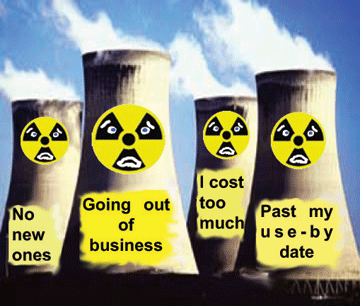 Nuclear power is being left behind, industry experts say https://www.pv-magazine.com/2018/09/10/nuclear-power-is-being-left-behind-nuclear-industry-experts-say/
This statement, though it sounds like a press release from a renewable energy trade body, or a campaign from an environmental group, is one of the main conclusions of the 2018 edition of the Nuclear Industry Status Report (WNISR), which is published each year by French independent consultant specializing in nuclear energy, Mycle Schneider.
It is said to be based on a third-party-perspective, aimed to open discussion on the sustainable development of nuclear energy and a rational approach to thinking of the nuclear industry at large.
According to the authors, nuclear power will have few chances to compete in the future, if it does not prove to be able to develop commercially available, smaller, factory-assembled, modular reactors, at lower cost, with reliable, passive safety features and, above all, if it is not able to attract private investors; “the prospects of which seem remote,” according to the report.
The share of nuclear in global power production has dropped significantly, from 17.5% in 1996 to 10.3% in 2017. “It is instructive to note that the construction of new nuclear power plants is mostly driven and backed by states, and not by the private sector,” the report further notes. On top of this, most state proponents of nuclear power programs are nuclear weapon states.
Support for nuclear power projects, the document says, is being given by countries that are prepared to offer public support, and often this is facilitated by rent-seeking and corruption. Especially due to their large size (between 1 GW and 1.6 GW), nuclear power facilities are said to be an unviable solution for many African developing countries, the power systems of which are usually small and not equipped to integrate big capacities.
Furthermore, the report highlights that solar and wind saw its share in the global power mix increase by 35% and 17% in 2017, while the growth of nuclear power was of only 1% last year. Only four reactors became operational in 2017, of which three were in China and one in Pakistan, while construction started on another five plants worldwide.
Moreover, the number of facilities under construction has decreased from 68 reactors at the end of 2013, to 50 in 15 countries by mid-2018, of which 16 are in China and 33 are behind schedule, mostly by several years. In China, however, nuclear power generation grew by 18% in 2017, and its share in the country’s power mix climbed from 3.6% in 2016, to 3.9% last year.
Yet, as of mid-2018, 115 units were undergoing decommissioning, although so far, only 19 units have been fully decommissioned: 13 in the U.S., five in Germany, and one in Japan.
But what is really hurting nuclear power, the experts say, is economics. “Auctions resulted in record low prices for onshore wind (<US$20/MWh) offshore wind (<US$45/MWh) and solar (<US$25/MWh), which compares with the “strike price” for the Hinkley Point C Project in the U.K. (US$120/MWh),” the authors of the report wrote.
Total investments in nuclear power for 2017, relating to 4 GW of capacity, totaled just $16 billion, while global investments in wind and solar equaled $100 billion and $160 billion, respectively.
The report also stresses how nuclear power may also be impacted by global warming, as the cooling of the reactors requires large amounts of water, and governments, especially in Europe, are introducing operational restrictions to avoid the excessive heating of rivers. “While in most cases, regulations required to lower the output of the reactors by 10 percent or so, some reactors were shut down, including at least four reactors in France, to deal with the problem,” the report notes.
Although this heating issue is considered secondary, the experts warn that the “malaise” about the uncertain future of the industry remains “deep and disconcerting.”
It is also interesting to note that, writing about France’s nuclear plans, the authors of the document highlight the ambiguity of its state-owned utility, EDF, which “seems to live in a different world,” as its envisages “certain closures” of nuclear reactors only starting 2029, while the French government has clearly said it will reduce the share of nuclear power from around 71% currently, to 50% in 2025. The same EDF, on the other hand, has announced a 30 GW solar planthat is aimed at partly offsetting the loss of this capacity.
As for the Hinkley Point nuclear plant in the U.K., which is also being developed by EDF (although its construction has not started yet) and is expected to sell power at $115–120/MWh under a Contract for Difference (CfD) deal, the report stresses that UK National Audit Office (NAO) has already defined it as “risky and expensive project with uncertain strategic and economic benefit.”
In order to raise funds for the project, EDF announced its intention to sell non-core assets worth $11.4 billion, with the project being finally approved in September 2016. “The constant decline in energy and electricity consumption in the U.K. do not favor the economic case for nuclear new-build,” the report suggests.
Critics becoming more concerned about safety issues in Texas nuclear waste storage plan
 A Texas waste storage plan is back. So is the opposition, Edward Klump, E&E News reporter, Energywire: Tuesday, September 11,
  2018 A proposal to send used nuclear fuel to West Texas didn’t end last year, but it did stall during a trip to corporate purgatory.
Now a joint venture called Interim Storage Partners LLC has the plan moving forward again. The Nuclear Regulatory Commission recently restarted its review of a consolidated interim storage application for a site in Andrews County, Texas. And the NRC staff’s safety, security and environmental reviews could be finished in summer 2020.
Critics are worried about what’s brewing. They’re asking questions and hoping for more public meetings. Some would like to halt the project. One of the chief opponents knows the proposal won’t be easy to stop, but she’s working to rally Texans and others against the plan.
“Most people don’t even know this is happening,” said Karen Hadden, executive director of the Texas-based Sustainable Energy and Economic Development Coalition. “The public is unaware, and they’re unaware of the risks that they are about to be exposed to.”
The project is another flashpoint in a long-running debate over nuclear energy and associated waste after a number of U.S. nuclear plants stopped producing power or announced plans to close. Congress has considered legislation that could help pave the way for interim storage facilities in Texas and New Mexico as well as a longer-term site at Yucca Mountain in Nevada. Hadden has voiced concern about those three sites and potential plans to transport nuclear waste across the country.
The spent fuel storage plan for West Texas is tied to Waste Control Specialists (WCS), which has endured financial issues and houses low-level radioactive waste in the region. A plan by Valhi Inc. to unload WCS to EnergySolutions collapsed in 2017. Early this year, J.F. Lehman & Co. announced that an investment affiliate had acquired WCS. That was followed in March by news of a planned venture involving Orano USA and WCS (Energywire, March 19).
The new Orano-WCS entity — now called Interim Storage Partners, or ISP — later sought a restart of the NRC review that was halted in 2017. In August of this year, the NRC said the revised application was acceptable but that additional information would be sought.
“The NRC staff has reviewed your request and concludes that the revised license application provides information sufficient to resume its detailed review,” the NRC said in a letter.
Jeff Isakson, chief executive of ISP, said in a recent statement that ISP looked forward “to an energized and timely process.”
‘Snickering and giggling’
ISP said its venture initially is intended to store used nuclear fuel from shutdown reactor locations. That would lower the burden on U.S. taxpayers and allow sites to be redeveloped, it said. The application is for 40 years, though it could be extended by decades…….
A license application with the NRC said Orano USA ultimately is majority owned and controlled by an entity of the French government. But ISP has said its governing officers and management board members are U.S. citizens……..
Much of nuclear waste critics’ focus had turned to an interim storage proposal from Holtec International for New Mexico. That plan is also under review at the NRC (Greenwire, May 9).
While Hadden said there was “a nice reprieve” on the West Texas proposal, she said “the threat is ever-present and on the burner now.”
Instead of using the proposed interim sites or Yucca Mountain, Hadden would like to see the United States pursue a new location for a permanent repository that’s geologically sound and uses improved storage technology.
A public step in the process for the West Texas site was evident in late August: a meeting about the emergency response plan. Representatives of the NRC, ISP and other interested parties attended in person in Maryland or on the phone.
The meeting covered aspects of the response plan and gave people a chance to interact. At one point, a speaker said that “nobody lives anywhere near us.” That was followed by a description of the location as “in the middle of stinking nowhere.” The remarks drew laughter as well as an unhappy response from a listener on the phone who wasn’t sure who made them.
“There was a statement made about this site being in the middle of nowhere, and there was some snickering and giggling,” said Monica Perales, an attorney. “I live in the middle of nowhere, and that’s not appreciated.”
In an interview last week, Perales said the attitude during the meeting “made me feel as though we in West Texas are expendable.”
………Critics remain concerned about transportation, including the potential effects on cities and the potential for terrorists to target waste.
Hadden has called for public meetings in places such as Dallas, Houston, San Antonio, Midland, El Paso and Andrews County to discuss issues related to possible interim nuclear waste storage in Texas. She’s working on a public awareness campaign that’s expected to take place later this month and run into October, featuring a full-scale mock radioactive waste transport cask.
Hadden argued future NRC requests for additional information could bring up new issues the public should be able to examine, so NRC deadlines should be extended. Critics say there is already a new financial situation to analyze in terms of ISP’s involvement.……….https://www.eenews.net/stories/1060096457
U.N.Secretary General- world is at a defining moment for action on climate change
 U.N. Chief Warns of a Dangerous Tipping Point on Climate Change https://www.nytimes.com/2018/09/10/climate/united-nations-climate-change.html?smid=tw-nytclimate&smtyp=cur, By Somini Sengupta Sept. 10,
 2018
2018
Warning of the risks of “runaway” global warming, the United Nations secretary general, António Guterres, on Monday called on global leaders to rein in climate change faster.
· “If we do not change course by 2020, we risk missing the point where we can avoid runaway climate change,” Mr. Guterres said at United Nations headquarters in New York.
· “Climate change is the defining issue of our time, and we are at a defining moment,” he said. “Scientists have been telling us for decades. Over and over again. Far too many leaders have refused to listen.”
· His remarks came with countries around the world far short of meeting the goals they set for themselves under the 2015 Paris accord to reduce the emissions that have warmed the planet over the last century. The next round of climate negotiations is scheduled for this year in Poland.
· One of the big tests at those talks, which start Dec. 3 in Katowice, will be whether countries, especially industrialized countries that produce a large share of global emissions, will set higher targets for reducing their emissions.
· “The time has come for our leaders to show they care about the people whose fate they hold in their hands,” Mr. Guterres said, without taking questions from reporters. “We need to rapidly shift away from our dependence on fossil fuels.”
· Mr. Guterres’s speech came days before a high-level climate meeting in San Francisco, spearheaded by Gov. Jerry Brown of California, meant to demonstrate what businesses and local leaders have done to tackle climate change.
· The United Nations chief seems to be taking a page from Mr. Brown’s playbook. He, too, is looking beyond national leaders to make a difference. He has invited heads of industry and city government leaders to his September 2019 climate change forum in an apparent effort to increase pressure on national governments.
The Paris Agreement aims to keep temperatures from rising more than 2 degrees Celsius from preindustrial levels in order to avoid what scientists call the most catastrophic impacts of climate change.
But few countries are even close to meeting the targets they set under the Paris pact. And an assessment by the United Nations found that country targets so far would achieve only one-third of the global target.
Mr. Guterres sought to make the case that a shift away from fossil fuels like oil and coal would create jobs and bolster economies. Rebutting critics who argue that such a shift would be costly, he called that idea “hogwash.”
He cited the steps private companies are taking to wean themselves away from polluting fossil fuels — including a hat tip to the insurance company Allianz, which has promised to stop insuring coal fired power plants — though he said such actions are plainly insufficient.
“These are all important strides,” Mr. Guterres said. “But they are not enough. The transition to a cleaner, greener future needs to speed up.”
He warned that governments were not meeting their Paris Agreement commitments and goaded world leaders to step up.
“What we still lack, even after the Paris Agreement, is leadership and the ambition to do what is needed,” he said.
Mr. Guterres did not mention any countries or any heads of state by name. But looming large over his remarks was the leader of world’s most powerful country: President Trump, who has dismissed climate science, rolled back environmental regulations and vowed to pull the United States out of the Paris climate accord.
Bangkok climate talks a ‘limited’ success. Next international climate meeting in Poland in December
 ‘Limited’ progress at Bangkok climate talks, Executive secretary says ‘progress was made, but nothing was finalised’. Nations will meet again in Poland in December, Guardian, 11 Sep 18 An international meeting in Bangkok fell short of its aim of completing fruitful preparations to help an agreement be reached in December on guidelines for implementing the 2015 Paris climate change agreement.The six-day meeting, which ended on Sunday, was scheduled to step up progress in the battle against rising global carbon emissions by adopting a completed text that could be presented at the COP24 conference in Katowice, Poland, three months from now.
A primary objective of the 2015 Paris agreement, to which 190 nations subscribe, is to limit the global temperature increase by 2100 to less than 2C and as close as possible to 1.5C, which is vital to the survival of island nations threatened by rising seas. But the absence of guidelines for meeting that goal has led to fears that not enough action is being taken.
There have been notable disagreements over fair financing for implementation of the rules by developing countries, and the technical details of their reporting on progress.
Patricia Espinosa, executive secretary for the United Nations Framework Convention on Climate Change, said on Sunday at the closing press briefing for the Bangkok meeting that progress was made on most issues but nothing was finalised.
The meeting was attended by representatives of most of the countries party to the Paris agreement, as well as the United States, which has announced that it is pulling out of the pact…………
wealthy and developed countries “led by the United States and including countries such as Australia, Japan and even the European Union” refused to clearly show “how much money they are going to provide and how that is going to be counted.”
Advocacy for the developing countries was led at the meeting by China, said Meyer, but was also supported by others, including India, Iran, Saudi Arabia and Malaysia.
Activists were critical of Washington’s lobbying at the meeting, especially because president Donald Trump has announced plans to have the US withdraw from the Paris pact, which had been heavily promoted by his predecessor, Barack Obama.
“The US has announced its withdrawal from the Paris Agreement but still negotiates as if it is a party, weakening international cooperation by not contributing to finance and technology transfer to developing countries,” Meena Raman, legal adviser at Third World Network, said in an emailed statement.
Climate change is a polarising issue in the United States, and some states and local communities have announced policies supporting the Paris agreement.
Thousands of governors, mayors, company CEOs and civil society leaders are expected to gather this week in San Francisco for the Global Climate Action Summit. https://www.theguardian.com/environment/2018/sep/10/limited-progress-at-bangkok-climate-talks
UK’s nuclear wastes- the clean-up will be a bonanza for nuclear companies
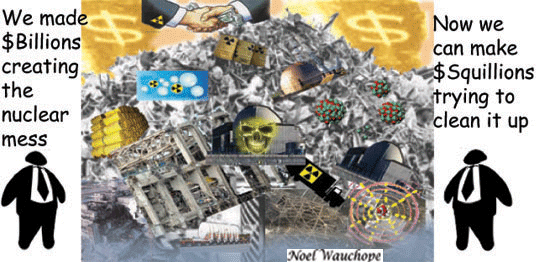
Eureka 10th Sept 2018 , The cover story of Eureka’s September issue looks at the programme to
decommission the UK’s legacy nuclear power plant, with particular
emphasis on the opportunities this creates for engineering innovation. The
reasons for this are clear: radioactive environments represent some of the
most challenging engineering scenarios possible, with extended human
presence in them simply not feasible. This means that robotics have a
massive role to play and it is these solutions that are attracting much
investment.
What many may not understand is just how massive an undertaking
this decommissioning programme is. Decommissioning across 17 nuclear sites
will take more than a century and involve the expenditure of an estimated
£118 billion pounds over that period. Clearly this offers considerable
scope for investment in and applications of new technologies. The Nuclear
Decommissioning Authority currently offers significant funding for the
right solutions. With that in mind, it would seem a good time for the
UK’s design engineers to step up.
http://www.eurekamagazine.co.uk/design-engineering-blogs/the-decommissioning-dividend-1/182843/
Now even the International Atomic Energy Agency (IAEA) reports a dim view of nuclear energy’s future
 New IAEA Energy Projections See Possible Shrinking Role for Nuclear Power, IAEA, 11 Sept 18 Nuclear power’s electricity generating capacity risks shrinking in the coming decades as ageing reactors are retired and the industry struggles with reduced competitiveness, according to a new IAEA report……
Overall, the new projections suggest that nuclear power may struggle to maintain its current place in the world’s energy mix. In the low case to 2030, the projections show nuclear electricity generating capacity falling by more than 10% from a net installed capacity of 392 gigawatts (electrical) (GW(e)) at the end of 2017. In the high case, generating capacity increases 30% to 511 GW(e), a drop of 45 GW(e) from last year’s projection. Longer term, generating capacity declines to 2040 in the low case before rebounding to 2030 levels by mid-century, when nuclear is seen providing 2.8% of global generating capacity compared with 5.7% today……..
The wide range in the projections is also due to the considerable number of reactors scheduled to be retired around 2030 and beyond, particularly in North America and Europe, and whether they will be replaced by new nuclear capacity. ……
Over the short term, the low price of natural gas, the impact of renewable energy sources on electricity prices, and national nuclear policies in several countries following the accident at Japan’s Fukushima Daiichi Nuclear Power Plant in 2011 are expected to continue weighing on nuclear power’s growth prospects, according to the report. In addition, the nuclear power industry faces increased construction times and costs due to heightened safety requirements, challenges in deploying advanced technologies and other factors……….
Commitments agreed to at the 21st session of the United Nations Climate Change Conference (COP21) could also produce a positive impact on nuclear energy development in the future, according to the publication.
Regional Trends……….https://www.iaea.org/newscenter/pressreleases/new-iaea-energy-projections-see-possible-shrinking-role-for-nuclear-power
UK’s Moorside nuclear power project now teeters on the edge of collapse
 Plans for new Cumbria nuclear power station on verge of collapse,Toshiba’s plan to sell plant in disarray over government’s ‘risky’ financing plan, Guardian, Adam Vaughan, 11 Sept 18 Plans for a new nuclear power station in Cumbria are on the verge of collapsing after the Toshiba-owned company behind it laid off 60% of its workforce and embarked on a final effort to sell the project.Toshiba was due to sell the NuGen consortium to South Korea state-owned firm Kecpo in early 2018, as the Japanese firm exits international nuclear projects and looks to recoup some of the £400m it has spent on the Moorside plant.
However, Kepco has been delaying a final decision, due in part to the UK government signalling a new approach to financing nuclear power stations.
That forced NuGen to cut 60 of 100 jobs on Tuesday, following a six-week consultation with staff.
Unions said the the project’s problems showed the need for the government to take a stake in Moorside. Justin Bowden, the GMB national secretary, said: “The looming collapse of this vital energy project has been depressingly predictable for months.”
The skeleton NuGen team is now focused on clinching a deal with Kepco by the end of the year before Toshiba writes the unit off entirely at the end of March 2019………..
A team of about 30 government officials is being assembled to work on new nuclear financing, the Guardian understands. The government’s feasibility study on using RAB for new nuclear is expected in January. https://www.theguardian.com/business/2018/sep/11/toshiba-plans-for-new-cumbria-nuclear-power-station-on-verge-of-collapse
 |
ReplyForward
|
UK’s Department of Business, Energy and Industrial Strategy is NOT backing Small Modular Nuclear Reactors
 Global Warming Policy Foundation 10th Sept 2018 An important new briefing paper published by the Global Warming Policy Foundation reveals that the government has kicked a key nuclear programme into the long grass.
This follows an announcement last week by the Department of Business, Energy and Industrial Strategy on its small modular nuclear (SMR) competition, which outlined new funding for feasibility studies into a range of new nuclear technologies.
The report, by nuclear industry expert Andrew Dawson, shows that while this might appear to represent progress, in reality it is likely to be the end of the SMRs in the UK: “When George Osborne announced the SMR competition in 2015, it was about identifying SMR technologies that could be deployed in the near-term. But in its announcement last week, BEIS made it clear that it would only back “blue-skies” projects, some of which are not SMRs, and
none of which have any hope of breaking ground in the next few decades……
https://www.thegwpf.org/who-killed-the-small-modular-nuclear-programme/
From 1948-till now -UK’s Springfield nuclear plant’s radioactive discharge continues into River Ribblde
Radiation Free Lakeland 10th Sept 2018 , Springfields** This is from the 1990s. “You and Yours” BBC Radio 4 programme
describing the “biggest in the UK” radioactive discharges The
Springfields plant discharges directly into the River Ribble and has done
so since 1948. What has changed? Nothing, apart from the fact that any
mention of cancer and radioactive discharge by eminent doctors is now a
taboo subject.
https://mariannewildart.wordpress.com/2018/09/10/6th-installment-of-the-springfields-archive-prestons-radioactive-river/
More $millions for nuclear weapons in US spending bill
 Nuclear weapons budget gets boost in US spending bill, Defense News, WASHINGTON 11 Sept 18
— Congress could, in the coming days, finalize a nuclear weapons budget that adds $458 million in 2019 over last year, after a conference committee released a compromise funding plan on Monday.
CODEPINK’s Medea Benjamin takes a look inside Iran

Anti-war activist wants peace talks with Iran, not crushing sanctions
By Sophia Akram, The Iranian
Medea Benjamin’s entry into the public sphere came with disruptive vigor in May 2013, when she interrupted an address by former US President Barack Obama to object to his then policy on the use of armed drones.
Obama responded to Benjamin at the time saying, “The voice of that woman is worth paying attention to… these are tough issues, and the suggestion that we can gloss over them is wrong.”
The incident perhaps gave Benjamin a bigger audience for her activism via the organization CODEPINK, through which she had been involved for years. And through which she’s tackled a number of global issues across the world.
Having looked at the Kingdom of Saudi Arabia in a book published in 2016, she’s now taking on Iran.
 CODEPINK co-founder, Medea Benjamin, has a new book out…
View original post 1,331 more words
Trump’s chaos campaign
Iran honored its nuclear deal. But Trump’s sanctions could plunge the region into conflict
By Vijay Prashad, Independent Media Institute
On August 4, Iran’s President Hassan Rouhani went on television to talk about the reinstatement of sanctions by the United States against his country. He prepared the country for more privations as a result of the sanctions. Responding to Trump’s offer for a meeting, Rouhani said pointedly, “If you stab someone with a knife and then say you want to talk, the first thing you have to do is to remove the knife.”
It is clear to everyone outside the U.S. government that Iran has honored its side of the 2015 nuclear deal that it made with the governments of five permanent members of the UN Security Council (the U.S., the UK, France, China and Russia) as well as the European Union. In fact, quite starkly, the European Union’s foreign…
View original post 1,430 more words
Iranians want peace. Trump isn’t helping
Tehran Peace Museum is a vibrant hub of peacemaking and education
By Linda Pentz Gunter
The fact that there is a Tehran Peace Museum seems like an important thing to know right now. Despite the bellicose, all capital letters Twitter rhetoric of the man inflicted on us to run the United States, there are many ordinary people in Iran who want peace.
That peace has been put in greater jeopardy, not only by a man who refuses to look in the mirror (or the history books) when accusing Iran of “DEMENTED WORDS OF VIOLENCE & DEATH.” It has been undermined by the White House decision to withdraw the US from the Iran nuclear deal — officially known as the Joint Comprehensive Plan of Action (JCPOA). The JCPOA, forged under the Obama administration, created the greatest likelihood to date that Iran would not develop nuclear weapons.
On the face of…
View original post 1,397 more words
American politicians pushing to have tax-payers fund new nuclear
 Bipartisan senators seek to revive nuclear energy investment, Utility Dive, Iulia Gheorghiu
Dive Brief:
- Sen. Lisa Murkowski, R-Alaska, introduced a nuclear energy bill with a group of bipartisan senators Thursday, seeking more action from the Department of Energy (DOE) in support of advanced nuclear energy goals.
- The bill would extend the maximum length for federal power purchase agreements (PPA) from 10 years to 40, to accommodate the long life and costs of nuclear plants.
- The bill also seeks to enhance federal investment in the nuclear industry, establishing facilities to test and develop advanced nuclear reactors and to develop domestic capabilities to produce the type of uranium needed for advanced reactors.
Dive Insight:While nuclear advocates are already lauding the ambitious scope of the bill, it may not have much chance to pass based on other policy priorities this late into the legislative session.
“But it will definitely be a top priority for us next year and shows very solid bipartisan momentum for advanced nuclear,” Darren Goode, spokesperson for the conservative consulting group ClearPath, wrote Utility Dive via email.
ClearPath supports advanced nuclear reactor development and the group’s president, Jay Faison, recently penned a piece with Murkowski regarding the need for nuclear energy in rural communities.
“Whether it gets done in this session or it gets reintroduced the next session, directionally, I think it’s a key message from the congress to the executive branch,” Chris Colbert, chief strategy officer for the advanced nuclear developer NuScale Power, told Utility Dive.
NuScale is the closest company to commercial deployment of a small modular reactor in the U.S., with the first plant to use NuScale technology scheduled to be online in 2026, Colbert said. The PPA extension would “clearly help with near-term deployment for the NuScale plant,” he said. The plant will have a 60-year life, making the possibility of a 40-year PPA “that much stronger to help with the project.”
The bill seeks to extend PPAs since more than a decade is needed to pay for the initial capital costs for nuclear reactors. Besides creating an extension for federal PPAs, the bill directs the DOE to partner with industry and purchase a longer-term nuclear PPA as part of a pilot program to use the new technology to increase reliability and resilience for critical grid assets.
The plant using NuScale technology, under development at the Idaho National Laboratory, is a testament to the importance of federal funding, research and development. Republican Idaho Sens. James Risch and Mike Crapo co-sponsored the bill and praised the ongoing work in their statements.
“The research and advances in nuclear energy being achieved by the experts at Idaho National Lab will be supported well into the future under this legislation,” Crapo said in a statement. he bill directs the DOE to establish specific advanced nuclear reactor R&D goals and a 10-year strategic plan for the DOE Office of Nuclear Energy to meet those goals, while also creating an education program to help meet nuclear energy workforce needs……..https://www.utilitydive.com/news/bipartisan-senators-seek-to-revive-nuclear-energy-investment/531917/
1 This Month

18 March Webinar @ 1 PM EST: An Assessment of SMR Projects: The Case of Canada
register for the zoom:
https://us02web.zoom.us/webinar/register/WN_o8BIIOUvQ2ONJR1nta65DQ#/registration

of the week – STOP SMALL MODULAR REACTORS IN CANADA
To see nuclear-related stories in greater depth and intensity – go to https://nuclearinformation.wordpress.com
-
Archives
- February 2026 (256)
- January 2026 (308)
- December 2025 (358)
- November 2025 (359)
- October 2025 (376)
- September 2025 (258)
- August 2025 (319)
- July 2025 (230)
- June 2025 (348)
- May 2025 (261)
- April 2025 (305)
- March 2025 (319)
-
Categories
- 1
- 1 NUCLEAR ISSUES
- business and costs
- climate change
- culture and arts
- ENERGY
- environment
- health
- history
- indigenous issues
- Legal
- marketing of nuclear
- media
- opposition to nuclear
- PERSONAL STORIES
- politics
- politics international
- Religion and ethics
- safety
- secrets,lies and civil liberties
- spinbuster
- technology
- Uranium
- wastes
- weapons and war
- Women
- 2 WORLD
- ACTION
- AFRICA
- Atrocities
- AUSTRALIA
- Christina's notes
- Christina's themes
- culture and arts
- Events
- Fuk 2022
- Fuk 2023
- Fukushima 2017
- Fukushima 2018
- fukushima 2019
- Fukushima 2020
- Fukushima 2021
- general
- global warming
- Humour (God we need it)
- Nuclear
- RARE EARTHS
- Reference
- resources – print
- Resources -audiovicual
- Weekly Newsletter
- World
- World Nuclear
- YouTube
-
RSS
Entries RSS
Comments RSS
 nuclear-news