The danger if other countries followed Australia on its dismissal of climate action

if all other countries were to follow Australia’s current policy settings, warming could reach over 3°C and up to 4°C.
 Climate Change Policy Toppled Australia’s Leader. Here’s What It Means for Others, New York Times, By Somini Sengupta Aug. 24, 2018
Climate change policy toppled the government in Australia on Friday.
How much does that really matter?
It is certain to keep Australia from meeting its emissions targets under the Paris climate agreement.
It’s also a glimpse into what a potent political issue climate change and energy policy can be in a handful of countries with powerful fossil fuel lobbies, namely Australia, Canada and the United States.
In Australia, the world’s largest exporter of coal, climate and energy policy have infused politics for a decade, helping to bring down both liberal and conservative lawmakers.
This week, the failure to pass legislation that would have reined in greenhouse gas emissions precipitated Malcolm Turnbull’s ouster as prime minister. He was elbowed out by Scott Morrison, an ardent champion of the Australian coal industry who is known for having brought a lump of the stuff to Parliament.
It could be a bellwether for next year’s Canadian elections, expected in October, in which Prime Minister Justin Trudeau faces a powerful challenge from politicians aligned with the country’s oil industry. Conservatives have pledged to undo Mr. Trudeau’s plans to put a price on carbon nationwide if they take power. At the provincial level, conservatives won a majority in Ontario after campaigning against the province’s newly enacted cap-and-trade program.
The Australian parallels with the United States are striking. The Trump administration has promised to revive the coal industry, rolled back fuel emissions standards and announced the country’s exit from the Paris pact altogether. Climate change is not a driving issue in the United States midterm election campaign, though it is for liberal Democrats, a recent study by the Yale Program on Climate Change Communication has shown.
Environmental policy and global warming are top priorities for those who describe themselves as liberal Democrats, the study found, after health care and gun control.
……… Robert C. Orr, dean of the School of Public Policy at the University of Maryland, pointed to another parallel: In both Australia and the United States, local leaders have embraced renewable energy even as national politicians promote fossil fuels.
“Australia is a lot like the U.S.,” said Dr. Orr, who is also the special adviser on climate change to the United Nations secretary general. “Climate policy has really been driven from below, from the state, local and business level. That is not going to change.”
Most Australian states have renewable energy targets, and Australians are powering their houses with solar energy at one of the highest rates in the world. But Australia’s emissions have continued to rise.
Australia is among several industrialized nations that are not on track to reduce greenhouse gas emissions to keep global warming below two degrees Celsius as the Paris accord promises, according to independent analyses.
Climate Action Tracker, an alliance of European think tanks that tracks countries’ climate pledges under the agreement, concluded recently that “if all other countries were to follow Australia’s current policy settings, warming could reach over 3°C and up to 4°C.” Those are levels that climate scientists consider “highly insufficient” to stop the worst effects of climate change. https://www.nytimes.com/2018/08/24/climate/australia-climate-change.html
Imran Khan and Pakistan’s nuclear bomb

 Managing Pakistan’s Bomb: Learning on the job, Bulletin of the Atomic Scientisrs, By Pervez Hoodbhoy, Zia Mian, August 17, 2018 “…….the biggest and most important challenge Imran Khan will confront as prime minister is something he did not mention at all in his speech—how to manage the Bomb. The lives and well-being of Pakistan’s 200 million citizens and countless millions in India and elsewhere depend on how well he deals with the doomsday machine Pakistan’s Army and nuclear complex have worked so hard to build.
To be fair, it is not clear that Imran Khan will have much choice regarding nuclear policy. For Pakistani politicians, the options largely come down to either support the Bomb, or keep quiet about it. Like other prime ministers before him, Imran Khan may go and have his picture taken with the missiles that will carry nuclear warheads and pose with the scientists and engineers that make them and the military units that plan and train to fire them.
Imran Khan’s two-decade-long political career overlaps with the creation of Pakistan’s nuclear arsenal, but he has had very little to say about the Bomb. When he has spoken, it has been as a Bomb supporter…….
Imran Khan also has courted the support of Abdul Qadeer Khan (no relation), the man most closely identified in Pakistani minds with the country’s Bomb. ……..
This history suggests that Imran Khan may be likely to support the continued build-up of Pakistan’s nuclear arsenal. It is estimated that the arsenal now is on the order of 150 nuclear weapons, with Pakistan being able soon to deliver these weapons from airplanes (either via bombs or cruise missiles), on land-based ballistic missiles and cruise missiles, and on cruise missiles launched from submarines…….https://thebulletin.org/2018/08/managing-pakistans-bomb-learning-on-the-job/?utm_source=Bulletin%20Newsletter&utm_medium=iContact%20email&utm_campaign=August24
Increased danger for mountaineers, as climate change melts the French Alps
Climate change is melting the French Alps, say mountaineers

 Permafrost ‘cement’ is evaporating, making rocks unstable and prone to collapse with many trails now deemed too dangerous to use, Guardian, Simon Birch, 24 Aug 18, For the tourists thronging the streets and pavement cafes of Chamonix, the neck-craning view of Mont Blanc, the highest mountain in the Alps, is as dazzling as ever.
But the mountaineers who climb among the snowy peaks know that it is far from business as usual – due to a warming climate, the familiar landscape is rapidly changing.
“Global climate change has serious and directly observable consequences in high mountains,” says Vincent Neirinck from Mountain Wilderness, a campaign group that works to preserve mountain environments around the world.
One of the consequences of climate change is the ongoing retreat of glaciers. “In the Alps, the glacier surfaces have shrunk by half between 1900 and 2012 with a strong acceleration of the melting processes since the 1980s,” says Jacques Mourey, a climber and scientist who is researching the impact of climate change on the mountains above Chamonix.
The most dramatic demonstration of glacial retreat is shown by the Mer de Glace, the biggest glacier in France and one of Chamonix’s biggest tourist hotspots which would now be unrecognisable to the Edwardian tourists who first flocked there.
“The Mer de Glace is now melting at the rate of around 40 metres a year and has lost 80m in depth over the last 20 years alone,” says glaciologist Luc Moreau.
A stark consequence of the melting Mer de Glace is that 100m of ladders have now been bolted onto the newly exposed vertical rock walls for mountaineers to climb down onto the glacier.
Another key impact of climate change in the mountains is that it is leading to an increase in the number of rockfalls; more than 550 occurred in the Mont Blanc massif alone between 2007 and 2015.
Another key impact of climate change in the mountains is that it is leading to an increase in the number of rockfalls; more than 550 occurred in the Mont Blanc massif alone between 2007 and 2015……..https://www.theguardian.com/environment/2018/aug/24/climate-change-is-melting-the-french-alps-say-mountaineers
A failed test leaves Russia’s ultimate doomsday weapon lost in the Barents Sea

 Russia Seems to Have Lost the Ultimate Doomsday Weapon: A Nuclear-Powered Cruise Missile https://nationalinterest.org/blog/buzz/russia-seems-have-lost-ultimate-doomsday-weapon-nuclear-powered-cruise-missile-29632
Here’s what we know.
– Citing an unnamed U.S. intelligence official, CNBC reports that that Russian military lost one of the four cruise missiles used during tests conducted over the Barents Sea between last November and February, all of which ended in failure.
– While it’s currently unclear which launch resulted in the lost missile, U.S. Air Force nuclear-sniffing WC-135 ‘Constant Phoenix’ aircraft were active in the Barents Sea and Baltic Sea from March to August of this year, with a Russian fighter intercepting one of the aircraft over the Baltic Sea on August 8.
– This missile, one of many doomsday devices touted by Russian President Vladimir Putin’s government during Moscow’s last showcase of new military capabilities, is purportedly capable of loitering as an unmanned second-strike platform that can remain in the air for an extended period of time over a virtually unlimited range.
Frankly, a nuclear-powered cruise missile is a 1950s dream that goes against all logic in a world with hundreds of ICBMs tipped with multiple independently-targetable reentry vehicles, all of which can kill a city.
This article by Brad Howard originally appeared at Task & Purpose. Follow Task & Purpose on Twitter .
Donald Trump has directed the secretary of state, Mike Pompeo, to delay a planned trip to North Korea
 Trump orders Pompeo to delay nuclear North Korea talks due to lack of progress https://www.theguardian.com/us-news/2018/aug/24/trump-pompeo-delay-nuclear-north-korea-talks-lack-of-progress
‘I do not feel we are making sufficient progress’
Trump suggests US-China trade dispute may be to blame, Guardian, Martin Pengelly, 24 Aug 18, Donald Trump has directed the secretary of state, Mike Pompeo, to delay a planned trip to North Korea, the president tweeted on Friday, “because I feel we are not making sufficient progress with respect to the denuclearisation of the Korean Peninsula”.
Trump met Kim Jong-un in Singapore in June, after months of abuse and threats between the two leaders and the US-led imposition of tough sanctions against Pyongyang.
Trump claimed the Singapore summit was a success, after he signed a joint statement which said in part: “President Trump committed to provide security guarantees to the DPRK, and Chairman Kim Jong-un reaffirmed his firm and unwavering commitment to complete denuclearization of the Korean peninsula.”
North Korea has returned to the US remains of soldiers killed in the Korean war, which was fought between 1950 and 1953 and has never formally ended. But critics have said the Singapore statement achieved nothing concrete and progress has been slow.
On Friday, at the end of a week in which the International Atomic Energy Agency said North Korea was still developing nuclear weapons, Trump made a striking U-turn.
Some of the blame rested with China, he said, “because of our much tougher Trading stance”.
Trump’s imposition of tariffs on steel and other imports has touched off an intensifying trade war with Beijing.
Trump added: “I do not believe they are helping with the process of denuclearization as they once were (despite the UN Sanctions which are in place).
“Secretary Pompeo looks forward to going to North Korea in the near future, most likely after our Trading relationship with China is resolved.”
Pompeo, formerly CIA director, has played a leading role in talks with North Korea, meeting Kim twice on three visits to Pyongyang. On Thursday, he appointed a senior Ford executive, Steven Biegun, to be his special envoy. The two men would visit the country next week, Pompeo said.
A senior White House official told Reuters Trump asked Pompeo not to go to North Korea during a meeting at the White House on Friday afternoon.
Trump tweeted: “I would like to send my warmest regards and respect to Chairman Kim. I look forward to seeing him soon!”
In response, Kelly Magsamen, vice-president for national security and international policy at the Center for American Progress and a former Pentagon and White House adviser on Asia, tweeted that Trump was “undermining his own leverage again. Not to mention his [secretary of state] and new envoy”.
“It’s fine to not send the secretary due to lack of progress,” she wrote, “but don’t then also talk about how you are eager to meet with [Kim] and how China is thwarting you.”
Trump left the White House on Friday for Ohio, where he was due to visit a hospital and speak at a Republican dinner. He did not respond to shouted questions about North Korea.
UK government outlines plans for the civil nuclear sector if Britain leaves European Union without any deal
‘No deal’ nuclear Brexit papers published by BEIS https://utilityweek.co.uk/no-deal-nuclear-brexit-papers-published-beis/ 24/08/2018 at 8:02pm Adam John The government has outlined plans for the civil nuclear sector to prepare for a scenario in which the UK leaves the EU with “no deal”.
As part of the first batch of 25 documents, which offer advice to people and organisations, the government has published two papers looking at the key issues of regulations and research for nuclear.
Rules on the ownership of nuclear material, supply contracts and nuclear import and export licences are set out in the papers.
All operators in the UK civil nuclear sector will need to comply with a new domestic safeguards regime, which will come into force after 29 March 2019. The UK has already passed new legislation so that the Office for Nuclear Regulation (ONR) can oversee domestic safeguards instead of the European Atomic Energy Community (Euratom).
The new regime is not dependent on there being a deal with the EU and Euratom, the Department of Business, Energy and Industrial Strategy (BEIS) said.
Agreements have been signed by the government and the International Atomic Energy Agency (IAEA) to replace the existing trilateral agreements between the IAEA, Euratom and the UK.
BEIS says Euratom ownership of special fissure material in the UK will end and operators will have full ownership after Brexit. Energy UK said the documents contain “some important clarifications” but the trade body expects the second batch of papers to provide “more clarity”.
It stresses a “no deal” scenario will have “significant and negative consequences” for the energy industry.
But the government insists a scenario in which the UK leaves the EU without agreement “remains unlikely”.
It said it has a duty to “prepare for all eventualities” until it can be certain of the outcome of those negotiations.
Under current rules the UK is a member of Euratom, which facilitates cooperation between EU countries in the civil nuclear sector. Following Brexit the country will leave the organisation.
Upon exit from the EU, Euratom Supply Agency approval will no longer be required for supply contracts for nuclear material agreed by UK-established operators, except where these involve an EU27-established operator.
With regards to import and export licences, if there is no deal on exit day then under updated arrangements, importers may need to obtain an import licence for relevant nuclear materials from the EU.
Rules on managing spent fuel and radioactive waste have also been considered. A no deal situation will mean the UK will no longer have to notify the European Commission of plans for the disposal of radioactive waste.
A second notice explains how civil nuclear research that the UK already undertakes with the EU will be affected in the event of no deal.
Through the Euratom research and training programme, of which the country is currently a part of, the UK participates in several research programmes.
In a no deal scenario, the UK will:No longer be a member of the Euratom research and training programme
No longer be a member of Fusion for Energy
Therefore, no longer be able to collaborate on the international thermonuclear experimental reactor project through the EU
The government has however reaffirmed its commitment to nuclear research. This will mean continued domestic research, as well as its other international partnerships, to ensure the UK retains its “world leading position” in this field. Responding to the publication of the first batch of advice papers, Energy UK’s head of European affairs, Marta Krajewska, said: “While it contains some important clarifications for the nuclear sector, as well as on a number of horizontal issues with impact on our industry, we would expect the second batch to provide more clarity in a number of other areas critical for the energy sector.
“We would also stress that, while it is responsible for government and business to prepare for all eventualities, a ‘no-deal’ scenario will have significant and negative consequences for the energy industry and would likely create cost pressure that could impact customers’ bills.
“Energy UK believes that a deal, with a transition period, is by far the best way forward for the energy industry and the UK as a whole.” The first batch of papers also covered areas including medical supplies, financial services, farming and organic food production. Around 80 notices are expected to be released in the coming weeks.
Brexit secretary Dominic Raab admitted to a risk of potential “short-term disruption” if the UK leaves the EU without a deal but said it remains an unlikely outcome.
Plutonium remains in the ground below proposed Rocky Flats national wildlife refuge

 Guardian 22nd Aug 2018 The nation’s newest national wildlife refuge, filled with swaying prairie
grass and home to a herd of elk, is slated to open next month just outside
Colorado’s largest city.
But seven Denver metro area school districts
have already barred school-sanctioned field trips to the preserve. A top
local health official says he would probably never hike there.
And a town is suing over what the soil might contain. “The threat posed by
contamination at Rocky Flats and its effect on visiting children appears to
be an issue of dispute amongst experts,” Lisa Flores, a Denver public
schools board of education member, told the Guardian.
“Until we have definitive assurances of child safety, we will exercise an abundance of
caution.” The 2,119-hectare (5,237-acre) Rocky Flats national wildlife
refuge, due to open this autumn, sits on land surrounding what once was a
nuclear weapons production facility. From 1951 to 1989, the Rocky Flats
Plant manufactured plutonium triggers – grapefruit-size spheres that,
when compressed by explosives, catalyze a nuclear reaction. Though the
area, about 20 miles north-west of Denver, has been cleaned up and declared
safe by the government, plutonium remains in the ground where the facility
once stood.
https://www.theguardian.com/environment/2018/aug/22/new-us-refuge-rocky-flats-plutonium-toxic
The nuclear modernization program is not sustainable economically- Kristensen
“…………KRISTENSEN: The current modernization program, to the best we can see, is not sustainable economically. It’s not that the United States couldn’t pay for all of those
So what’s happening now is that there are so many warning signs already that in the ’20s, the cost of the nuclear modernization program is going to force cuts elsewhere in the defense budget, if you want to pay for it. So right now there are people who are out saying, well, why don’t we adjust the nuclear modernization program now, so we don’t have to make these catastrophe cuts later in that may mess up a program or create confusion about our posture and all these types of things.
But we have a very die-hard nuclear advocacy group or community right now that, every time they go to Congress and testify about the nuclear modernization program, it’s like, “Oh no, this is the only one, this is all we can do. Oh no, we can pay for it, it’s only a small portion of defense budget.” They just keep perpetuating this and all the warning signs are out that there are going to be some nasty adjustments that have to be made. https://www.washingtonpost.com/news/checkpoint/wp/2018/08/24/the-modern-nuclear-arsenal-a-nuclear-weapons-expert-describes-a-new-kind-of-cold-war/?utm_term=.fba7f776436e
Minnesota community concerned about nuclear waste storage dangers
Cautious optimism surrounds nuclear waste storage progress in Minnesota, Duluth News Tribune, RED WING, Minn. 24 Aug 18 — Federal lawmakers voiced optimism Thursday, Aug. 23, about progress toward relocating the country’s radioactive waste to a permanent repository, though the community living closest to spent nuclear fuel in Minnesota has its doubts.
“Until we actually see it start moving, we won’t be 100 percent optimistic,” Prairie Island Tribal Council President Shelley Buck said about the more than two dozen dry storage casks holding spent nuclear fuel at Xcel Energy’s Prairie Island nuclear plant. The waste has been building up for years a few hundred yards away from the Prairie Island Indian Community.
The proximity of the storage casks, combined with the potential for flooding on the Mississippi River and derailment of an oil train that could block the only evacuation route off the island, puts the existence of the tribal community at risk, Buck said.
She made the comments during a roundtable discussion at the nuclear plant attended by U.S. Reps. Jason Lewis, R-Minnesota, and John Shimkus, R-Illinois, as well as representatives from the city of Red Wing, Prairie Island Indian Community and Xcel Energy.
Shimkus, who sits on the House Energy and Commerce Committee, sponsored a bill directing the Department of Energy to begin a program to consolidate and temporarily store the country’s spent nuclear fuel while a permanent storage facility is developed at Yucca Mountain, about 90 miles northwest of Las Vegas in the Nevada desert.
The bill, H.R. 3053, passed in the House by a vote of 340-72 in May. It has been referred to the U.S. Senate Committee on Environment and Public Works.
Shimkus said he believes the bill would pass by the same ratio or better as it did in the House if it goes before the Senate for a vote.
Another hurdle is budget appropriations to fund Yucca Mountain licensing work.
Local storage, national issue.……..
Nevada lawmakers and residents have long opposed the Yucca Mountain plan, along with conservation groups, groups opposed to nuclear energy and those concerned about the safety of transporting nuclear waste across the country.
Lewis, who represents Minnesota’s 2nd Congressional District which is home to Prairie Island nuclear plant, said the issue extends beyond his constituents.
“This is a national issue,” Lewis said, noting nuclear waste is being stored at 121 locations across 39 states.
Xcel Energy also owns a nuclear plant in Monticello.
Ratepayers who benefited from nuclear energy had been paying into a government fund to finance the repository project to the tune of about $40 billion over 35 years, according to a House Energy and Commerce Committee report. Legal proceedings have since ceased the collection of funds. The federal government also is on the hook for lawsuits over the failure to dispose of nuclear waste.“We don’t have a choice but to get something done,” Lewis said. “And we are as close as we have ever been.” http://duluthnewstribune.com/business/energy-and-mining/4490010-cautious-optimism-surrounds-nuclear-waste-storage-progress
China co-operating with Russia in nuclear war games
The People’s Liberation Army will send more than 3,200 troops, 900 pieces of military equipment, and 30 aircraft to Russia for the exercise known as Vostok-18, or East-18, the Chinese Defense Ministry said, noting the exercises will involve practicing maneuver defense, live firing of weapons, and counterattack.
“We urge Russia to take steps to share information regarding its exercises and operations in Europe to clearly convey its intentions and minimize and potential misunderstanding,” Pentagon spokesman Eric Pahon said when asked about Vostok-18.
Additionally, the joint Russian-Chinese exercises scheduled for Sept. 11 through 15 will include military forces from Mongolia for the first time……….https://freebeacon.com/national-security/chinese-military-joining-russians-nuclear-war-games/
Trump declared the North Korea nuclear threat over. The United Nations isn’t so sure,
LA Times,By TRACY WILKINSON Two months after President Trump boasted that North Korea is “no longer a nuclear threat,” growing evidence suggests that leader Kim Jong Un has not shut down the country’s illicit production of bomb-making material and other nuclear activities, raising concerns that the proposed denuclearization deal has stalled at the starting gate………http://www.latimes.com/nation/la-na-pol-us-norkor-nuclear-20180823-story.html
War fear panic is good for bunker salesmen in South Korea
 In South Korea’s war panic economy, sales thrive on nuclear angst, USA Today Seoul is renowned for its stoicism in the face of potential war. At least that’s what we’re often told, that the majority of people in this city of 25 million can wake up to North Korean threats about immolation in a nuclear “sea of fire,” shrug and just go to work.
Even when Pyongyang was detonating nukes last fall — and President Donald Trump spoke of bringing “fire and fury” to their peninsula — polls suggested that roughly six in 10 South Koreans believed there was “no possibility” of war. (Even Americans living an entire ocean away appear more panicky over North Korean nukes than that.)
But what about those in South Korea who can’t shake an impending sense of doom? For that anxious minority, there is a marketplace offering to aid in their survival should North Korea ever unsheathe its self-proclaimed “nuclear sword of justice.”
Call it the war panic economy: a small industry selling all the stuff you might want on doomsday. Think gas masks, hazmat suits and emergency rations. Or, for the upper classes, your own personal bunker………..
priciest bunker runs about $37,000. That buys a roughly 600-square-foot sanctum, complete with four beds, a sink trickling out purified water, an electrical system powered by a hand crank and an air purification system that can filter out radiation.
Imagine a small studio apartment with rounded steel walls, as in a submarine, with an entrance hatch that’s heavy as a bank-vault door. To make the bunker fully nuke-proof, he says, it must be buried underground and encased in cement.
“My clientele tend to be people in their 60s or older who might have memories of the war,” he says. “Often they want to provide bunkers to their sons or daughters.”
Those old enough to recall the aftermath of the Korean War can be forgiven for shivering at any mention of a redux. Between 1950 to 1953, parts on the peninsula were turned to veritable seas of fire, largely thanks to more than half a million American bombs.
As Curtis LeMay, the U.S. Air Force general overseeing the aerial campaign, put it:
“Over a period of three years, we killed off — what? — 20 percent of the population of Korea as direct casualties of war or from starvation and exposure.”
That these horrors exist within living memory might explain why some elderly Koreans feel especially jumpy over Pyongyang’s bombast — or aggressive tweets sent from the White House. Go has noticed that calls have spiked when either side makes threats.
But there is a flip side to this war panic economy. When fear runs hot, it thrives. But when peaceful vibes pervade, it practically collapses……..
Lee sells hundreds of items, all of which might prove handy in a world turned anarchic by nuclear or chemical attacks. Among his inventory: flare guns, attack batons, radiation detectors, four types of gas masks and, for the discriminating survivalist, emergency rations that taste like French Basque-style chicken stew. ………https://www.usatoday.com/story/news/world/2018/08/23/south-koreans-prepare-north-korean-nuclear-attack/1074765002/
Small Modular Nuclear Reactors could be a costly mistake for Idaho utility
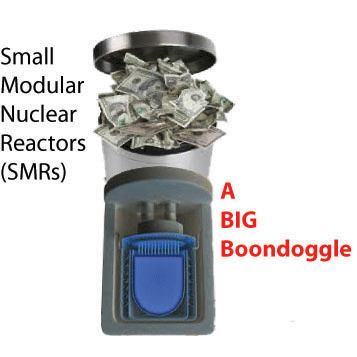 Murray Power looks to tap into nuclear energy Murray Journal By Shaun Delliskave|s.delliskave@mycityjournals.com Aug 23, 2018 Murray Power is moving forward with plans to tap into the nation’s first small nuclear modular reactor (SMR)—but not without opposition. Murray Power has, so far, committed $15,000 towards NuScale Power’s reactor, which is in development at the Idaho National Laboratory in Idaho Falls.Murray’s main power supplier belongs to the Utah Associated Municipal Power Systems (UAMPS) consortium, consisting of several municipally owned power systems in Utah. Murray City has subscribed to a portion of the nuclear plant’s capacity through its partnership with the UAMPS organization…….
NuScale Power is based out of Corvallis, Oregon and recently completed the Phase 1 review of its design certification application by the U.S. Nuclear Regulatory Commission (NRC). NuScale’s reactor is the first and only SMR to ever undergo an NRC review. …….
Diane Turner, chair of the Murray City Council, is leery about Murray’s interest in a reactor using unproved technology. “I have concerns about Murray committing funds to a new energy form that has not yet been proven and is likely to cost billions of dollars. It is my understanding that our initial investment is not that high. However, it is my concern that as we get further into the commitment it will cost much more.”
Watchdog groups have also expressed concerns regarding the new reactor. HEAL Utah, an advocacy group that promotes renewable energy to protect public health and the environment from dirty, toxic and nuclear energy threats, attended a recent city council committee-of-the-whole meeting to advocate for cleaner renewable investments in power and to express their concerns. They argued that renewable energy is more cost-effective and proven technologies already exist……..
radioactive waste generated by reactors remains toxic for thousands of years. The NuScale reactor has space to store waste for 60 years. Nuclear reactors also draw significantly from water resources.
This is one reason for Council Chair Turner’s reservations. “I don’t know that it is in Murray’s best interest to invest in nuclear rather than making further investments in renewable energy that has been determined to be more environmentally and fiscally sound.” http://www.murrayjournal.com/2018/08/23/179014/murray-power-looks-to-tap-into-nuclear-energy
Anxiety in Norway over Russia’s missing reactor-powered cruise missile in the Barents Sea
«There is no reason for any state to have a nuclear-powered missile»
Russia’s missing reactor-powered cruise missile in the Barents Sea obviously causes concerns, says Norway’s Environment Minister, Ola Elvestuen. Barents Observer ByThomas Nilsen August 23, 2018
«We have to take this seriously. From an environmental point of view this obviously causes concern,» Minister Elvestuen says to the Barents Observer.
Norway and Russia share the stocks of cod in the Barents Sea, a multi-billion business and important for tens of thousands of dinner-tables across Europe every day. A missing reactor-powered missile is no good news.
On Wednesday, Minister Ola Elvestuen met with the Barents Observer at the Fram Center in Tromsø, a Arctic climate and research center where also Norway’s High North section of the Radiation Protection Authority opened its new offices and lab.
«A possible missing nuclear-powered missile in important fishing grounds of the Barents Sea shows the importance of having a radiation emergency preparedness unit in Tromsø,» Elvestuen says.
First made public by President Vladimir Putin in March this year, the existence of a nuclear-powered cruise-missile was shown in a defense ministry video of the test-launching. Putin told that during the flight, the missile reached its design capacity and provided necessary propulsion. That would mean a start of the reactor, although the reactor going critical is not confirmed. During initial launch, the missile lifts off with regular fuel as can be seen in the video.
«We have to take this seriously. From an environmental point of view this obviously causes concern,» Minister Elvestuen says to the Barents Observer.
Norway and Russia share the stocks of cod in the Barents Sea, a multi-billion business and important for tens of thousands of dinner-tables across Europe every day. A missing reactor-powered missile is no good news.
On Wednesday, Minister Ola Elvestuen met with the Barents Observer at the Fram Center in Tromsø, a Arctic climate and research center where also Norway’s High North section of the Radiation Protection Authority opened its new offices and lab.
«A possible missing nuclear-powered missile in important fishing grounds of the Barents Sea shows the importance of having a radiation emergency preparedness unit in Tromsø,» Elvestuen says.
First made public by President Vladimir Putin in March this year, the existence of a nuclear-powered cruise-missile was shown in a defense ministry video of the test-launching. Putin told that during the flight, the missile reached its design capacity and provided necessary propulsion. That would mean a start of the reactor, although the reactor going critical is not confirmed. During initial launch, the missile lifts off with regular fuel as can be seen in the video………..
Attention to possible incidents or accidents involving nuclear reactors are raising in Norway, not least because of the increasing number of nuclear powered submarines sailing in Arctic waters. Both Northern Fleet submarines from bases on the Kola Peninsula and U.S. or British submarines making port calls to Northern Norway.
For the nuclear experts at NRPA in Tromsø though, the news about testing of reactor-powered missile and crashes are worrying. From Russia, little information about what’s going on is available. The missile program is surrounded by secrecy by the military………
Intelligence service confirms crashes
Norway’s military intelligence confirms to the Barents Observer their knowledge about two of the tested missiles failing during flight.
«The intelligence service confirms that Russia in November 2017 conducted two failed test-shootings of a new land-based cruise-missile from a temporarily test range at Novaya Zemlya. The first failed shortly after launch and fell down on the island. The other had a longer flightpath before failing or the test was aborted. That missile fell down in the sea near the shores on the west coast of Novaya Zemlya,» says Major Brynjar Stordal, spokesperson with the Joint Headquarters.
He says the intelligence service connects the tests to the new weapon President Putin described earlier this year. «It is indicated that the new missile is using a reactor-propulsion system. The intelligence service can not confirm that the missiles tested in November 2017 had such propulsion system,» Stordal says.
Also, the intelligence service has so far not registered, or received any information about, unormal levels of radiation from this area that is located some 800 kilometers from Norway……..
Small reactor, little radiation
In July, the Russian online Popular Mechanics published a longer article about the new missile powered by a small reactor. The article argues that the reactor could be a fast neutron reactor like the largest space reactors used by the Soviet Union. Also, the core may consist of Americium-242.
The reactor is very small in size, maybe less than half a meter.
Nils Bøhmer, nuclear physicist with Bellona says such reactor core might be possible. «It would then need less fissionable material to reach critical mass and consequently it would be less radioactivity compared with amore traditional reactor with uranium fuel,» Bøhmer says.
He underlines that there are many unanswered questions and a lot of uncertainty regarding such untested technology.
Testing a missile with a small nuclear reactor will, whatever, involve a calculated radiation risk. Any missile launched will have to come down, whether it is by accident or it hits its designated target. https://thebarentsobserver.com/en/security/2018/08/there-no-reason-any-state-have-nuclear-powered-missile
Missile defense systems bad for India-Pakistan nuclear détente
Asia Times, By MOHAN GURUSWAMY AUGUST 24, 2018 It has been reported that theDefense Acquisitions Council (DAC), chaired by Indian Defense Minister Nirmala Sitharaman, has approved the “acceptance of necessity” (AoN) for the acquisition of the National Advanced Surface to Air Missile System-II (NASAMS-II) worth around US$1 billion from the United States. However, in 2002 the US had vetoed India’s bid to acquire the Israeli Arrow-2 missile interceptor system.
Consequently, India’s Defense Research and Development Organization began developing the Prithvi Air Defense (PAD), which will provide long-range high-altitude interception during an incoming ballistic missile’s mid-course phase as well as interception during the terminal phase. At various times these systems had different monikers, such as ballistic missile defense (BMD) or anti-ballistic missile system (ABM).The people who decide on such things reside in New Delhi and understandably their safety gets priority. So it is the National Capital Region that will get the expensive and exaggerated sense of protection such systems tend to generate.But no air defense system can be deemed impenetrable. The Americans and Russians realized long before the Cold War ended that the costs involved were prohibitive, even for them. But the idea was seductive
……….We need to learn from how nuclear-weapons strategies evolved during the Cold War, instead of mimicking US and Soviet follies. The notion of deterrence between the US and USSR was based on no escape from MAD.
Cold War follies peaked with the two antagonists together deploying almost 70,000 warheads each aimed at a specific target. At the height of this madness almost every open ground was targeted as possible tank-marshaling or military-logistics areas.
Hence the last thing India wants is to get into a numbers game with Pakistan or China. Credibility depends on reducing the uncertainty of use from the opposite perspective. The Indian PAD missile defense system only increases them.
India and Pakistan have ensured a modicum of confidence by not mating the warheads and delivery systems, giving a vital period to roll back the unleashing of Armageddon. But now both countries will have to evolve a launch-on-warning doctrine.
Clearly, the two South Asian nuclear powers have a local version of MAD in place. The Pakistani doctrine “commits itself” to use battlefield nuclear weapons if an Indian conventional assault threatens its essential nationhood, and hence it has steadfastly refused to accept the notion of “no first use” (NFU). The Indian doctrine emphasizes NFU but also makes it explicit that any Pakistani use of nuclear weapons on India or its forces will be responded to with a massive retaliation.
India may have fewer nuclear weapons, not because it cannot make more, but because what it has is enough to ensure the complete annihilation of Pakistan, which is geographically a much smaller country.
For its part, China has moved on from NFU to a doctrine now called “credible minimum deterrence.” But how much is credible?
Mercifully, nuclear doctrines these days are couched in such abstractions since MAD requires a degree of predictability, ironically ensured by opacity. The United States’ “single integrated operational plan” (SIOP) began with the ominous words that its objective, after the outbreak of a general war with the then Soviet Union, was to turn it into a “smoking, radiating ruin.” This was written by its certifiable US Air Force chief, General Curtis Lemay Jr, based on whom the character played by George C Scott in the Stanley Kubrick classic Dr Strangelove was created.
But it was people like Lemay who gave MAD credibility. Since no one of a sane frame of mind would even contemplate the enormity of the disaster of a nuclear war, uncertainty of use was a key element of MAD. It has been written that Soviet leader Leonid Brezhnev used to have sleepless nights thinking of a man like Richard Nixon with his finger on the button.
India’s nuclear strategy documents in detail who the nuclear command would devolve to in the unlikely event of a decapitating first strike on New Delhi with the aim of eliminating its national leadership. It is said that the chain of nuclear command keeps descending to a major-general, a modern-day Raja Parikshit so to say, who will perform the final obsequies.
At last count India had more than 600 military officers at that level. Decapitating all of them is a near statistical and physical impossibility. It would take tens of thousands to precision nuclear weapons to annihilate India’s military chain of command, and it can be speculated whether even America or Russia could achieve that, let alone Pakistan.
Ironically, the evocative acronym MAD is an eminently sensible doctrine. Good sense should tell us: Enough of this madness, and leave MAD alone. http://www.atimes.com/missile-defense-systems-bad-for-india-pakistan-nuclear-detente/
1 This Month
Chernobyl: The Lost Tapes – A good documentary on Chernobyl on SBS available On Demand for the next 3 weeks– https://www.sbs.com.au/ondemand/tv-program/chernobyl-the-lost-tapes/2352741955560

of the week–London Campaign for Nuclear Disarmament

Tell the Ukrainian Government to Drop Prosecution of Peace Activist Yurii Sheliazhenko
To see nuclear-related stories in greater depth and intensity – go to https://nuclearinformation.wordpress.com
-
Archives
- April 2026 (126)
- March 2026 (251)
- February 2026 (268)
- January 2026 (308)
- December 2025 (358)
- November 2025 (359)
- October 2025 (376)
- September 2025 (257)
- August 2025 (319)
- July 2025 (230)
- June 2025 (348)
- May 2025 (261)
-
Categories
- 1
- 1 NUCLEAR ISSUES
- business and costs
- climate change
- culture and arts
- ENERGY
- environment
- health
- history
- indigenous issues
- Legal
- marketing of nuclear
- media
- opposition to nuclear
- PERSONAL STORIES
- politics
- politics international
- Religion and ethics
- safety
- secrets,lies and civil liberties
- spinbuster
- technology
- Uranium
- wastes
- weapons and war
- Women
- 2 WORLD
- ACTION
- AFRICA
- Atrocities
- AUSTRALIA
- Christina's notes
- Christina's themes
- culture and arts
- Events
- Fuk 2022
- Fuk 2023
- Fukushima 2017
- Fukushima 2018
- fukushima 2019
- Fukushima 2020
- Fukushima 2021
- general
- global warming
- Humour (God we need it)
- Nuclear
- RARE EARTHS
- Reference
- resources – print
- Resources -audiovicual
- Weekly Newsletter
- World
- World Nuclear
- YouTube
-
RSS
Entries RSS
Comments RSS
 nuclear-news