Scepticism, even among pro-nukers, about Russia’s much boasted floating nuclear power plant

The Nuclear Power Plant of the Future May Be Floating Near Russia, NYT 26 Aug 26 18 “………some environmental groups — even those open to a role for nuclear power as a substitute for traditional power plants — are skeptical.
For one, they are not convinced by Rosatom’s assurances of safety. Critics worry that during a tsunami, the 21,000-ton steel structure might not ride out the wave. In a worst-case scenario, they say, it would instead be torn from its moorings and sent barreling inland, plowing through buildings until it landed, steaming and dented and with two active reactors on board, well away from its source of coolant.
In such a case, Rosatom says, a backup power source and coolant on board would prevent the reactors from melting down, at least for the first 24 hours. “During this time we would consider what to do,” said Dmitri Alekseyenko, the deputy director for Rosatom’s floating reactor program. Regulators in the United States, however, require on-land reactors to operate for 72 hours in an emergency shutdown without external water supplies.
And the fact that the technology is well tested in Russian ships gives critics little solace, given a long history of spills and accidents involving nuclear-powered submarines and icebreakers operated by the Soviet and Russian navies.
In the 1960s and 1970s, the Soviet Union dumped reactors in the Kara Sea, in the Arctic Ocean north of Kola Bay. Russian nuclear submarines sank in 1989 and 2000, while one Russian nuclear icebreaker caught fire in 2011 and the reactor on another leaked radiation that year, according to Bellona, a Norwegian environmental group.
“The question is, would clients of Russia be comfortable with something like this being parked right at a pier in a major city?” Matthew McKinzie, director of the nuclear program at the Natural Resources Defense Council in Washington, said in a telephone interview.
A Greenpeace sailboat tailed the Akademik Lomonosov on its maiden voyage from a shipyard in St. Petersburg to Murmansk, where it will be fueled, flying a banner in English saying: “Floating Nuclear Reactor? Srsly?” ….
Russian official threatens use of nuclear weapons in Syria
Among such measures, the official said the deployment of Russian tactical nukes in countries such as Syria, the use of gold-linked cryptocurrencies for Russian arms exports and the suspension of a number of treaties with the US – such as non-proliferation of missile technologies.
Mr Gutenev said: “I believe that now Russia has to draw its own ‘red lines.’ “The time has come to ponder on variants of asymmetric response to the US, which are now being suggested by experts and are intended not only to offset their sanctions but also to do some retaliatory damage.
Among such measures, the official said the deployment of Russian tactical nukes in countries such as Syria, the use of gold-linked cryptocurrencies for Russian arms exports and the suspension of a number of treaties with the US – such as non-proliferation of missile technologies.
Mr Gutenev said: “I believe that now Russia has to draw its own ‘red lines.’
“It’s no secret that serious pressure is being put on Russia, and it will only get worse.
“It is intended to deal a blow to defence cooperation, including defence exports.”
The minister added that Russia should follow the advice of “experts” and follow the US’ example of deploying nuclear weapons in other countries.
He added: “We should follow the advice of certain experts, who say that Russia should possibly suspend the implementation of treaties on non-proliferation of missile technologies, and also follow the US example and start deploying our tactical nuclear weapons in foreign countries.
“It is possible that Syria, where we have a well-protected airbase, may become one of those countries.”……….https://www.express.co.uk/news/world/1008474/world-war-3-russia-nuclear-weapon-syria-us-sanctions
Nobody wants to pay the $4.7 Billion Nuclear Bill for South Carolina’s abandoned nuclear project

The $4.7 Billion Nuclear Bill That No One Wants to Pay Utility and South Carolina lawmakers clash over who should pick up the costs of abandoned project, WSJ By Mengqi Sun, 26 Aug 18
Aug. 25, 2018 The primary owner of a power plant with two partially built nuclear reactors in South Carolina walked away from the $9 billion project last summer because of high construction costs and delays. Now no one wants to pay for it.
The utility overseeing the Virgil C. Summer plant is asking ratepayers across the Palmetto State to shoulder its construction expenses of $4.7 billion, citing a law passed last decade. But local lawmakers are trying to force South Carolina Electric and Gas Co to pick up more of the tab. … (subscribers only) https://www.wsj.com/articles/the-4-7-billion-nuclear-bill-that-no-one-wants-to-pay-1535194801
Exelon teaching kids about nuclear power – conflict of interest?
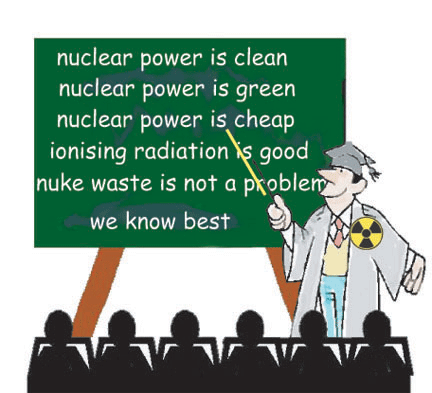 Exelon welcomes community to learn about nuclear power, Watertown Daily Times By DEBRA J. GROOM
“This is cool,” he said.
Dominick, 6, a first-grader at Hastings-Mallory Elementary School, visited the Exelon Generation nuclear plant site Tuesday with his grandmother Diane Giamartino as part of the annual Community Information Night. Nearly 200 people showed up to learn more about what the company does at its three Oswego nuclear plants and the different types of jobs available in the nuclear industry.
There were two buildings filled with “cool” things to see, according to Dominick.
In the first building, visitors could watch a 3D printer turn out these spinning toys that Dominick and other children could take home. The small plastic devices were made of one piece of plastic, but had parts that would spin in different directions……..
Dominick saw even more “cool” stuff in the other Exelon building — especially the nuclear plant control room simulator used by employees. The control room is the brain of the plant, a place filled with various lights and readings on a huge control-room board that supervisors, senior reactor operators and reactor operators keep their eyes tuned to 24 hours a day to ensure all systems in the plant are operating correctly.
Jill Lyon, speaking for Exelon, said the Community Information Nights have been held since 2014 to help area residents learn more about what goes on at the plants.http://www.watertowndailytimes.com/news04/exelon-welcomes-community-to-learn-about-nuclear-power-20180826
Risk of terrorist attacks in Japan Olympics: Japan strengthening waterfront security
 Tokyo tightening waterfront security ahead of Olympics, Japan Times 7 Aug 18 , JIJI, AUG 7, 2018
“…….Tokyo police will restrict ship operations near the competition venues and other facilities on the waterfront during the Olympics, while considering introducing state-of-the-art security equipment
…..The Japan Coast Guard is enhancing its security activities using patrol ships and aircraft.
……The Tokyo police are also beefing up their presence at Haneda airport.
A new facility adjacent to the airport is to be built by 2020. Anti-terrorist officers and explosive sniffer dogs will be stationed there at all times.
The police will have to guard a wide range of waterfront facilities, including “hotel ships,” during the games……https://www.japantimes.co.jp/news/2018/08/07/national/tokyo-tightening-waterfront-security-ahead-olympics/#.W4MdgiQzbGg
Tokyo Olympics have offical dance – ? The Radiation Tango?
 ICYMI, the Tokyo 2020 Olympics Have an Official Dance This month marks just 24 months (squee!) until the next Summer Olympics, set to go down summer 2020 in Tokyo, Japan. And what better way to get in the Olympic spirit starting RIGHT NOW than to learn a surprisingly intense choreographed dance?
The Tokyo 2020 Organizing Committee based this ditty and its accompanying moves on the theme song for the 1964 Summer Olympics, aka the last time Japan’s capital city hosted the Games……https://www.dancespirit.com/tokyo-2020-dance-2598707903.htm
Following Brexit, UK will no longer be a member of Nuclear Fusion for Energy
Nucnet 23rd Aug 2018 , If the UK and the EU fail to reach an agreement on Brexit terms, the UK
will no longer be a member of the Euratom R&T programme, no longer be a
member of Fusion for Energy, and will no longer be able to collaborate on
the International Thermonuclear Experimental Reactor (Iter) project through
the EU, the government said today.
In a paper on nuclear research if there is no Brexit deal, the UK government said it is committed to continued
domestic research and other international partnerships to ensure the UK
retains its “world leading position” in this field. The paper said the
UK is on track to have bilateral nuclear cooperation agreements in place
with “key priority partners” ahead of Brexit in March 2019. This will
allow for continued, unimpeded civil nuclear trade and nuclear research
cooperation with these countries.
But the UK will no longer be a member of Fusion for Energy, the organisation responsible for providing the EU’s
contribution to the multinational Iter fusion project in France. This means
UK businesses will not be able to bid for contracts to work on the Iter
project. However, the UK government said today it would be willing to
discuss opportunities for UK researchers, companies, and institutions, to
collaborate on “this critical experiment”.
https://www.nucnet.org/all-the-news/2018/08/23/uk-will-not-be-able-to-contribute-to-iter-without-brexit-deal-says-government
Renewable energy systems set to go ahead with new technology enhancing flexibility
 Chatham House 22nd Aug 2018 Electricity Markets** As renewables become a large share of the global energy mix, greater electricity system flexibility will be critical and will originate from the
small scale, write Daniel Quiggin and Antony Froggatt.
represent 75 per cent of global renewable electricity capacity growth over
the medium-term’. Bloomberg New Energy Finance also estimates that by
2040, nearly three-quarters of the $10.2 trillion invested in new
power-generating capacity will be in renewables.
costs associated with managing the system start to escalate once renewables
exceed a 30 per cent share of generated electricity. Unless properly
planned for, the growth in electric vehicle use and electric heating could
further amplify these ‘system integration costs’. They include the cost
of holding fossil fuel power plants in reserve for periods of low renewable
supply, grid upgrades and the dumping of power from renewables when system
constraints are reached.
and as a growing number of cars and domestic-heating systems begin to add
to power usage, how can governments ensure electricity is affordable? The
answer is ‘flexibility’. A raft of technologies already entering the
market, promise to radically enhance the flexibility of electricity
systems, helping contain system integration costs while accelerating the
low-carbon transition.
https://hoffmanncentre.chathamhouse.org/article/decentralised-flexibility/
Flexible localised renewable energy networks in UK
Centrica (accessed) 24th Aug 2018 , By 2040 Bloomberg New Energy Finance predicts that more than half of global
energy capacity will come from renewables and flexible sources, such as
battery storage and demand side response. At 7% of global capacity,
flexible sources such as batteries and demand side response – where homes
and businesses automatically cut energy usage a peak times – will account
for the same level of global energy capacity as oil-fired power plants
today.
And more than half of this energy storage capacity will come from
small-scale batteries installed by households and businesses alongside
rooftop solar panels.
This trend away from larger power plants and towards
smaller, decentralised energy systems is happening in both developed and
developing nations. The decarbonisation trend is being accelerated by the
falling price of renewable energy technology, and the availability of
technology such as batteries that makes it easier to store electricity.
This in turn accelerates decentralisation, as renewables are by their
nature smaller and more spread out than the equivalent capacity provided by
a traditional power plant.
The rate of decarbonisation and decentralisation
is being accelerated by digital technology, giving people the power to
save, or even make, money by being more flexible with their energy use,
while helping electricity grid operators to balance supply and demand.
Europe’s largest demand side response aggregator, REstore, was acquired
by Centrica in 2017. Centrica CEO Iain Conn says he expects demand side
response to become one of the fastest growing elements of the energy market
over the next few years. From smart home products such as Hive that allow
home owners to control their energy use from their smartphone, through to
companies like REstore employing artificial intelligence to calculate just
how much energy capacity a factory can offer as a virtual power plant.
Energy, like every other sector, is going digital.
Greater insight through
digital technology is just the start of the shift of power away from energy
companies and towards the customer. Centrica is currently piloting a
project in the south west of England that will allow local residents and
businesses to buy and sell energy between themselves without the
intervention of their energy supplier. The £19 million Local Energy Market
in Cornwall is enabling 200 homes and businesses to do this using a digital
record known as Blockchain. It is used to create a secure electronic ledger
of transactions between participants. Iain Conn says he believes such local
networks will become the norm in a new decentralised energy market.
https://www.centrica.com/platform/three-tech-trends
Mary Olson warns on the danger to women of ionising radiation
 Resource Service, talks about the greater danger faced by women and girls
exposed to ionizing nuclear radiation.
nuclear weapons facilities. Mary Olson’s research and activism is a
driving force for the Treaty to Abolish Nuclear Weapons. This Nuclear Free
Future conversation takes heed of this topic 73 years after the bombing of
Hiroshima and Nagasaki on August 6 and August 9, 1945.
https://www.cctv.org/watch-tv/programs/gender-matters-atomic-era
Cesium in California’s wine – from Fukushima nuclear accident
 The Register 19th Aug 2018 , Savants reckon radiation released by the 2011 Fukushima nuclear kerfuffle
has made its way into California’s wine. A paper emitted this month by
researchers at the University of Bordeaux Centre d’Études Nucléaires de
Bordeaux-Gradignan (CNRS) in France revealed that levels of cesium-137 in
the atmosphere rose as a result of the reactor accident, judging by Cali
tipple tested before and after Japan’s level-7 nuclear disaster.
where trace amounts of the highly soluble cesium isotope got into the
grapes used to make the region’s famed wines.
https://www.theregister.co.uk/2018/07/19/fukushima_cesium_wine/
USA emergency measures include preparations for nuclear attacks on 60 U.S. cities
 The Hill 24th Aug 2018 The Federal Emergency Management Agency (FEMA) is updating emergency
management plans to include plans for potential nuclear detonations in 60
U.S. cities. An agency official told BuzzFeed News that the agency is
shifting plans away from the likelihood of a terrorist detonating a smaller
nuclear device and toward the possibility of a state actor detonating a
military-grade nuclear weapon.
http://thehill.com/policy/national-security/403481-fema-updates-us-nuclear-disaster-plans
Russia -Iran negotiations on building new nuclear power plant
Iran resumes talks with Russia to build new nuclear power plant Reuters Staff (Reuters) 26 Aug 18 – Iran has resumed talks with Russia to build a new nuclear power plant capable of generating up to 3,000 megawatts of electricity, energy minister Reza Ardakanian said Saturday, according to the Tasnim news agency.
The Islamic Republic currently has the capacity to produce 1,000 megawatts of nuclear electricity, Tasnim reported.
Iran already runs one Russian-built nuclear reactor at Bushehr, its first. Russia signed a deal with Iran in 2014 to build up to eight more reactors in the country.
The United States in May pulled out of a deal between Tehran and major powers to limit Iran’s nuclear ambitions, and Washington imposed new sanctions on Tehran in August.
Reporting By Babak Dehghanpisheh in Geneva; Editing by Ros Russell
Fukushima prefecture to start 2020 Olympic Games Torch Relay


Fukushima, one of the three prefectures hit hardest by the March 11, 2011, powerful earthquake and tsunami, has been picked as the starting point for the relay to highlight progress in the reconstruction of affected areas.
“We’ll proceed with preparations for realizing a torch relay that is suited for the start of the Olympics symbolizing postdisaster reconstruction,” Fukushima Gov. Masao Uchibori said at the meeting.
Torch-bearers are scheduled to run through Fukushima for three days starting on March 26, 2020, as part of the 121-day relay across the nation’s 47 prefectures.
The Fukushima officials will also discuss ways to select torch-bearers and ensure the safety of the relay route.
Why bother with an underground bunker? USA tests Upgraded ‘Earth-Penetrating’ Nuclear Bomb
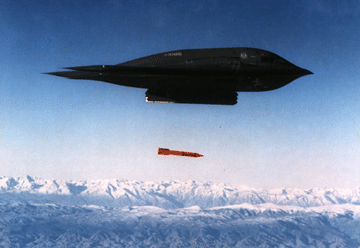
 US Air Force Tests Upgraded ‘Earth-Penetrating’ Nuclear Bomb, Sputniik News, 24.08.2018 The US Air Force sent out a B-2 stealth bomber to deploy an upgraded B61-12 nuclear bomb recently in an effort to review the weapon’s accuracy and ability to carry out its various attack options.
According to Warrior Maven, the latest upgrades enable the nuclear bomb to be able to carry out “earth-penetrating attacks, low-yield strikes, high-yield attacks, above surface detonation and bunker-buster options,” giving the Air Force a five-in-one kind of deal.
“The main advantage of the B61-12 is that it packs all the gravity bomb capabilities against all the targeting scenarios into one bomb,” Hans Kristensen, director of the Nuclear Information Project, told the website. “That spans from very low-yield tactical ‘clean’ use with low fallout to more dirty attacks against underground targets.”
“A nuclear weapon that detonates after penetrating the earth more efficiently transmits its explosive energy to the ground, thus is more effective at destroying deeply buried targets for a given nuclear yield. A detonation above ground, in contrast, results in a larger fraction of the explosive energy bouncing off the surface,” Kristensen added, noting that the B-2 bomber presently carries nuclear bombs of the models B61-7, B61-11 and B83-1.
However, the B61-12 nuclear bomb won’t be the only piece of military equipment to receive a facelift. The B-2 bomber, first introduced in the 1980s, is expected to see upgrades to its Defensive Management System, hardware used to help the bomber recognize and deter enemy air defenses, Warrior Maven reported. The US Air Force operates an estimated 20 B-2 bombers. Its next-generation competition is the B-21 Raider.
The latest test, conducted at an undisclosed area, follows news in late June that the Department of Energy’s National Nuclear Security Administration (NNSA) and the US Air Force tested two B61-12 bombs on June 9 at the Tonopah Test Range in Nevada……..
The life extension program is part of a joint effort to preserve the critical elements of the US nuclear triad, a three-pronged military structure consisting of land-launched missiles, nuclear missile-armed submarines and strategic aircraft with nuclear bombs and missiles. ……https://sputniknews.com/military/201808241067454740-earth-penetrating-nuclear-bomb-tested/
-
Archives
- February 2026 (211)
- January 2026 (308)
- December 2025 (358)
- November 2025 (359)
- October 2025 (376)
- September 2025 (258)
- August 2025 (319)
- July 2025 (230)
- June 2025 (348)
- May 2025 (261)
- April 2025 (305)
- March 2025 (319)
-
Categories
- 1
- 1 NUCLEAR ISSUES
- business and costs
- climate change
- culture and arts
- ENERGY
- environment
- health
- history
- indigenous issues
- Legal
- marketing of nuclear
- media
- opposition to nuclear
- PERSONAL STORIES
- politics
- politics international
- Religion and ethics
- safety
- secrets,lies and civil liberties
- spinbuster
- technology
- Uranium
- wastes
- weapons and war
- Women
- 2 WORLD
- ACTION
- AFRICA
- Atrocities
- AUSTRALIA
- Christina's notes
- Christina's themes
- culture and arts
- Events
- Fuk 2022
- Fuk 2023
- Fukushima 2017
- Fukushima 2018
- fukushima 2019
- Fukushima 2020
- Fukushima 2021
- general
- global warming
- Humour (God we need it)
- Nuclear
- RARE EARTHS
- Reference
- resources – print
- Resources -audiovicual
- Weekly Newsletter
- World
- World Nuclear
- YouTube
-
RSS
Entries RSS
Comments RSS
 nuclear-news