USA scales back emergency zones for Small Modular Nuclear Reactors (SMRs) to make them more affodable
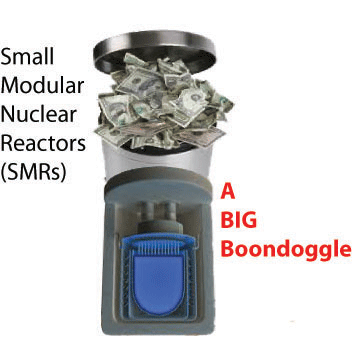 US regulators agree smaller SMR emergency zones http://www.world-nuclear-news.org/Articles/US-regulators-agree-smaller-SMR-emergency-zones, 28 August 2018
The NRC’s preliminary finding is part of a safety evaluation of a 2016 Early Site Permit application from the Tennessee Valley Authority (TVA) for the potential use of a site at Clinch River for two or more SMR modules of up to 800 MWe. This is the first SMR-related application of any type to be received by the NRC.
The US Nuclear Energy Institute (NEI) described the decision as a “potential regulatory breakthrough” that could accelerate future deployment of SMRs and advanced reactors. “The industry believes that this recognition of the enhanced safety features of small and advanced reactors could greatly simplify the licensing of these technologies and increase their cost competitiveness,” it said.
TVA’s application uses information from four SMR designs – BWXT’s mPower, Holtec International’s SMR-160, NuScale Power’s SMR, and Westinghouse’s SMR – to provide the technical basis for a requested exemption to the ten-mile EPZ requirement currently in use. The most detailed information was provided on the NuScale SMR, for which a design certification application was submitted to the NRC in January 2017. According to the application, the enhanced safety characteristics of those designs, such as smaller reactor cores, simpler systems, and built-in passive safety features, mean that off-site emergency planning requirements and plans can be scaled down to be proportionate with those reduced risks.
NRC staff found TVA’s proposed dose-based, consequence-oriented methodology to be a “reasonable technical basis” for determining EPZ size, consistent with the basis used to determine that for large light water reactors, NEI said.
The NRC also granted TVA its exemption from a ten-mile EPZ for future combined construction and operating licence applications for which the radioactive source term is bounded by the conditions established by the NRC. An SMR plant at the Clinch River site based on the NuScale SMR design would meet the conditions for a so-called site boundary-sized EPZ.
NEI Technical Advisor for Nuclear Generation David Young said current emergency planning requirements would impose an unnecessary regulatory burden on applicants and licensees, which would diminish the cost competitiveness of advanced reactors and hinder their development.
NEI Technical Advisor for Nuclear Generation David Young said current emergency planning requirements would impose an unnecessary regulatory burden on applicants and licensees, which would diminish the cost competitiveness of advanced reactors and hinder their development.
No comments yet.
1 This Month

of the week – Shut Down Drone Warfare!


Tell the Ukrainian Government to Drop Prosecution of Peace Activist Yurii Sheliazhenko

Petition to revoke the licensing of the Near Surface Nuclear Disposal Facility (NSDF) at Chalk River. https://www.ourcommons.ca/petitions/en/Petition/Details?Petition=e-7247
To see nuclear-related stories in greater depth and intensity – go to https://nuclearinformation.wordpress.com
-
Archives
- April 2026 (103)
- March 2026 (251)
- February 2026 (268)
- January 2026 (308)
- December 2025 (358)
- November 2025 (359)
- October 2025 (376)
- September 2025 (257)
- August 2025 (319)
- July 2025 (230)
- June 2025 (348)
- May 2025 (261)
-
Categories
- 1
- 1 NUCLEAR ISSUES
- business and costs
- climate change
- culture and arts
- ENERGY
- environment
- health
- history
- indigenous issues
- Legal
- marketing of nuclear
- media
- opposition to nuclear
- PERSONAL STORIES
- politics
- politics international
- Religion and ethics
- safety
- secrets,lies and civil liberties
- spinbuster
- technology
- Uranium
- wastes
- weapons and war
- Women
- 2 WORLD
- ACTION
- AFRICA
- Atrocities
- AUSTRALIA
- Christina's notes
- Christina's themes
- culture and arts
- Events
- Fuk 2022
- Fuk 2023
- Fukushima 2017
- Fukushima 2018
- fukushima 2019
- Fukushima 2020
- Fukushima 2021
- general
- global warming
- Humour (God we need it)
- Nuclear
- RARE EARTHS
- Reference
- resources – print
- Resources -audiovicual
- Weekly Newsletter
- World
- World Nuclear
- YouTube
-
RSS
Entries RSS
Comments RSS
 nuclear-news
Leave a comment