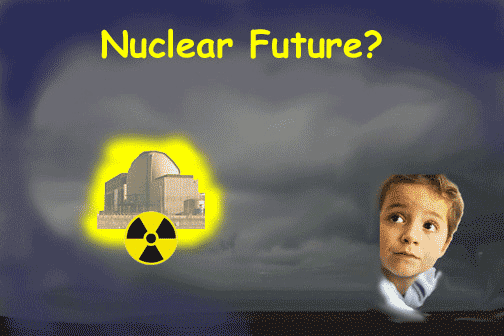
With the unsolved wastes problem, the threats from climate change, why build new nuclear?
Mersea Life August 2018 ,Andy Blowers: It’s interesting to see how government works. The other day I was invited to give evidence to the Parliamentary Select Committee on Business, Energy and Industrial Strategy. They were pondering the Draft National Policy Statement for Geological Disposal Infrastructure. Arcane, perhaps, but undoubtedly important and a riveting topic for anyone concerned with the future of our environment.
Although I said what I wanted to say, I felt my words went into a void, rather like the geological void that was the topic of debate. Recently the Government published its policy for the development of a deep geological repository in which to bury all the most dangerous nuclear wastes created by its military and civil nuclear programmes.
That something needs to be done is not in doubt but a repository must be in suitable geology, safely engineered and must achieve public support – conditions unlikely to be forthcoming in the near future.
The problem of managing the wastes that already exist will be difficult enough. But, the idea that a repository can also be used to accommodate the unknowable quantity of dangerous wastes from a new build programme is surely preposterous.
Yet this is what the Government proposes, stating its belief that ‘effective arrangements will exist to manage and dispose of the waste from new build power stations’.
How can they possibly know? There is no foreseeable solution to the problem of wastes from new nuclear power stations, other than leaving them in stores scattered around our coasts at vulnerable, low-lying sites like Bradwell for the indefinite future.
If Bradwell B is ever built these wastes will be left, according to the Government’s own estimates, until at least the turn of the twenty-third century, that is seven generations from now. The future physical conditions on the site and the state of society so far away is simply undefinable. It is unethical and should be unthinkable to present such an intractable problem to our children, grandchildren and generations beyond.
New build wastes take a very long time to cool before they can be ready for disposal. On current evaluations it could require between 60 and 140 years before disposal. So, let’s assume that Bradwell B starts generating in 2030 and continues for 60 years until 2090. It will then be between 2150 and 2230 before all its wastes could be disposed of, assuming,of course, there is a repository available. The simple truth is we have absolutely no idea how to estimate, let alone manage, the spent fuel and other dangerous wastes that will arise from a new nuclear power station at
Bradwell.
But we do know that the site is liable to flood and to be exposed to sea- level rise, coastal processes and storm surges as climate change proceeds.
http://edition.pagesuite-professional.co.uk/Launch.aspx?EID=ddcce4b1-5034-407a-b286-ae89641d115d
No comments yet.
1 This Month

5 March -Online – Reversing nuclearization:
From nuclear weapons in Belarus and NATO host countries to a European-Nuclear-Weapon Free Zone
11am-12:30pm Eastern Time USA / 5pm-6:30pm CET

of the week – Advocating for a
nuclear free beach – https://www.samuellawrencefoundation.org/
The Samuel Lawrence Foundation advocates for a Nuclear Waste Free Beach at San Onofre, join us and take action!

10 March A LIVE WEBINAR THE REAL EFFECTS OF NUCLEAR POWER
What the Industry Isn’t Telling Us
1:00 PM Mountain, 2 pm Central, 3 pm Eastern. Live on the Keepers of the Water Facebook page


18 March Webinar @ 1 PM EST: An Assessment of SMR Projects: The Case of Canada
register for the zoom:
https://us02web.zoom.us/webinar/register/WN_o8BIIOUvQ2ONJR1nta65DQ#/registration

of the week – STOP SMALL MODULAR REACTORS IN CANADA
To see nuclear-related stories in greater depth and intensity – go to https://nuclearinformation.wordpress.com
-
Archives
- March 2026 (51)
- February 2026 (268)
- January 2026 (308)
- December 2025 (358)
- November 2025 (359)
- October 2025 (376)
- September 2025 (258)
- August 2025 (319)
- July 2025 (230)
- June 2025 (348)
- May 2025 (261)
- April 2025 (305)
-
Categories
- 1
- 1 NUCLEAR ISSUES
- business and costs
- climate change
- culture and arts
- ENERGY
- environment
- health
- history
- indigenous issues
- Legal
- marketing of nuclear
- media
- opposition to nuclear
- PERSONAL STORIES
- politics
- politics international
- Religion and ethics
- safety
- secrets,lies and civil liberties
- spinbuster
- technology
- Uranium
- wastes
- weapons and war
- Women
- 2 WORLD
- ACTION
- AFRICA
- Atrocities
- AUSTRALIA
- Christina's notes
- Christina's themes
- culture and arts
- Events
- Fuk 2022
- Fuk 2023
- Fukushima 2017
- Fukushima 2018
- fukushima 2019
- Fukushima 2020
- Fukushima 2021
- general
- global warming
- Humour (God we need it)
- Nuclear
- RARE EARTHS
- Reference
- resources – print
- Resources -audiovicual
- Weekly Newsletter
- World
- World Nuclear
- YouTube
-
RSS
Entries RSS
Comments RSS
 nuclear-news
Leave a comment