North Korea Now in Standoff With U.S.A. on nuclear negotiations
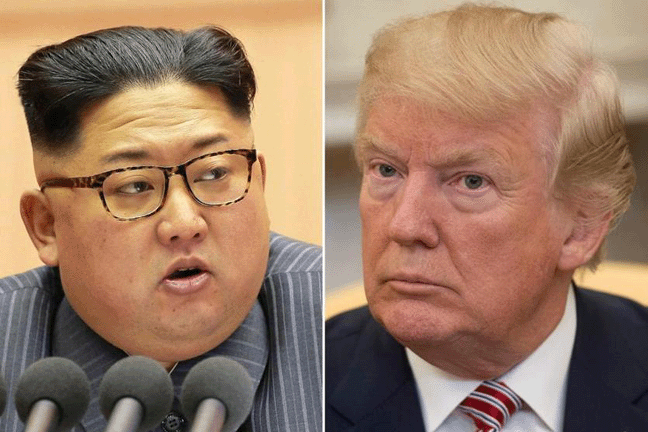 Once ‘No Longer a Nuclear Threat,’ North Korea Now in Standoff With U.S. NYT, By David E. Sanger and William J. Broad, Aug. 10, 2018 WASHINGTON — North Korea is insisting that the United States declare that the Korean War is over before providing a detailed, written disclosure of all its atomic weapons stockpiles, its nuclear production facilities and its missiles as a first major step toward denuclearization.
Two months after President Trump declared his summit meeting in Singapore with Kim Jong-un a complete success, North Korea has not yet even agreed to provide that list during private exchanges with Secretary of State Mike Pompeo, according to American and South Korean officials familiar with the talks.
Mr. Pompeo maintains progress is being made, although he has provided no details. But John R. Bolton, Mr. Trump’s national security adviser, this week said, “North Korea that has not taken the steps we feel are necessary to denuclearize.”
On Thursday, North Korea’s state-run newspaper, Rodong Sinmun, called the declaration of the end of the war “the demand of our time” and that would be the “first process” in moving toward a fulfillment of the June 12 deal struck between Mr. Trump and Mr. Kim. Pyonygang also wants peace treaty talks to begin before detailing its arsenal.
If the standoff over the parallel declarations remains, it is hard to see how the two countries can move forward with an agreement.
“The North Koreans have lied to us consistently for nearly 30 years,” Joseph Nye, who wrote one of the National Intelligence Council’s first assessments of the North’s weapons programs in 1993, said at the Aspen Institute on Tuesday.
“Trump is in a long tradition of American presidents who have been taken to the cleaners,” Mr. Nye said.
Neither Mr. Trump nor Mr. Pompeo has acknowledged the impasse. But officials said South Korea has quietly backed the North Korean position, betting that once Mr. Trump has issued a “peace declaration” it would be harder for him to later threaten military action if the North fails to disarm or discard its nuclear arsenal.
Against North Korea’s continuing nuclear buildup — and its threats to strike the United States — Washington has long refused to formally declare the end of the war, which was halted with a 1953 armistice but never officially brought to a close.
And fears remain that making concessions to Pyongyang — especially after Mr. Trump shelved annual American military exercises with South Korea that he called “war games,’’ the phrase used by the North — would outrage Republicans in Congress and open Mr. Trump to charges that he has been outmaneuvered by the North Korean leader.
The White House has never reconciled Mr. Trump’s post on Twitter after meeting Mr. Kim that “there is no longer a Nuclear Threat from North Korea” with Mr. Bolton’s assessment that the Singapore agreement has so far yielded almost no progress in the nuclear arena. That view is shared by many in Congress and the American intelligence agencies.
For Mr. Trump and Mr. Pompeo, much rides on how this standoff is resolved — or whether it results in the collapse of what the president called his determination to “solve” the nuclear crisis.
Mr. Pompeo has told associates that he believes his tenure as secretary of state will be judged largely on how he handles the negotiations. In recent weeks he has softened some of his statements toward North Korea, saying the United States is open to a step-by-step approach that most officials had previously rejected.
“The ultimate timeline for denuclearization will be set by Chairman Kim,”Mr. Pompeo said last week — a stark contrast to Mr. Trump’s statements last year that North Korea should give up its weapons rapidly, or face tremendous, if unspecified, consequences.
Challenged about the lack of progress so far, officials at the White House and State Department pointed to three developments as signs that the strategy with North Korea is advancing.
They noted that North Korea has not conducted a missile or nuclear test since November. Since the Singapore summit, Pyongyang has returned the remains of about 55 Americans killed in the Korean War, which appear genuine, a good-will gesture though one unrelated to the nuclear program. And satellite evidence suggests North Korea has begun dismantling a test site where it has developed missile technologies and launched space satellite missions. Experts cautioned, however, that all the steps taken so far are easily reversible……..https://www.nytimes.com/2018/08/10/us/politics/north-korea-denuclearize-peace-treaty.html
No comments yet.
1 This Month


Tell the Ukrainian Government to Drop Prosecution of Peace Activist Yurii Sheliazhenko

Petition to revoke the licensing of the Near Surface Nuclear Disposal Facility (NSDF) at Chalk River. https://www.ourcommons.ca/petitions/en/Petition/Details?Petition=e-7247


of the week – STOP SMALL MODULAR REACTORS IN CANADA
To see nuclear-related stories in greater depth and intensity – go to https://nuclearinformation.wordpress.com
-
Archives
- March 2026 (204)
- February 2026 (268)
- January 2026 (308)
- December 2025 (358)
- November 2025 (359)
- October 2025 (376)
- September 2025 (258)
- August 2025 (319)
- July 2025 (230)
- June 2025 (348)
- May 2025 (261)
- April 2025 (305)
-
Categories
- 1
- 1 NUCLEAR ISSUES
- business and costs
- climate change
- culture and arts
- ENERGY
- environment
- health
- history
- indigenous issues
- Legal
- marketing of nuclear
- media
- opposition to nuclear
- PERSONAL STORIES
- politics
- politics international
- Religion and ethics
- safety
- secrets,lies and civil liberties
- spinbuster
- technology
- Uranium
- wastes
- weapons and war
- Women
- 2 WORLD
- ACTION
- AFRICA
- Atrocities
- AUSTRALIA
- Christina's notes
- Christina's themes
- culture and arts
- Events
- Fuk 2022
- Fuk 2023
- Fukushima 2017
- Fukushima 2018
- fukushima 2019
- Fukushima 2020
- Fukushima 2021
- general
- global warming
- Humour (God we need it)
- Nuclear
- RARE EARTHS
- Reference
- resources – print
- Resources -audiovicual
- Weekly Newsletter
- World
- World Nuclear
- YouTube
-
RSS
Entries RSS
Comments RSS
 nuclear-news
Leave a comment