How nuclear is preparing for climate change http://www.corporateknights.com/channels/utilities-energy/nuclear-preparing-climate-change-15339111/, BY JOHN VIDAL – AUGUST 10, 2018
Plans to weather erosion and storm surges for new nuclear power plants may not be up to date, some experts say.The outer defensive wall of what is expected to be the world’s most expensive nuclear power station is taking shape on the shoreline of the choppy gray waters of the Bristol Channel in western England.
 By the time the US$25 billion Hinkley Point C nuclear station is finished, possibly in 2028, the concrete seawall will be 12.5 meters (41 feet) high, 900 meters (3,000 feet) long and durable enough, the UK regulator and French engineers say, to withstand the strongest storm surge, the greatest tsunami and the highest sea-level rise.
But will it? Independent nuclear consultant Pete Roche, a former adviser to the UK government and Greenpeace, points out that the tidal range along this stretch of coast is one of the highest in the world, and that erosion is heavy. Indeed, observers reported serious flooding on the site in 1981 when an earlier nuclear power station had to be shut down for a week. following a spring tide and a storm surge. However well built, says Roche, the new seawall does not adequately take into account sea-level rise due to climate change.
“The wall is strong, but the plans were drawn up in 2012, before the increasing volume of melting of the Greenland ice cap was properly understood and when most experts thought there was no net melting in the Antarctic,” he says. “Now estimates of sea level rise in the next 50 years have gone up from less than 30 centimeters to more than a meter, well within the operating lifespan of Hinkley Point C — let alone in 100 years time when the reactors are finally decommissioned or the even longer period when spent nuclear fuel is likely to be stored on site.”
In fact, research by Ensia suggests that at least 100 U.S., European and Asian nuclear power stations built just a few meters above sea level could be threatened by serious flooding caused by accelerating sea-level rise and more frequent storm surges.
Some efforts are underway to prepare for increased flooding risk in the future. But a number of scientific papers published in 2018 suggest that climate change will impact coastal nuclear plants earlier and harder than the industry, governments or regulatory bodies have expected, and that the safety standards set by national nuclear regulators and the United Nations’ nuclear watchdog, the International Atomic Energy Agency (IAEA), are out of date and take insufficient account of the effects of climate change on nuclear power.
The Problem With Flooding
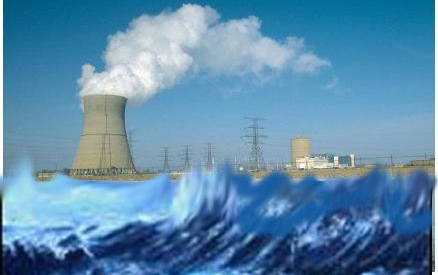
Flooding can be catastrophic to a nuclear power plant because it can knock out its electrical systems, disabling its cooling mechanisms and leading to overheating and possible meltdown and a dangerous release of radioactivity. Flooding at the Fukushima Daiichi plant in Japan as a result of the March 2011 tsunami caused severe damage to several of the plant’s reactors and only narrowly avoided a catastrophic release of radioactivity that could have forced the evacuation of 50 million people.
According to maps prepared by the World Association of Nuclear Operators (WANO), around one in four of the world’s 460 working commercial nuclear reactors are situated on coastlines. Many were built only 10–20 meters (30–70 feet) above sea level at a time when climate change was barely considered a threat.
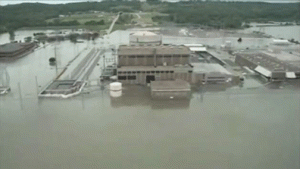 (At left flooded Fort Calhoun nuclear plant, USA) In the U.S., where nine nuclear plants are within 2 miles (3 kilometers) of the ocean and four reactors have been identified by Stanford academics as vulnerable to storm surges and sea-level rise, flooding is common, says David Lochbaum, a former nuclear engineer and director of the nuclear safety project at the Union of Concerned Scientists (UCS).
Lochbaum says over 20 flooding incidents have been recorded at U.S. nuclear plants since the early 1980s. “The most likely [cause of flooding] is the increasing frequency of extreme events,” he says.
“There was no consideration of climate change when most U.S. plants were built,” says Natalie Kopytko, a University of Leeds researcher who has studied nuclear power plant adaptations to climate change. “They used conservative models of historical reference. Also, they were largely built at a calm period, when there were not many major storms.”
“While an accident has never yet happened due solely to sea-level rise and storms, the flooding experienced at Fukushima resembles what could occur in the future from sea-level rise,” says Kopytko.
Considering Climate Change
IAEA’s current global safety standards were published in 2011. These state that operators should only “take into account” the 18- to 59-centimeter (7- to 23-inch) sea-level rise projected by 2100 in the Intergovernmental Panel on Climate Change (IPCC)’s fourth assessment report, published in 2007.
But those safety standards don’t factor in the most recent assessment of the IPCC, published in 2013–14. This scientific consensus report has seas rising 26 centimeters (10 inches) to 1 meter (39 inches) by 2100, depending on how far temperature continue to rise and the speed at which the polar ice caps melt.
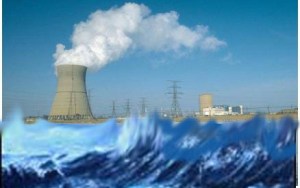 A 1-meter (39-inch) increase, combined with high tides and a storm surge, significantly increases the risk of coasts and nuclear stations being swamped, says Michael Mann, director of the Earth System Science Center at Pennsylvania State University.
“Nuclear stations are on the front line of climate change impacts both figuratively and quite literally,” Mann says. “We are likely profoundly underestimating climate change risk and damages in coastal areas.”
A recent study from NASA’s Goddard Space Flight Center expects the mean average rise to be a minimum of 65 centimeters (26 inches) by 2100.
“This 65-centimeter [rise] is almost certainly a conservative estimate,” says NASA lead author Steve Nerem, a professor of aerospace engineering sciences at the University of Colorado Boulder. “Our [study] assumes that sea level continues to change in the future as it has over the last 25 years. Given the large changes we are seeing in the ice sheets today, that’s not likely.”
A Matter of Timing Continue reading →
August 11, 2018
Posted by Christina Macpherson |
2 WORLD, climate change |
Leave a comment

 Why has China’s nuclear expansion programme stalled? By Compelo Staff Writer, 9 Aug 18, Completion of the first EPR and AP1000 reactors in China marks a major milestone, but, as Steve Kidd of East Cliff Consulting explains, the nation’s ambitious nuclear expansion programme is no longer on track. Many of the negative factors which have affected nuclear programmes elsewhere in the world are now also equally applicable in China. Despite many new reactors starting up, it is clear that the programme has continued to slow.
The most obvious sign of this is the lack of approvals for new construction starts. There have been no new approvals for approaching three years, so the number of reactors under construction has been falling sharply. Other indications of trouble are:
uncertainties about the type of reactor to be utilised in the future
the position of the power market
the structure of the industry with its large state-owned enterprises (SOEs)
the degree of support from state planners and the level of public opposition to nuclear plans.
where China now stands with its planned transition to advanced reactors and a fuel reprocessing strategy.
Over-supply and the AP1000 reactor
Start-ups of two imported Gen III reactor designs (Westinghouse AP1000 and the Areva EPR) are now happening at last, but the delays no doubt concerned the regulatory authorities. The problems with the AP1000 (at Sanmen and Haiyang) are the more serious, as this reactor was destined for most of the future sites in China. Although the units at both sites are now ready to enter commercial operation, this is unlikely to bring forward a flood of new approvals. China has suffered a severe dent in its confidence in the AP1000, not helped by Westinghouse’s US bankruptcy. The authorities now no doubt wish to see clear evidence of successful operation before authorising more units. There may be further reactors at the two existing sites, but there are many others that have been “ready to go” for several years now.
Another important reason for the slowdown relates to the size of nuclear programme China needs. Problems of power over-supply in particular regions are now pressing and connected to the continued construction of coal generating stations and the rapid expansion of wind and solar power. There are important questions to be resolved about how many reactors are needed to satisfy power demand and the price that can be paid for their electricity. Nevertheless, most of the Chinese nuclear companies want to build lots of new units and feel they are being held back by the authorities. The rapid expansion of wind and solar generating capacity has reminded the planners that there are alternative means of achieving environmental goals, while the Chinese hydroelectric programme is still enormous.
The shadow of Fukushima
The Fukushima accident still casts a significant shadow over the nuclear sector in China and regulators are clearly very cautious about having a big nuclear programme. Ultimately one person at the top of the regulatory authority has to take responsibility for safety and having 100 reactors in operation is far more burdensome than 20 or 40. South Korea’s apparent turning away from nuclear and the tardiness of Japanese reactor restarts are also unhelpful in inspiring confidence in the region.
China’s nuclear programme is now much harder to assess. The picture up to 2020 is fairly certain, as units under construction come into operation). The 58GW capacity target by end-2020 will be missed by perhaps 5GW, but more serious is another goal – having 30GW under construction by then. This would imply a programme of six reactors a year up to 2025, a similar level to 2015-2020. Almost all will have to be approved before the end of 2020. On recent trends, this looks unlikely and so it may be prudent to assume a programme of only 3-4 units per year beyond 2020. This means nuclear generating capacity of only 90GW or so by 2030, well below previous expectations. Beyond then it is difficult to judge, but the chance of China having a huge nuclear programme by 2050, perhaps consisting of 200-400 reactors, is much less than a few years ago. Estimates that China may move ahead of the USA in nuclear generating capacity by the mid or late 2020s now look wide of the mark. Even if 10-20 US units do eventually shut down by 2030, it could happen after then.
The dent in confidence surrounding the imported Gen III designs has been overcome, to some extent, by China’s development of the Hualong reactor, which satisfies the regulators’ insistence that all approved designs are at the Gen III level. Four units are now under construction in China (plus two in Pakistan). The two units being built by CNNC at Fuqing are on schedule to go online in 2020-2021, but CGN’s pair at Fangchenggang are apparently unlikely before 2021-2022. Whether Hualongs will replace AP1000s at any of its sites in China remains to be seen.
Big questions surround the CAP1400, the larger version of the AP1000, which China has developed, and the extent of the programme for high-temperature gas-cooled reactors (HTGRs) and small modular reactors (SMRs).
Approval of construction of the initial CAP1400s has been long-delayed and surely still awaits the regulator’s satisfaction with the AP1000. It appears that the HTGRs and SMRs will remain as marginal components of the main Chinese nuclear programme, but may offer useful additional export opportunities. The economics of the HTGRs are apparently questionable versus large LWRs, while there are lots of SMR designs around the world without anyone committing to build them.
Economic issues
Perhaps surprisingly, a big issue today affecting the Chinese nuclear programme is its economic viability. With nuclear power only currently representing 3-4% of China’s electricity supply, one would think that there is still plenty of room for dramatic growth. However, the slowing of the Chinese economy and the switch to less energy-intensive activities, together with over-investment in power generation capacity, means that there is now more than can be carried in the grids in some provinces. It cannot therefore be assumed that new nuclear units will run at the 80-90% capacity factors necessary to pay back the funds invested in their construction.
Tariffs that producers receive when they sell power to the grid are also under threat. The central government wishes to liberalise the Chinese power sector and make it more responsive to economic criteria and this may not help nuclear. The rising costs of building Gen III units are also a factor. Reactors may have to load-follow, which is not ideal in the technical or economic sense. Nuclear has to compete against other generation options…………
Power to the people
Many people used to believe that because China is a centrally-planned economy with a strong one-party government, public opinion did not matter much and any opposition to nuclear could be easily overcome. Nothing could be further from the truth. Public opinion matters a great deal in China and politicians fight shy of any issue that could inflame public opinion in any way. The last thing the Chinese government wants is people protesting on the streets – and this has already happened with two proposed fuel cycle plants. Both were quickly cancelled.
One particular public acceptance problem is inland sites for nuclear plants. Having imposed a moratorium on these for now (in fact to slow the nuclear programme down), the government has made a huge problem for itself by giving the impression that these sites are “second best” and maybe not as safe as the coastal sites (where all current Chinese reactors are located).
The threat in China is that nuclear may become no more than a niche, bridging technology, as a route to something better in the future.
This article originally appeared in Nuclear Engineering International.
Steve Kidd is an independent nuclear consultant and economist with East Cliff Consulting. https://www.compelo.com/energy/news/china-nuclear-expansion/
August 11, 2018
Posted by Christina Macpherson |
business and costs, China, politics |
Leave a comment
Bulletin of the Atomic Scientists, By Ezra Friedman, August 7, 2018
Yesterday US President Donald Trump issued an executive order restoring one set of economic sanctions on Iran that were lifted by the Obama-era nuclear deal known as the Joint Comprehensive Plan of Action. The sanctions cover Iranian trade in items including metals such as gold and steel, automobiles, and aircraft.
In early November, Trump plans to reintroduce even more crippling sanctions on Iranian oil and banking. Collectively, these sanctions are likely to cause immense damage to the Iranian economy. Even carpets and foodstuffs are being sanctioned by the United States. The European Union and the three European countries that signed the nuclear deal (France, Germany, and the United Kingdom) are attempting to assemble an economic package that will save the deal from complete collapse, but so far with little progress and growing frustration on all sides. A joint statement issued yesterday by European foreign ministers says they “deeply regret” the White House decision.
By reimposing sanctions, Trump aims to force the current regime in Iran to negotiate a more comprehensive nuclear deal, or to inflict enough economic pain to change the regime’s behavior—if not the regime itself. Iran now finds itself in the crosshairs of a president who has made it his personal mission to aggressively combat Tehran.
Trump’s strategy might not have the intended effect, but it is likely to cause Iran to withdraw from the Joint Comprehensive Plan of Action (JCPOA). Does that mean Iran will go all Pyongyang and start developing nuclear weapons? Probably not. But unless a new nuclear deal can be made, Iran can be expected to resume its pre-JCPOA program of uranium enrichment, taking the country to the threshold of becoming a nuclear weapons state.
Why Iran will probably leave the JCPOA. When the JCPOA was signed three years ago, its supporters hailed it as a breakthrough against the proliferation of nuclear weapons, and a chance to welcome Iran back into the fold of nations following a long exile that began in 1979. The nuclear deal’s detractors claimed that the agreement was not broad enough, because it allowed Iran to continue its ballistic missile program unabated and to support its proxies in Syria, Iraq, Lebanon, and Yemen—thereby continuing to push an agenda of regional hegemony.
The May 8 withdrawal of the United States from the JCPOA amplified the debate. The United States is pursuing an almost fanatical campaign, lobbying its allies and partners across the globe, and educating them about the latest sanctions package—as well as the penalties for noncompliance. Critics say the sanctions regime will be ineffective because China and other countries will take advantage of the situation. But others, including several major foreign companies, are taking the sanctions seriously, in some cases withdrawing altogether from Iran.
What is clear is that sanctions will make an already difficult domestic economic situation worse in Iran. Iranians are largely young, educated, and tired of the regime’s policies. Many are angry about the billions of dollars spent in support of foreign wars, and protests are escalating. Iran also finds itself overextended regionally with challenges to its grand strategy in Yemen, Iraq, and Syria. While Tehran’s ally Bashar al-Assad will remain in power, Iran will now find itself in competition with Russia for dominance in Syria, both economically and politically, despite the high price Tehran has paid in both men and money to support Assad………..
Why it’s not in Iran’s interest to leave the NPT. Iran has several options once it leaves the JCPOA. Some statements by Iranian leaders suggest that Iran will race to acquire a nuclear device, ramping up its nuclear program so as to achieve this goal as quickly as possible, either overtly or covertly. Iran’s critics point to its past violations of the Nuclear Non-Proliferation Treaty (NPT) in the early 2000s, confirmed by an Israeli intelligence operation earlier this year. (Iran has been a party to the treaty since 1970.)
While frightening, this scenario is unlikely, because it would place Iran in the same category as North Korea: a pariah in the eyes of the international community. On a strategic level, Tehran is keenly aware of this possibility and wants to avoid it at all costs. Even if Iran would like to have a militarized nuclear program, the cost would be massive if not unbearable for the regime.
………Rather than withdrawing from the NPT, it is more likely that Iran will return to something akin to a pre-JCPOA scenario, with a nuclear program that is enriching uranium to 20 percent or more without the full oversight of the International Atomic Energy Agency—which will almost certainly lose its current ability to access Iran’s known non-military nuclear sites upon Iran’s exit from the JCPOA. In this scenario, Iran will have a short “breakout period”—the time needed to produce enough weapons-grade uranium to build its first nuclear device—estimated at five weeks to a year.It is important to note that there is a strong likelihood that some trading partners considered important to Iran economically—such as China, India, Turkey, and the European Union—will at least partially flout US extraterritorial sanctions. Such a scenario would be the best of both worlds for Tehran, allowing the regime to achieve the prestige and tacit recognition of a nuclear program that is illicit in nature, all the while not being subject to UN Security Council resolutions and maintaining its standing in the international community……….https://thebulletin.org/2018/08/will-iran-go-nuclear-over-reimposed-sanctions/?utm_source=Bulletin%20Newsletter&utm_medium=iContact%20email&utm_campaign=August10
August 11, 2018
Posted by Christina Macpherson |
Iran, politics international |
Leave a comment
Daily Mail 10th Aug 2018 , A federal judge on Thursday rejected a request to bar the public from a
Colorado wildlife refuge that was once part of a nuclear weapons plant.
Environmentalists and community activists had asked the judge to issue a
preliminary injunction that would prohibit opening Rocky Flats National
Wildlife Refuge northwest of Denver while the courts hear their lawsuit
claiming the government did not study public safety closely enough.
U.S. District Judge Philip A. Brimmer said the activists had not shown that
radioactive exposure at the site was bad enough to cause them irreparable
harm, so they had not met the judicial standard for an injunction.
http://www.dailymail.co.uk/wires/ap/article-6044945/Judge-wont-bar-public-refuge-nuke-site.html
August 11, 2018
Posted by Christina Macpherson |
environment, USA |
Leave a comment
 Arrests at nuclear sites mark 73rd anniversary of atomic bombings of Hiroshima and Nagasaki http://www.nukeresister.org/2018/08/07/arrests-at-nuclear-sites-mark-73rd-anniversary-of-atomic-bombings-of-hiroshima-and-nagasaki/ from the Ground Zero Center for Nonviolent Action
Activists honor Catholic archbishop, who was a prophetic voice for peace, on anniversary of atomic bombingby Leonard Eiger Silverdale, Washington: Activists blockaded the West Coast nuclear submarine base that would likely carry out a nuclear strike against the Democratic People’s Republic of Korea (North Korea) should President Donald Trump give the order.
Activists with Ground Zero Center for Nonviolent Action held a vigil at the Naval Base Kitsap-Bangor Main Gate beginning on the evening of August 5th and continuing into the morning of August 6th, the anniversary of the atomic bombing of Hiroshima. Approximately sixty activists were present at the morning vigil, and twelve participated in a nonviolent direct action in which participants blockaded the base at the peak of the morning shift change by carrying a banner onto the roadway of the main entrance gate.
The banner read, “Trident is the Auschwitz of Puget Sound – Raymond Hunthausen.”
The activists stopped traffic entering the base for ten minutes before being removed from the roadway by Washington State Patrol Officers, cited for being in the roadway illegally, and released on the scene.
The twelve activists cited are Phil Davis, Bremerton, WA; Susan Delaney, Bothell, WA; Lisa Johnson, Silverdale, WA; Mack Johnson, Silverdale, WA; Ann Kittredge, Quilcene, WA; James Knight, Altadena, CA; Brenda McMillan, Port Townsend, WA; Elizabeth Murray, Poulsbo, WA; George Rodkey, Tacoma, WA; Ryan Scott Rosenboom, Bothell, WA; Michael Siptroth, Belfair, WA; and Jade Takushi.
Raymond Hunthausen, retired archbishop of Seattle, died on July 22nd at age 96. Frank Fromherz, author of the the soon to be released book, “A Disarming Spirit: The Life of Archbishop Raymond Hunthausen,” said of Hunthausen:
“It was in the early 1980s that Archbishop Hunthausen denounced the Trident nuclear submarine fleet harbored in his archdiocese, famously calling it ‘the Auschwitz of Puget Sound.’ His opposition inspired Catholics worldwide, but gained him powerful opponents in the U.S. government during the era of President Reagan’s military buildup. Catholic peace activist Jim Douglass, a native of British Columbia, introduced Archbishop Hunthausen to the practice of contemplative nonviolent direct action.”
Douglass once described his longtime friend as ‘a holy prophet of nonviolence in the nuclear age.’ In what would become a truly historic address on June 12, 1981 at Pacific Lutheran University in Tacoma, Hunthausen spoke these prophetic words: ‘Our security as people of faith lies not in demonic weapons, which threaten all life on earth. Our security is in a loving, caring God. We must dismantle our weapons of terror and place our reliance on God.’”
Eight of the US Navy’s fourteen Trident ballistic missile submarines are based at the Bangor Trident base, which is just 20 miles west of Seattle. It is home to the largest concentration of deployed nuclear weapons in the US. The W76 and W88 warheads at Bangor are equal respectively to 100 kilotons and 455 kilotons of TNT in destructive force (the bomb dropped on Hirosima was between 13 and 18 kilotons). The Trident bases at Bangor and Kings Bay, Georgia, when combined, represent just over half of all warheads deployed by the United States.
While the US has been calling for the complete denuclearization of North Korea, it continues to modernize and upgrade its nuclear weapons and delivery systems, among them the Trident system. It has declared, along with some other nuclear weapon states, that it will never sign the Treaty on the Prohibition of Nuclear Weapons (TPNW), also known as the Ban Treaty.
Monday morning’s action was the culmination of a weekend commemorating the atomic bombings of Hiroshima and Nagasaki, and calling for the abolition of all nuclear weapons. Activities included keynote presentations by former CIA officer and peace activist Ray McGovern, and Backbone Campaign executive director Bill Moyer. Activists at Ground Zero Center also welcomed participants of the Interfaith Peace Walk and held a waterborne protest, “Boats by Bangor,” on Hood Canal by the Bangor base waterfront where Trident submarines are prepared for their patrols.
The Ground Zero Center for Nonviolent Action was founded in 1977. The center is on 3.8 acres adjoining the Trident submarine base at Bangor, Washington. We offer the opportunity to explore the roots of violence and injustice in our world and to experience the transforming power of love through nonviolent direct action. We resist all nuclear weapons, especially the Trident ballistic missile system.
August 11, 2018
Posted by Christina Macpherson |
opposition to nuclear, Religion and ethics, USA |
2 Comments
 Abe should keep pledge to lead on elimination of nuclear weapons, Asahi Shimbun , August 10, 2018
Prime Minister Shinzo Abe, representative of the government of Japan, and atomic bomb survivors, witnesses to the horrific scenes of 1945, appeared to have little language in common.
That unfortunate scene, almost too painful to bear, was repeated again this summer.
During the peace memorial ceremonies to mark the 73rd anniversary of the atomic bombings of Hiroshima and Nagasaki, the mayors of the two cities and a representative of atomic bomb survivors all expressed their positive hopes for the Treaty on the Prohibition of Nuclear Weapons and called on Tokyo to take serious action.
But Abe did not even mention the treaty during his speeches at the ceremonies. When he met with atomic bomb survivors, he said Tokyo has a “different approach” to the shared goal of eliminating nuclear weapons, thereby denying Japan’s participation in the pact.
The nuclear weapons ban treaty, adopted last year with approvals of 122 countries at the United Nations, embodies the fruition of longstanding calls by atomic bomb survivors. The treaty’s spirit, which stresses the inhumane nature of nuclear arms, has a universal value that has much in common with “human security,” one of the stated pillars of Japan’s diplomacy.
Abe, however, did not even pay homage to the significance of the pact, any more than he did last year………
Abe described himself as a “mediator” for bridging the gap between nuclear weapon states and non-nuclear weapon states. Given that, his words would sound persuasive only if he took initial action to call on nuclear weapon states to reduce their nuclear arsenals.
Far from that, Foreign Minister Taro Kono has “highly appreciated” a new strategy of nuclear arms buildup that was set out by the U.S. administration of President Donald Trump. By no means would Japan be able to live up to its duty of a country that suffered atomic bombings if it were only ratifying a military policy that could be described as representing a superpower’s egotism………….http://www.asahi.com/ajw/articles/AJ201808100022.html
August 11, 2018
Posted by Christina Macpherson |
Japan, politics international, weapons and war |
Leave a comment
 Rick Perry Rejects Facts in Favor of Coal and Nuclear Bailouts, Union of Concerned Scientists, JEREMY RICHARDSON, SENIOR ENERGY ANALYST | AUGUST 9, 2018
Much has been written on coal and coal miners since the president began campaigning in earnest in 2016. Since taking office, he has continued that dishonest and dangerous rhetoric—and has directed his agencies to do something. Anything. Except, of course, anything that represents real solutions for coal miners and their communities, instead proposing (initially at least) to cut federal programs that invest in those communities.
The president continues to push for a misguided federal bailout of the coal industry—a blatant political payoff to campaign donors using taxpayer money with no long-term solutions for coal workers. The latest shiny object masquerading as reasoning? National security. But as we know, bailing out uneconomic coal plants only exacerbates the real national security issues brought on by climate change, while continuing to saddle our country with the public health impacts of coal-fired electricity—which hurt real people in real communities.
As is typical with this administration, substance and science and evidence are inconsequential compared to ideology, and their attempts to bail out money-losing coal and nuclear plants are no exception. Here’s a quick take on how we got here and what to expect next…….
LET’S SEE WHAT STICKS…
THE ADMINISTRATION DIDN’T EXACTLY HIT THE GROUND RUNNING AFTER THE 2016 ELECTION—NO ONE BOTHERED TO SHOW UP AT THE DEPARTMENT OF ENERGY UNTIL AFTER THANKSGIVING OF 2016, EVEN THOUGH CAREER STAFF WERE READILY AVAILABLE AND PREPARED TO BRIEF THE INCOMING ADMINISTRATION ON THE IMPORTANT WORK OF THE AGENCY. BUT BY THE SPRING, IT HAD BECOME CLEAR THAT ENERGY SECRETARY RICK PERRY WOULD BE THE FRONT-MAN IN LEADING THE CHARGE FOR A FEDERAL BAILOUT OF COAL AND NUCLEAR PLANTS. HIS SHIFTING RHETORIC AND POOR JUSTIFICATIONS FOR USING CONSUMERS’ MONEY TO PROP UP UNECONOMIC COAL PLANTS SUGGESTS THAT HE AND HIS INNER CIRCLE ARE DESPERATE TO FIND AN ARGUMENT THAT STICKS AND SURVIVES LEGAL CHALLENGES.
BRIEFLY:
- MARCH 2017: PERRY MEETS WITH COAL MAGNATE AND MAJOR CAMPAIGN DONOR AT DOE. THE PHOTOGRAPHER WHO CAPTURES A SHOT OF THEM EMBRACING AT THE START OF THE MEETING IS LATER FIRED FOR RELEASING THE INFORMATION TO THE PUBLIC.
- APRIL 2017: PERRY ASKS DOE STAFF TO WRITE A REPORT EXAMINING THE CHANGES TO ELECTRICITY MARKETS AFFECTING “BASELOAD” POWER (READ: COAL AND NUCLEAR) THAT MIGHT AFFECT GRID RESILIENCE AND RELIABILITY. PERRY’S REQUEST FOR AN ELECTRICITY GRID STUDY IS RIDDLED WITH FLAWED ASSUMPTIONS, ENCOURAGES PREDETERMINED CONCLUSIONS, AND CONTRADICTS RESEARCH BY HIS OWN AGENCY.
- JULY 2017: A LEAKED VERSION OF THE DRAFT GRID STUDY SUGGESTS THAT DOE CAREER STAFF WERE PUTTING TOGETHER AN UNBIASED REPORT IN SPITE OF TREMENDOUS POLITICAL PRESSURE.
- AUGUST 2017: THE FINAL GRID STUDY CONCLUDES THAT CLOSURE OF COAL AND NUCLEAR PLANTS DO NOT THREATEN RESILIENCE AND RELIABILITY, NOT EXACTLY THE CONCLUSION PERRY WAS LOOKING FOR. THE STUDY FINDS THAT THE GRID IS OPERATING RELIABLY WITH HIGH LEVELS OF RENEWABLES AND THAT LOW NATURAL GAS PRICES WERE LARGELY TO BLAME FOR RECENT PLANT RETIREMENTS. BUT, IN A HINT OF THINGS TO COME, IT DOES SUGGEST EXPLORING THE IDEA OF “UTILIZING EXISTING FEDERAL AUTHORITIES UNDER THE FEDERAL POWER ACT … TO ENSURE SYSTEM RELIABILITY AND RESILIENCE” AND HAVING STATES USE REGULATORY AUTHORITY “TO SUPPORT SPECIFIC AT-RISK PLANTS THAT CONTRIBUTE TO SYSTEM RESILIENCE.”
- SEPTEMBER 2017: PERRY PUSHES FORWARD. UNDETERRED BY THE CONCLUSIONS OF THE STUDY HE REQUESTED AND EVIDENTLY UNINTERESTED IN FURTHER RESEARCH, PERRY ASKS THE FEDERAL ENERGY REGULATORY COMMISSION (FERC) TO GUARANTEE PROFITS FOR COAL AND NUCLEAR PLANTS UNDER THE GUISE OF ENSURING A RELIABLE AND RESILIENT GRID.
- JANUARY 2018: FERC REJECTS THE PROPOSAL—UNANIMOUSLY, EVEN THOUGH FOUR OF THE FIVE COMMISSIONERS WERE APPOINTED BY THE CURRENT PRESIDENT—NOTING THAT THE PROPOSAL REPRESENTED AN UNWARRANTED INTRUSION INTO ELECTRICITY MARKETS, AND INSTEAD OPENING A DOCKET TO STUDY THE ISSUE.
- JANUARY 2018: THE BOMB CYCLONE BRINGS EXTREME COLD TO THE NORTHEAST. DOE REQUESTS ONE OF ITS NATIONAL LABS, THE NATIONAL ENERGY TECHNOLOGY LABORATORY (NETL), TO WRITE A STORY (MASQUERADING AS A REPORT) ABOUT HOW COAL SAVED THE DAY AND PREVENTED MASSIVE BLACKOUTS. NETL DELIVERED WITH THE INTENT OF PUSHING BACK AGAINST FERC’S DECISION, AND IT MIGHT AS WELL HAVE BEEN A FAIRY TALE ABOUT A HANDSOME PRINCE.
- MAY 2018: AN INTERNAL MEMO LEAKS ON MAY 31. IT REVEALS THE ADMINISTRATION’S PLANS TO USE EMERGENCY POWERS, UNDER THE KOREAN WAR-ERA DEFENSE PRODUCTION ACT AND THE FEDERAL POWER ACT, IN ORDER TO BAIL OUT THE MONEY-LOSING COAL AND NUCLEAR PLANTS, WHICH TOOK FERC BY SURPRISE. THE NEW RATIONALE IS THAT THESE PLANTS ARE VITAL FOR NATIONAL SECURITY AND THAT WITHOUT THEM, THE ELECTRICITY SYSTEM WOULD SOMEHOW BE MORE VULNERABLE TO CYBERATTACKS.
- JUNE 2018: THE LEAK PROMPTS THE WHITE HOUSE TO RELEASE A STATEMENT ON JUNE 1 DIRECTING PERRY TO “TAKE IMMEDIATE STEPS TO KEEP BOTH COAL AND NUCLEAR PLANTS RUNNING” ON THE BASIS OF NATIONAL SECURITY.
- AUGUST 2018: HAVING FAILED TO GET ITS POLITICAL PAYBACKS THROUGH ON THE FIRST GO-AROUND, THE ADMINISTRATION MOVES TO POLITICIZE THE IMPORTANT AND ONCE-INDEPENDENT FERC. PROMINENT STAFF HAVE TAKEN THE UNPRECEDENTED MOVE OF DISCUSSING PROPOSALS BEFORE DECISIONS HAVE BEEN MADE, THE ADMINISTRATION IS PLANNING TO PUT FORTH A NOMINEE THAT SUPPORTS THE BAILOUT PROPOSAL.
SO, THE GAME OF WHACK-A-MOLE CONTINUES.
FALSE ARGUMENTS
IN SHORT, THE ADMINISTRATION IS PROPOSING TO USE EMERGENCY AUTHORITIES TO FORCE GRID OPERATORS AND CONSUMERS TO BUY ELECTRICITY FROM UNECONOMIC COAL AND NUCLEAR PLANTS. LET’S BREAK DOWN THE ARGUMENTS ONE BY ONE. …….
Led by Secretary Perry, the administration continues to make false and misleading arguments about the purported need for keeping uneconomic plants from retiring early—and this issue will be with us as long as the current president is in office. ……
At UCS, we’re going to continue the fight to hold the administration accountable and stop this misguided and disastrous proposal from being implemented. The facts are on our side—there is no grid reliability crisis and no grid resiliency crisis, but there is a climate crisis, and bailing out coal plants will only add to the climate crisis with real adverse consequences to the economy and public health. Stand with us. https://blog.ucsusa.org/jeremy-richardson/rick-perry-rejects-facts-in-favor-of-coal-and-nuclear-bailouts
August 11, 2018
Posted by Christina Macpherson |
politics, USA |
1 Comment

Telegraph-Journal 9th Aug 2018 Several experts blinked a few weeks ago when the province announced its
intention to begin research into new types of nuclear reactors, smaller and
producing less electricity. It would not be the first time the New
Brunswick government has turned to nuclear power for its energy supply.
Should the province proceed more cautiously this time?
The New Brunswick government recently pledged $10 million to create a nuclear research group.
The province also announced on July 9 a partnership with the American
company Advanced Reactor Concepts, which will try to build a new type of
more compact nuclear reactor designed to produce 100 MW of electricity,
nearly six times less than the Point Lepreau nuclear power plant.
Then a week later, the province announced another partnership with the English
company Moltex. The latter is even promising a reactor capable of producing
energy by reusing nuclear wastes (from uranium fuel). This perspective is
tempting at first. Among the advantages of Moltex’s reactors are (1) the
ability to produce clean energy at low cost and (2) the ability to reduce
environmental impacts by burning irradiated uranium fuel. William Cook,
professor of chemical engineering at the Centre for Nuclear Energy Research
at the University of New Brunswick in Fredericton, believes that small
modular reactors could be quite efficient in terms of energy production,
and that they could overcome many of the problems created by conventional
CANDU (Canada Deuterium Uranium) reactors such as Point Lepreau.
On the one hand, Mr. Cook says that the small reactors under development are small
enough to be built in a factory and then transported to a destination by
train or ship, which would significantly reduce their cost of installation.
He also mentioned the possibility of reusing the uranium fuel from the
Point Lepreau reactor. “Not all compact reactor models can use irradiated
nuclear fuel, but [Moltex] is advertising that they can process the old
fuel on site to prepare it for reuse. There is still an enormous amount of
energy remaining in the spent fuel when it comes out of a CANDU reactor,”
says the chemical engineering professor.
But this concept of a small reactor that reuses nuclear fuel is only a dream for now. In fact, the
project is still in its infancy. “Certainly [small modular reactors are]
very far from commercialization, or even feasibility,” says Gordon
Edwards, president of the Canadian Coalition for Nuclear Responsibility, a
non-profit organization based in Montreal.
According to Edwards, the deployment of these reactors would create a host of new problems. He
disputes the benefits promised by Moltex. “The benefits of small modular
reactors are zero,” he says. “For used fuel from Point Lepreau to be
recycled, it would first have to be reprocessed after it is removed from
the reactor.”
He explained that this would result in the creation of
liquid and volatile [gaseous] radioactive waste. He also noted that [the
Moltex] small modular reactor would use plutonium, unlike Point Lepreau,
which uses uranium. The use of uranium creates plutonium as a byproduct. So
part of the [Moltex] plutonium fuel could come from Point Lepreau, but the
province could also import it from the United States.
https://www.telegraphjournal.com/letoile/story/100669270/point-lepreau-nucleaire-petits-reacteurs-dechets-environnement
August 11, 2018
Posted by Christina Macpherson |
Canada, Small Modular Nuclear Reactors |
Leave a comment
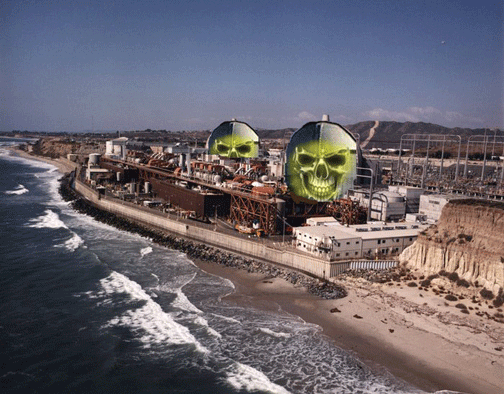
Courthouse News 8th Aug 2018 , Southern California residents packed a California State Lands Commission
meeting Tuesday night to protest the plan to demolish the shuttered San
Onofre Nuclear Generating Station.
The SONGS nuclear power plant closed in
2012 after reactor coolant leaked from an 11-month-old steam generator,
leaking 82 gallons of radioactive coolant a day. Edison alerted the public
to a “possible leak” on Jan. 31, 2012, and on Feb. 17, 2012, responded
to a Nuclear Regulatory Commission report about the leak with confirmation
a “barely measurable” amount of radioactivity was released into the
atmosphere.
The California Coastal Commission issued a permit to SONGS
operator Southern California Edison to store spent nuclear waste in
canisters buried under the beach next to the shuttered power plant. This
year, Edison began burying the spent nuclear waste on the beach and is a
third of the way through burying the 70-plus canisters.
But to complete the entire decommissioning process – including tearing down the twin
buildings which used to house energy operations – the California Coastal
Commission needs to approve a final permit. That permit will not be taken
up by the Coastal Commission until a recently released 706-page
environmental impact report by the California State Lands Commission –
which assesses the environmental impacts of tearing down SONGS – gets
approved.
It outlines the components and structures proposed to be taken
down in a way to reduce radioactivity and impacts on the environment. Among
significant “unavoidable impacts” outlined in the EIR, however, are
potential release of radiological materials and impacts on air quality. The
majority of speakers from a group of more than 100 people at Tuesday’s
meeting said those “unavoidable impacts” are unacceptable.
https://www.courthousenews.com/southern-california-residents-protest-nuclear-plant-demolition-plans/
August 11, 2018
Posted by Christina Macpherson |
decommission reactor, USA |
Leave a comment
 Factcheck: How global warming has increased US wildfires , Carbon Brief , 9 Aug 18
In the midst of record or near-record heatwaves across the northern hemisphere this summer, deadly wildfires have swept through many regions, such as the western US, Europe and Siberia. This has focused a great deal of public attention on the role that climate change plays in wildfires.
Recently, some commentators have tried to dismiss recent increases in the areas burnt by fires in the US, claiming that fires were much worse in the early part of the century. To do this, they are ignoring clear guidance by scientists that the data should not be used to make comparisons with earlier periods.
The US National Interagency Fire Center (NIFC), which maintains the database in question, tells Carbon Brief that people should not “put any stock” in numbers prior to 1960 and that comparing the modern fire area to earlier estimates is “not accurate or appropriate”.
Here, Carbon Brief takes a look at the links between climate change and wildfires, both in the US and across the globe. As with any environmental issue, there are many different contributing factors, but it is clear that in the western US climate change has made – and will continue to make – fires larger and more destructive.
As one scientist tells Carbon Brief: “There is no question whatsoever that climate plays a role in the increase in fires.”
More area burned………
August 11, 2018
Posted by Christina Macpherson |
climate change, USA |
Leave a comment

QUANTM Irradiation System™ Earns CE Mark Approval https://business.financialpost.com/pmn/press-releases-pmn/business-wire-news-releases-pmn/quantm-irradiation-system-earns-ce-mark-approval
VANCOUVER, British Columbia, 8 Aug 18 — ARTMS Products today announced it received CE marking approval for its first-in-class, advanced technology QUANTM Irradiation System™ for producing high-value radioisotopes, such as Tc-99m and Ga-68, on medical cyclotrons. Cyclotron facilities are constantly facing higher isotope costs and poor supply availability. Now, with CE marking, ARTMS’ QUANTM Irradiation System™ will help ease these issues.
“CE marking is an important milestone for ARTMS,” remarked Dr. Kaley Wilson, CEO of ARTMS Products. “There is a huge opportunity in providing a cost effective and secured supply of radioisotopes to hospitals and research institutions. ARTMS provides a more economical, environmentally safe and secured supply of important radioisotopes than reactor-based sources. Now, with CE marking approval, ARTMS can be readily integrated in a standardized fashion into existing and emerging facilities which ultimately leads to improved patient access and care across Europe.”
Giving Cyclotron Facilities More Control Over the Supply of Medical Isotopes
Unlike traditional reactor and generator production methods, which are growing increasingly more expensive and cannot consistently supply user requirements, the ARTMS QUANTM Irradiation System™ combines both local production control and a cost-effective, easy-to-use solid target system for production of radioisotopes on medical cyclotrons. Medical radioisotopes are used in the field of nuclear medicine on a daily basis for both medical diagnostic imaging and therapy, particularly in the fields of oncology, cardiology and neurology.
The ARTMS QUANTM Irradiation System™ is currently available for most OEM cyclotron systems and has been installed and is operating in a number of countries.
About ARTMS Products
Based in Vancouver, British Columbia, ARTMS Products Inc. is a leader in the development of novel technologies and products which enable the production of the world’s most-used diagnostic imaging isotope, technetium-99m (Tc-99m), using local, hospital-based medical cyclotrons. ARTMS holds the exclusive global commercialization rights to award-winning and proprietary Canadian inventions which address these challenges, and which offer the prospect of revolutionizing the nuclear medicine industry.
For more information on the QUANTM Irradiation System™ and ARTMS Products, please follow us on Twitter @Quantm99 and LinkedIn and visit http://www.artms.ca/
August 11, 2018
Posted by Christina Macpherson |
Canada, health, technology |
Leave a comment

Keep up the fight to eliminate nuclear weapons, Japan Times, 10 Aug 18 “……… The number of surviving hibakusha as of the end of March was 154,859, a decline of 9,762 from a year earlier. In recent years, nearly 10,000 hibakusha have been passing away annually. Their average age has surpassed 82. This nation’s firsthand experience of the atomic bombings will fade with time. That is all the more reason for us to keep pushing for the elimination of nuclear weapons.
In his address during this year’s anniversary ceremony marking the Hiroshima atomic bombing, Hiroshima Gov. Hidehiko Yuzaki summed up the danger of believing in the balance of power ensured by nuclear deterrence by asking how would you explain it to your children.
“You see, we don’t get along well with our next-door neighbor. So we have set a bomb that can blow up their house with all the family inside, just in case. We can press the button to set off this bomb any time. Our neighbor, on the other hand, has also set a bomb to blow up our house. Of course, neither family wants both families to end up dead, so I feel assured that they will never press the button. We will never do so, either. In short, we will never go into battle against each other. And the bombs will probably not malfunction. And we won’t press the button by mistake, either, I hope. So you don’t have to worry,” the governor said, adding, “How many of you could seriously offer such an explanation to your children?”
How can we continue with a policy that we cannot explain to our next generation? https://www.japantimes.co.jp/opinion/2018/08/10/editorials/keep-fight-eliminate-nuclear-weapons/#.W24MLyQzbGg
August 11, 2018
Posted by Christina Macpherson |
general |
Leave a comment

China promoting own technical standards to aid nuclear push overseas https://www.reuters.com/article/us-china-nuclear-standards/china-promoting-own-technical-standards-to-aid-nuclear-push-overseas-idUSKBN1KV05O Reuters Staff, SHANGHAI (Reuters), 10 Aug 18 – China’s State Council said it would promote the use of China’s nuclear industry’s independent technological standards worldwide, aiming to play “a leading role” in the global standardization process by 2027.
Its two major nuclear project developers, China National Nuclear Corporation (CNNC) and the China General Nuclear Project Corporation (CGN), are jointly promoting an advanced third-generation reactor known as the Hualong One to overseas clients, with CGN aiming to deploy the technology at a proposed nuclear project at Bradwell in England.
The push to extend Chinese technological standards was disclosed in new cabinet guidelines published late on Thursday.
China aims to raise its total nuclear capacity to 58 gigawatts (GW) by the end of the decade, up from 37 GW at the end of June.
Capacity could reach as high as 200 GW by 2030, and China also has ambitions to dominate the global nuclear industry via its homegrown technologies.
Reporting by David Stanway; Editing by Eric Meijer
August 11, 2018
Posted by Christina Macpherson |
China, marketing |
1 Comment
Nation’s oldest nuclear plant reduces power generation due to water leak, By Cassidy Grom cgrom@njadvancemedia.com For NJ.com. 10 Aug 18
A water leak at Oyster Creek Generating Station has forced the nation’s oldest nuclear power plant to operate at reduced capacity as it nears the final month before closure, federal officials said…….
Oyster Creek is the oldest operating commercial nuclear power plant in the nation, according to the NRC and is slated to completely stop generating electricity Sept. 17.
About a decade ago, New Jersey officials informed Exelon that it would need to add costly cooling towers in order to continue operating for the next 20 years, Sheehan said. The state and the company reached an agreement that the company didn’t have to add the towers if it agreed to close after just 10 years………
Once it stops generating energy, the plant must undergo the lengthy process of being decommissioned or cleaned, according to Suzanne D’ Ambrosio, the Oyster Creek Communications manager.
In late July, Camden-based Holtec International announced it will purchase Oyster Creek and take over the plant’s spent nuclear waste and it’s decommissioning trust fund, worth about $980 million.
Exelon estimated that cost to restore the site to its original state would cost near $1.4 billion.
Holtec International must obtain permission from the NRC before it can take over Exelon’s license for Oyster Creek. The NRC is hosting a public meeting about the license transfer at 11555 Rockville Pike in Rockville, Maryland at 1 p.m. on Aug. 15.
Cassidy Grom may be reached at cgrom@njadvancemedia.com Follow her at @cassidygrom. Find NJ.com on Facebook. https://www.nj.com/ocean/index.ssf/2018/08/water_leak_at_nj_nuclear_plant_means_less_power_ou.html
August 11, 2018
Posted by Christina Macpherson |
safety, USA |
Leave a comment
WNN 10 August 2018
Chugoku Electric Power Company has initiated the regulatory process for starting up unit 3 at its Shimane nuclear power plant by applying to the Japanese regulator for a review to assess its compliance with revised safety standards. Construction of the 1373 MWe advanced boiling water reactor (ABWR) is nearing completion………
Chugoku becomes the second Japanese utility to apply to the NRA for pre-operation safety inspections for a new nuclear power reactor since the Fukushima Daiichi accident. The first was Japan Electric Power Development Corp (J-Power), which applied in December 2014 for inspections of unit 1 at its Ohma nuclear power plant, also an ABWR, being built in Aomori prefecture. However, with construction of Shimane 3 more advanced than Ohma 1, Shimane 3 is likely to be the first new reactor to begin operating in Japan. http://www.world-nuclear-news.org/Articles/Safety-review-sought-for-new-Japanese-reactor
August 11, 2018
Posted by Christina Macpherson |
business and costs, Japan |
Leave a comment












 nuclear-news