Small Modular Nuclear Reactors (SMRs) now recognised as unviable: governments still pouring money into them
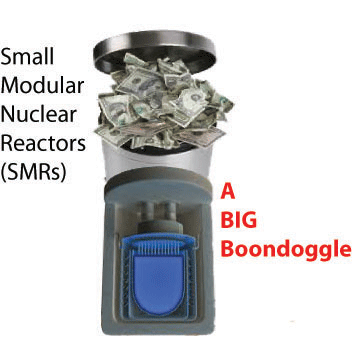 AMRs rise from the ashes of SMRs No2nuclearpower, 29 July 18
On both sides of the Atlantic billions of dollars are being poured into developing small modular reactors. (SMRs) But it seems increasingly unlikely that they will ever be commercially viable, writes Paul Brown on the Climate News Network.
The idea is to build dozens of the reactors (SMRs) in factories in kit form, to be assembled on site, thereby reducing their costs, a bit like the mass production of cars. The problem is finding a market big enough to justify the building of a factory to build nuclear power station kits. For the last 60 years the trend has been to build ever-larger nuclear reactors, hoping that they would pump out so much power that their output would be cheaper per unit than power from smaller stations. However, the cost of large stations has escalated so much that without massive government subsidies they will never be built, because they are not commercially viable. To get costs down, small factory-built reactors seemed the answer. It is not new technology, and efforts to introduce it are nothing new either, with UK hopes high just a few years ago. Small reactors have been built for decades for nuclear submarine propulsion and for ships like icebreakers, but for civilian use they have to produce electricity more cheaply than their renewable competitors, wind and solar power. A number of companies in the UK and North America are developing SMRs, and prototypes are expected to be up and running as early as 2025.
However, the next big step is getting investment in a factory to build them, which will mean getting enough advance orders to justify the cost. A group of pro-nuclear US scientists, who believe that nuclear technology is vital to fight climate change, have concluded that there is not a large enough market to make SMRS work. Their report, published in the Proceedings of the National Academy of Sciences, says that large reactors will be phased out on economic grounds, and that the market for SMRs is too small to be viable. On a market for the possible export of the hundreds of SMRs needed to reach viability, they say none large enough exists.
In the UK, where the government in June poured £200 million ($263.8) into SMR development, a parliamentary briefing paper issued in July lists a whole raft of reasons why the technology may not find a market. The paper’s authors doubt that a mass-produced reactor could be suitable for every site chosen; there might, for instance, be local conditions requiring extra safety features. They also doubt that there is enough of a market for SMRs in the UK to justify building a factory to produce them, because of public opposition to nuclear power and the reactors’ proximity to population centres. And although the industry and the government believe an export market exists, the report suggests this is optimistic, partly because so many countries have already rejected nuclear power
New funding measures for advanced reactor research and manufacturing will help the UK retain and grow its nuclear expertise and signals support for a widening range of SMR applications, according to Nuclear Energy Insider. The UK nuclear industry has broadly welcomed the UK government’s new 200 million-pound ($263.8-million) Nuclear Sector Deal which aims to cut the cost of nuclear power and bolster the UK skills base.
The deal, announced June 27, includes £56m towards the development and licensing of advanced modular reactor (AMR) designs and £32m towards advanced manufacturing research. In addition, the UK and Welsh governments will jointly invest $40 million in new thermal hydraulics testing. The development funding will initially allocate a total £4m to eight non-light water reactor (non-LWR) vendors, to perform detailed technical and commercial feasibility studies. The eight vendors are: Advanced Reactor Concepts; DBD; LeadCold; Moltex Energy (which is planning to build a demonstration SSR-W – Stable Salt Reactor Wasteburner at Point Lepreau in New Brunswick Canada); Tokamak Energy; U-Battery Developments; Ultra Safe Nuclear Corporation and Westinghouse Electric Company UK
In April 2019, three or four of these companies will be selected to receive a total of £40m to accelerate the development of the design over two years. The Office for nuclear regulation will receive £5m to support the process and a further £7m to build regulatory resources to assess and license new designs.
The new development funding schedule indicates the government has slowed down and broadened its approach to SMR deployment since it launched a competition for the best value SMR in March 2016.
The latest funding announcements could, for now, prevent an exodus of UK expertise to other countries supporting SMR development. Several advanced reactor developers are simultaneously pursuing SMR programs in North America, where government support programs are larger
The final selection of SMR designs will come later than originally expected and signals a change in scope and a recognition of multiple potential applications, Mike Middleton, Strategy ManagerNuclear at the Energy Technologies Institute (ETI), said. The funding scope recognises the application of SMR technologies could be “broader than the traditional role as a baseload electricity provider.”
In addition to baseload supply, SMR developers are targeting applications such as renewable energy load following, industrial power and heat, district heating, and hydrogen production.(3)
Meanwhile Rolls-Royce is threatening to shut down its SMR development project unless the government makes a long-term commitment including financial support in the coming months. It has scaled back investment significantly, from several millions to simply paying for “a handful of salaries”, said Warren East, Rolls-Royce chief executive. David Orr, executive vice-president of Rolls-Royce’s SMR programme, said that without comfort from the government on two fronts the project “will not fly. We are coming to crunch time.”
Rolls-Royce wants its technology to be chosen as the first to apply for a licence when a slot is made available later this year. It also wants the government to provide financial support, initially of about £20m, to take the technology through the early stages of the licensing process. This would be match-funded by the consortium, which includes companies such as Laing O’Rouke and Arup. Rolls-Royce is one of several consortia to have bid in a governmentsponsored competition launched in 2015 to find the most viable technology for a new generation of small nuclear power plants.
However, when the nuclear sector deal was finally unveiled last month, the government allocated funding only for more advanced modular reactors (AMRs). SMR’s, which typically use water-cooled reactors similar to existing nuclear power stations, were omitted from specific funding even though they are closer to becoming commercial. This has frustrated those putting forward SMR bids. Rolls-Royce has argued that developing its technology should be regarded as a “national endeavour” to develop nuclear skills that can be used to create an export led industry. (4) http://www.no2nuclearpower.org.uk/wp/wp-content/uploads/2018/07/NuClearNewsNo109.pdf
No comments yet.
1 This Month



Tell the Ukrainian Government to Drop Prosecution of Peace Activist Yurii Sheliazhenko

Petition to revoke the licensing of the Near Surface Nuclear Disposal Facility (NSDF) at Chalk River. https://www.ourcommons.ca/petitions/en/Petition/Details?Petition=e-7247


of the week – STOP SMALL MODULAR REACTORS IN CANADA
To see nuclear-related stories in greater depth and intensity – go to https://nuclearinformation.wordpress.com
-
Archives
- March 2026 (213)
- February 2026 (268)
- January 2026 (308)
- December 2025 (358)
- November 2025 (359)
- October 2025 (376)
- September 2025 (258)
- August 2025 (319)
- July 2025 (230)
- June 2025 (348)
- May 2025 (261)
- April 2025 (305)
-
Categories
- 1
- 1 NUCLEAR ISSUES
- business and costs
- climate change
- culture and arts
- ENERGY
- environment
- health
- history
- indigenous issues
- Legal
- marketing of nuclear
- media
- opposition to nuclear
- PERSONAL STORIES
- politics
- politics international
- Religion and ethics
- safety
- secrets,lies and civil liberties
- spinbuster
- technology
- Uranium
- wastes
- weapons and war
- Women
- 2 WORLD
- ACTION
- AFRICA
- Atrocities
- AUSTRALIA
- Christina's notes
- Christina's themes
- culture and arts
- Events
- Fuk 2022
- Fuk 2023
- Fukushima 2017
- Fukushima 2018
- fukushima 2019
- Fukushima 2020
- Fukushima 2021
- general
- global warming
- Humour (God we need it)
- Nuclear
- RARE EARTHS
- Reference
- resources – print
- Resources -audiovicual
- Weekly Newsletter
- World
- World Nuclear
- YouTube
-
RSS
Entries RSS
Comments RSS
 nuclear-news
Leave a comment