Climate change ensures that there’ll be more heat waves

It’s a savage summer in the Northern Hemisphere – and climate change is slashing the odds of more  heatwaves https://theconversation.com/its-a-savage-summer-in-the-northern-hemisphere-and-climate-change-is-slashing-the-odds-of-more-heatwaves-100582
In Australia we know about sweltering summer heat. We all remember the images of burned koala paws, collapsing tennis players and, far more seriously, the tragic events of Black Saturday.
Aussies may scoff at Britain’s idea of a heatwave, but this time it’s the real deal and it’s no laughing matter.
Extreme heat has hit locations throughout the Northern Hemisphere, in places as far apart as Montreal, Glasgow, Tokyo and Lapland. In the past few weeks heat records have tumbled in a wide range of places, most notably:
- a new record high temperature for Africa of 51.3℃ in Algeria
- a record high temperature in Japan of 41.1℃ near Tokyo
- a world record hottest overnight minimum of 42.6℃ in Oman.
There have also been major wildfires in northern England, Sweden and, most recently and devastatingly, Greece. The Greek wildfires came off the back of a very dry winter and spring.
What’s behind the widespread extreme heat?
The jet stream, a high-altitude band of air that pushes weather systems around at lower altitudes, has been weaker than normal. It has also been positioned unusually far to the north, particularly over Europe. This has kept the low-pressure systems that often drive wind and rain over northern Europe at bay.
The jet stream has remained locked in roughly the same position over the Atlantic Ocean and northern Europe for the past couple of months. This has meant that the same weather types have remained over the same locations most of the time.
Weather is typically more transient than it has been recently. Even when we do have blocking high-pressure systems associated with high temperatures in northern Europe, they don’t normally linger as long as this.
Is it driven by climate change?
Although climatologists have made great strides in recent years in the field of event attribution – identifying the human climate fingerprint on particular extreme weather events – it is hard to quantify the role of climate change in an event that is still unfolding.
Until the final numbers are in we won’t be able to tell just how much climate change has altered the likelihood or intensity of these particular heat extremes.
Having said that, we can use past analyses of extreme heat events, together with future climate change projections, to infer whether climate change is playing a role in these events.
We also know that increasing numbers of hot temperature records are being set, and that the increased probability of hot temperature records can indeed be attributed to the human influence on the climate.
In Europe especially, there is already a large body of literature that has looked at the role of human-caused climate change in heat extremes. In fact, the very first event attribution study, led by Peter Stott from the UK Met Office, found that human-caused climate change had at least doubled the likelihood of the infamous European heatwave of 2003.
For all manner of heat extremes in Europe and elsewhere, including in Japan, a clear and discernible link with climate change has been made.
Research has also shown that heat extremes similar to those witnessed over the past month or two are expected to become more common as global temperatures continue to climb. The world has so far had around 1℃ of global warming above pre-industrial levels, but at the global warming limits proposed in the Paris climate agreement, hot summers like that of 2003 in central Europe would be a common occurrence.
At 2℃ of global warming, the higher of the two Paris targets, 2003-like hot summers would very likely happen in most years.
Similarly, we know that heat exposure and heat-induced deaths in Europe will increase with global warming, even if we can limit this warming to the levels agreed in Paris.
But summers have always been hot, haven’t they?
For most parts of the world summers have got warmer, and the hottest summer on record is relatively recent – such as 2003 in parts of central Europe and 2010 in much of eastern Europe. One exception is central England, where the hottest summer remains 1976, although it may be challenged this year.
While extreme hot summers and heatwaves did happen in the past, they were less common. One big difference as far as England is concerned is that its extreme 1976 heatwave was a global outlier, whereas this year’s isn’t.
In 1976 northwestern Europe had higher temperature anomalies than almost anywhere else on the globe. In June 2018 the same region was unusually warm, but so was most of the rest of the Northern Hemisphere.
So while the persistent weather patterns are driving much of the extreme heat we’re seeing across the Northern Hemisphere, we know that human-caused climate change is nudging the temperatures up and increasing the odds of new heat extremes.
France’s nuclear power stations affected by extreme heat – causing restricted output

 S&P 24th July 2018 , France’s EDF expects nuclear-fired power production at its Bugey and
Saint-Alban power stations to be curtailed “due to extreme temperature forecast,” the utility said Tuesday. On grid operator RTE’s website, EDF said environmental issues are limiting “some” nuclear production availability in the country, starting Saturday. EDF did not give details on the exact impact of the output restrictions. The two nuclear power stations have a combined capacity of over 6 GW. Environmental issues have already resulted in weekend outages at EDF’s Bugey-3 reactor on the river Rhone.
Hot weather conditions previously have led to cooling water restrictions due to raised river temperatures. According to forecaster MeteoFrance, temperatures should remain above seasonal average, or around 2 degrees Celsius above norms over the weekend.
https://www.spglobal.com/platts/en/market-insights/latest-news/electric-power/072418-high-temperatures-to-cut-french-nuclear-production-edf
Japan has amassed enough plutonium to make 6,000 nuclear bombs

 Economist 25th July 2018 Japan has now amassed 47 tonnes of plutonium, enough to make 6,000 bombs.
What is Japan doing with so much plutonium? Plutonium is at the heart of
Japan’s tarnished dream of energy independence. Spent fuel from nuclear
reactors can be reprocessed to extract plutonium, which is then recycled
into mixed oxide, or MOX, fuel. This was intended for use in Japan’s
reactors but most of its nuclear power plants have been offline since the
2011 Fukushima disaster.
Tougher safety checks have failed to reassure the
nuclear-phobic public that the reactors can be restarted. And Japan’s
nuclear-energy fleet is ageing. Taro Kono, Japan’s foreign minister, has
admitted that this situation is “extremely unstable”.
Japan’s status as a plutonium superpower is increasingly under scrutiny. The government
says it has no intention of building a bomb. But China and other countries
question how long it can be allowed to stockpile plutonium. Analysts worry
about a competitive build-up of plutonium in Asia.
Moreover Japan’s stock, which is weapons-grade, is reprocessed and stored in France and
Britain. It is moved across the world in heavily armed convoys. America
says those shipments and the storage of plutonium in civilian sites present
a potential threat to non-proliferation goals: they could be redirected to
make weapons, or targeted by terrorists. It is nudging its ally to start
reducing the hoard.
https://www.economist.com/the-economist-explains/2018/07/25/why-does-japan-have-so-much-plutonium
Warming sea water affecting cooling systems in Finland’s nuclear power station
 Warm sea water in Finland reduces power from Loviisa nuclear plant https://www.reuters.com/article/us-finland-nuclear-fortum-oyj/warm-sea-water-in-finland-reduces-power-from-loviisa-nuclear-plant-idUSKBN1KF2COLefteris Karagiannopoulos 26 July 18 OSLO (Reuters) – Finland’s Loviisa power plant, consisting of two reactors with a combined capacity of 1 gigawatt, had to reduce power by 170 megawatts on Wednesday as the sea water that is used to cool the reactors had become too warm, operator Fortum said.
Because of the very warm temperatures the Nordic region is currently experiencing, the sea water that is collected to cool the Loviisa reactors is warmer and the water released is also warmer, at 32 degrees Celsius on Wednesday.
Releasing hot water back to the sea after cooling the reactors could be a hazard and if it exceeds 34 degrees Fortum said the reactors must be shut down due to regulations.
“We decreased power by 170 megawatts for a bit less than two hours. The sea water that cools the reactors was at 24 degrees, which is warmer than usual,” Fortum’s chief of operations in the plant, Timo Eurasto, told Reuters.
Such a rare occurrence may happen again in the next days because of the unusually warm temperatures, he said, adding that there was no danger to people, the plant, or the environment.
“High sea water temperature may indeed reduce the efficiency of the cooling systems of the plant. This is compensated by reducing or shutting down the reactor power,” said Nina Lahtinen, nuclear safety section head at Finland’s regulator STUK.
In Germany traders warned last week that higher temperatures in August may create cooling issues for the country’s reactors, with E.ON subsidiary PreussenElektra cutting output slightly from two units.
Sweden’s nuclear energy regulator SSM, told Reuters on Tuesday that power production at the Forsmark nuclear plant has also been reduced “by a few percentage points” due to cooling issues.
Last time Fortum had to reduce power in its reactors due to warmer-than-usual cooling water was seven years ago, said Loviisa plant’s Eurasto.
Unusually warm and dry weather in the Nordics led temperatures to record highs this summer, affecting water levels at the reservoirs that feed Norway and Sweden with hydropower, causing prices to spike as a result.
Japan’s biggest utility, Tokyo Electric Power Company moving from nuclear power to renewables
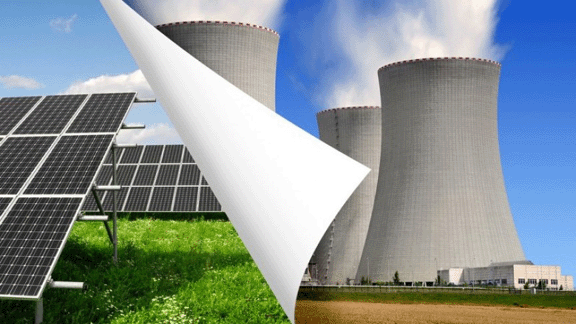
 Japan’s Tepco plans 7GW renewables roll-out, in pivot away from nuclear, REneweconomy, By Sophie Vorrath on 26 July 2018
Japan’s biggest utility, Tokyo Electric Power Company, has revealed plans to develop up to 7GW of new renewable energy capacity, marking a major departure from nuclear as the company strives to re-gain “the competitive advantage” in energy generation.
Tepco President Tomoaki Kobayakawa told the Nikkei Asian Review on Monday that the company planned to pour tens of billions of dollars into between 6 and 7GW of renewable energy projects both in Japan and abroad, including offshore wind and hydro power.
Reports suggest the focus in Japan will largely be on offshore wind, including the use of floating turbine technology that is considered to be well suited to the island nation’s relatively deep coastal waters.
And in hydro, Tepco plans to develop sites in south-east Asia, alongside its overseas and domestic wind power businesses. The company reportedly hopes to have each of the three renewables components generating at least 2GW of power.
……..The new tack for Tepco suggests a major change in direction and thinking in the Japanese electricity market, where a skew towards nuclear and “baseload” generation has roughly mirrored Australia’s attachment to coal.
As a 2016 Greenpeace Japan report noted, the nation’s nuclear utilities have had a history of “(lobbying) hard for the right to block access to the grid for renewable power plants” whenever they deemed it necessary to preserve grid stability.
They argued, said Greenpeace Japan, the all-too familiar line that the fluctuating output of renewables was incompatible with the output of nuclear reactors the government was trying to restart.
But this thinking appears to be shifting, and not just among power companies. A separate report last week in the Nikkei Asian Review noted that renewable energy momentum was also building in Japan’s corporate and industrial sectors, boosted by the liberalisation of the nation’s energy market in 2016.
“More Japanese companies are promising to source all of their electricity from renewable energy in 10 to 30 years,” the news site said. “A trend that could in turn spur investment to bolster grid capacity, to accommodate demand.” https://reneweconomy.com.au/japans-tepco-plans-7gw-renewables-roll-out-in-pivot-away-from-nuclear-72286/
South Carolina Nuclear Plant leaking radioactive uranium into ground below
 Uranium Leaked Through Floor of South Carolina Westinghouse Nuclear Plant https://www.ecowatch.com/south-carolina-nuclear-plant-leak-2590122072.html 26 July 18 A nuclear plant in Richmond County, South Carolina with a history of contaminating groundwater has leaked radioactive uranium into the soil below the plant, The State reported Tuesday.
Creusot nuclear safety scandal continues with many more anomalies revealed
 Stop Penly 24th July 2018 , Creusot, the scandal continues and concerns a growing number of components.
On July 17, 2018, EDF published a note on the information provided to the safety authority concerning the nuclear equipment manufacturing files carried out at the Creusot plant, now under the control of the state energy
operator.
The verification of all the manufacturing files of these components reveals 1,775 anomalies and 449 non-compliances on the equipment of 46 of its operating nuclear reactors. With 94 anomalies and 19 nonconformities for 34 parts manufactured at Le Creusot, reactor 3 Bugey (Ain) seems to be the most affected.
http://stopeprpenly.org/?p=1161
Is the 100 in Holtec’s Spent Nuclear Fuel HI-STORM 100 Cask a Reference to “Exemptions” to its Certificate of “Compliance” (CoC)? — Mining Awareness +
Originally posted on Mining Awareness + : Holtec is up to its 10th Amendment for its Certificate of “Compliance” for its Spent Nuclear Fuel System, for Lethal High Level Nuclear Waste. If the last few Amendments are indicative, each Amendment has been characterized by at least one Revision, and each Amendment and Revision has multiple exemption requests.…
More US NRC Safety Related Exemptions for Holtec: Increase Risk of a Criticality Accident and are Illegal (Comment Deadline July 30th, 11:59 pm) — Mining Awareness +

Originally posted on Mining Awareness + : Forget North Korea, Holtec and its owner Kris Singh is the biggest nuclear menace. Holtec’s nuclear “spent fuel” canisters are already a flimsy 1/2 inch thick, for the sealed metal part which protects the public from radiation, even though they are huge, as seen in the picture. The concrete surrounding…
USA Unlikely To See New Nuclear Power Anytime Soon
 Study: US Unlikely To See New Nuclear Power Anytime Soon, WABE • Nuclear power doesn’t have much of a future in the U.S., according to a recent paperthat says the country is unlikely to see many new reactors in coming decades, unless there are major policy changes.
Tactical nuclear weapons for U.S. submarines: why this is a bad idea
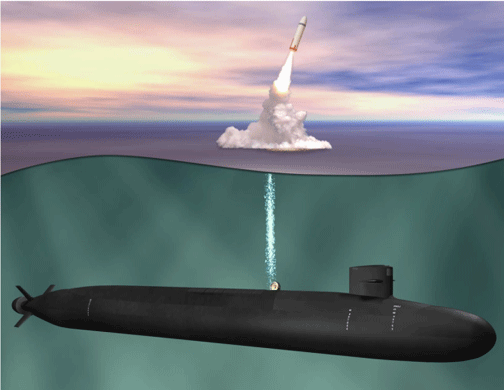
U.S. Submarines Will Soon Carry Tactical Nuclear Weapons https://www.popularmechanics.com/military/weapons/a22550758/us-submarines-will-soon-carry-tactical-nuclear-weapons/ By Kyle Mizokami
Electricite de France wants pension funds to cough up for building Sizewell nuclear project
 EDF Wooing Pension Funds to Finance Sizewell U.K. Nuclear Plant, Bloomberg, By Rachel Morison 12 pension funds interested in backing plant in East Anglia Plant would lower nuclear costs by copying design of Hinkley
The developer of Britain’s first nuclear power station in more than three decades has approached 12 pension funds about helping finance a sister plant on the other side of the country.
Electricite de France SA is working on ways to pay for its Sizewell C project in East Anglia that will make it cheaper than the Hinkley Point C nuclear plant it’s building on the coast of Southwest England. Hinkley has been a lightning rod for controversy since the government pledged to pay 92.50 pounds ($122) a megawatt-hour for its power, more than 60 percent more than the latest offshore wind farms……..
Prime Minister Theresa May’s government has estimated it needs to draw in 100 billion pounds within the next decade to upgrade power grids and replace aging generation plants as the bulk of Britain’s nuclear fleet finishes its life in service. ……..https://www.bloomberg.com/news/articles/2018-07-26/edf-wooing-pension-funds-to-finance-sizewell-u-k-nuclear-plant
British tax-payers’ liability in the event of a nuclear accident at Wylfa

Government outlines public liability at Wylfa nuclear plant https://www.newcivilengineer.com/latest/government-outlines-public-liability-at-wylfa-nuclear-plant/10033570.article 26 JULY, 2018
Nuclear operators must have insurance, energy and clean growth minister Claire Perry told parliament, and any costs more than €1.5bn (£1.33bn) would be “met at parliament’s discretion”.
The Westminster Hall debate followed a report in the Times that claimed Japanese company Hitachi would not pay for any accidents at the proposed plant in Anglesey, north Wales.
Energy and clean growth minister Claire Perry said: “There were some questions about liability in the event of an accident. I am happy to say that the last significant incident was the Windscale fire in 1957, and we are light years away from that plant in terms of nuclear operating technology and the safety regime that we operate.
“The Nuclear Installations Act 1965 makes the insurance that I mentioned a requirement, without which operators cannot operate. As the hon. Member for Southampton, Test mentioned, we also have legislation based on the Paris and Brussels conventions.
If the total cost of claims ever exceeded €1.2 billion, a further €300 million would be provided by all contracting parties to the Brussels supplementary convention. Any further claims above that total would be met at Parliament’s discretion.”
Alan Brown MP said: “It marks a departure from the “polluter pays” principle. It is critical that the UK Government do not sign up to any such crazy proposals.”The government is in “commercial negotiations” with Hitachi over the plans, and will take a £5bn stake in the project.
Further delays, costs escalations, at EDF’s Flamanville European Pressurized Reactor (EPR)

FT 25th July 2018 , French power utility EDF has said there will be further delays and cost overruns at its flagship Flamanville nuclear site. In April, the company said that problems with the weldings at its Flamanville site might have an
impact on the costs and the schedule for starting the long-delayed nuclear reactor.
On Wednesday, the company said that out of the 148 inspected welds, 33 had quality deficiencies and would be repaired. As a result it had “adjusted the Flamanville EPR schedule and construction costs . . . The loading of nuclear fuel is now scheduled for the fourth quarter in 2019 and the target construction costs have been revised from €10.5bn to €10.9bn.”
The plant was already seven years late and €7bn over budget. The Flamanville plant in France is one of three being
built in Europe using the next-generation European Pressurized Reactor technology. The other two projects are the Olkiluoto project in Finland, which is more than a decade late, and the UK’s Hinkley Point, which is mired in controversy over the high cost of the project.
http://www.ft.com/content/1b2473c8-8fdd-11e8-b639-7680cedcc421
Holtec Refused to Make Costs-Profits Available to US Government But Wants Permission To Bury High Level Nuclear Waste In New Mexico – Comment Deadline July 30th 11.59 pm — Mining Awareness +

Holtec should not be able to use a highly regulated and publicly funded industry to make profits, but to refuse to provide information about the cask business….” “COMMONWEALTH EDISON COMPANY, Plaintiff, v. No. 98-621C Judge Hewitt UNITED STATES, Defendant, Case 1:98-cv-00621-ECH , Document 288 , Filed 03/12/2004“, Page 6 of 9 http://www.plainsite.org/dockets/download.html?id=14565388&z=24a65e24. Kris Pal Singh-Holtec’s […]
1 This Month

of the week – Shut Down Drone Warfare!


Tell the Ukrainian Government to Drop Prosecution of Peace Activist Yurii Sheliazhenko

Petition to revoke the licensing of the Near Surface Nuclear Disposal Facility (NSDF) at Chalk River. https://www.ourcommons.ca/petitions/en/Petition/Details?Petition=e-7247
To see nuclear-related stories in greater depth and intensity – go to https://nuclearinformation.wordpress.com
-
Archives
- April 2026 (79)
- March 2026 (251)
- February 2026 (268)
- January 2026 (308)
- December 2025 (358)
- November 2025 (359)
- October 2025 (376)
- September 2025 (257)
- August 2025 (319)
- July 2025 (230)
- June 2025 (348)
- May 2025 (261)
-
Categories
- 1
- 1 NUCLEAR ISSUES
- business and costs
- climate change
- culture and arts
- ENERGY
- environment
- health
- history
- indigenous issues
- Legal
- marketing of nuclear
- media
- opposition to nuclear
- PERSONAL STORIES
- politics
- politics international
- Religion and ethics
- safety
- secrets,lies and civil liberties
- spinbuster
- technology
- Uranium
- wastes
- weapons and war
- Women
- 2 WORLD
- ACTION
- AFRICA
- Atrocities
- AUSTRALIA
- Christina's notes
- Christina's themes
- culture and arts
- Events
- Fuk 2022
- Fuk 2023
- Fukushima 2017
- Fukushima 2018
- fukushima 2019
- Fukushima 2020
- Fukushima 2021
- general
- global warming
- Humour (God we need it)
- Nuclear
- RARE EARTHS
- Reference
- resources – print
- Resources -audiovicual
- Weekly Newsletter
- World
- World Nuclear
- YouTube
-
RSS
Entries RSS
Comments RSS
 nuclear-news