TV News Media is letting the world down as it fails to cover unprecedented global heat wave
 Global heat wave: an epic TV news fail https://thebulletin.org/2018/07/global-heat-wave-an-epic-tv-news-fail/?utm_source=Bulletin%20newsletter&utm_medium=iContact%20email&utm_campaign=July20 By Dawn Stover, July 19, 2018
This month’s scorching heat wave broke records around the world. The Algerian city of Ouargla, with a population of half a million, had a temperature of 124.3 degrees Fahrenheit on July 6, the hottest reliably measured temperature on record in Africa. In Ireland and Wales, the unusually hot weather revealed ancient structures normally hidden by grass or crops. In Chino, California, the mercury soared to 120 degrees. Another round of hazardous summer heat is expected this week, with record high temperatures possible in the southern United States.
The prolonged heat wave has been a staple of television news for weeks. However, most of the coverage has been sorely lacking in context: Humans are warming the planet, and scientists have already linked some heat waves to climate change. A recent analysis published in the journal Nature Climate Change concludes that  human-driven climate change, rather than natural variability, will be the leading cause of heat waves over the western United States and Great Lakes region as early as the 2020s and 2030s, respectively.
Like the heat itself, much of the media coverage was stupefying. “Major broadcast TV networks overwhelmingly failed to report on the links between climate change and extreme heat,” according to a Media Matters survey. “Over a two-week period from late June to early July, ABC, CBS, and NBC aired a combined 127 segments or weathercasts that discussed the heat wave, but only one segment, on CBS This Morning, mentioned climate change.”
TV coverage would undoubtedly improve if weather forecasters were better informed about climate science. But four Republican senators with close ties to the fossil fuel industry are trying to eliminate government funding for a National Science Foundation designed to help forecasters (and by extension, the general public) “become more familiar with the science behind how their local weather and its trends are related to the dynamics of the climate.”
Pickering nuclear station – unsafe, and likely to remain so

 The Pickering nuclear plant’s explosive secret https://www.durhamregion.com/opinion-story/8738033-the-pickering-nuclear-plant-s-explosive-secret/?s=n1
Angela Bischoff says OPG has no plans to make its nuclear waste as safe as possible Jul 19, 2018 by Angela Bischoff Pickering News Advertiser
These bundles contain radioactive materials that can penetrate the human body, leading to serious illness or death. They also contain an enormous amount of plutonium, the key ingredient in nuclear warheads or dirty bombs. There is enough plutonium on-site at Pickering today to construct more than 11,000 nuclear warheads.
We recently asked internationally recognized risk expert Dr. Gordon Thompson to review the advisability of storing this enormous pile of toxic waste in the midst of Canada’s largest urban area and next to the source of our drinking water.
His conclusion was stark: The Pickering site, he found, is “suboptimal as a spent nuclear fuel-storage site from perspectives including defensibility, proximity of populations, and potential to contaminate Lake Ontario.” He added that the current waste storage facilities have no protection from rocket, bomb or aircraft attacks from the air or water and that, overall, the site is “lightly defended” at best.
Half-a-century after the start of nuclear power operations in Canada, the Nuclear Waste Management Organization is still on the hunt for a “willing host” community to accept thousands of tonnes of spent fuel that will remain highly radioactive for thousands of years.
This means there is little chance the waste currently being stored at Pickering is going anywhere in the next 60 to 100 years. To add insult to injury, while Ontario Power Generation is planning to expand its conventional storage facilities so that Pickering can continue to produce and store more toxic nuclear wastes, it has no plans to make its new storage facilities as safe as possible. Specifically, it has no plans to build above-ground, attack-resistant, reinforced-concrete vaults to protect Pickering’s wastes from a terrorist attack.
Continuing to operate this patched-up nuclear plant surrounded by millions of people, while piling up more and more toxic nuclear wastes in conventional commercial storage buildings, is the very definition of an extremely bad idea that can only get worse.
Those who support keeping Pickering running until 2024 or beyond, such as Premier Doug Ford, need to explain how they plan to safeguard the thousands of tonnes of deadly waste already stored at the site and why it is a good idea to continue adding more.
— Angela Bischoff is the director of the Ontario Clean Air Alliance. We’re behind Ontario’s coal phase-out and are now working to move Ontario to a 100-per cent renewable electricity system.
EU Energy and Environment Sub-Committee want clarity on UK’s nuclear plans after Brexit
 House of Lords 19th July 2018 The EU Energy and Environment Sub-Committee has written to the Minister for Business and Industry, Richard Harrington MP, following an evidence session with the Office for Nuclear Regulation which considered their efforts to prepare for Brexit.
The Committee has written to BEIS’ Minister for Business and Industry to ask for further clarity on the ONR’s future funding arrangements, and to request regular updates between now and the point of withdrawal to ensure the ONR’s preparation remains on track.
The Committee also asks for an update on negotiations regarding the intended Nuclear Cooperation Agreements with the USA, Canada, Japan and Australia.
https://www.parliament.uk/business/committees/committees-a-z/lords-select/eu-energy-environment-subcommittee/news-parliament-2017/nuclear-preparedness-letter-to-minister/
Fukushima radioactive cesium particles detected in California wine
Fukushima’s nuclear signature found in California wine https://www.technologyreview.com/s/611654/fukushimas-nuclear-signature-found-in-california-wine/
The Japanese nuclear disaster bathed north America in a radioactive cloud. Now pharmacologists have found the telltale signature in California wine made at the time. by Emerging Technology from the arXiv, July 19, 2018
Throughout the 1950s, the US, the Soviet Union, and others tested thermonuclear weapons in the Earth’s atmosphere. Those tests released vast quantities of radioactive material into the air and triggered fears that the nuclear reactions could ignite deuterium in the oceans, thereby destroying the planet in a catastrophic accidental fireball.
Atmospheric tests ended in 1980, when China finished its program, but the process has left a long-lasting nuclear signature on the planet. One of the most obvious signatures is cesium-137, a radioactive by-product of the fission of uranium-235.

After release into the atmosphere, cesium-137 was swept around the world and found its way into the food supply in trace quantities. Such an addition is rarely welcomed. But in 2001, the French pharmacologist Philippe Hubert discovered that he could use this signature to date wines without opening the bottles.
The technique immediately became a useful weapon in the fight against wine fraud—labeling young wines as older vintages to inflate their price. Such fraud can be spotted by various types of chemical and isotope analysis—but only after the wine has been opened, which destroys its value.
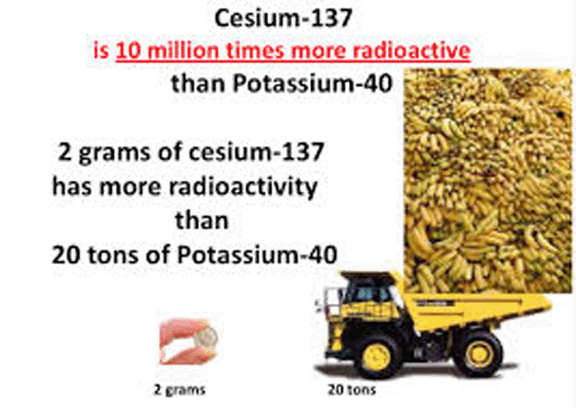 Cesium-137, on the other hand, allows noninvasive testing because it is radioactive. It produces distinctive gamma rays in proportion to the amount of isotope present. Dating the wine is a simple process of matching the amount of cesium-137 to atmospheric records from the time the wine was made. That quickly reveals any fraud. Indeed, if there is no cesium-137, the wine must date from after 1980.
There is one blip in this record, though. The Chernobyl disaster in 1986 bathed much of Europe, and other parts of the world, in a radioactive cloud that increased atmospheric levels of cesium-137 again. Hubert and colleagues can see this blip in their data from wines.
And that raises an interesting question about the Fukushima disaster of 2011, an accident of Chernobyl proportions caused by a meltdown at the Fukushima nuclear power plant in Japan following a huge earthquake and tsunami. It released a radioactive cloud that bathed North America in fissile by-products.
Is it possible to see the effects of the Fukushima nuclear disaster in California wines produced at the time?
Today we get an answer, thanks to a study carried out by Hubert and a couple of colleagues. “In January 2017, we came across a series of Californian wines (Cabernet Sauvignon) from vintage 2009 to 2012,” say Hubert and company.
This set of wines provides the perfect test. The Fukushima disaster occurred on March 11, 2011. Any wine made before that date should be free of the effects, while any dating from afterward could show them.
The team began their study with the conventional measurement of cesium-137 levels in the unopened bottles. That showed levels to be indistinguishable from background noise.
But the team was able to carry out more-sensitive tests by opening the wine and reducing it to ash by evaporation. This involves heating the wine to 100 degrees Celsius for one hour and then increasing the temperature to 500 degrees Celsius for eight hours. In this way, a standard 750-milliliter bottle of wine produces around four grams of ashes. The ashes were then placed in a gamma ray detector to look for signs of cesium-137.
Using this method, Hubert and his colleagues found measurable amounts of cesium-137 above background levels in the wine produced after 2011. “It seems there is an increase in activity in 2011 by a factor of two,” conclude the team.
That probably won’t be very useful for fraud detection in California wine—the levels of cesium-137 are barely detectable, and even then, only if the wine is destroyed.
But the result does show how nuclear disasters can have unexpected consequences long after the fact.
Ref: arxiv.org/abs/1807.04340 : Dating of Wines with Cesium-137: Fukushima’s Imprint
Radiation from smartphones could be affecting memory performance in teenagers
Study suggests mobile phone radiation could affect teenagers’ memory performance https://www.irishnews.com/magazine/science/2018/07/20/news/study-suggests-mobile-phone-radiation-could-affect-teenagers-memory-performance-1388073/, 20 July, 2018 18:31
Radiation from smartphones could be affecting memory performance in teenagers, a new study has warned.
Scientists at the Swiss Tropical and Public Health Institute (Swiss TPH) have found that increased exposure to mobile phones over the course of a year negatively affects the figural memory – which refers to the human ability to understand images, shapes, patterns and objects – of adolescents.
According to the researchers, youngsters who hold their phone next to their right ear are more likely to be affected as figural memory is located in the right hemisphere of the brain.
The Swiss TPH team studied nearly 700 adolescents between the ages of 12 and 17, looking to see if there was a link between regular exposure to radiofrequency electromagnetic fields (RF-EMF) – which are produced by mobile phone technologies and other wireless devices – and memory performance.
They found that RF-EMF absorbed by the brain to be associated with a negative effect on figural memory performance.
Sending text messages, playing mobile games and browsing the internet were found to “cause only marginal RF-EMF exposure to the brain and were not associated with the development of memory performance”, the researchers said.
The study follows up a report in 2015 and more recent information on the absorption of RF-EMF in adolescents’ brains during different types of wireless communication device use.
Martin Roosli, head of Environmental Exposures and Health at Swiss TPH, said that further research is needed to rule out other factors.
He said: “For instance, the study results could have been affected by puberty, which affects both mobile phone use and the participant’s cognitive and behavioural state.”
While the potential effects of RF-EMF exposure to the brain is a relatively new field of scientific research, Dr Roosli advises that using headphones or turning on the phone’s loudspeaker could help reduce the exposure to RF-EMF.
He said: “It is not yet clear how RF-EMF could potentially affect brain processes or how relevant our findings are in the long-term.
“Potential risks to the brain can be minimised by using headphones or the loudspeaker while calling, in particular when network quality is low and the mobile phone is functioning at maximum power.”
The research is published in the journal Environmental Health Perspectives.
Children’s eyes need protection from ultraviolet radiation
Get Your Sunglasses Out: UV-Radiation and Eye Health https://www.advancedsciencenews.com/get-your-sunglasses-out-uv-radiation-eye-health/ ByJuly 19, 2018
Visual perception is a complex phenomenon that is initiated when electromagnetic radiation from the sun reaches the retina and the visible spectrum is converted from radiant energy into sensation by the phototransduction in the retinal photoreceptors. The ability to translate electromagnetic radiation into usable visual information relies on a complex interaction between the different structural and functional components of the eye and the brain.
Because of its function and structure, the eye is most susceptible to light damage; it is designed to focus incoming light rays to form images on the neural retina. This has the effect of concentrating the light or increasing the power density of light on the retina. Thus, light delivering a radiant exposure insufficient to produce skin damage may indeed cause injury when focused on the retina. In the eye, ultraviolet radiation (UVR) is not known to contribute to visual perception and there are strong evidences that acute high dose exposure to UVR causes photokeratitis and photoconjunctivitis, while even low dose chronic exposure to UVR is a risk factor for cataract, pterygium and squamous cell carcinoma of the cornea and conjunctiva. There is weaker evidence in relation to other, noncancer eye conditions, related with the oxidative stress (OS) induced by UVR exposure.
A reviewin the latest issue of Journal of Biophotonics a team of German researchers present an overview of the most recent knowledge on the role of the UVR in eye health and its aging process with a main focus on OS‐induced noncancer diseases. Highlighted are endogenous and exogenous mechanisms to protect the retina from different type of injuries caused by the invisible bands of the electromagnetic spectrum. Most prevalent ocular diseases are analyzed in relation to OS and solar UVR exposure and possible OS signaling streams and mechanisms related to the various diseases in the aging eye are discussed as well.
Excessive exposure to UVR through live may seriously contribute to increase in OS of various eye tissues and thus lead to the advancement of serious ocular pathologies. “Children are especially vulnerable to UVR because of their larger pupils and more transparent ocular media: therefore, efficient everyday protection of the sensitive tissues of the eye by wearing of sunglasses, clear UVR‐blocking spectacles or contact lenses should be considered from early age on” according to team member Iliya Ivanov.
1 This Month


Tell the Ukrainian Government to Drop Prosecution of Peace Activist Yurii Sheliazhenko

Petition to revoke the licensing of the Near Surface Nuclear Disposal Facility (NSDF) at Chalk River. https://www.ourcommons.ca/petitions/en/Petition/Details?Petition=e-7247


of the week – STOP SMALL MODULAR REACTORS IN CANADA
To see nuclear-related stories in greater depth and intensity – go to https://nuclearinformation.wordpress.com
-
Archives
- March 2026 (204)
- February 2026 (268)
- January 2026 (308)
- December 2025 (358)
- November 2025 (359)
- October 2025 (376)
- September 2025 (258)
- August 2025 (319)
- July 2025 (230)
- June 2025 (348)
- May 2025 (261)
- April 2025 (305)
-
Categories
- 1
- 1 NUCLEAR ISSUES
- business and costs
- climate change
- culture and arts
- ENERGY
- environment
- health
- history
- indigenous issues
- Legal
- marketing of nuclear
- media
- opposition to nuclear
- PERSONAL STORIES
- politics
- politics international
- Religion and ethics
- safety
- secrets,lies and civil liberties
- spinbuster
- technology
- Uranium
- wastes
- weapons and war
- Women
- 2 WORLD
- ACTION
- AFRICA
- Atrocities
- AUSTRALIA
- Christina's notes
- Christina's themes
- culture and arts
- Events
- Fuk 2022
- Fuk 2023
- Fukushima 2017
- Fukushima 2018
- fukushima 2019
- Fukushima 2020
- Fukushima 2021
- general
- global warming
- Humour (God we need it)
- Nuclear
- RARE EARTHS
- Reference
- resources – print
- Resources -audiovicual
- Weekly Newsletter
- World
- World Nuclear
- YouTube
-
RSS
Entries RSS
Comments RSS
 nuclear-news