Since President Xi Jinping announced China’s Belt and Road Initiative (BRI) in 2013, there has been no shortage of speculation on the motivations behind it. While Beijing has extolled the $1 trillion initiative’s benefits — including trade creation, economic development, and renewable energy — it has also repeatedly tried to soft-pedal the BRI’s military strategic implications.
Nuclear power plant (NPP) projects, for example, are not listed on several Chinese government BRI websites. Yet, over the next decade China plans to build 30 reactors in BRI countries, many of which are either not party to global nuclear nonproliferation regimes or lack the regulatory basis for controlling nuclear fuel uses. These projects are certainly part of China’s grander energy strategy and paint a clearer, drearier picture of how the initiative might unravel.
Developing countries should not be enticed by NPPs, with or without Chinese funding. China is backing them to achieve its own economic and geostrategic goals rather than a public good. Civil nuclear energy presents grave pitfalls in terms of cost, innovation and security that BRI countries cannot and should not afford.
The vision statement for the BRI, issued by the Chinese government, states clearly that it will advance nuclear power cooperation, and the Belt and Road Energy Cooperation website lists a handful of bilateral nuclear agreements. Many independent sources like the Carnegie Endowment for International Peace, PricewaterhouseCoopers, and the Stockholm International Peace Research Institute include reactors under the official BRI umbrella. The Chinese National Nuclear Corporation stated that it has already sold eight to seven countries, and is in talks with more than 40 others. Many of them are BRI participants, including Sudan, Kenya, Egypt, Thailand, Malaysia, Turkey, Saudi Arabia, Iran, and the United Kingdom.
However, official BRI websites like the Belt and Road Portal, the Belt and Road Forum and the China-Pakistan Economic Corridor (CPEC) database leave out NPP projects.
There are a number of reasons why Chinese websites might not list them. Nuclear technologies are dual-use, meaning that weapons-grade uranium enrichment requires essentially the same technology as enrichment for civil energy purposes (albeit with many more centrifuges). By leaving nuclear projects officially out of the BRI, China downplays the threat of nuclear weapons proliferation along BRI corridors, binding countries to Beijing via technological cooperation and long-term debt.
Another reason is that China wants to whitewash its violations of nuclear nonproliferation regimes. China is a member of the Nuclear Suppliers Group, prohibiting it from exporting nuclear material to countries like Pakistan, which has not signed the Non-Proliferation Treaty, acceded to full International Atomic Energy Agency (IAEA) safeguards, or decelerated its nuclear weapons program. Yet, Chinese officials have stated their involvement in six nuclear reactor projects there.
A third reason is that China is building NPPs in scant regulatory environments, regardless of the glaring security risks. Sudan, which plays a huge role in the BRI, recently signed a framework agreement with China to construct its first nuclear reactor. However, a 2017 study by the Institute for Science and International Security ranked 200 countries based on their ability to limit nuclear trafficking. Sudan ranked 194th. Moreover, it has not signed the IAEA Additional Protocol, which significantly improves the organization’s ability to verify that nuclear fuel is used only for civil energy purposes. Four countries on Sudan’s porous borders have not signed it either.
These highly irresponsible “geostrategic nuclear exports” are China’s attempt to compete with Russia. Both countries have signed nuclear deals with Iran, Egypt, Sudan and Turkey, and both have looked to dominate nuclear export markets by pushing reactors in places where they do not belong. For Beijing, these projects buy lasting influence in regions supplying raw materials and draw historically pro-Western countries further into the Chinese camp………
Disregarding Both Risk and Better Options
The “nuclear renaissance” that world leaders championed at the start of the century quickly deteriorated into a nuclear quagmire, with projects being delayed or abandoned throughout the developed world. Now, China is leading a nuclear resurgence without political, humanitarian or safety liabilities that is likely to yield similar results, if not worse.
None of this is to say that the BRI is entirely negative, but there are still unresolved security issues which NPPs will only exacerbate. The BRI includes a large number of renewable energy projects, which will certainly encourage countries to achieve their commitments to mitigating climate change. China and BRI participants should rely more heavily on these cheaper, cleaner and safer technologies.
There is enormous potential for wind power in Pakistan and solar in Sudan. Pakistan has an estimated wind energy potential of 346 GW, most of which would come from the southeastern province of Sindh, one of the most stable regions in the country where wind speeds reach up to 12 m/s. Sudan is considered one of the sunniest countries in the world, with an average sunlight duration of nine hours and solar energy densities of more than quadruple other regions. Still, solar power remains largely untapped there.
Recently, I wrote that China is leading the charge towards a renewable energy future, particularly with regards to solar panel manufacturing. It is also advancing battery storage devices, reducing the need for nuclear as baseload power. Developing countries should not fall victim to the entrapments of civil nuclear energy. They have the opportunity to leapfrog, but only if they learn from past mistakes. https://thediplomat.com/2018/07/why-the-civil-nuclear-trap-is-part-and-parcel-of-the-belt-and-road-strategy/
Sam Reynolds is pursuing his master’s degree in international relations from the Johns Hopkins School of Advanced International Studies. His primary areas of interest include the geopolitics of climate change, migration, and science diplomacy. He is currently an intern in the Asia-Pacific program of the EastWest Institute.
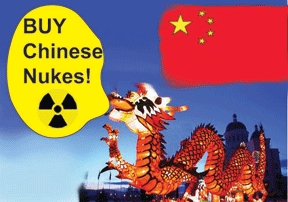 Why the Civil Nuclear Trap Is Part and Parcel of the Belt and Road Strategy

 nuclear-news
Leave a comment