Appalling hypocrisy in statement from USA, UK and Russia on Treaty on the Non-Proliferation of Nuclear Weapons

Ekklesia 1st July 2018 ,The Campaign for Nuclear Disarmament has responded to a statement released
by the USA, UK and Russia to mark the 50th anniversary of the Treaty on the
Non-Proliferation of Nuclear Weapons (NPT) on Sunday 1 July 2018. Kate
Hudson, CND General Secretary, said: “While it is right to mark the
anniversary of the landmark NPT, this statement from three of the major
nuclear states smacks of appalling hypocrisy.
http://www.ekklesia.co.uk/node/26227
UN Nuclear Non-Proliferation Treaty turns 50 – not a lot of hope for complete nuclear disarmament
 Nuclear-free world unlikely as UN treaty turns 50, DW, 1 July 18 Fifty years after countries signed the UN Nuclear Non-Proliferation Treaty, there are still nearly 15,000 nuclear weapons spread around the world. Experts today believe that complete nuclear disarmament remains unlikely.
If it weren’t the site of a historical anachronism, hardly anyone would take any notice of Büchel, a small town west of Frankfurt, between Koblenz and Trier. Büchel is home to the last remaining atomic bombs in Germany, which have been stored here since the end of the Cold War. The air force base here allegedly houses around 20 B61 bombs, although the exact number is secret. But one thing is certain: each of them is many times more destructive than the bombs that wiped out Hiroshima and Nagasaki.
The atomic bombs in Büchel belong to the US, but in an emergency they would be flown to a target and dropped by German Tornado fighter-bombers. Pilots from the Tactical Air Force Wing 33 have been regularly practicing with dummy bombs for decades. The squadron is the main employer in the area, but the existence of these nuclear weapons doesn’t show up anywhere on Büchel’s website.
This strategy, in which other NATO states also participate, is called “nuclear sharing.” Belgium, the Netherlands, Italy and Turkey also have US nuclear weapons on their territory. The concept of nuclear deterrence which underlies this strategy is still in great demand. As recently as 2012, it was confirmed by NATO as a “core element of collective defense.”
Original goal: Nuclear disarmament
The mood was very different 50 years ago. In the UN’s Nuclear Non-Proliferation Treaty, signed by the US, Great Britain and the Soviet Union on July 1, 1968, the signatory states undertook to prevent the proliferation of nuclear weapons. They were also striving for complete nuclear disarmament. Germany joined the treaty in 1975, and it has since been signed by more than 190 states.
For a long time, the treaty was regarded as the cornerstone of global disarmament efforts. Today, it appears to be little more than a toothless tiger. The Stockholm International Peace Research Institute (SIPRI) estimates there are still nearly 15,000 nuclear weapons worldwide. According to their research, the majority are held by the US (6,800) and Russia (7,000).
According to theologian Eberhard Schockenhoff, a professor at the Albert Ludwigs University of Freiburg and long-standing member of the German Ethics Council, the nuclear strategies of both sides are based on maintaining this residual stock, at least at its current level.
“This is ethically unacceptable,” he said. The nuclear powers have “written off” the goal of nuclear disarmament — if not in public, at least behind closed doors.
The clock is ticking…
Tom Sauer, a political scientist and disarmament expert at the University of Antwerp, believes the treaty is “in total crisis.” The last review conference in 2015 broke down, and he fears this will also be the case for the next one in 2020.
He believes that this state of affairs will continue until the signatory countries finally fulfil their obligations, which include a massive reduction of warheads down to zero, he says. “They promised that in 1968, but they’re not doing it.”
But instead of reducing their stockpiles, nuclear weapon states have been modernizing their weapons and incorporating new technology, such as sophisticated guidance systems. Experts say the danger of nuclear war is greater today than it has been for decades.
In January, a panel of scientists, including 17 Nobel Prize winners, set the symbolic Doomsday Clock— which measures how close the planet could be to catastrophe — at 11:58 p.m.. The readjustment put the clock at the closest it’s been to midnight since the height of the Cold War…..
New UN attempt
Has the danger posed by the continued existence of nuclear weapons been misjudged, 50 years after the signing of the non-proliferation treaty? Sauer fears this might be the case. He remains concerned that disarmament talks between the US and Russia are currently on hold, and that other countries, in particular Iran and Saudi Arabia, may be striving for nuclear weapons of their own.
Sauer hopes the United Nations will eventually support a complete ban on nuclear weapons, as outlined in a treaty adopted in July 2017 by 122 votes from its 193 member states. Once 50 countries ratify this treaty, it will become legally binding. To date, only 10 countries have done so — none of them major world powers.
If and when that happens, all the signatory countries would then consider nuclear weapons illegal, said Sauer. “The wind is changing, and nuclear powers are on the defensive.”……
….https://www.dw.com/en/nuclear-free-world-unlikely-as-un-treaty-turns-50/a-44471683
Hypocrisy relating to Nuclear Non Proliferation Treaty – US-UK Mutual Defense Agreement
David Lowry’s Blog 29th June 2018 , Article I of the NPT starts with the following commitment on Russia, the US
and UK: “Each nuclear-weapon State Party to the Treaty undertakes not to
transfer to any recipient whatsoever nuclear weapons or other nuclear
explosive devices or control over such weapons or explosive devices
directly, or indirectly”
Extraordinarily, just two days earlier in
Washington, the US hosted a bilateral meeting with the UK to celebrate the
60th anniversary – from July 3, 1958 – of a hugely significant nuclear
defence agreement (commonly called the US–UK Mutual Defense
Agreement,(MDA) with defence spelled with an ‘s’ even in the official
UK version, hinting at the origin of its drafting).
http://drdavidlowry.blogspot.com/2018/06/naked-nuclear-hypocrisy.html
Federal and tribal officials support proposed amendments to the Radiation Exposure Compensation Act

 Officials seek support for radiation exposure compensation amendments https://www.daily-times.com/story/news/local/navajo-nation/2018/06/30/officials-seek-support-radiation-exposure-compensation-amendments/740239002/,
Horizon Nuclear Power’s Wylfa Newydd plans formally approved.
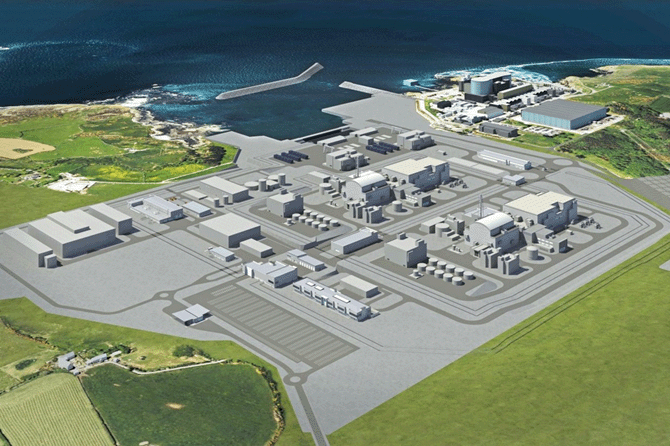 Energy Live News 29th June 2018 ,Horizon Nuclear Power’s Wylfa Newydd plans formally approved. Four key
environmental permits will now enter the assessment stage. Horizon Nuclear
Power has had its plans to build the proposed Wylfa Newydd nuclear power
station in Wales formally approved by the Planning Inspectorate. The
Development Consent Order process now formally begins with the
pre-examination phase, which is where members of the public can become an
‘interested party’. An Examining Authority is also appointed at this
stage and interested parties will be invited to attend a preliminary
meeting. Four other key environmental permits will now also enter the
assessment stage, which will be delivered by Natural Resources Wales.
https://www.energylivenews.com/2018/06/29/horizon-nuclear-powers-wylfa-newydd-plans-formally-approved/
UK Public Accounting for Costs of the Defence Nuclear Enterprise – seriously underscrutinised
 Parliament 19th June 2018 Neglected Large-Scale Value for Money Issues in Public Accounting for Costs
of the Defence Nuclear Enterprise :Written evidence a review of issues that
are of direct relevance to the core topic of the National Audit Office
(NAO) report of 2018 concerning ‘the Defence Nuclear Enterprise’
(henceforth ‘NAO Report’). The material summarized here supplements and
updates evidence published by the PAC Inquiry of October 2017. The authors
believe on grounds of many years of research at the Science Policy Research
Unit at the University of Sussex that the matters documented here raise
large-scale, long-run value for money issues of pressing national
importance, which remain seriously neglected in work to date either by the
NAO, the PAC or any other official bodies – and which are therefore
gravely under-scrutinized by Parliament or wider UK policy debates
Unresolved Israel-Palestinian conflict prevents region-wide prohibition of nuclear weapons
 Palestinians and Nuclear Weapons, The National Interest,
The unresolved Israel-Palestinian conflict is one of the major factors preventing an effective region-wide prohibition of nuclear weapons.,
China and UK to work together on promoting the nuclear industry to universities etc
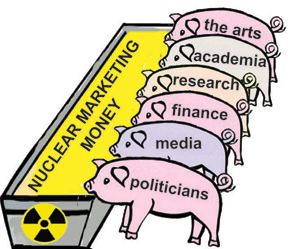
Energy Live News 29th June 2018 , China’s largest nuclear power producer has signed a Memorandum of
Understanding (MOU) with the UK Nuclear Advanced Manufacturing Research
Centre (Nuclear AMRC) to help deepen its links with Britain’s supply
chain.
CGN, the developer of the Bradwell B project, hopes to develop its
expertise and knowledge, as well as improve commercial and academic
connections. The wide-ranging deal includes working out how UK businesses
and universities can prepare themselves to participate in the project and
how these organisations can add value to CGN’s nuclear operations in
China and elsewhere.
https://www.energylivenews.com/2018/06/29/cgn-signs-mou-to-deepen-links-with-uks-nuclear-supply-chain/
Plan to save nuclear reservoir at Winfirth from “collapse”
Dorset Echo, Richard Percival, 1 July 18
Germany’s biggest utility E.ON to merge with its biggest competitor RWE
Energy Post 26th June 2018 , It came as a great surprise to me some weeks back that Germany’s biggest
utility E.ON reached an “agreement in principle” with its biggest
competitor RWE to acquire its grid and retail business Innogy via a
wide-ranging “exchange of assets,” including RWE taking over the
renewables and other power generation businesses of E.ON.
The result, if the various competition authorities and regulators allow the deal to take
place, will be the biggest European grid company and energy retailer in the
form of E.ON, with RWE becoming the second biggest power generator in
Europe and third biggest owner of renewable assets. In addition, as part of
the deal, RWE will keep a minority stake in E.ON which ties the companies
together.
http://energypost.eu/trying-to-make-sense-of-the-rwe-eon-utility-deal/
Costs of UK’s Nuclear Decommissioning Authority: call for submissions by July 10
Public Accounts Committee 29th June 2018 , A new report by the National Audit Office into the NDA found that work at
Sellafield accounted for 61% of the NDA’s total £3.3 billion expenditure
in 2017–18. 8 of NDA’s 10 most hazardous sites are at Sellafield,
whilst NAO expected current major projects at Sellafield will cost £6
billion total.
The NAO found that the NDA had made significant progress in
reducing delays and meeting significant milestones, but expects major NDA
projects to cost more than originally estimated in 2015.
Evaluating performance at Sellafield remained difficult due to the complexity and
scale of the site, but more could be done to explain progress, and to
provide assurance of major projects. The Committee will take evidence from
the Department of Business, Energy and Industrial Strategy, the Nuclear
Decommissioning Authority, and Sellafield to explore NDA and Sellafield’s
progress and performance. If you wish to submit written evidence to this
inquiry, the deadline to do so is midday on Tuesday 10 July.
https://www.parliament.uk/business/committees/committees-a-z/commons-select/public-accounts-committee/inquiries/parliament-2017/nuclear-decommissioning-authority-17-19/
Questions on whether Saudi Arabia plans for nuclear weapons
Analysis: Israeli regime backs Saudi nuclear ambitions: Tactic or Strategy?, July 1, 2018 – (AhlulBayt News Agency) – On Tuesday, the Israeli Energy Minister Yuval Steinitz said that Tel Aviv will support Saudi Arabia’s entry to the club of nuclear states if Riyadh signs the treaty preventing nuclear weapons proliferation, NPT.
Steinitz, addressing World Gas Conference in Washington, said that the Israeli regime supports the development of nuclear power in the Arab kingdom if it includes the gold standard protections and if the kingdom purchases uranium from the US.
The remarks on the Saudi nuclear ambitions on the one hand signal the sensitivity and significance of a nuclear Saudi Arabia in the Israeli security strategy and on the other hand carry hallmarks of an eased tone of Tel Aviv on Riyadh’s nuclear ambitions after the Arab monarchy showed a will to support Arab-Israeli diplomatic normalization efforts. Saudis are winning the Israeli positive stance as they are deeply engaged in an endeavor to pave the way for the “deal of the century” on al-Quds (Jerusalem) through putting strains on the Palestinians to bow.
The oil-rich Arab monarchy has designed ambitious plans to develop the nuclear energy as part of a futuristic roadmap. A royal decree issued in 2010 by then-King Abdullah led to setting up a nuclear power and renewable energies research center, dubbed (KA-Care), in the capital Riyadh. The facility was meant to suggest solutions to address energy and water needs of the country in the future. A year later, the center announced the kingdom aims to build 16 nuclear reactors to produce about 20 percent of its electricity by 2032.
The nuclear roadmap resulted in nuclear cooperation agreements with a series of nuclear technology holders, including France, Argentina, South Korea, and Kazakhstan. According to the deals, Saudi Arabia will see its nuclear industry fully operational and production-ready by 2040. In June 2017, Prince Mohammed bin Salman replaced Prince Mohammad bin Nayef as crown prince. The young crown prince very soon started his motion to get the US green light and technology allowing the Saudis to enrich the uranium on their soil. Media reports suggested that nuclear cycle acquisition was a top case in the prince’s negotiations with the American officials during his March visit to the US.
Despite the Saudi show of desire to become a nuclear state, some factors affect the nuclear technology acquisition possibility: The argument on the type of nuclear power use, Tel Aviv’s role-playing in this course, and the Israeli insistence on keeping its military superiority in the region through nuclear weapons monopoly.
Now a question presents itself: Is the Israeli compromise to the Saudi nuclear ambitions a fruit of Prince Mohammed-led pro-normalization policy, concession to the Israelis, and turning a blind eye to US embassy relocation to al-Quds at the price of the Palestinian cause?
…….. Another reason for Saudi Arabia to move towards developing nuclear arms is its military weakness and vulnerability caused by its geopolitical position. With its 2.15 million square kilometers of area size, Saudi Arabia is a big country. The capital is in the center, but the income sources and facilities, like oil facilities, are located on the Persian Gulf and the Red Sea coasts, hence being an easy target for military action from air and sea. The failure to win a war waged against Yemen in 2015 after three years has exhibited the Saudi military weakness.
But Saudi nuclear ambitions are unlikely to materialize despite Riyadh’s compliance with the Western and Israeli interests in the Palestinian dispute. An unclear Saudi future caused by the fragility of the Al Saud family rule prevents a US go-ahead to nuclear technology acquisition.http://en.abna24.com/news/comment/analysis-israeli-regime-backs-saudi-nuclear-ambitions-tactic-or-strategy_899893.html
In France a captured Islamic State jihadist talks of a terrorist plot to attack a nuclear power plant.
Breitbart 30th June 2018 ,Captured Islamic State jihadist Jonathan Geffroy has made even more
startling revelations, claiming terrorists buried multiple Kalashnikov
rifles around the city of Toulouse, France and plotted to attack a nuclear
power plant.
https://www.breitbart.com/london/2018/06/30/captured-french-islamic-state-fighter-reveals-buried-kalashnikovs-plot-to-attack-nuclear-power-plant/
Vermont Yankee nuclear power station water cost: $6M and counting
Vermont Yankee water cost: $6M and counting, VT Digger, By Mike FaherJul 1 2018,
1 This Month
10 March A LIVE WEBINAR THE REAL EFFECTS OF NUCLEAR POWER
What the Industry Isn’t Telling Us
1:00 PM Mountain, 2 pm Central, 3 pm Eastern. Live on the Keepers of the Water Facebook page

18 March Webinar @ 1 PM EST: An Assessment of SMR Projects: The Case of Canada
register for the zoom:
https://us02web.zoom.us/webinar/register/WN_o8BIIOUvQ2ONJR1nta65DQ#/registration


of the week – STOP SMALL MODULAR REACTORS IN CANADA
To see nuclear-related stories in greater depth and intensity – go to https://nuclearinformation.wordpress.com
-
Archives
- February 2026 (256)
- January 2026 (308)
- December 2025 (358)
- November 2025 (359)
- October 2025 (376)
- September 2025 (258)
- August 2025 (319)
- July 2025 (230)
- June 2025 (348)
- May 2025 (261)
- April 2025 (305)
- March 2025 (319)
-
Categories
- 1
- 1 NUCLEAR ISSUES
- business and costs
- climate change
- culture and arts
- ENERGY
- environment
- health
- history
- indigenous issues
- Legal
- marketing of nuclear
- media
- opposition to nuclear
- PERSONAL STORIES
- politics
- politics international
- Religion and ethics
- safety
- secrets,lies and civil liberties
- spinbuster
- technology
- Uranium
- wastes
- weapons and war
- Women
- 2 WORLD
- ACTION
- AFRICA
- Atrocities
- AUSTRALIA
- Christina's notes
- Christina's themes
- culture and arts
- Events
- Fuk 2022
- Fuk 2023
- Fukushima 2017
- Fukushima 2018
- fukushima 2019
- Fukushima 2020
- Fukushima 2021
- general
- global warming
- Humour (God we need it)
- Nuclear
- RARE EARTHS
- Reference
- resources – print
- Resources -audiovicual
- Weekly Newsletter
- World
- World Nuclear
- YouTube
-
RSS
Entries RSS
Comments RSS
 nuclear-news