Hinkley Point C nuclear power project – another Great British Cock-up
Unherd 22nd June 2018 , The great British cock-up: ten times the state got it catastrophically
wrong. Tony Benn, that great champion of socialist state planning, was, as
‘Minister of Technology’, instrumental in saving Concorde from
cancellation in late 60s.6 Fittingly, he also played a pivotal role in
another ill-fated venture – the Advanced Gas-cooled Reactor or AGR. The
supposedly superior design was meant be a sure-fire winner for British
industry. In practice, the AGRs were plagued by construction delays and
operational problems. Many of the problems continue to this day and we
still have the decommissioning costs to look forward to – which were, of
course, significantly underestimated.
With an unerring failure to learn
from past mistakes, the current UK Government is now committed to Hinkley
Point C – the fabulously expensive new nuclear power station due to be
built next to Hinkley Point B, the first of the AGRs. HPC is of a different
and more recent design – but one that already has a track record of
construction delays and cost overruns. Undaunted, the Government has signed
us up to the project – only this time we’ll be blowing billions to the
benefit of French-owned industries instead of British ones. Brilliant!
https://unherd.com/2018/06/great-british-cock-ten-times-state-got-catastrophically-wrong/
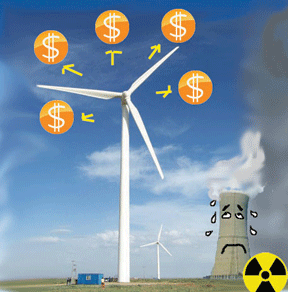
Britain’s wind energy programmes have proved to be cheaper and better climate policy, as against nuclear
 Dave Toke’s Blog 22nd June 2018, The Climate Change Act has been celebrating its 10th anniversary, but there
is surprisingly little to celebrate in the earlier advice of the Committee on Climate Change (CCC). The CCC is the body created to advise the Government on the achievement of the carbon reduction commitments (80 per cent of 1990 levels by 2050).
You would expect the advice of the CCC to speed the Government’s low carbon programme, but in the crucial aspect of
electricity supply policy it has (in the past) actually damaged it! Looking back on its past, it looks like the Committee gave completely the wrong advice to the Government, advice which, alas, they still seem to be following now. In particular, in the ‘Renewable Energy Review’ issued in 2011 (which I criticised at the time), the CCC, urged the Government to cut
back the targets for offshore wind and instead focus on nuclear power.
They told the Government not to be put off by the Fukushima disaster that had happened earlier that year. According to the Times Report on May 9th 2011 ”The Committee on Climate Change says heavy reliance on offshore wind could result in unacceptable increases in fuel bills.’ David Kennedy, the then Chief Executive of CCC said that ‘Nuclear looks like it will be the lowest cost for the next decade or two’. Indeed the Review stated that nuclear power was currently ‘the most cost effective of the low carbon technologies’.That conclusion, given the cost of onshore wind, was highly challengable at the time, especially as given the existing record of nuclear power plant that had been built in the UK and the roll-out of
onshore wind.
Whereas the deployment of renewable energy has soared ahead, despite the best efforts of many in the Conservatives to block it, nuclear power plans set out in 2010 have proved to be fantasy. And, of course, offshore wind costs have tumbled rapidly making the CCC’s earlier pronouncements looking especially silly.
http://realfeed-intariffs.blogspot.com/2018/06/how-committee-on-climate-change-gave.html
The total world nuclear weapons count, as of today
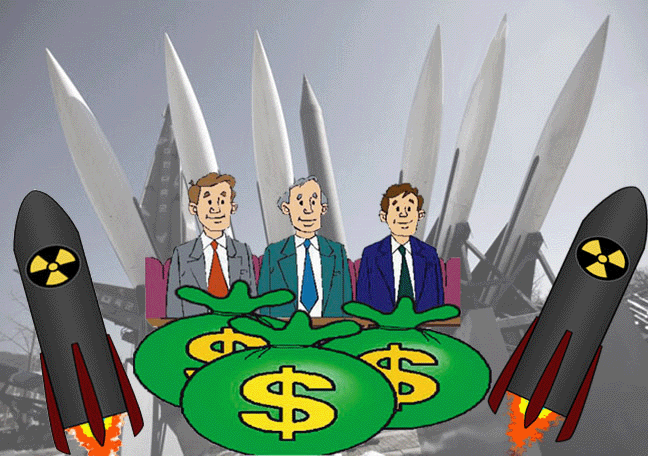 World Nuke Count: 14,465 Bombs https://www.ladailypost.com/content/world-nuke-count-14465-bombs, by Carol A. Clark June 23, 2018 HSNW News:
International Law is now challenged by the “normalisation” of nuclear weapons

 Amid Nuclear Entanglement, International Law May Well Have to Ban the Weapons Altogether https://thewire.in/law/amid-nuclear-entanglement-international-law-may-well-have-to-ban-the-weapons-altogether
As long as the conventionalisation of nuclear weapons is taking place, no binding treaties will be able to stop the proliferation of or regulate nuclear weapons. Olha Bozhenko, 22/JUN/2018
Nuclear weapons enjoy a separate and unique regime under international law. The majority of states struggle to establish a complete prohibition of nuclear weapons, as in the case of other categories of Weapons of Mass Destruction (WMD). In fact, in its only authoritative pronouncement on the matter, the International Court of Justice (ICJ) stressed ‘the unique characteristics of nuclear weapons, and in particular their destructive capacity’.
Yet in view of some recent developments, to be discussed below, this distinction has been gradually disappearing, with the line between nuclear and conventional weapons becoming blurred. This means that nuclear weapons are not stigmatised as their WMD counterparts, but rather conventionalised.
This piece is an attempt to, first, ascertain the progressing conventionalisation among the current trends related to nuclear weapons and, second, delineate its consequences for the international legal regulation of armaments.
Paths of conventionalisation
Nuclear weapons conventionalisation has been referred to as ‘nuclear entanglement’, which essentially means the merger of nuclear and conventional weapons. Broadly understood, it manifests itself in the following ways.
Increased reliance on non-strategic (tactical) nuclear weapons:
As early as in his Dissenting Opinion to the Nuclear Weapons Advisory Opinion, Mohamed Shahabuddeen, a judge of the ICJ suggested that assuming tactical nuclear weapons could be no more destructive than conventional weapons, they should not be less lawful than the latter. Hence, placing nonstrategic nuclear weapons (NSNW) at the top of ‘conventionalisation agenda’ is not a brand-new idea. Besides, it has recently been emphasised in national strategies.
The most striking example is, of course, the US 2018 Nuclear Posture Review (NPR), which radically departs from its predecessor in mandating the development of a range of nonstrategic low-yield nuclear options. The Trump administration considers this departure necessary as a response to Russia’s substantial reliance on and expansion of non-strategic nuclear arsenal, which considerably outstrips that of the US. At face value, this means that the two most powerful nuclear-weapon states have embarked upon the rapid expansion of their non-strategic nuclear options.
Such an approach depicting NSNW as quite a usable tool to advance military and non-military goals significantly lowers the threshold for the actual use. Such reliance on a limited nuclear strike can well lead to the full-blown nuclear escalation, which the ICJ considered among the possible consequences of using low yield nuclear weapons.
Integration of nuclear and conventional planning and operations:
The integration of nuclear and conventional capabilities also contributes to the conventionalisation. This is ‘nuclear entanglement’ in the original meaning of the term. The integration includes equipping dual use means of delivery with nuclear and non-nuclear warheads, merging nuclear and conventional support facilities, as well as integrating planning and training for both nuclear and non-nuclear forces. China and Russia are said to pursue this strategy whether deliberately or as a matter of historical legacy. Furthermore, US’s NPR specifically mandates ensuring ‘the ability to integrate nuclear and non-nuclear military planning and operations’ to ‘deter limited nuclear escalation and nonnuclear strategic attacks’.
These developments are frowned upon for a number of reasons. They tend to erode the line between nuclear and conventional forces in the most palpable manner. They also increase the risk of adversary’s misinterpretation of the nature of an attack, which can simultaneously target ‘entangled’ capabilities.
Expanding range of scenarios for the use of nuclear weapons:
Much has been said on the expanded range of scenarios where US contemplates first use of nuclear weapons, also in response to non-nuclear threats. Although the US strategy is most widely discussed owing to its considerable departure from the previous pattern, other nuclear-weapon states either preserve deliberate ambiguity with regard to the possible use of nuclear weapons (eg UK and France) or explicitly declare their readiness to balance an adversary’s conventional superiority with a nuclear strike (eg Russia and Pakistan).
Expanding the role of nuclear weapons beyond deterring nuclear threats alludes to an increased rationality and military utility of a nuclear strike. This further undermines the arguments that there exists opinio juris (an opinion of law) prohibiting recourse to nuclear weapons, except for the purposes of deterrence. In view of such developments, it is understandable why the ICJ refused to acknowledge that the non-recourse to nuclear weapons since 1945 had been due to such opinio juris rather than the absence of military necessity.
Nuclear saber rattling:
Finally, never before has it been so common for political leaders to boast of their states’ nuclear capacities. One may recall Vladimir Putin’s threats to deploy nuclear weapons in the course of Crimea crisis and against Baltic states, or his most recent brandishing cutting-edge nuclear technology with animated nukes striking Florida in an address to the parliament. Along the same lines, Donald Trump publicly threatened North Korea with ‘fire and fury’ and even with ‘total destruction’.
Although the ICJ refused to differentiate between nuclear and conventional weapons, when assessing the legality of the threat of nuclear weapons use (para 48), the state practice seems to have accepted a special standard for nuclear threats which is measured against the strategy of deterrence. For instance, UK’s High Court of Justiciary stated that ‘deployment of nuclear weapons in time of peace … is utterly different from the kind of specific ‘threat’ which is equated with actual use’ . Under this approach, states would only cross the line of nuclear deterrence and resort to the threat of using nuclear weapons if such a threat is specific enough, i.e. directed against a specific target.
Considering that the arbitral tribunal went so far as to equate the phrase ‘to face consequences’ to a threat of the use of force in Guyana vs Suriname, it is doubtful that states are still within the safe harbour of deterrence when directing their nuclear threats explicitly and specifically against other states.
Consequences for international law
Driven by analogy with other types of WMD, international law seeks to raise the threshold for using of nuclear weapons (or even contemplating such use) as high as possible. The adoption of the Treaty on the Prohibition of Nuclear Weapons (TPNW) is among the most notable developments to this end. Still, there is an observable tension between the movement towards nuclear weapons ban as enshrined in the TPNW and the trends described above.
International legal instruments like the TPNW are grounded on humanitarian considerations. In this particular case, the TPNW is meant to stigmatise nuclear weapons to the extent of their total abandonment by nuclear-weapon states. Considering that nuclear-weapon states refused to take any part in the ‘ban campaign’ leading to the adoption of the TPNW, it is reasonable to assume that such progressive stigmatisation (which can eventually generate a parallel customary prohibition) is the only way to endow the TPNW with pragmatic force. Analogy may be drawn with other disarmament treaties such as Convention on Anti-Personnel Mines Ban and Convention on Cluster Munitions: they contributed to the establishment of the customary prohibition of respective armaments even without directly binding all states possessing them.
However, when nuclear weapons are postured to be as usable as conventional ones, the normative boundary between the two is not hardened at all. No stigma is likely to appear for weapons possessing which is dictated and justified by strong military utility. As long as the conventionalisation of nuclear weapons is taking place, no binding obligations will probably proceed from the newly established TPNW regime, either as treaty rules or as a crystallising custom.
Along with the TPNW, the Treaty on the Non-Proliferation of Nuclear Weapons (NPT) is to bear a major part in the ramifications. The core obligation of non-proliferation under Article II is likely to be affected, since nuclear weapons, if conventionalised, make their acquisition by non-nuclear-weapon states more conceivable. Additionally, the deployment of tactical nuclear devices makes nuclear weapons more accessible and ‘proliferable’ in the technical sense, spurring their acquisition by non-state actors, particularly, by terrorist groups. This is an alarming possibility considering that the non-proliferation to non-state actors still constitutes a legal gap largely left to Security Council Resolution 1540.
Besides, the conventionalisation of nuclear weapons invites their advancement, which is hardly in line with the (allegedly customary) obligation of nuclear disarmament under Article VI of the NPT. States are not in compliance with their disarmament obligation ‘to achieve a precise result – nuclear disarmament in all its aspects’ when they engage in the ‘vertical proliferation’ (i.e. modernising their nuclear arsenals or expand the range of scenarios to deploy nuclear weapons).
Should the described trends gain traction, their impact will in no way be limited to nuclear weapons regulation, but extend to the whole set of rules on the use of force. In particular, the gradually vanishing line between the threat of use of force and nuclear deterrence will further blur. It is questionable whether teetering on the brink of threats to use nuclear weapons is still justifiable under the concept of nuclear deterrence, which the ICJ was careful to characterise as practice ‘adhered to by states’. Consequently, it is doubtful whether nuclear deterrence should enjoy such leniency with respect to the standard of the threat of use of force.
The jus ad bellum (right to war) requirements for self-defence may also be affected by nuclear entanglement. For instance, it is highly questionable whether a limited strike with tactical nuclear weapons to preclude a massive conventional attack fails to meet the standard of proportionality. Similarly, it is not that clear whether anticipatory nuclear strike against a missile equipped with non-nuclear warhead is unlawful, since a state intercepting such a missile can be misled by its dual-use capacity in view of nuclear entanglement.
The questions of similar nature will arise with respect to jus in bello (laws of war). With the gap between nuclear and conventional weapons narrowing, there is less room to assert that employing nuclear weapons should be contrary to the proportionality principle. Correspondingly, what concerns the lawfulness of belligerent reprisals conducted with the use of nuclear weapons, a pre-defined approach exclusively based on the ‘nuclear element’ is likely to give ground to the qualification irrespective of the type of weapons. To put it bluntly, the ICJ’s reasoning that the legality of the use of nuclear weapons shall be considered on the basis of case-to-case compliance with jus in bello seems to be regaining relevance.
Conclusions
While any radical transformation of the international legal regime governing nuclear weapons is still unlikely, there is definitely room for considering its adequacy for current challenges. In the near future we should be ready to make a choice of either raising the bar on the conventionalisation of nuclear weapons or easing this process. Simply put, international law may find itself in need of deciding whether it is better to ban nuclear weapons altogether rather than to regulate them.
This article originally appeared on Arms Control Law.
Scotland’s Youth Peace Academy running 3 day programme to train activists
 The National 22nd June 2018 , A FULLY funded three-day training programme is giving young people the
chance to become top activists on nuclear disarmament. The Youth Peace
Academy is inviting 18 to 30-years-olds residing in Scotland to take part
in a packed training programme. Participants will learn about nuclear
weapons, lobbying, writing press releases, fundraising tools and more.
Peace Education Scotland’s Flavia Tudoreanu helped come up with the idea
after attending a similar event in Berlin. She said: “We thought it would
be really good to bring to Scotland.
http://www.thenational.scot/news/16306981.Young_Scots_offered_training_in_anti-nuclear_activism/
French nuclear corporation EDF hedges its bets: now starting 2 renewable energy programmes
Renews 22nd June 2018 Energy giant EDF is celebrating a UK double after cutting the ribbon on two
renewables projects this week. The company’s chairman and chief executive
Jean-Bernard Levy was present for the official opening of both the 41.5MW
Blyth offshore wind farm off the Northumberland coast and the 49MW West
Burton B battery storage facility.
The Blyth project (pictured) features
five MHI Vestas V164-8.0MW turbines optimised to 8.3MW. The West Burton B
facility will operate within the new frequency control system to be
deployed across the UK to improve national grid stability. Levy said:
“These two innovative projects demonstrate our expertise in renewable
energies and electricity storage. They contribute greatly to
decarbonisation of the energy mix in the UK, our second largest market
after France.”
http://renews.biz/111572/edf-celebrates-uk-one-two/
Radioactive soil from Ohio heads to Wayne County landfill next week
Up to 124,000 tons of low-level radioactive soil and other materials from a contaminated former military supplier in Ohio will begin arriving at a Wayne County landfill next week, the U.S. Army Corps of Engineers has announced.
Protest campaign to stop nuclear waste transport in Idaho
 Opponents protest nuclear waste transport in Idaho, June 22, 2018, By SAVANNAH CARDON, Post Register ,Idaho Press CALDWELL — Among the tents set up at the Caldwell Farmers Market on June 13, one stuck out. Covered in nuclear waste symbols and mock waste barrels was the Radioactive Waste Roadshow with Don’t Waste Idaho.
Japan’s business firms shifting to clean energy, despite govt’s pro nuclear policy
Japanese firms shift to clean energy despite state’s cling to nuclear power, Japan Today , By Hidetoshi Takada, TOKYO While Japan’s government clings to atomic power even after the Fukushima nuclear crisis, its private sector is moving ahead with more use of renewables to power their operations amid growing international awareness of global warming.
Daiwa House Industries Co, for instance, became in March a member of both RE100 (Renewable Electricity) and EP100 (Energy Productivity), two global initiatives by the Climate Group.
RE100 is a global, collaborative initiative of influential businesses committed to using 100 percent renewable electricity, while EP100 brings together companies committed to doubling energy productivity to lower greenhouse gas emissions.
Among RE100’s 136 members are U.S. General Motors Co and Dutch consumer goods giant Unilever.
Printer maker Ricoh Co, the first Japanese firm to join RE100, was followed by five firms such as online stationery retailer Askul Corp and retail giant Aeon Co., aiming to meet the electricity needs of their global operations with renewable energy between 2030 and 2050.
Daiwa House says it is the world’s first company in the construction and housing sectors to join both campaigns and the first to declare it is taking bold action as part of EP100 among Japanese firms. Currently, there are 15 EP members. Daiwa aims to achieve the both by 2040.
Katsuhiro Koyama, general manager of Daiwa’s environment department, spurred debate to achieve the targets after returning to Japan from the COP23 global climate round in Germany last November.
He had previously taken a cynical view of such tech giants as Apple Inc, Google Inc and Microsoft Corp participating in the RE100 clean energy initiative, seeing it as an “atonement for their sins” of consuming huge amounts of electricity.
But Koyama, one of the Japanese delegate members to the global conference, said he was “inspired” by the firms’ “serious aspirations to leverage clean energy producers” after hearing various discussions.
The Osaka-based Daiwa group has invested an estimated 46.6 billion yen (about $424 million) in the construction of its own solar, hydro and wind power plants nationwide since 2007, producing power equivalent to about 60 percent of the group’s annual use of 481 million kilowatt hours. Meanwhile, it doubled its electricity use efficiency in fiscal 2016 compared to fiscal 2005.
Japanese businesses became much more aware of renewable energy in the wake of the Hokkaido Toyako summit in 2008 in which the Group of Eight countries set a long-term target to reduce greenhouse gas emissions.
The 2011 Great East Japan Earthquake, which triggered the suspension of all nuclear power plants in Japan, also sparked public concerns over the country’s energy mix.
The ratio of renewable energy to the nation’s entire power output capacity has risen from 10 percent in fiscal 2010 to 15 percent in fiscal 2016, according to the Agency for Natural Resources and Energy, boosted by a feed-in tariff system that obliges utilities to buy electricity generated by renewable energy at fixed prices.
The scheme has attracted businesses large and small, even individuals, to pour money into the photovoltaic field as it requires less effort to install and operate in a shorter period of time compared to other types of energy sources, said Yushi Inoue, a research director at Mitsubishi Research Institute, a think tank.
Individual power producers are actively trying to connect with grids in northeastern Japan, and sought to supply “more than three times what we can accept” in a recent offering, said a spokesman of Tohoku-Electric Power Co, the regional utility.
The region, part of which was devastated by the mega quake seven years ago and the subsequent nuclear disaster, has a number of favorable locations for wind power plants. “A vast majority of the seekers are renewable-energy oriented,” he said.
Meanwhile, a similar scheme in Europe that utilizes renewable energy certificates under a guarantee of origin of electricity generated from such sources has gained momentum among environmentally conscious firms, particularly after the 2008 summit on Japan’s northernmost island………
The Ministry of Economy, Trade and Industry drafted the latest energy mix plan due to be finalized this summer, calling nuclear power “an important baseload energy source.” This stance appears to conflict with public opinion which shifted after the 2011 Fukushima disaster. In addition to public sentiment against nuclear power plants, the government’s tougher safety standards led to the shutdown of all the countries reactors. ……..https://japantoday.com/category/business/feature-japan-firms-shift-to-clean-energy-despite-state%27s-cling-to-nuclear-power
New book: Climate Scientist Michael E. Mann and political cartoonist Tom Toles join forces
Amazon 23rd June 2018 Climate Scientist Michael E. Mann and political cartoonist Tom Toles have
been on the front lines of the fight against climate denialism for most of
their careers. In The Madhouse Effect, the two climate crusaders team up to
take on denialists and their twisted logic. Toles’s cartoons and Mann’s
expertise in science communication restore sanity to a debate that
continues to rage despite widely acknowledged scientific consensus—and
may even hit home with die-hard doubters. This paperback edition includes a
new chapter on the Trump administration’s attack on climate science.
https://www.amazon.co.uk/Madhouse-Effect-Threatening-Destroying-Politics/dp/0231177860
Draft revision of Japan’s Basic Energy Plan does not call for new nuclear power reactors.
 Japan’s nuclear energy policy at crossroads , Japan News June 23, 2018, By Koichi Kuranuki / Yomiuri Shimbun Senior Writer The Economy, Trade and Industry Ministry has compiled a draft revision of the nation’s Basic Energy Plan. The revised plan will serve as the new guidelines for long-term energy policies. In the plan, nuclear power is defined as “an important mainstay energy source,” but the plan does not specifically call for construction of new and additional nuclear power reactors.
If the situation is left as it is, Japan will move slowly toward zero nuclear energy over the long term. How can the people’s understanding of nuclear power deepen? Japan’s nuclear power policy is at a crossroads.
Mainstay energy source
The draft revision of the Basic Energy Plan presented on May 16 laid out a policy aiming to make solar power and other renewable energy the nation’s key energy sources. At the same time, it also listed technical issues such as fluctuations in energy output according to weather conditions and time of day……..
Growing costs
However, major power companies have to overcome high hurdles to independently build new plants or replace current reactors with new ones.
The total cost of Hitachi, Ltd.’s nuclear power business in Britain has ballooned to more than ¥3 trillion with two reactors. The project is likely to receive financial support from the British government, but negotiations are still under way for the prices of electricity the government guarantees to purchase, and no final conclusion has been reached.
The cost of building the Nos. 6 and 7 reactors at Tokyo Electric Power Company Holdings, Inc.’s Kashiwazaki-Kariwa nuclear power plant in Niigata Prefecture, which began operating in the 1990s, was about ¥400 billion per reactor. TEPCO was a blue chip company before its nuclear accident in 2011, and it was able to procure low-interest funding. Its interest burden for the construction funds of the reactors was only ¥10 billion in total.
However, the situation has changed completely since the nuclear accident. Nuclear safety standards have been ramped up worldwide, and construction costs have soared. TEPCO has spent a total of ¥700 billion on safety measures for the Nos. 6 and 7 reactors at the Kashiwazaki-Kariwa plant.
Even if companies build new plants at tremendous cost, a good return on the investment seems unlikely, and it is difficult to procure funds.
……. Public resistance…….. Many residents in Niigata Prefecture are opposed to nuclear power. A local resident related to the electric power industry who supported Hanazumi said, “I feel that possible votes for him are sure to decrease if constituents see [Hanazumi as being linked to] the activities of electric power companies.”…… Not only those living in the vicinity of nuclear power plants, but Japanese citizens in general have negative views on nuclear power generation…….http://the-japan-news.com/news/article/0004518947
124,000 tons of low grade radioactive soil being dumped at Michigan landfill
NBC26 , Alan Campbell, Jun 22, 2018 VAN BUREN TOWNSHIP, Mich. — There are questions about radioactive soil and materials coming from out of state to the Wayne County landfill in Michigan.
Decision to keep Pickering Nuclear Station going does not make financial sense
Clean Air Alliance 21st June 2018, Today Ontario Premier-Designate Doug Ford failed to seize his opportunity
to lower Ontario’s electricity costs by $1.1 billion per year by
directing Ontario Power Generation (OPG) to close the Pickering Nuclear
Station in August when its licence expires.
On the contrary, Mr. Ford announced that he will allow the 4th oldest nuclear station in North
America to continue to operate in the middle of the GTA until 2024. Mr.
Ford’s decision does not make financial sense for Ontario’s electricity
consumers. The annual savings from closing the Pickering Nuclear Station
would be 183 times greater than the savings from firing Mayo Schmidt, the
CEO of Hydro One. According to the Canadian Manufacturers & Exporters
association, the Pickering Nuclear Station’s performance is
“persistently abysmal…by any objective standard.”
http://www.cleanairalliance.org/ford-fails-to-seize-opportunity-to-lower-ontarios-electricity-costs-by-1-1-billion-per-year/
Adivasis (indigenous people) in a remote area of India, suffer health effects from the nuclear industry?
News Click 21st June 2018 , Sanjay Gope, a 13-year-old boy from Bango village near Jadugora town in
East Singhbhum district of Jharkhand, cannot move or speak because he has
been suffering from muscular dystrophy – a group of disorders that
involves a progressive loss of muscle mass and consequent loss of strength
– for the past nine years. At least one person of his family has to be
with him all the time to look after him. He cannot be left unattended.
Eighteen-year-old Parvati Gope from the same village is suffering from
lumbar scoliosis – a C-shpaed curve formation of her vertebral column.
Rakesh Gope, a 13-year-old school-going boy, is also suffering from
muscular dystrophy. Although he is active and walks with arched feet and
soles, he is unable to speak normally.
A three-year-old child Kartik Gope has been having seizures since birth and is developing muscular dystrophy
too. These examples are not enough; there are hundreds of such cases of
congenital illness and other birth defects in addition to high incidence of
infertility, miscarriages and pre-mature deliveries.
Now, a pertinent question arises here: why are such large number of health hazards being
reported from this remote and overlooked corner of the country? While India
is dreaming to become energy efficient by 2032 by generating 63 Gigawatts
of nuclear power, it is taking a major toll on human lives in a small
township of Jharkhand. Jadugora has the deposits of world’s best quality
uranium ore, magnesium diuranate. It is because of the rich deposits of the
region, India is capitalising its nuclear dreams. The whole belt of the
reactors is affecting the Adivasis (indigenous people) disproportionately
in and around the uranium mining operational area.
https://newsclick.in/uranium-mining-jharkhand-radioactive-poisoning-ravaging-lives-villages
1 This Month
Chernobyl: The Lost Tapes – A good documentary on Chernobyl on SBS available On Demand for the next 3 weeks– https://www.sbs.com.au/ondemand/tv-program/chernobyl-the-lost-tapes/2352741955560

of the week–London Campaign for Nuclear Disarmament

Tell the Ukrainian Government to Drop Prosecution of Peace Activist Yurii Sheliazhenko
To see nuclear-related stories in greater depth and intensity – go to https://nuclearinformation.wordpress.com
-
Archives
- April 2026 (126)
- March 2026 (251)
- February 2026 (268)
- January 2026 (308)
- December 2025 (358)
- November 2025 (359)
- October 2025 (376)
- September 2025 (257)
- August 2025 (319)
- July 2025 (230)
- June 2025 (348)
- May 2025 (261)
-
Categories
- 1
- 1 NUCLEAR ISSUES
- business and costs
- climate change
- culture and arts
- ENERGY
- environment
- health
- history
- indigenous issues
- Legal
- marketing of nuclear
- media
- opposition to nuclear
- PERSONAL STORIES
- politics
- politics international
- Religion and ethics
- safety
- secrets,lies and civil liberties
- spinbuster
- technology
- Uranium
- wastes
- weapons and war
- Women
- 2 WORLD
- ACTION
- AFRICA
- Atrocities
- AUSTRALIA
- Christina's notes
- Christina's themes
- culture and arts
- Events
- Fuk 2022
- Fuk 2023
- Fukushima 2017
- Fukushima 2018
- fukushima 2019
- Fukushima 2020
- Fukushima 2021
- general
- global warming
- Humour (God we need it)
- Nuclear
- RARE EARTHS
- Reference
- resources – print
- Resources -audiovicual
- Weekly Newsletter
- World
- World Nuclear
- YouTube
-
RSS
Entries RSS
Comments RSS
 nuclear-news