Demand for answers over claims of cold war radiation experiments Gibraltar Chronicle Press Association 1 June 18 Politicians have called for answers from the Ministry of Defence (MoD) over claims that British nuclear test pilots were deliberately exposed to radiation in experiments during the Cold War.
The widow of one pilot claims to have obtained secret documents which show her husband was ordered to fly through the cloud of a thermonuclear explosion at Christmas Island in the Pacific.
Shirley Denson, 83, said husband Eric was exposed to so much radiation that it caused crippling headaches that became so bad he later killed himself, the Mirror reports.
Two of their four daughters were also said to have been born with abnormalities.
Deputy Labour leader Tom Watson described the documents as “shocking”, and said the Defence Secretary should issue an unqualified apology to Mrs Denson in the Commons.
He told the paper: “We need answers about what experiments were conducted, and how many of the 22,000 nuke vets were involved in them.”
Shadow defence secretary Nia Griffiths said they were “deeply worrying revelations” and called for them to be investigated by the MoD.
The department has denied claims the pilots were subject to an experiment to test the effects of radiation, and said there was no valid evidence to link the programme with ill health.
According to the Mirror, the documents revealed Flight Lieutenant Denson had flown his Canberra B6 bomber into the mushroom cloud of a 2.8 megaton nuclear explosion on April 28 1958, with X-ray badges on the seat to measure radiation.
He was reportedly exposed to 65 years’ worth of normal background radiation during the six-minute flight.
Left in the wake of this race to nuclear modernity are people harmed and exploited along the way..
Ironically, as nuclear weapon states pursue upgrades to their arsenal, they also insist that countries like North Korea and Iran abandon plans to develop nuclear weapons. The double-standard traps the world in a situation that increase tension and competition between nuclear haves and have-nots.
As world leaders continue to wield nuclear weapons as part of their geopolitical power plays, we should resist automatically accepting the trope that nuclear weapons are custodians of global security.
The Nuclear Industry’s Winners and Losers, The New Republic
As Donald Trump plays chicken with North Korea, it’s worth remembering that this is also a business. Some profit; others suffer. By LOVELY UMAYAM, May 31, 2018 “…. Today, nuclear weapons are having a renaissance, again confronting news consumers with their duality as harbingers of destruction and champions of national security. …….
The American government’s renewed focus on nuclear weapons raises, again, the question taken up by protesters of the 1960s and 70s: of exactly who these weapons protect. Pomp and patriotism can obscure a more specific cast of characters—some who immensely benefit while others unjustly sufferfrom the nuclear weapons enterprise. ….
This venture is dangerous in more ways than one: companies running U.S. nuclear weapons laboratories, including Sandia Corp. (a subsidiary of Lockheed Martin) and Bechtel National among others, were found to have committed egregious safety violations and inadequate training that encouraged workers to circumvent proper procedures. Despite such infractions, the wheels of the military-industrial complex continue to turn. Companies with safety lapses are still considered top contenders to oversee future projects, thus benefiting from the Trump administration’s trillion-dollar decision to revamp the U.S. nuclear arsenal.
One country’s nuclear force improvements will naturally propel others into motion:Russia this spring announced its own exorbitant nuclear force modernization project as a counter to U.S. nuclear buildup, China recently scaled its nuclear simulations in an effort to develop next-generation nuclear weapons, while France and the United Kingdom are spearheading plans to renew their nuclear submarines despite cost concerns. In the UK, proponents argue that it is necessary to bolster nuclear capabilities in the face of an “uncertain security environment,” although it is also uncertain how the government will shore up funds for a possible £2.9 billion gap to complete the project—the lionshare of which will go to four private contractors: AWE Management, BAE Systems, Babcock International, and Rolls Royce (better known for their luxury cars, the company supplies engines for military assets, including the UK’s nuclear submarines).
Left in the wake of this race to nuclear modernity are people harmed and exploited along the way, grievances that date decades back to the inception of the bomb itself. In stark contrast to the romanticized image of military men and scientists tinkering with the bomb in secret laboratories was dirty, unacknowledged work done by uranium miners starting in the early twentieth century—from the pits of the Congo, Australia, and the indigenous lands of Southwest United States—who dug the Earth in horrible conditions in search for the special ingredient. ………
health problems continue to plague the families of miners and those who live around former mining towns. In the Navajo territory, there are still 500 abandoned uranium mines waiting to be cleaned. These sitting mines continue to contaminate local water supply, harming the next generation Navajo.
…… A quick study of nuclear weapons testing overtime reveal a disturbing pattern: from the heart of the Saharan Desert to the rugged terrain in Kazakhstan, tests were primarily conducted in former colonies or territories of nuclear weapon states, where the land and livelihood of people were neglected for a greater national cause. Today, some former test sites are facing health hazards and environmental catastrophe. Recent declassified information divulged that French nuclear testing in Polynesia caused significant radioactive fallout in the region, which was not publicly disclosed for almost four decades. And in the Marshall Islands, where the United States detonated more than a hundred tests in a span of 15 years, rising tides due to climate change are threatening to flood nuclear waste sites and former testing grounds. To date, nuclear weapon states have yet to fully compensate victims and address this growing environmental damage. All the while, they are allocating big budgets for their nuclear arsenals to protect vital national interests.
Ironically, as nuclear weapon states pursue upgrades to their arsenal, they also insist that countries like North Korea and Iran abandon plans to develop nuclear weapons. The double-standard traps the world in a situation that increase tension and competition between nuclear haves and have-nots.
As world leaders continue to wield nuclear weapons as part of their geopolitical power plays, we should resist automatically accepting the trope that nuclear weapons are custodians of global security. A more holistic discussion would acknowledge the many players in the nuclear weapons enterprise, some bound to reap enormous benefits, while others fated to lose without recompense. What would a conversation about nuclear weapons look like if we demanded recognition for those harmed by its production process? Or if we closely scrutinized government spending on these bombs when the world already has thousands—14,000 spread among nine countries, to be precise—pointed at one another? While it seems unrealistic to envision a world free of nuclear weapons, the alternative is to tolerate a broken system that favors the military-industrial complex and exploits communities in exchange for a sense of protection. And if we collectively decide that we can live with this system, and that we are comfortable using fear as our ultimate savior, we must ask ourselves what sort of a society we are now “protecting.”
Beyond Iran and North Korea, the nuclear-armed rivals of India and Pakistan need help to prevent a war. A cease-fire in disputed Kashmir shows progress, but a deeper reconciliation, especially an understanding in their shared history, is needed. May 31, 2018, By the Monitor’s Editorial Board
As long as he is already trying to denuclearize North Korea as well as permanently ban Iran from building a nuclear weapon, President Trump may want to pay heed to India and its neighbor Pakistan. The two nuclear-armed powers have gone to war three times since they achieved independence in 1947. And over the past year, regular skirmishes along their disputed border in Kashmir have killed dozens and displaced 50,000 civilians.
Pakistan and India each recognize a nuclear war would be mutually devastating. Yet they need help in overcoming a deep suspicion and animosity, driven in part by diverging narratives of their shared past, that could someday trigger a full-scale conflict.
With the border fighting in Kashmir getting out of hand in recent months, the two countries agreed May 29 to honor a cease-fire pact that was first put in place 15 years ago. The agreement is a welcome step. Yet it provides only a pause in hostilities without a commitment to a peace dialogue and, more important, the creation of a culture of reconciliation.
Iran and North Korea are still a long way from any attempt to reconcile with their perceived foes. Ending their nuclear threat has required outside pressure. Pakistan and India, however, have tried at times to come to terms with each other since the violent partition of British India into their respective countries, one largely Muslim and the other largely Hindu. Sometimes their leaders talk or the countries share a sports contest. Nonetheless, trade and travel between the two remain minimal given the size of their economies. And the Kashmir dispute as well as terrorist attacks keep them apart.
Religious differences have mattered less in their relations than the role of nationalist politicians who find it convenient to whip up hatred and fear of the other side. The ill will is generated in large part by competing histories of the 1947 partition – who started it, who killed more people, and who were the heroes and villains. Over the decades, the official history textbooks in each country have become political weapons to create an enemy and build up national unity.
Peace between India and Pakistan will require some sort of agreement on their shared history, one that must reduce old grievances and lessen the paranoia that could trigger a nuclear war. In Northeast Asia, Japan, South Korea, and China have tried in the past two decades to write a joint history in hopes of reducing the use of old resentments. The efforts have largely failed.
Yet this past winter, India and Pakistan achieved some success in transcending nationalist histories with the first citizen-level attempt at a joint telling of their shared history. Two history professors, one in Pakistan and the other in India, held a semester-long course titled “Introduction to South Asian History” that included more than 20 students from each country connected online. The teaching took place mainly over Skype and included a visit of 11 Pakistani students to India in May.
The two teachers, Ali Usman Qasmi of the Lahore University of Management Sciences and Pallavi Raghavan at OP Jindal Global University, reported that the students were amazed to discover what they did not know about the other country. They achieved an “overlapping consensus” on historical events with respect and understanding. The success of the course, they wrote, “shows that an alternative imagining of the past conducive to achieving peace and harmony in the region is … possible.”
Cease-fires in Kashmir, even a peace dialogue or a full opening of trade, will help India and Pakistan avoid the worst kind of wars. But much of that may not matter until the two peoples can craft a shared understanding of the past in order to reconcile for a better future.
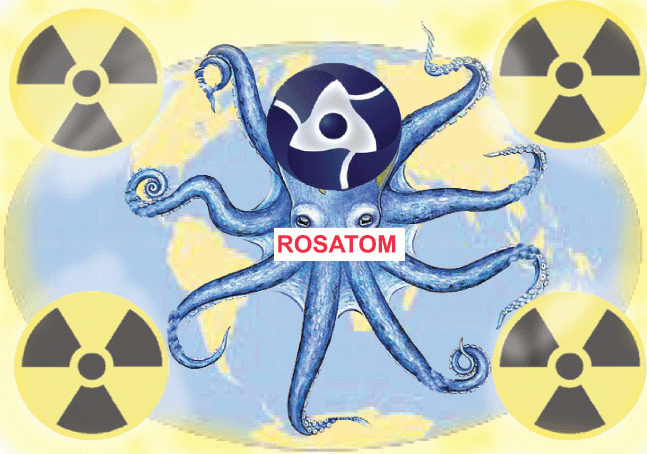
World Nuclear News 29th May 2018, Russia’s Rosatom and the French Alternative Energies and Atomic Energy
Commission (CEA) have signed a strategic document on partnership in the
peaceful uses of nuclear energy.
NEW YORK — Secretary of State Mike Pompeo cited progress Thursday toward salvaging a historic summit between President Trump and North Korean leader Kim Jong Un and what he called the “once in a lifetime opportunity” of ending the nuclear weapons threat from North Korea.
Following two days of talks with Kim’s right-hand aide, Vice Chairman Kim Yong Chol, Pompeo spoke as though the summit Trump had canceled last week was likely to be reinstated, but still framed it as an “expected” first meeting.
Israel ‘is selling nuclear information’ to Saudi Arabia, Middle East Monitor, May 31, 2018
Western security agencies believe that Israel is selling nuclear information to Saudi Arabia, Arabi21 has reported. According to Israeli writer Ami Dor-on, such information will give the government in Riyadh nuclear weapons capabilities. Writing on the News One website, Dor-on said that the joint intention is to make sure that Iran will not be the only country in the region that possesses such weapons which threaten the security and safety of the Kingdom.
“This information should shock us,” he said, “as we see the world is changing for the worse, following the race for the possession of nuclear weapons that pass right over our heads in the Middle East.” Saudi Arabia no longer conceals its wish to develop nuclear weapons, the writer added.
However, General Amos Yadlin, former chief of Israel’s Military Intelligence Directorate, has suggested that the Saudis would not wait to get nuclear capabilities. “They will go to Pakistan, and take whatever they want,” he claimed……..
While Pakistan could clearly simply transfer a nuclear bomb to Saudi Arabia, that would not be Israel’s intention. “Israel may transfer information and nuclear expertise to the Kingdom that would enable it to develop its advanced capabilities in this specific area,” Dor-on clarified. “Yadlin’s comments as a senior Israeli intelligence official gives credibility to the leaks of the Western intelligence services.”
Ex-Israeli spy chief: Netanyahu planned Iran strike in 2011 By ILAN BEN ZION, JERUSALEM (AP) 31 May 18 — Israeli Prime Minister Benjamin Netanyahu gave the order in 2011 for the military to prepare to attack Iran within 15 days, a former Mossad chief said in remarks released on Thursday.
Tamir Pardo, who served as head of the Israeli intelligence agency from 2011 to 2016, told Israeli Keshet TV’s investigative show Uvda that the order was not given “for the sake of a drill,” according to excerpts of the interview released ahead of the broadcast on Thursday evening.
“When he tells you to start the countdown process, you know that he isn’t playing games with you,” Pardo is quoted as saying. “These things have enormous significance.”
There was no immediate comment from Netanyahu’s office on Pardo’s claim.
On Wednesday, Netanyahu said Israel “will not allow Iran to arm itself with nuclear weapons. We will continue to act against its intentions to establish itself militarily in Syria besides us, not just opposite the Golan Heights, but any place in Syria.”
Pardo’s claim comes as archenemies Israel and Iran are fighting a shadow war in Syria, which briefly threatened to burst into full-blown conflagration this month after Israel bombed Iranian positions in Syria, killing Iranian fighters after an alleged Iranian rocket barrage toward the Israeli-controlled Golan Heights…….. https://apnews.com/ff3d8d27040e45f0a24beab254a63e3d
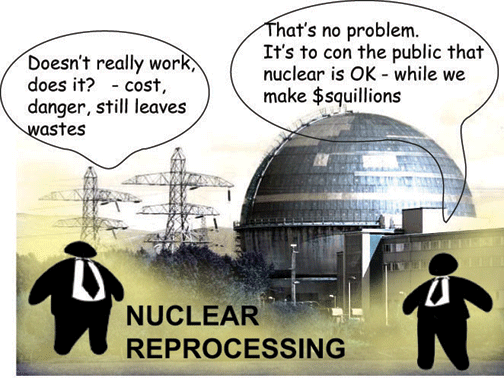
Scaling back of French reactor a blow for nuke fuel reprocessing THE ASAHI SHIMBUN May 31, 2018
Japan’s hopes of keeping its nuclear fuel recycling program alive faces another major obstacle with signs from France that a reactor project there will be scaled back because of swelling construction costs.
After the nuclear fuel recycling program suffered a heavy blow with the decision in late 2016 to decommission the Monju prototype fast-breeder reactor, government officials turned to France’s ASTRID program as an alternative information source for the fuel recycling plan.
But French government officials said the Advanced Sodium Technological Reactor for Industrial Demonstration will have its planned power generation scaled back from the initial plan of 600 megawatts of electricity to between 100 and 200 megawatts.
The major aim of the nuclear fuel recycling program is to reprocess spent nuclear fuel to extract plutonium, which would be used to create mixed-oxide fuel that could be burned in nuclear reactors.
Government officials had hoped to use various technologies emerging from the ASTRID program to eventually construct a demonstration fast reactor in Japan. But a scaled-back ASTRID would mean knowledge needed for the demonstration reactor would not be available.
According to several government sources, French government officials informed their Japanese counterparts of the planned reduction in the ASTRID power generation plan due mainly to the high construction costs.
French officials also inquired about the possibility of Japan shouldering half the ASTRID construction burden, which could run anywhere between several hundreds of billions of yen to about 1 trillion yen ($9.2 billion).
Plans call for constructing the ASTRID in France with construction to start sometime after 2023………
Even some officials of the Ministry of Economy, Trade and Industry, which has been promoting the nuclear fuel recycling program, have raised doubts about participating in the ASTRID program.
Concerns are also being raised among lawmakers in the ruling Liberal Democratic Party, with one executive wondering if cooperating with the ASTRID program could end up much like the Monju project, which wasted more than 1 trillion yen following a spate of accidents and other problems.
THE Ministry of Defence (MoD) used British nuclear test pilots like “guinea pigs” during the Cold War, deliberately exposing them to radiation, it has been claimed By ALICE SCARSI, May 31, 2018
The shocking allegation was made by the widow of a pilot who obtained secret documents suggesting her husband took part in a life-threatening experiment.
Shirley Denson, 83, said the documentation shows her husband, Flight Lieutenant Eric Denson, was ordered to fly through the cloud of a thermonuclear explosion at Christmas Island in the Pacific.
The test exposed him to so much radiation he was left with unbearable headaches which eventually brought him to kill himself to make the pain stop, she added.
And the experiment may have affected two of the couple’s four daughters, as Mrs Denson claimed they were born with abnormalities.
The widow, who was handed the papers by the MoD while conducting research about her husband’s service, described the situation “wicked” and “evil”.
“It makes me furious to think it was done on purpose, that my Eric mattered so little to them.”
The documents revealed Fl Lt Denson had flown his Canberra B6 bomber into the mushroom cloud of a 2.8 megaton nuclear explosion on April 28 1958, with X-ray badges on the seat to measure radiation, the Mirror reported.
During the flight, the pilot would have been exposed to 65 years’ worth of normal background radiation during the six-minute flight.
British Nuclear Test Veterans’ Association chairman Alan Owen said: “This is the first time in all our years of campaigning we have ever found evidence this strong.
“Our members always believed they were guinea pigs and this appears to prove some of them were, at best, collateral damage in horrifying experiments.
“We need to know everything – now.”
The MoD denied Fl Lt Denson was purposely exposed to radiation.
The allegations caused outrage among politicians, who urged the MoD to answer the claim.
Deputy Labour leader Tom Watson described the documents as “shocking”, and said the Defence Secretary should issue an unqualified apology to Mrs Denson in the Commons.
He said: “This is a shocking document the MoD cannot wriggle out of.
“We need answers about what experiments were conducted, and how many of the 22,000 nuke vets were involved in them.”
Shadow defence secretary Nia Griffiths said the papers brought to light “deeply worrying revelations” and called for them to be investigated by the MoD.
And Shadow Health Secretary Jonathan Ashworth added: “This is an absolute scandal.”
A spokesman for the MoD rejected the claims saying: “It is not true to say these men were subject to an experiment to look at the effects of radiation.
“The British nuclear testing programme contributed towards keeping our country secure during the Cold War and regular health checks were conducted throughout.
“The National Radiological Protection Board has carried out three studies of nuclear test veterans and found no valid evidence to link this programme to ill health.”
And he exclusively revealed to Express.co.uk: “According to the information available in the Operational Record Books for the squadron, Fl Lt Denson did not fly the same aircraft in the week after his sampling sortie.
“The ‘experiments’ referred to were to determine the best possible arrangement on the body of dosemeters (devices that measure radiation) so that these mens’ exposure could be measured as accurately as possible.”
Times 30th May 2018 Hitachi ‘won’t pay’ for nuclear accidents at proposed Wylfa plant on Anglesey. Hitachi could seek to absolve itself of financial responsibility for any accidents at its proposed new nuclear power station in north Wales.
The Japanese conglomerate has decided to continue with work developing the planned Wylfa plant on Anglesey after progress in financing talks with the government, which Hitachi is already relying on for a package of loan guarantees, subsidies and potential direct investment to make the project viable.
However, the company wants further concessions to reduce its risks, the Japanese newspaper Nikkei reported. Reports in several Japanese media outlets have claimed that the Wylfa plant could cost as much as three trillion yen, or almost £21 billion — making it even more expensive than Hinkley Point C.
EDF decided to build Hinkley Point only thanks to a 35-year subsidy contract from the government, which locks consumers into paying a fixed price for the power it generates and has been criticised for its high cost.
The Nikkei reported that some of Hitachi’s directors also wanted “safeguards that reduce or eliminate Hitachi’s financial
responsibility for accidents at the plant”. Nuclear operators are already obliged to take out insurance to cover their liabilities in case of an accident. If they are unable to secure insurance from the market, the government is obliged to step in and provide it instead. It is unclear what alternative arrangement or safeguards Hitachi might be seeking. https://www.thetimes.co.uk/edition/business/hitachi-wont-pay-for-nuclear-accidents-at-proposed-wylfa-plant-on-anglesey-gtm28q0k3
Liberation 30th May 2018 [Machine Translation] “The impasse”, how the EPR sank French nuclear.
France 5 broadcasts this Wednesday night “Nuclear, the French impasse”, a documentary against the declining reign of the atom. This film investigates EDF’s crazy gamble: risking its survival on the EPR, a reactor that accumulates trouble.
Will the EPR be the Titanic of French nuclear power? This is the shocking question posed by a film investigated by director Patrick Benquet broadcast tonight on France 5 which points to the “impasse”
in which the “most nuclearized country in the world” has locked up by equipping itself with 58 reactors. the 70s-80s. A fleet of 19 aging plants, which still produces 75% of French electricity, and which EDF wants to keep at all costs by launching a new generation of pressurized water reactor:
the EPR, “the most powerful never built, able to supply electricity to a metropolis like Paris. It must have been the deadly weapon of the nuclear lobby to defend the reign of the atom undermined by the Fukushima disaster and the rise of green energies.
EDF dreamed of exporting it all over the world by selling this “new nuclear” as the best lever against global warming. But things did not go at all as planned. And today EDF is going through a crisis that threatens the very existence of the “public service preferred by the French,” says the documentary.
There are these hidden costs of the atom, put under the carpet for decades, which rise to the surface: the enormous costs of reprocessing radioactive waste, is added the bill of the “great refit”: these works of Hercules designed to extend the lifespan of aging plants from 40 to 50 years. ”
EDF promised cheap electricity, but the real cost of nuclear energy today is in the tens and tens of billions. And ultimately it is the taxpayer who will pay, announces the implacable voice off. Yet, EDF, the nuclear state in the state, will launch the EPR at all costs. By assigning a strategic mission: take over
the old reactors that will gradually retire by 2035. http://www.liberation.fr/france/2018/05/30/l-impasse-comment-l-epr-a-coule-le-nucleaire-francais_1655363
Ionizing radiation can cause cells to turn cancerous, Pakistan Observer Islamabad : It is well established that exposure to ionizing radiation can result in mutations or other genetic damage that cause cells to turn cancerous.
Now a new study led by researchers with the U.S. Department of Energy’s Lawrence Berkeley National Laboratory (Berkeley Lab) has revealed another way in which radiation can promote cancer development.
Working with cultures of human breast cells, the researchers discovered that radiation exposure can alter the environment surrounding the cells so that future cells are more likely to become cancerous.
“Our work shows that radiation can change the microenvironment of breast cells, and this in turn can allow the growth of abnormal cells with a long-lived phenotype that has a much greater potential to be cancerous,” says Paul Yaswen, a cell biologist and breast cancer research specialist with Berkeley Lab’s Life Sciences Division.
A cell’s phenotype is its full complement of observable physical or biochemical characteristics. Different cells can have phenotypes that look dramatically different or exhibit radically different behaviour even though their genetic makeup (genotype) is identical.
Signals from outside the cell can alter a cell’s phenotype by regulating (or de-regulating) the cell’s use of its genes. Studies have shown that if a cell develops a pre-cancerous phenotype, it can pass on these “epigenetic” changes to its daughters, just as it can pass on genetic mutations.
“Many in the cancer research community, especially radiobiologists, have been slow to acknowledge and incorporate in their work the idea that cells in human tissues are not independent entities, but are highly communicative with each other and with their microenvironment,” Yaswen says. “We provide new evidence that potential cancer agents and their effects must be evaluated at a systems level.”
Yaswen is the corresponding author of a paper describing this study that appears in the on-line journal Breast Cancer Research. Co-authoring the paper were Rituparna Mukhopadhyay, Sylvain Costes, Alexey Bazarov, William Hines and Mary Helen Barcellos-Hoff.
“The work we did was performed with non-lethal but fairly substantial doses of radiation, unlike what a woman would be exposed to during a routine mammogram,” says Yaswen, who is also a member of the Bay Area Breast Cancer and the Environment Research Center. “However, the levels of radiation involved in other procedures, such as CT scans or radiotherapy, do start to approach the levels used in our experiments and could represent sources of concern.”……….
This study was jointly funded the National Institute of Environmental Health Sciences (NIEHS), and the National Cancer Institute (NCI), NIH, through the Bay Area Breast Cancer and the Environment Center, and by the NASA Specialized Center of Research. https://pakobserver.net/ionizing-radiation-can-cause-cells-to-turn-cancerous-5/
Motley Fool 28th May 2018, It has been a tough few years for one-time high-flying uranium miner Cameco Corp.. Over the last five years, its value has plummeted by 38% after nuclear power fell into disfavour after the 2011 Fukushima disaster in Japan, which caused the price of uranium to collapse.
Since then, uranium has remained caught in a protracted slump, despite claims by industry insiders and analysts that it is poised to rebound because of a combination of growing demand and emerging supply constraints. Nonetheless, despite these claims, there has been no sign of a sustained rally, and an upturn in the fortunes of the radioactive metal may never occur.
Ontario Greens would close nuclear plant this summer
Province could save $1.2B by closing Pickering plant, buying power from Quebec, leader says CBC News
The Pickering Nuclear Generating Station would close this summer if the Green Party of Ontario formed a government, according to leader Mike Schreiner.
Speaking on CBC Radio’s Ontario Today, Schreiner said while 1,900 jobs would be lost if the plant closed, others could be created by developing the plant’s prime waterfront property.
The party would not close the Bruce or Darlington nuclear generating stations, Schreiner said.
“There is no way we can shut down our nuclear plants tomorrow. It’s just unrealistic because (nuclear) produces 70 per cent of our power,” Schreiner said, though the party does oppose rebuilding such facilities.
The Liberals and the Progressive Conservatives have also said they would close the Pickering plant, but not until 2024. Like the Greens, the NDP has vowed to start decommissioning it this year.
Schreiner would also turn to Quebec to meet more of Ontario’s electricity needs. Cheap power from Quebec would help bring down hydro prices for consumers, he said.
The savings from both the plant closure and cheaper power from the neighbouring province would add up to $1 billion, Schreiner said, which could then be invested in making homes and businesses more energy efficient, Schreiner said.
“Nobody should have to choose between putting food on the table (and) paying their electricity bill,” Schreiner said.
Why are renewables suddenly trouncing nuclear energy? City Metric, ByDavid Toke, 31 May 18
If recent trends continue for another two years, the global share of electricity from renewables excluding hydropower will overtake nuclear for the first time. Even 20 years ago, this nuclear decline would have greatly surprised many people – particularly now that reducing carbon emissions is at the top of the political agenda.
On one level this is a story about changes in relative costs. The costs of solar and wind have plunged while nuclear has become almost astoundingly expensive. But this raises the question of why this came about. As I argue in my new book, Low Carbon Politics, it helps to dip into cultural theory.
Culture wars
The seminal text in this field,Risk and Culture (1982), by the British anthropologist Mary Douglas and American political scientist Aaron Wildavsky, argues the behaviour of individuals and institutions can be explained by four different biases:
Individualists: people biased towards outcomes that result from competitive arrangements;
Hierarchists: those who prefer ordered decisions being made by leaders and followed by others;
Egalitarians: people who favour equality and grassroots decision-making and pursue a common cause;
Fatalists: those who see decision-making as capricious and feel unable to influence outcomes.
The first three categories help explain different actors in the electricity industry. For governments and centralised monopolies often owned by the state, read hierarchists. For green campaigning organisations, read egalitarians, while free-market-minded private companies fit the individualist bias.
The priorities of these groups have not greatly changed in recent years. Hierarchists tend to favour nuclear power, since big power stations make for more straightforward grid planning, and nuclear power complements nuclear weapons capabilities considered important for national security.Egalitarians like Greenpeace and Friends of the Earth usually oppose new nuclear power plant and favour renewables. Traditionally they have worried about radioactive environmental damage and nuclear proliferation. Individualists, meanwhile, favour whichever technologies reduce costs.
These cultural realities lie behind the problems experienced by nuclear power. To compound green opposition, many of nuclear power’s strongest supporters are conservative hierarchists who are either sceptical about the need to reduce carbon emissions or treat it as a low priority. Hence they are often unable or unwilling to mobilise climate change arguments to support nuclear, which has made it harder to persuade egalitarians to get on board. ………..
even hierarchists cannot ignore economic reality entirely. The South Carolina project has been abandoned and the Georgia project only survives through a very large federal loan bailout.
Contrast this with casino complexes in Nevada like MGM Resorts not only installing their own solar photovoltaic arrays but paying many millions of dollars to opt out from the local monopoly electricity supplier. They have campaigned successfully to win a state referendum supporting electricity liberalisation.
The UK, meanwhile, is an example of how different biases can compete. Policy has traditionally been formed in hierarchical style, with big companies producing policy proposals which go out to wider consultation. It’s a cultural bias that favours nuclear power, but this conflicts with a key priority dating back to Thatcher that technological winners are chosen by the market.
This has led policymakers in Whitehall to favour both renewables and nuclear, but the private electricity companies have mostly refused to invest in nuclear, seeing it as too risky and expensive. The only companies prepared to plug the gap have been more hierarchists – EDF, which is majority-owned by France, and Chinese state nuclear corporations.
Even then, getting Hinkley C in south-west England underway – the first new nuclear plant since the 1990s – required an extensive commitment by the UK treasury to underwrite bank loans. There is also an embarrassingly high price to be paid for the electricity over a very long 35-year period. Such has been the bad publicity that it’s hard to imagine a politician agreeing to more plant on such terms.
Where does this reality leave hierarchists? Increasingly having to explain prohibitive nuclear costs to their electorates – at least in democracies. The alternative, as renewable energy becomes the new orthodoxy, is to embrace it.
In Australia, for example, a big utility company called AGL is trying to seduce homeowners to agree to link their solar panels to the company’s systems to centralise power dispatch in a so-called a “virtual power plant”.
When the facts change, to misquote John Maynard Keynes, you can always change your mind.












 When the facts change, to misquote John Maynard Keynes, you can always change your mind.

 nuclear-news