In South Africa, there’s confusion about the new government’s policy on matters nuclear
Nuclear energy: Ramaphosa’s mixed messages https://www.news24.com/Analysis/nuclear-energy-ramaphosas-mixed-messages-20180629 Ellen Davies and Saliem Fakir
December 2017 marked the beginning of significant political changes in South Africa. Former President Jacob Zuma was replaced by Cyril Ramaphosa as president of the African National Congress (ANC). On 14 February 2018, Zuma stepped down as president of the Republic of South Africa (RSA), almost one year short of completing his second and final term. He was replaced by the newly elected president of the ANC, Cyril Ramaphosa.
This has brought about significant changes in South Africa. However, what this means for Government’s nuclear energy ambitions is not yet clear. While the Zuma administration remained unwaveringly committed to the Nuclear Energy New Build Programme in its full 9.6GW glory, mixed messages about the future of nuclear energy have emerged from President Ramaphosa and his newly appointed Minister of Energy, Jeff Radebe.
Given this uncertainty, as well as the country’s questionable track record with pursuing nuclear energy procurement under the Zuma administration, those opposed to the nuclear new build programme are left in limbo.
Will government continue to pursue nuclear energy despite its prohibitively high costs; the lack of energy demand to justify a build on this scale; the fact that we don’t have the money to finance it; and the continued resistance from many constituencies throughout South Africa? If it does, will the procurement process be more open and transparent than it was under the Zuma administration and will government engage with and listen to the concerns of its people?
These are critical questions because the energy choices we make now will have significant impacts not only on our energy security and economic performance today but also in the future.
It is in this spirit that the World Wide Fund for Nature (WWF) undertook two studies to explore the future of nuclear energy in South Africa. The purpose of these studies is two-fold. First, it seeks to understand what we can learn from the decisions made and strategies pursued to push nuclear energy under the Zuma administration. Second, it seeks to highlight the potential points of intervention available to those seeking to oppose nuclear energy deployment, or at the very least ensure accountability in the procurement thereof.
The first study, South Africa’s nuclear new-build programme: Who are the players and what are the potential strategies for pushing the nuclear new-build programme, maps the most vocal constituencies in the nuclear energy debate and their reasons for either opposing or supporting the new build programme. What it reveals is that across the board, irrespective of ideological positions or technology preferences, South Africans are opposed to the nuclear programme. The reasons given by these commentators include, the prohibitively high costs involved, the lack of energy demand to justify the programme, the lack of finance to fund such a programme, the secrecy associated with nuclear procurement and the potential for corruption, among others.
The study also unpacks some of the lessons we can learn from government’s strategy to push the nuclear programme under the previous administration. Importantly, it unpacks the Earthlife Africa and Southern African Faith Communities’ Environment Institute (SAFCEI) legal challenge, which saw the Western Cape High Court declare Government’s Intergovernmental Agreement with Russia unlawful and what those opposed to nuclear energy can learn from this process. It attempts to understand what, given the High Court decision, are the strategies available to Government if it is to continue to pursue nuclear energy in South Africa.
The second study, South Africa’s nuclear new-build programme: The domestic requirements for nuclear energy procurement and public finance implications, provides insight into the various legislative requirements for large infrastructure builds in South Africa.
What it reveals is that SA has a robust legislative framework in place to ensure that due process is followed in large infrastructure procurement. In particular, Treasury’s various procurement rules impose a number of checks and balances to prevent cost overruns and delays and to ensure transparency and accountability. These are critical to understand, not only in the context of nuclear energy, but for any infrastructure build we might seek to undertake.
The second report also shows unequivocally that SA cannot afford to pursue the nuclear new build programme. Using very conservative cost estimates, it shows not only that the fiscus can neither finance the programme nor provide the guarantees necessary to seek financial support elsewhere.
Given this, and as we move into a new period in SA’s democracy, it is critical we entrench inclusive and accountable decision making from the get go. This requires that we ensure that government engages with and listens to all stakeholders when making important decisions about our energy future.
Going into this new period, we can draw on two fundamental lessons from our past. The first is that everyone has the power to make a difference. Against all odds, Earthlife Africa and SAFCEI, were able to change the course of our energy future. The second is that in order to exercise this power we need to be informed. The energy space is unnecessarily complicated. It is time for those working in this space, to move away from the technical language that excludes participation by most South Africans and start driving Energy Democracy in its truest form.
– Ellen Davies is the Project Manager of Extractives Industry at the World Wide Fund for NatureSaliem Fakir is the Head of the Policy & Futures Unit at the World Wide Fund for Nature South Africa.
This article first appeared on The Journalist.
Norwegian anti nuclear protest ship “Nora” sails to Sellafield to campaign for the closure of the nuclear plant.
 Fraserburgh Herald 28th June 2018 ,The ‘Nora’ is an open-decked wind-powered wooden Norwegian boat which
has been sailing along the Norwegian coast for the last three years
bringing attention to claims of radioactive discharge from the Sellafield
nuclear plant.
Nora is sailing under the direction of the Neptune Network,
a private foundation established in April 2001 with the aim of stopping the
destruction of environment and nature. The crew arrived in Fraserburgh on
Monday morning after a tough voyage over the North Sea having left Bergen
on June 15. While in port they met up with fellow Norwegian Anders Blix who
lives at Memsie and who kindly took pictures for the Herald. After making
some small repairs and picking up supplies,
Nora left Fraserburgh crewed by
skipper Frank-Hugo Storelv along with Øystein Storelv and Roger Jenssen on
Tuesday afternoon heading for Inverness. Their plan is to sail through the
Caledonian Canal towards their destination at Sellafield to campaign for
the closure of the nuclear plant.
https://www.fraserburghherald.co.uk/news/nuclear-campaigners-dock-in-fraserburgh-1-4761098
U.S. Energy Secretary Rick Perrys claim: bailing out coal and nuclear industries so important that the cost doesn’t matter
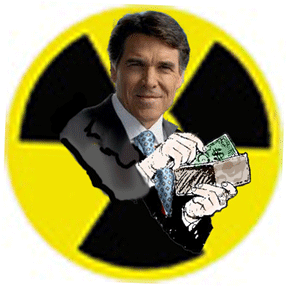 Reuters 28th June 2018 , U.S. Energy Secretary Rick Perry said on Thursday that bailing out
struggling coal and nuclear power plants is as important to national
security as keeping the military strong, and that the cost to Americans
should not be an issue.
https://uk.reuters.com/article/us-gas-conference-perry-grid/nuclear-coal-bailout-worth-any-cost-to-keep-america-free-u-s-energy-chief-idUKKBN1JO2J
Halden nuclear reactor shut down not just for safety reasons, more because it lost so much money
Halden Reactor to be decommissioned, WNN, 28 June 2018
“In conjunction with the licence renewal process for the Halden Reactor, IFE has over the last year carried out a strategic review of reactor operations, including a financial and operational risk assessment. Based on this review, IFE’s Board concluded that operation of the reactor beyond the current licence period is not viable, as this would imply business risks in excess of what IFE is capable of handling on its own,” IFE said.
Over the past seven years, IFE has lost more than EUR18 million on its nuclear operation and has this year relied on extraordinary funding from the Norwegian government. As a self-owning foundation, IFE said it is not able to manage the financial risk of operating the reactor. ……
What happened last time it was as warm as it’s going to get later this century?
Kids today will be grandparents when most climate projections end—does the past have more hints? Ars Technica –
Wildfire danger s are increasing, due to climate change
How climate change is increasing the risk of wildfires, The Conversation, Senior Lecturer in GIS and Ecology, Anglia Ruskin University,
The army has been called in to help firefighters deal with a huge wildfire on Saddleworth Moor, Greater Manchester, where residents have been forced to evacuate. Wildfires are also blazing across Northern Californiawhile the issue of bushfires in Australia calls for constant vigilance from the emergency services there. These fires are becoming more common and one of the reasons for this is climate change.
Warmer temperatures in the summer and associated drier conditions desiccate plant materials and create more vegetation litter, providing more fuel for these fires. Several studies have linked the increase of wildfires with climate change in various parts of the world, such as North America and Southern Europe.
For example, a study in California from 2004 found that the warmer and windier weather (brought about by an atmosphere with higher levels of CO2) produced fires that burned more intensely and spread faster in most locations. Despite enhanced firefighting efforts, the number of escaped fires (those exceeding initial containment limits) increased by 51% in the south San Francisco Bay area, 125% in the Sierra Nevada.
It has also been demonstrated that increases in rainfall during winter and spring – which are also known consequences of climate change – provide more favourable conditions for plant growth and therefore more potential fuel for the fires later in the summer.
Even though climate change increases the vulnerability of dry environments to wildfires, a source of ignition is still required. In the UK, it can be natural (such as bolts of lightning) or caused by man either deliberately or accidentally. Various studies have shown that the number of recreational visits to “risky” sites, such as the English Peak District, increase the occurrence of wildfire.
Despite its destructive power, fire is an important ecological process that can benefit several endangered species by maintaining their habitat. It is an important tool in the management and preservation of heathlands and moorlands in the UK when used appropriately and in a controlled way.
But climate change and human activities increase the vulnerability of those habitats to uncontrolled wildfires and higher population densities near these areas will potentially put more people and houses at risk. In addition to the global battle against climate change, appropriate management procedures are necessary to maintain those habitats and ensure the risks of uncontrolled fires are minimised and the potential spread of them reduced. https://theconversation.com/how-climate-change-is-increasing-the-risk-of-wildfires-99056
Climate change linked to potential population decline in bees
Study finds that warmer temperatures push bees to their physiological limits, may drive local extinction, Science daily
- Date:
- June 28, 2018
- Source:
- Northwestern University
- Summary:
- A new study has found that climate change may drive local extinction of mason bees in Arizona and other naturally warm climates.
A new study from Northwestern University and the Chicago Botanic Garden has found that climate change may drive local extinction of mason bees in Arizona and other naturally warm climates.
In a two-year, in situ field experiment that altered the temperature of the bees’ nests to simulate a warmer, future climate, 35 percent of bees died in the first year and 70 percent died in the second year. This is compared to a 1-2 percent mortality rate in the control group.
“The projected temperatures appear to be pushing this species up against its physiological limits,” said Northwestern’s Paul CaraDonna, who led the research. “This is evidence that we might see local extinction in the warmer parts of this species’ range, which is pretty sobering.”
-
The study will publish online on Thursday, June 28 in the British Ecological Society’s journal Functional Ecology. CaraDonna is an assistant professor of instruction in the Program in Plant Biology and Conservation in Northwestern’s Weinberg College of Arts and Sciences and a research scientist at the Chicago Botanic Gardens…….https://www.sciencedaily.com/releases/2018/06/180628105009.htm
Radiation from USA’s nuclear bomb tests went far and wide – now compensation is needed
Cold War Weapons Testing Made People Sick. Now, More Mountain West Residents Could Be Compensated http://boisestatepublicradio.org/post/cold-war-weapons-testing-made-people-sick-now-more-mountain-west-residents-could-be-compensated#stream/0 By RAE ELLEN BICHELL • JUN 28, 2018
Nuclear testing during the Cold War sent radioactive fallout far away from the actual test sites. Politicians are moving to expand who can be compensated by the government for getting sick after exposure to that fallout.
The tests mostly happened in Nevada but winds sent radioactive materials far and wide. Idaho Sen. Mike Crapo said one detonation in 1952 was particularly memorable to his constituents.
“Idahoans that I’ve spoken to in Emmett and elsewhere have shared their memories of waking to find their pastures and orchards covered with a fine grey-white dust that seemingly appeared out of nowhere. It looked like frost, yet it was not cold to touch,” Crapo said in a Senate Committee on the Judiciary hearing Wednesday.
In 1990 Congress created a program to compensate people who became seriously ill after radiation exposure.
According to the Department of Justice, since the programstarted more than $2 billion has been given in compensation. People like miners who worked directly with radioactive materials can get $100,000, people who were on site during nuclear tests get $75,000 and people who lived downwind of a major test site in Nevada get $50,000. So-called “downwinders” have to have lived in certain counties within Utah, Nevada and Arizona at the time of testing to be considered eligible.
“Unfortunately, the science at the time failed to recognize that radioactive fallout is not restricted by state lines,” said Crapo.
According to the National Cancer Institute, some of that fallout landed on fields across the country and especially in the Mountain West. It was consumed by animals like cows and eventually made it into milk cartons. Because of that, people who were milk-drinking children at the time are considered to have a higher risk of thyroid cancer.
Senators, including Crapo, have sponsored a bill that would expand the group of eligible “downwinders” to people who lived in parts of Idaho, Colorado, Montana, New Mexico and Guam at the time that tests were conducted.
The bill would also establish a grant program for further research into the health impacts of uranium mining and would extend the deadline for filing claims from 2022 to the late 2030s.
This story was produced by the Mountain West News Bureau, a collaboration between Wyoming Public Media, Boise State Public Radio in Idaho, Yellowstone Public Radio in Montana, KUER in Salt Lake City and KRCC and KUNC in Colorado.
Socialism is the Trump govt’s policy when it comes to coal and nuclear
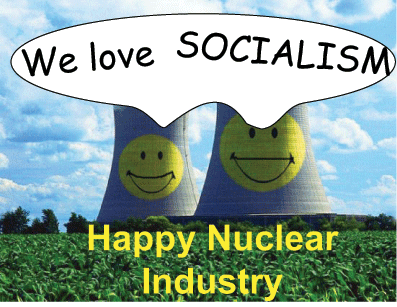 Trump administration wants welfare for coal and nuclear power, https://www.denverpost.com/2018/06/29/trump-administration-wants-welfare-for-coal-and-nuclear-power/ By TOM RIBE | Writers on the Range
The Trump administration just sent a tsunami through America’s electrical energy world when a leaked memo revealed that it had a new plan to shovel millions of dollars to the coal and nuclear power industries.
The memo, leaked to Bloomberg News and written by a member of Trump’s National Security Council, said that the nation faced a “grid emergency” because so many coal and nuclear power plants had shut down. The memo argued that the government could simply order private utility companies to buy high-cost electric power, because “national security” concerns mandated using “fuel-secure” sources to protect national security.
The memo claimed that “resources that have a secure, on-site fuel supply, including nuclear and coal fired power plants … are essential to support the nation’s defense facilities and critical energy infrastructure.” And it added that “due largely to regulatory and economic factors, too many of these fuel-secure facilities have retired prematurely.”
Prematurely? There is no shortage of electric power generation in the United States. The historic shift in this country toward cleaner, renewable energy is driven by national and international energy markets, not by tax breaks or government regulations. Countries around the world are investing in cheaper solar and wind power to address climate change and air pollution. One might think that free-market conservatives would be delighted to see competitive markets providing abundant, low-cost electricity from diverse sources to American consumers — all without interference from government. But apparently this case is different.
As for any threats to our national security, Vermont Law School professor Peter A. Bradford has pointed out: “We have no military crisis and no threats to our system reliability or resilience that require this drastic and expensive governmental intervention. The facts are being fixed around the desired end result.”
A political explanation seems like the real reason behind the administration’s determination to prop up coal. Trump’s staff has found a way to fulfill his campaign promise to rescue the dying coal industry, whose production has dropped 38 percent in the last decade. Robert Murray, CEO of Murray Energy, who gave Trump $300,000 for his inauguration, presented Energy Secretary Rick Perry with an “action plan” last March that included ending pollution controls on coal plants and stopping the rapid shift toward wind and solar energy.
Perry tried to direct federal subsidies to coal, only to be blocked last September by the Federal Energy Regulatory Commission. The leaked National Security Council memo noted that the Trump administration could use laws, such as the Federal Power Act and the Defense Production Act, to force utilities to buy high-cost power from coal and nuclear plants, though neither act has been used for these purposes before.
The memo also stated that natural gas is vulnerable to “cyber attacks” that make its supply unreliable, though record supplies of natural gas exist throughout the country. What the memo ignores is the reality that wind and solar, which make up about a quarter of power generation in this country, are abundant resources — nowhere near scarce.
Ever since horizontal drilling — fracking — transformed the oil and gas industry, this country has been producing large amounts of natural gas. Prices have dropped dramatically, and many coal-burning plants have converted to natural gas. Natural gas, however, is also a potent contributor to global climate change, and the continued flaring of methane during gas production is a significant, largely uncalculated source of pollution.
The Nuclear Information and Resource Service, a nonprofit that supports nuclear-free renewable energy, estimates that the coal and nuclear plant subsidies proposed in the memo could cost consumers up to $35 billion per year. Tim Judson, the group’s executive director, said, “Betting on old, increasingly uneconomical nuclear and coal power plants as a national security strategy is like gold-plating a Studebaker and calling it a tank. It could destroy the booming renewable energy industry, which is already employing more Americans than coal and nuclear combined.”
At a Senate hearing on June 11, Washington Democratic Sen. Maria Cantwell characterized the proposal as nothing more than “political payback” for the coal industry, and members of the Federal Energy Regulatory Commission who testified agreed that there is no “grid emergency.” Citing market interference, even the American Petroleum Institute testified against subsidizing coal and nuclear power.
Trump, who apparently developed his ideas on energy policy back in the 1970s, has shown little interest in any of the major changes to America’s energy picture since then. His effort to turn back the clock to fulfill his campaign promises to coal miners and repay political contributions could throw tens of thousands of people out of work, forfeit America’s leadership in energy technology, and worsen global warming.
America’s environmental and energy future depends upon a vigorous public pushback against this wrongheaded move.
Delay in removing spent nuclear fuel from Fukushima’s crippled nuclear reactor
Fuel removal from Fukushima reactor may be delayed, https://www3.nhk.or.jp/nhkworld/en/news/20180629_14/The operator of the damaged Fukushima Daiichi nuclear power plant says work to remove spent nuclear fuel from a cooling pool at one of its reactors may be delayed.
A total of 566 fuel units remain in the cooling pool at the No.3 reactor, which suffered a meltdown in 2011. Tokyo Electric Power Company, or TEPCO, planned to start removing the fuel as early as this autumn, as part of the decommissioning of the nuclear complex.
But on Thursday, TEPCO revealed the control board of a crane used in the removal malfunctioned during a test run last month. It blamed a voltage error and said the board will be replaced.
The company said the test run may be delayed by one or 2 months, pushing back the start date for fuel removal.
TEPCO’s chief decommissioning officer, Akira Ono, says he takes the glitch seriously as it shows key equipment was not handled properly.
He says that although safety must come first, his team still aims to stick to the original timetable and start the removal of nuclear fuel by around the middle of the current fiscal year, which ends in March next year.
Climate change: ‘Next generation will bear the cost’
https://www.bbc.com/news/av/science-environment-44642147/climate-change-next-generation-will-bear-the-cost Climate change: ‘Next generation will bear the cost’
The chair of the Climate Change Committee, Lord Deben, has warned that the next generation will have to bear the cost of lowering carbon emissions.
He told Today that due to the Industrial Revolution, Britain is “rich because of that pollution” and the government isn’t doing enough to tackle climate change.
Britain’s Planning Inspectorate has accepted Hitachi unit Horizon’s application for the Wylfa nuclear power station in Wales
Reuters 29th June 2018 , Britain’s Planning Inspectorate has accepted Hitachi unit Horizon’s
application for the Wylfa nuclear power station in Wales, it said, one of
several new plants aimed at replacing the UK’s ageing fleet of atomic
reactors and coal plants. “We have considered very carefully the
application submitted by Horizon Nuclear Power and decided that it meets
the required tests set out in the legislation to be accepted for
examination,” Sarah Richards, chief executive of the Planning
Inspectorate, said in a statement. “Of course, this does not mean that
consent will be given for the project to go ahead – acceptance of the
application simply means that the Examining Authority can begin to make
arrangements for the formal examination of the application,” she added.
https://uk.reuters.com/article/uk-britain-nuclear-horizon/uk-inspectorate-accepts-hitachi-units-planning-bid-for-wylfa-nuclear-plant-idUKKBN1JP0VV?rpc=401&
UK’s nuclear power bigwigs want “community engagement”, but exclude critics of Sizewell nuclear project
Ipswich Star 28th June 2018 , Sizewell C boss under fire for meeting Suffolk business leaders – but not
campaign groups. EDF Energy chief executive Simone Rossi is addressing
Suffolk Chamber of Commerce members at their annual general meeting in
Ipswich on Friday, June 29.
But Theberton and Eastbridge Action Group on
Sizewell (TEAGS), Minsmere Levels Stakeholder Group (MLSG) and the B1122
Action Group said he should show his commitment to community engagement and
meet with them too. “Despite being in post for eight months and speaking
about Sizewell regularly to the national media, Simone Rossi appears
surprisingly reluctant to visit us,” said Paul Collins of TEAGS and MLSG.
“If EDF really wants to show its commitment to engagement, Simone Rossi
will make it a priority to come and meet the community that is on the
frontline of Sizewell C and D and that will suffer a cumulative and
disproportionate impact during construction. He owes it to the people of
east Suffolk to come and hear our concerns face to face and ensure that EDF
meets its stated obligations before the next round of consultation.”
http://www.ipswichstar.co.uk/news/sizewell-c-edf-suffolk-teags-leiston-suffolk-chamber-of-commerce-1-5583182
Jordan gives up on big nuclear power station, but might be sucked in by “Small Nukes” propaganda
Middle East Monitor 29th June 2018 The chairman of the Jordan Atomic Energy Commission, Dr. Khaled Toukan,
announced today that his country has abandoned the idea of establishing a
nuclear power plant, which was planned to be built with Russian technology
with a capacity of 2,000 megawatt. Dr. Toukan told a news conference that
the commission has abandoned the construction of a large plant and will
consider building small reactors. The chairman added that small reactors
need less funding and are more likely to be sponsored internationally than
large stations.
https://www.middleeastmonitor.com/20180629-jordan-gives-up-idea-of-large-nuclear-power-plant/
North Korea has little incentive to “denuclearize”. Trump’s incoherent strategy leaves the world in danger
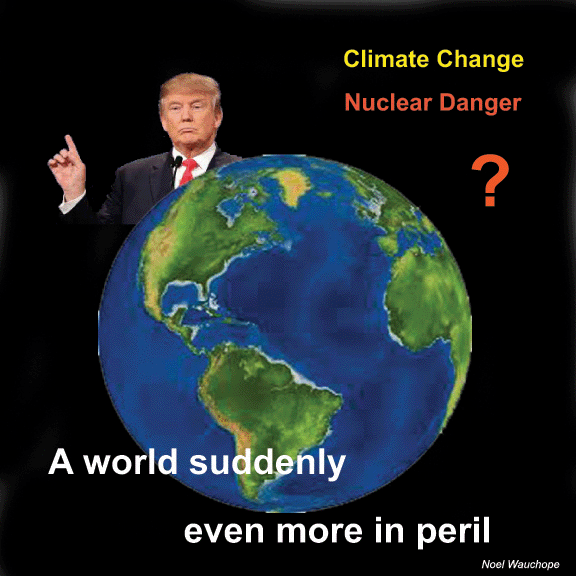
 North Korea’s nuclear facilities cannot be closed with a handshake http://www.kbzk.com/story/38534251/north-koreas-nuclear-facilities-cannot-be-closed-with-a-handshake: Jun 29, 2018 By Jonathan Cristol , Research Fellow in the Levermore Global Scholars Program at Adelphi University and Senior Fellow at the Center for Civic Engagement at Bard College. @jonathancristol.
(CNN) — On Wednesday, the North Korea watchers at 38 North released satellite imagery that shows North Korea making improvements to the Yongbyon Nuclear Scientific Research Center. While this report is unsettling, it is not at all surprising.
More unsettling than the report is the possibility that President Donald Trump believed that the North Korean nuclear threat could be solved by a handshake. In the immediate aftermath of the Singapore Summit, Trump said that, “There is no longer a Nuclear Threat from North Korea.” That statement was false, and the North Korean activity at Yongbyon proves it.
But North Korean nuclear activity is not in violation of the terms of the summit, since Trump and Kim Jong Un did not sign paperwork regarding immediate and complete denuclearization. Instead, they signed an agreement that includes a vague statement that North Korea will “work toward” denuclearization of the Korean Peninsula.
So far, the Trump administration is the only side moving in that direction — by agreeing to suspend joint military exercises with South Korea in exchange for vague promises. The improvements at Yongbyon, however, do not even violate Kim’s vague promise, which was only to stop nuclear and ballistic missile testing.
But, more importantly, Kim has little incentive to cease nuclear activity, and for that he can thank the incoherent strategy of Trump. The “maximum pressure” campaign of ever-tightening, crippling sanctions against North Korea is all but forgotten by Washington, and even Secretary of State Mike Pompeo says, “I am not going to put a timeline on [denuclearization].”
Additionally, Trump’s statements that the problem is solved gives China little incentive to apply pressure on its southern ally and gives America little leverage over China. Historically, China has been reluctant to apply too much pressure on Pyongyang for fear of a North Korean collapse that would both inundate China with refugees and potentially bring US troops to the Chinese border. It was Kim’s nuclear program that brought China into the sanctions regime. If, as the President said, the nuclear program is solved, then Washington has little recourse if China chooses to resume trading with North Korea.
CNN reports that the upgrades at Yongbyon were long-planned. These upgrades and further actions to strengthen Pyongyang’s nuclear deterrent will continue overtly in absence of an explicit agreement to stop them. And if such an agreement is reached, upgrades to the nuclear program and further research and development will likely continue in underground facilities. North Korea is not likely to give up its nuclear weapons for any reason or for any price.
Trump may think that a warm handshake and a few shared laughs will solve the North Korean problem, but Kim is not so naive. One of the world’s most brutal and repressive dictators, according to Human Rights Watch, is not going to be won over by Trump’s public remarks that he “got along great with Kim Jong Un, who wants to see wonderful things for his country” or that the two leaders share a “special bond.” Kim is going to take advantage of Trump’s pathological desire for praise and promise him the world, while continuing to develop his weapons programs.
The new developments at Yongbyon are not, on their face, cause for concern. But there are reasons to worry about the 38 North report. If Trump thinks that Kim agreed not to continue with his program, then this report (if discussed on his preferred news network) might cause Trump to return to his previous belligerent rhetoric vis-a-vis North Korea. If Trump thinks that this report makes him look weak, then he may be susceptible to John Bolton’s argument that there is a “legal case” to mount a preventive strike against North Korea.
Trump may think that the summit in Singapore prevented a war, but that is only true in the sense that it stopped him from starting one. That said, the summit does not need to be futile — it could also be the start of a genuine and serious set of arms control and limitation negotiations. These negotiations would require patience and skill without an obvious or immediate photo-op or half-clever tweet.
But since Trump is neither known for his patience nor his restraint on social media, we can expect North Korean nuclear research and facilities upgrades to continue apace.
1 This Month
Chernobyl: The Lost Tapes – A good documentary on Chernobyl on SBS available On Demand for the next 3 weeks– https://www.sbs.com.au/ondemand/tv-program/chernobyl-the-lost-tapes/2352741955560

of the week–London Campaign for Nuclear Disarmament

Tell the Ukrainian Government to Drop Prosecution of Peace Activist Yurii Sheliazhenko
To see nuclear-related stories in greater depth and intensity – go to https://nuclearinformation.wordpress.com
-
Archives
- April 2026 (114)
- March 2026 (251)
- February 2026 (268)
- January 2026 (308)
- December 2025 (358)
- November 2025 (359)
- October 2025 (376)
- September 2025 (257)
- August 2025 (319)
- July 2025 (230)
- June 2025 (348)
- May 2025 (261)
-
Categories
- 1
- 1 NUCLEAR ISSUES
- business and costs
- climate change
- culture and arts
- ENERGY
- environment
- health
- history
- indigenous issues
- Legal
- marketing of nuclear
- media
- opposition to nuclear
- PERSONAL STORIES
- politics
- politics international
- Religion and ethics
- safety
- secrets,lies and civil liberties
- spinbuster
- technology
- Uranium
- wastes
- weapons and war
- Women
- 2 WORLD
- ACTION
- AFRICA
- Atrocities
- AUSTRALIA
- Christina's notes
- Christina's themes
- culture and arts
- Events
- Fuk 2022
- Fuk 2023
- Fukushima 2017
- Fukushima 2018
- fukushima 2019
- Fukushima 2020
- Fukushima 2021
- general
- global warming
- Humour (God we need it)
- Nuclear
- RARE EARTHS
- Reference
- resources – print
- Resources -audiovicual
- Weekly Newsletter
- World
- World Nuclear
- YouTube
-
RSS
Entries RSS
Comments RSS
 nuclear-news