Next week’s summit between President Kim Jong-un and President Donald Trump will help determine the fate of a decades-long international effort to stop the spread of nuclear weapons – and prevent the sort of nuclear annihilation that the inventors of the atomic bomb greatly feared.
“I alone can fix it,” Mr. Trump declared two summers ago at the Republican National Convention. Applied to nuclear weapons, that belief is delusional and potentially catastrophic. International co-operation, through mechanisms like the NPT, offers the only real hope of survival.
Eric Schlosser’s books include Command and Control: Nuclear Weapons, the Damascus Accident, and the Illusion of Safety.
At first, the destruction of Hiroshima and Nagasaki by atomic bombs in August, 1945, was celebrated in the United States. The new weapon had seemingly ended the war with Japan, eliminating the need for a protracted and bloody invasion. But the celebratory feeling was short-lived. That same month, General Henry H. Arnold, commander of the United States Army Air Forces, publicly warned that nuclear weapons might soon be placed atop missiles and aimed at American cities. Once launched, such weapons would be impossible to stop and “destructive beyond the wildest nightmares of the imagination.” Nuclear proliferation – the spread of this lethal technology to other countries – could lead to nuclear wars that threatened the survival of mankind. A few months later, J. Robert Oppenheimer, the “father of the atomic bomb,” gave a farewell speech to his fellow Los Alamos scientists that described how easily proliferation might occur. Nuclear weapons “are going to be very cheap if anyone wants to make them,” he said, “they are not too hard to make … they will be universal if people wish to make them universal.” The invention of the atomic bomb, Oppenheimer thought, marked no less than “a change in the nature of the world.”
Almost 73 years have passed since Oppenheimer’s speech – and a great many apocalyptic predictions have proven wrong. No other cities have been destroyed by a nuclear weapon. No nuclear wars have been fought. And only nine countries now possess nuclear arsenals, not dozens. The absence of nuclear catastrophes has multiple causes, among them: sober national leadership, wise crisis management, military professionalism, technical expertise and a remarkable amount of good luck. The Treaty on the Non-Proliferation of Nuclear Weapons (NPT) and the guiding spirit behind it also deserve a prominent place on that list. The NPT is essentially a bargain struck between nations that have nuclear weapons and those that don’t. Former president Barack Obama once explained its three pillars: “Countries with nuclear weapons will move toward disarmament, countries without nuclear weapons will not acquire them and all countries can access peaceful nuclear energy.” But as the NPT approaches its 50th anniversary next month, the treaty faces unprecedented assaults and the prospect of nuclear arms races in Asia and the Middle East. Of the 190 countries that have signed the NPT, North Korea is the only one that’s withdrawn from it and developed nuclear weapons. Next week’s summit between President Kim Jong-un and President Donald Trump will help determine the fate of a decades-long international effort to stop the spread of nuclear weapons – and prevent the sort of nuclear annihilation that the inventors of the atomic bomb greatly feared.
The NPT began as a 1958 push by Ireland to dissuade the United States from sharing nuclear weapons with its NATO allies, especially West Germany. At the time, four countries had nuclear weapons: the United States, the Soviet Union, Britain and France. After a slow, uneven start, the non-proliferation movement gained momentum in 1964 when China detonated its first nuclear device. U.S. intelligence estimates had warned the previous year that eight other countries – Australia, Egypt, West Germany, India, Israel, Japan, South Africa and Sweden – could produce nuclear weapons within a decade. An additional six – Argentina, Brazil, Bulgaria, Hungary, Romania and Yugoslavia – might have them by the early 1980s. The Cuban Missile Crisis had demonstrated that a confrontation between two nuclear powers could inadvertently start a nuclear war. And numerous nuclear-weapon accidents suggested that disasters could be caused by simple mistakes and miscalculations. It seemed obvious that if more countries possessed nuclear weapons, the danger would increase. Working closely with the Soviet Union, the United States played a large role in drafting the NPT. On July 1, 1968, the first day that the treaty was open for signature, 66 countries signed it, and less than two years later, the NPT went into effect. It seemed a triumph of international co-operation on behalf of world peace.
During the next quarter-century, the NPT was more successful at preventing the spread of nuclear weapons than at achieving disarmament. The five nuclear-weapon states recognized by the treaty (the United States, Britain, France, China and the Soviet Union) had promised to seek “cessation of the nuclear arms race at an early date … and complete disarmament under strict and effective international control.” And yet, none of those things happened during the 1970s and ‘80s. Meanwhile, the other NPT signatories had kept their side of the bargain and forsworn nuclear weapons. The four additional countries that eventually did obtain them – Israel, India, Pakistan and South Africa – had never signed the treaty.
During the early 1990s, the threat of nuclear war finally seemed to be diminishing. South Africa not only gave up its nuclear weapons but also signed the NPT. After the collapse of the Soviet Union, the Ukraine had the world’s third-largest nuclear arsenal. Nevertheless, it surrendered the weapons, as did Belarus and Kazakhstan, two other former Soviet republics with nuclear stockpiles, and all three signed the NPT. The end of the Cold War led the United States and Russia to make enormous cuts in their nuclear arsenals, reducing the number of weapons by about 80 per cent. But grand hopes that the 21st century would see the end of the nuclear threat were illusory.
One of the compromises that made the NPT possible now threatens to make it irrelevant. Article IV of the treaty guarantees its signatories “the inalienable right” to obtain nuclear technology for peaceful uses. Without strict monitoring and enforcement, however, the possession of civilian nuclear-power facilities can enable the development of military nuclear technology. Weapons-grade uranium and plutonium can be made at enrichment and reprocessing plants ostensibly built to make fuel for nuclear reactors. India developed its atomic bomb with civilian nuclear technology obtained from Canada and the United States; Israel got its bomb with civilian technology from France. Despite having signed the NPT, Iran, Iraq, Libya, North Korea and Syria secretly launched nuclear-weapon programs under the guise of seeking the peaceful use of nuclear energy.
Today, all three pillars of the NPT are in grave jeopardy. Instead of disarming, the five nuclear states recognized by the treaty are modernizing their arsenals. The renewed arms race between the United States and Russia is especially dangerous. Thanks to the “inalienable right” to civilian nuclear power, perhaps 20 to 30 NPT signatories have the latent ability to develop nuclear weapons. Japan has stockpiled about 10 tonnes of plutonium, enough to produce thousands of nuclear warheads, and could probably manufacture some within a year. The nuclear threat posed by North Korea may encourage South Korea, as well as Japan, to become a nuclear weapon state. Last year, an opinion poll found that about 60 per cent of South Koreans would like their country to have its own nuclear weapons. Henry Sokolski, executive director of the Nonproliferation Policy Education Center in Washington, thinks that the Middle East now stands on the brink of a volatile and chaotic nuclear arms race. “If Iran resumes its nuclear weapons program,” Mr. Sokolski recently wrote in Foreign Policy, “the Saudis will certainly pursue their own – and Algeria, Egypt and Turkey might well follow.” Given the large petroleum and natural-gas supplies in Saudi Arabia, as well as the ample sunlight available there for solar power, the current Saudi proposal to spend more than $80-billion on nuclear technology suggests that future energy needs aren’t the sole reason for the investment.
To ensure that a treaty written to halt the proliferation of nuclear weapons isn’t transformed into one that facilitates their spread, a number of important steps can still be taken. The United States and Russia possess about 90 per cent of the world’s nuclear weapons, and those two countries must be pressured to reduce the size of their arsenals and minimize the risk of nuclear war. Frustrated with the slow pace of disarmament by the NPT’s five nuclear states, a few years ago the International Campaign to Abolish Nuclear Weapons (ICAN) began to seek a treaty to ban nuclear weapons. The Treaty on the Prohibition of Nuclear Weapons was adopted by the United Nations last year, and ICAN was subsequently awarded the Nobel Peace Prize. Ray Acheson, a Canadian who serves on ICAN’s steering committee, supports the goal of non-proliferation but strongly defends the group’s strategy of focusing their criticism on the NPT’s five nuclear states. “The nuclear weapons that already exist are more dangerous,” she says, “than the ones that don’t.”
As for the other NPT signatories, Scott Sagan, a nuclear-weapon expert who’s a professor of political science at Stanford University, thinks that an “unalienable right” to the peaceful use of nuclear energy doesn’t mean the right to hedge your bets and develop a latent nuclear-weapon capability. The NPT allows a country to leave the treaty simply by giving 90 days notice. Prof. Sagan argues that violating the treaty should lead to much stronger punishments by the United Nations and that leaving the treaty should be made more difficult. Contracts for the sale of civilian nuclear facilities and technology should have a “return to sender” clause – a requirement that any country that leaves the NPT must return all the nuclear equipment it bought.
The issue of nuclear proliferation is hardly inconsequential for Canada. Although Canada has never formally been a nuclear weapon state, its deployment of American weapons during the Cold War was precisely the sort of arrangement that inspired Ireland to seek a non-proliferation treaty. Between 1963 and 1984, hundreds of American nuclear weapons were assigned to Canadian forces. Two squadrons of BOMARC anti-aircraft missiles, carrying a total of 56 warheads, were based at North Bay, Ont., and La Macaza, Que. About 100 Genie anti-aircraft rockets with nuclear warheads were stationed at Royal Canadian Air Force bases, and Canadian fighter planes assigned to NATO carried low-yield Mark 28 hydrogen bombs. The weapons were technically in the custody of the United States, but Canadian officers were granted the authority to turn one of the two keys that launched the BOMARC missiles – and sole control over firing the Genies and dropping the Mark 28s. A Soviet bomber attack on the United States would have prompted nuclear warfare in the skies over Canada, as BOMARCS and Genies sought their targets. And the three nuclear-weapon systems operated by Canadian forces had serious safety defects that could have caused accidental nuclear detonations. Canada, like the United States, was fortunate to survive the Cold War without nuclear devastation. The effects of nuclear blasts, the electromagnetic pulses and deadly fallout, show little regard for national borders. Even if you don’t have nuclear weapons, having a neighbour who does can pose a considerable threat.
Some academics have argued that nuclear proliferation might make the world safer, suggesting that countries with nuclear weapons are less likely to fight one another. That argument makes about as much sense as the contention that having more guns will reduce the number of people killed by gunfire. A single switch prevented the accidental detonation of an American hydrogen bomb in North Carolina during January, 1961. The following year the vote of a single officer on a Soviet submarine prevented the launch of a nuclear torpedo that would have turned the Cuban Missile Crisis into a thermonuclear war. The number of close calls during the arms race between the United States and the Soviet Union is terrifying. Multiply that number by multiple arms races and, short of divine intervention, you have a recipe for disaster.
Mr. Trump has an extraordinary opportunity in Singapore to reassert the principles guiding the NPT. If North Korea can be persuaded to give up its nuclear weapons, it will be a tremendous victory for the cause of non-proliferation. But lasting success will never be attained by the kind of unilateral American action that has lately started a trade war with longstanding allies, pulled out of the Iran deal and withdrawn from the Paris agreement on climate change. “I alone can fix it,” Mr. Trump declared two summers ago at the Republican National Convention. Applied to nuclear weapons, that belief is delusional and potentially catastrophic. International co-operation, through mechanisms like the NPT, offers the only real hope of survival. Robert Oppenheimer recognized that fact in his farewell speech to the Los Alamos scientists, at the dawn of the nuclear age. He told them: “I think it is true to say that atomic weapons are a peril which affect everyone in the world, and in that sense a completely common problem.”
National Geographic joins nuclear propagandists — the Australian connection, Independent Australia A new documentary series is nothing more than a propaganda tool for nuclear power, writes Noel Wauchope.
IN SEPTEMBER THIS YEAR, National Geographic will launch the documentary series, Wild Edens. It’s all about wilderness areas and is also a soft sell for the nuclear industry. And there’s a proud Australian connection, with the Global Ecology Lab of Flinders University, South Australia. Their energy researcher, Ben Heard, was master of ceremonies at the premiere in Spain in April…….
By 2018, things have changed. The argument that nuclear power is cheap has fallen apart. As for the “peaceful atom” and “no connection with nuclear weapons”, that one has fallen through, too. Recent research in UK and the USA make it clear that nuclear energy and developing new reactors are necessary for the continued development of nuclear weapons.
‘The driving force behind the UK government’s affinity to nuclear technology is the cross-subsidization of the military nuclear program
In the 21st Century came changes in technology and in the content of propaganda. Enter the “new nukes” — modern designs, especially small modular nuclear reactors (SMRs — they leave out that unpopular word “nuclear”). After much soul-searching – or, rather, much complex research on public opinion – the proponents of new nukes have now finally settled on environment, climate change and also a nod to space travel as the reasons why the world must embrace SMRs.But it’s not only the content of their propaganda which has changed. It’s the style. It’s the copious wrapping around this 21st Century nuclear birthday present.
And here’s where National Geographic comes in — their new documentary series Wild Edenswill be gorgeous:
‘…filmed in the world’s most stunning untouched places and their inhabitants — wildlife and fauna alike, endangered by the effects of climate change.’
The PR for nuclear power will be introduced so slightly and subtly you’d hardly notice. This is the strategy of the SMR propagandists. They also do lobby business and government with sophisticated technical arguments. But for the public – us, the great unwashed and especially the young – it is all beautiful touchy-feely stuff ……..
Ben Heard’s speech, on opening the premiere of Wild Edens, talked about climate change but then moved on to a longer panegyric on nuclear power:
…this beautiful and important film from National Geographic, brought to us with the help of Rosatom, represents…recognition that nuclear technologies are crucial to the protection, restoration and expansion of our natural world.
…it is particularly nuclear technologies that will help us find energy at a global scale, without super-charging the climate change of tomorrow.
And one of the greatest, most hopeful signs I have seen that this can happen, is to see a major corporation like Rosatom step boldly forward in this way and claim this issue on behalf of nuclear technologies.
Wild Edens will surely be very beautiful, informative about wild places and worth watching. Just be aware of the underlying propaganda about:
nuclear power being the essential cure for climate change;
Kim, the economy and why UN sanctions did not bring North Korea to the summit table
Although UN sanctions have limited growth, North Korea’s financial health – and the physical health of its people – seem to be stabilising, SCMP, Lee Jeong-ho, 03 June, 2018 If top officials in Washington and Tokyo are to be believed, the application of “maximum pressure” through United Nations sanctions was decisive in bringing North Korean leader Kim Jong-un to the summit table.
Pyongyang has been the target of a string of UN bans from trade to travel for more than a decade, the toughest coming in September when they were expanded to cover crude oil.
Just six months later Kim sent a message offering to meet US President Donald Trump with no strings attached.
Senior US and Japanese officials credited the offer in large part to the international sanctions, which they maintained had battered the already beleaguered North Korean economy.
But there is evidence – anecdotal and data – that North Korea’s economy has stabilised over the past few years, and while UN sanctions are limiting its growth, the country is far from famine or total collapse.
Reliable data on North Korea is hard to get. But information from various sources suggests that it has been making noticeable improvement since Kim came to power in December 2011 – at least before a new round of United Nations sanctions began taking effect this year.
Park En-na, South Korea’s ambassador for public diplomacy, said the general picture was that North Korea’s economy was getting better.
“Kim has introduced many new elements to the economy. To some extent, they even allowed privatisation,” Park said.
Kim has rolled out various measures to accelerate his country’s economic development and loosen the government’s grip on business and industry. In 2012, he offered factories and companies incentives to improve productivity and a year later, he established 13 new economic development zones to try to attract foreign investment. More market-oriented reforms were adopted in 2014 to further liberalise the economy. On top of that, improving living standards is now a national priority.
TICKING OVER
Although the direct effect of these decisions is hard to measure, there are some economic indicators of progress.
The Bank of Korea, the central bank in Seoul, estimated the North Korean economy had grown 1.24 per cent on average since Kim took power, expanding by 4 per cent to US$28.5 billion in 2016, the fastest growth in 17 years.
Pyongyang’s trade figures also reveal signs of economic expansion since 1996.
North Korea’s main exports are minerals, metallurgical products and manufactured goods including armaments, according to the latest Central Intelligence Agency’s World Factbook. Its main imports are petroleum, coking coal and machinery.
………
ON THE GROUND
International observers also report that conditions in North Korea appear stable.
David Beasley, executive director of the World Food Programme (WFP), made an official trip to North Korea last month, visiting Pyongyang, Sinwon county in South Hwanghae province and Sinuiju city in North Pyongan province.
Beasley said signs of hunger and malnourishment in the country had diminished.
“What I did not see was starvation. In the 1990s, there was famine and starvation, but I saw none of them,” he said…….
NUCLEAR CONFIDENCE
North Korea’s economy-first focus emerged in April when Kim said he would start moving away from the “byungjin” policy, which calls for developing nuclear weapons and the economy simultaneously, to adopt a new strategy focusing on improving the economy.
That message was reinforced – albeit indirectly – during Kim’s talks with Chinese President Xi Jinping in the northeastern Chinese city of Dalian in May. In that meeting, Kim said he anticipated taking “phased and synchronous measures” to “achieve denuclearisation and lasting peace on the Korean peninsula”. That process would involve step-by-step eradication of nuclear weapons in return for economic sweeteners and a gradual lifting of sanctions.
Many analysts said Kim was simply using the weapons as a bargaining chip for aid to offset the effect of the sanctions and thereby realise his much-needed economic goals.
But Chung Jae-heung, a researcher at the Sejong Institute in Seoul, said North Korea was emboldened by its nuclear strength rather than bowed by a sanctions-hit economy.
“It’s Pyongyang’s confidence as a nuclear state that brought Kim to the negotiating table, not solely UN sanctions, as its economy is not as bad as many of us think,” Chung said.
“The North Korean regime is not likely to collapse due to UN sanctions, as Beijing is unlikely to cut down its oil supply to the extent that may threaten the survival of the Kim regime.”
Park, the South Korean ambassador, said that having acquired nuclear technology, Kim could next turn his focus to economic development.
“It is difficult to assess how much impact UN sanctions have on North Korea,” she said. “But it is obvious that under the sanctions, they can’t make meaningful economic development as there is no investment from the outside.”
Lim Eul-chul, a North Korea expert at the Institute for Far Eastern Studies in Seoul, said that while the recent UN sanctions may have caused the North Korean economy harm, their implications were limited, and they paled in the context of recent history.
The measures taken by the UN “will never be as bad as the great North Korean famine of the 1990s”, he said.
Radio Free Europe 6th June 2018, Scientists have been concerned for decades about potentially catastrophic wildfires inside the exclusion zone around the defunct Chernobyl nuclear power plant in Ukraine — the site in 1986 of the world’s worst nuclear accident.
That’s because trees and brush in the zone have absorbed radioactive particles that can be released into the air by the smoke of a wildfire.
Not surprisingly, some experts are skeptical about Ukrainian Prime Minister Volodymyr Hroysman’s claim on Facebook that “there’s no need to worry” about a June 5 blaze that raced through the so-called Red Forest — one of the most contaminated patches of forest near Chernobyl. https://www.rferl.org/a/prime-minister-says-don-t-worry-but-scientists-concerned-about-chernobyl-wildfires/29276072.html
“Given the instability in the world and in this White House, provoking nuclear brinksmanship is beyond reckless.”June 08, 2018 Jon Queally, staff writer
Lamenting the defeat of her amendment to defund the Pentagon’s $65 million program for so-called “low-yield” nuclear weapons in a House’s appropriations bill on Thursday, Rep. Barbara Lee (D-Calif) warned of the existential threat these weapons represent as they fuel a new arms race in an increasingly dangerous world.
“There is no such thing as a small nuclear weapon,” Lee declared after the amendment was defeated in a 241 to 177 vote—along mostly partisan lines—in the GOP-controlled House. The full roll call is here.
“Spending $65 million on a low-yield nuclear weapon – with unprecedented submarine-launch capability – heightens the risk of nuclear war,” Lee added. “We should be de-escalating tensions with our allies, not provoking a new nuclear arms race.”
Overall the spending in question involves the 2019 Energy and Water appropriations bill, which covers the nation’s nuclear weapons program, including an estimated $44.7 billion for annual funding—nearly $9 billion more than requested by the president.
Lee’s amendment called for cutting all $65 million for the W76-2 warhead—a 100 kiloton nuclear weapon, which is more than six times more powerful than the bomb dropped on Hiroshima—and transferring those funds to a government nuclear nonproliferation account.
AsDefense News reports, “The Pentagon’s Nuclear Posture Review calls for two nuclear designs: a low-yield variant of the W76 on Trident II missiles aboard America’s nuclear submarines and a potential new sea-launched nuclear cruise missile.”
The nonproliferation fund, Lee said, operates a program that “is critical to reducing the spread of nuclear weapons here at home and abroad. Instead of sinking more money into nuclear weapons that don’t enhance our national security, we should be preventing the proliferation of nuclear material and enforcing the treaties and arms control agreements on the books.”
She added, “Given the instability in the world and in this White House, provoking nuclear brinksmanship is beyond reckless. Congress should be building peace and diplomacy, not inviting a miscalculation with nuclear consequences.”
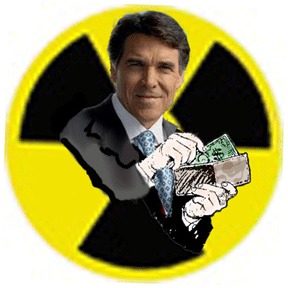
If the change is made, members of Congress will unburden themselves of a controversial vote and escape accountability for the potentially grave consequences. Instead, the matter will be unilaterally decided by Secretary of Energy Rick Perry, who can draw on whatever expertise he gained as … governor of Texas.
We also fundamentally disagree with the Board’s belief in the utility of limited nuclear use. There is no such thing as a limited nuclear war, and the United States should be seeking to raise the threshold for nuclear use, not blur that threshold by building additional so-called low-yield weapons.
Now the Senate is all that stands in the way of letting Rick Perry decide whether or not to fundamentally change the geopolitical balance of nuclear weapons.
A republic demands that the people’s representatives decide such matters. As a young House leadership page in the late 1970s, Jonathan Turley, the esteemed law professor, stood listening as passionate arguments stretched into the wee hours. “It was one of the most profound experiences of my life,” he said. “I came away with a deep respect for members on both sides who spoke honestly and directly about the consequences and the issues behind that type of weapon. I thought, this is a pretty great place where we debate whether we should do something, not just whether we could do something, and what implications it has for the world. That’s a debate that I think you should always want.”
Today a strikingly similar question arises: Should the United States develop a low-yield nuclear warhead to match a similar weapon developed by the Russians, as the Trump administration proposes to do? Would doing so lower the threshold for nuclear war, as many more experienced hands warn? Would it trigger a new arms race that ultimately sees more nuclear weapons held by more countries?
At present, Congress must decide what course to pursue. The Trump administration is constrained from developing a new, low-yield nuclear weapon without the approval of the representatives that citizens elected. So long as the decision remains with Congress, opportunities for a robust public debate will present themselves, and any American can write to their senators and representatives to influence the vote, then hold them responsible for it in future elections.
But strong efforts are underway to strip away those basic mechanisms of accountable republican government, as Senator Gary Peters warned Wednesday during a noteworthy aside in a Senate subcommittee hearing on a different matter.
In his words:
Today the Senate is starting debate on the National Defense Authorization Act for 2019. The bill that was before us includes a provision that will allow the Secretary of Energy to pursue development of a low-yield nuclear weapon without first receiving specific authorization from Congress. I voted against this provision as a member of the Armed Services Committee. It literally strikes from current law a requirement that a new, low-yield nuclear weapon be “specifically authorized by Congress.” And it replaces it with a provision that will allow the Secretary of the Energy to decide on his own whether or not to go forward.
The provision that was struck is a limitation that Congress put in place about 15 years ago to ensure that the legislature and not the executive branch would make such a highly consequential decision. … if members of Congress think our arsenal needs a low-yield nuclear weapon then we should debate it, we should authorize it, and do it in full view of the American people as existing law requires. Instead some are trying to change the rules to allow the executive branch to make this decision without Congressional approval. I think that’s fairly clear.
If the change is made, members of Congress will unburden themselves of a controversial vote and escape accountability for the potentially grave consequences. Instead, the matter will be unilaterally decided by Secretary of Energy Rick Perry, who can draw on whatever expertise he gained as … governor of Texas.
… the Defense Science Board recommends “a more flexible nuclear enterprise that could produce, if needed, a rapid, tailored nuclear option for limited use.” We strongly believe that there is no such thing as the limited use of nuclear weapons or limited nuclear war. In fact, the Board’s recommendation reminds us of an effort by the Bush Administration to build a new nuclear weapon specifically designed to destroy deeply buried enemy targets. That program, named the Robust Nuclear Earth Penetrator, or a nuclear “bunker buster,” was halted by the leadership of former Republican Congressman David Hobson in 2005.
The only role of nuclear weapons is to deter their use by others and we are aware of no evidence demonstrating that new nuclear weapons are needed to preserve or enhance deterrence. Our nation’s security is better protected by investments in advanced conventional weapons, not new nuclear weapons.
We also fundamentally disagree with the Board’s belief in the utility of limited nuclear use. There is no such thing as a limited nuclear war, and the United States should be seeking to raise the threshold for nuclear use, not blur that threshold by building additional so-called low-yield weapons.
We strongly agree with Deputy Secretary Work’s testimony last year when he stated: “anyone who thinks they can control escalation through the use of nuclear weapons is literally playing with fire. Escalation is escalation, and nuclear use would be the ultimate escalation.”
Additionally, as you know, U.S. nuclear capabilities are already highly credible, flexible, and lethal. The arsenal includes lower-yield weapons that can produce more “limited” effects, including the B61 gravity bomb, which is being modernized at an estimated cost of as much as $10 billion.
If congressional Republicans think otherwise, they should debate the matter before the public and put a vote behind their rhetoric, rather than sidestepping the merits, shirking accountability, and ceding what ought to be a legislative decision to a member of the executive branch. Using the appropriations process to sneakily decide a matter of this consequence is a dereliction of duty unworthy of the Framers. Yet this fight is already lost in the House.
The Union of Concerned Scientists put it this way in an update to their members:
… the full House passed its version of the NDAA on May 24th, in the process rejecting—in a surprisingly close and but mostly partisan vote—an amendment sponsored by Rep. John Garamendi (D-CA) and Rep. Earl Blumenauer (D-OR) that proposed fencing half of the funding for the low-yield warhead. This funding would have been held until the secretary of defense submitted a report to Congress assessing: the effect of the new warhead on strategic stability, ways to reduce the risk of miscalculation associated with it, and how to preserve the survivability of subs that would carry it, should it ever be launched.
The House rejected it by a vote of 226 to 188, largely along party lines, with seven Democrats voting against the amendment and five Republicans voting for it.
Now the Senate is all that stands in the way of letting Rick Perry decide whether or not to fundamentally change the geopolitical balance of nuclear weapons.
Outcome aside, how can anyone defend that process?
The spending bill, which includes appropriations for military construction and other federal departments, contains $267 million to restart the licensing process to open the Yucca Mountain nuclear repository in Nye County, about 90 miles northwest of Las Vegas.
An amendment to strip that spending from the bill died on a voice vote.
The amendment was filed by Rep. Ruben Kihuen and supported by Rep. Dina Titus and Rep. Jacky Rosen, all Nevada Democrats.
A Senate spending bill approved last month does not include funding for Yucca Mountain.
Differences in the two bills must be reconciled by a House-Senate conference committee.
London: Australian government officials have paid a mysterious visit to Julian Assange in his Ecuadorian embassy refuge in London, in a sign there may be a breakthrough in the stalemate that has lasted almost six years.
Two officials from Australia’s High Commission were spotted leaving the embassy in Knightsbridge in west London on Thursday.
It is the first time Australian consular officials have visited Assange at the embassy.
They were accompanied by Assange’s lawyer Jennifer Robinson.
Robinson confirmed the meeting to Fairfax but said she could not say what the meeting was about “given the delicate diplomatic situation”. “Julian Assange is in a very serious situation” she said. “He remains in the embassy because of the risk of extradition to the US. That risk is undeniable after numerous statements by Trump administration officials including the director of the CIA and the US attorney-general.”
Assange entered the embassy on June 19, 2012, after he had exhausted his appeals against an extradition order to go to Sweden to face rape and sexual assault allegations.
Swedish authorities have since closed their investigation, saying it couldn’t continue without Assange’s presence in their country.
However Assange still faces arrest if he steps out of the Ecuadorian embassy for breach of his bail conditions, after failing in a legal bid earlier this year to have the warrant cancelled by an English court.
His condition has recently become much worse, with his hosts repeatedly suggesting in public comments that they want the situation resolved and him out of the building. The court proceedings also revealed his worsening health, including serious tooth problems, respiratory infections, depression and a frozen shoulder.
His internet and phone connections were cut off by the Ecuadorian government six weeks ago and he was denied any visitors apart from lawyers, after Ecuador complained he had breached “a written commitment made to the government at the end of 2017 not to issue messages [on social media] that might interfere with other states”.
A spokeswoman from the High Commission said she would have to refer any questions about the meeting to the Department of Foreign Affairs and Trade in Canberra.
The Department of Foreign Affairs and Trade in Canberra confirmed it is providing consular assistance to Assange through the Australian High Commission in London.
Citing privacy obligations, however, DFAT refused to offer further comment.
Assange has complained for years that the Australian government has not offered him consular assistance, despite his being an Australian citizen.
In May last year Assange’s mother Christine Assange called on the Australian Government to give her son a new passport so that he can leave Britain.
“His passport’s been confiscated, the Australian Government should immediately issue him another one and demand safe passage for him to take up legal asylum in Ecuador,” she told the ABC.
In 2015, ninety-two American missile officers were suspended because they had been cheating, taking drugs, or sleeping in the missile silos. These men are employed to guard and to operate 150 nuclear missiles at F.E. Warren Air Force Base in Wyoming which constitutes one-third of the 400 Minuteman 3 missiles that stand “on hair trigger alert” 24 hours a day in silos which are scattered across the northern Great Plains.
Two officers aged between 22 and 27 are in charge of each missile silo, and each man is armed with a pistol to shoot the other if one shows signs of deviant behaviour.
The missile silos are equipped with antiquated equipment including floppy disks and telephones that often don’t work. Each Minuteman 3 missile contains three hydrogen bombs, almost 50 times the explosive power of the Hiroshima bomb. The officers in charge of these deadly weapons are clearly expected to follow strict behavioural standards at all times.
During the investigation, fourteen airmen had allegedly been using cocaine. Other drugs involved were ecstasy, cocaine, LSD and marijuana. All in all roughly one hundred officers were involved in the cheating scandal in 2015 and 2016.
Airman 1st Class Nickolos A. Harris, said to be the leader of the drug ring, testified that he had no trouble obtaining LSD and other drugs from civilian sources and he pleaded guilty to using and distributing LSD plus ecstasy, cocaine and marijuana.
A side note – because LSD had showed up so infrequently in drug tests across the military, in December 2006 the Pentagon eliminated LSD screening from standard drug-testing procedures.
In more episodes of gross malfeasance, 2013 Vice Admiral Timothy Giardina, the head of the U.S. Strategic Command, was sacked for illegal gambling while Major General Michael Carey, a man in charge of all of the 450 intercontinental ballistic missile silos, was dismissed after a visit to Moscow when he became inebriated and insisted on singing in Russian night clubs, while cavorting with inappropriate women.
Considering all of these facts among many others, it is amazing to me that we are still here having not been incinerated in a global nuclear holocaust. Suffice it to
Nuclear power plant legislation signed into law, June 8th, 2018, by Fulton Sun JEFFERSON CITY — Last week, 77 bills were signed into law including one regarding nuclear power plant security.
Rep. Travis Fitzwater’s bill strengthens security measures at nuclear power plants in Missouri and defines specifically what armed nuclear security guards can do to provide protection at those facilities.
House Bill 1797 specifies the level of physical force nuclear security guards can use while guarding a nuclear power plant; protects certain nuclear power plant employers from civil liability in carrying out their duties; and increases the penalties associated with trespassing at a nuclear power plant………
Commonly known as the Nuclear Power Plant Security Guard Act, the legislation faced little opposition in the state House and Senate. …….. To read the bill in its entirety, visit house.mo.gov/bill.aspx?bill=HB1797&year=2018&code=R.
Sellafield to store nuclear waste on site for up to 100 years
Waste will be stored in a facility until there is a long-term disposal solutionNWE Mail, UK, By Jenny Barwise, 8 June 2018
Sellafield is seeking permission to store extra nuclear waste in a specialised facility on the site for up to 100 years.
An application has been lodged with the county council to built two extra plant rooms in the existing Self Shielded Box Storage (SSBS) facility. The facility itself was granted permission three years ago and completed earlier this year. It is designed solely for the interim storage of boxes of waste from the Magnox storage pond which ceased operations 25 years ago.
The waste would be stored in the facility as an interim measure until a long term disposal solution – such as a geological waste facility which the Government is currently consulting on – was created. ……..
“This year we completed the construction of a new store which will hold hundreds of self-shielded boxes – these are specially built 30-tonne metal containers which safely hold radioactive waste and provide the necessary shielding from the waste inside them.”…….
As well as creating the extra plant rooms, the security fence needs to be raised by four-metres.
The application has been lodged with the county council as it is the authority which deals with minerals and waste matters, but Copeland Council has been consulted on the plans.
Chennai: Brain tumour has emerged as a type of cancer that affects a large population of youngsters mostly due to exposure to ionizing radiation.
Though a large number of brain tumours can be non-cancerous, the prevalence of brain tumour of both types is rising in the country. On World Brain Tumour Day, medicos discuss various factors associated with brain tumour.
Unnecessary growth of cells within a part of brain can lead to tumours namely, malignant and benign tumours. The incidence of brain tumour has been growing and statistics on childhood cancer reveal that brain tumour is commonest in girls and even in both sexes in adults in the country, though the data may vary for different states.
“Every year 40,000 to 50,000 people are diagnosed with brain tumour. There are 120 different types of brain tumour and they exhibit different symptoms. People who have been exposed to ionizing radiation for longer periods have an increased risk of brain tumour, especially among the youngsters,” said Dr Suresh Kumar, consultant neurologist, Fortis Malar.
After the central government introduced National Cancer Control Programme, various programmes have been launched to screen and diagnose brain tumour at an early stage, and a significant part of it emphasizes on providing palliative care in end stage.
“Genetic factors are also responsible for the incidence of brain tumours, and high dosage of X-rays is also dangerous and can be a risk factor for brain tumour. Some common symptoms are seizures, headaches, blurred vision, vomiting in morning, while the patient can also have difficulty in walking, speaking and sensation,” said senior neurologist N Dinesh.
Medicos usually suggest surgery, radiotherapy, chemotherapy, steroids and anti-seizure medication as few common treatments. However, the treatment can be individualistic based on the type, location, and stage of the tumour.
Romandie 7th June 2018,President of the Nuclear Safety Authority (ASN), Pierre-Franck Chevet, said
Thursday that EDF should repair the welding defects on the future EPR
Flamanville, a project that will represent “a minimum” few months of job.
“Already for the weld defects identified, it must be repaired.I feel that
on these defects detected – and I did not say it was the end of what we
would ask – nothing it must be a few months of work, “he said. “It is at
least a few months of work,” he added to members of the commission of
inquiry on the safety and security of nuclear facilities.
Defects had been detected at the end of March on welds of the piping of the reactor under
construction at Flamanville, whose start is officially scheduled for the
end of the year. They concern the pipes of the main secondary circuit,
which connect the steam generator and the turbine that produces the
electricity. By inspecting the work of its subcontractors, EDF realized
that the welds that had been declared compliant actually bore “quality
deviations”. The electrician has therefore launched additional controls.
“According to the indications, there are about 35% of welds that have
defects,” said Mr. Chevet.
“There are some for a few weeks … before. EDF
also explained last Thursday that it would take a few more weeks of
discussions with ASN to draw the conclusions of this dossier – and to have
a precise idea of the probable new delays and additional costs. Meanwhile,
the group had mentioned a possible delay of “a few months” from the start
of the nuclear reactor, potentially until the summer of 2019. The president
of the ASN also recalled that there was another problem concerning the weld
material quality, which had already been announced. https://www.romandie.com/news/925225.rom
New Research Study on Linear Accelerators for Radiation market predicts steady growth till 2024 – by Tanmay Reports
Global Linear Accelerators for Radiation Market Research Report 2018 presents an in-depth assessment of Linear Accelerators for Radiation market including enabling technologies, key trends, market drivers, challenges, standardization, regulatory landscape, deployment models, operator case studies, opportunities, future roadmap, value chain, ecosystem player profiles and strategies. The report also presents forecasts for Linear Accelerators for Radiation investments from 2018 till 2025……
Bulgaria is set to restart construction of a Russian designed nuclear power plant first proposed at the end of the Cold War. The move, supporters say, could reduce the country’s energy dependence on Russia.
The Belene nuclear power plant, designed by Russian-state corporation Rosatom, has already cost Bulgaria millions of euros after the project was halted by Prime Minister Boyko Boriov in his first stint as leader and then revived after his return to power.
The Bulgarian Minister of Energy concluded the most appropriate option for rational use of the available equipment at Belene, was to resume action finding investors to construct the NPP jointly with a strategic investor, on a market principle and without any sovereign guarantee. The Ministry of Energy believes this option would allow Bulgaria to reimburse the costs incurred over the years under the project and to ensure long-term energy security of Bulgaria.
Borisov’s Citizens for European Development of Bulgaria (GERB) party has not always been in favour of Belene NPP during his three separate terms in office. Borisov was Prime Minister from 2009-2013 and from 2014-2017 as well.
“It is difficult to answer the question why the project was restarted now, in 2018, after the same prime minister for 6 years had a pronounced negative attitude towards Belene,” the former Bulgarian Prime Minister Plamen Oresharski, of the Bulgarian Socialist Party told Euronews. Oresharski held power between Borisov’s terms from 2013-2014, until his government resigned in July 2014 after a long series of mass protests against the cabinet.
The project has faced opposition on environmental and safety grounds, but the biggest friction has been around the role of Moscow. In 1999, Bulgaria agreed to close four older reactors at the already functioning nuclear plant at Kozloduy, as a precondition for beginning negotiations to join the European Union. The EU held a hard line against countries with the oldest-generation design of Soviet reactors joining. Bulgaria officially joined NATO in 2004 and the European Union in 2007. …….http://www.euronews.com/2018/06/08/russian-designed-nuclear-power-plant-causes-tension-in-bulgaria








 nuclear-news