Radioactive Particles Found in Homes of Workers at Major US Nuclear Weapons Facility

 Radioactive Dust Found in Homes of Workers at Major US Nuclear Weapons Facility, Radioactive microparticles were detected in the homes of six workers in central Washington state’s Tri-City area who are associated with the Hanford nuclear site, a major Cold War-era plutonium manufacturing facility, scientists have reported. Sputnik News, 14 June 18
A study published this month in the Journal of Environmental Engineering Science reported that small but still dangerous amounts of radioactive elements were found in dust collected by cloth wipes and vacuum cleaners in order to track the potential spread of radiation from one of the United States’ most notorious nuclear cleanup sites.
The same study also found radioactive particles in the homes of nuclear workers associated with the Los Alamos National Laboratory in New Mexico and the Rocky Flats Plant in Colorado. All three sites are heavily associated with nuclear weapons production.
It’s believed the particles could have found their way into the homes in a variety of ways, including being attached to workers’ clothing and being stirred up by wind storms and wildfires, which are common in the region, and blown inside.
The tests found radioactive uranium, thorium, plutonium and americium particles that, while innocuous in the external environment, represent a “potential source of internal radiation exposure” if ingested, warns Marco Kaltofen, a civil engineer affiliated with the Worcester Polytechnic Institute in Massachusetts and author of the study, the Seattle Times reported.
Exposure to these materials increases the risk of cancer, the study noted. Plutonium is “fiendishly toxic, even in small amounts,” said Glenn Seaborg, the physicist who discovered the element in 1941, as quoted in a 2011 fact sheet on the Rocky Flats site. The Agency for Toxic Substances and Disease Registry notes in its public health statement on thorium exposure that the radioactive isotopes can sit in the soil for decades and cause lung cancer if inhaled. Uranium ingestion mainly targets the kidneys, the ATSDR notes, while americium destroys and irradiates bone tissue and can cause bone cancers such as leukemia or lymphoma and damage the thyroid.
“These radioactive particles are tiny and difficult to detect once you get a few inches away, but once inside the body, the distance from our tissue is essentially zero,” Kaltofen explained. While the skin can handle certain amounts of radiation safely, the body’s internal organs have no protection and a tiny amount can prove fatally toxic. Polonium-210, for example, is 250 million times more toxic than hydrogen cyanide, the New York Times reported.
The report’s conclusions come from years of testing coordinated with Hanford Challenge, a Seattle-based organization that has fought for decades for accountability in the federal cleanup of the Hanford site. Kaltofen used an unusual technique that involves both electron microscopy and a specialized X-ray analysis that can detect extremely low levels of radioactive particles. The samples were compared to those taken from the Hanford site, which served as a kind of fingerprint for identifying the particles.
The levels found in the Hanford workers’ homes represented a health risk exceeding that considered acceptable by the International Commission on Radiological Protection’s safety standards.
…….. The Yakama Nation, whose reservation sits only 20 miles from the site, for decades fought turning Hanford into a nuclear waste site, as did other affected tribes such as the Nez Perce and Umatilla nations. Three counties around the Yakama reservation have seen high rates of a rare and fatal birth defect called anencephaly, in which a fetus’ brain and skull fail to fully form, which is believed to be caused by irradiation, Earth Island reported. Higher rates of anencephaly are also associated with sites in Iraq where the US military used depleted uranium rounds during the Iraq War, Iraqi doctors in Basra and Baghdad have noted.
Indigenous nations in Washington aren’t the only ones negatively affected by the US nuclear weapons program: decades of uranium mining in the Navajo Nation have caused extensive irradiation of the countryside, creating a disease known as Navajo Neuropathy, NPR reported. One spring in northeastern Arizona was reported in 2015 to have uranium levels “at least five times greater than safe drinking water standards” by a study published in the journal Environmental Science & Technology. The contamination caused the early deaths of many children who drank from the spring or whose mothers drank the water while pregnant. https://sputniknews.com/us/201806141065421254-Radioactive-Dust-Found-US-Homes/
Tokyo Electric Power Company Holdings considers scrapping the shuttered Fukushima Dai-ni, or No. 2, nuclear plant
Japanese utility eyes scrapping 2nd Fukushima nuclear plant http://www.cbc.ca/news/world/japanese-utility-eyes-scrapping-2nd-fukushima-nuclear-plant-1.4705532, When Fukushima No. 2 is dismantled, Japan will have 35 workable reactors, down from 54 pre-disaster, The Associated Press
Guam wants inclusion in radiation exposure compensation program: U.S. Senate considering this
S Senate panel to hear Guam’s inclusion in radiation exposure compensation program http://www.mvariety.com/cnmi/cnmi-news/local/105237-us-senate-panel-to-hear-guam-s-inclusion-in-radiation-exposure-compensation-program, 15 Jun 2018, Mar-Vic Cagurangan – For Variety HAGÅTÑA — Guam is getting close to achieving its long quest for inclusion in the Radiation Exposure Compensation Act.
- The U.S. Senate Committee on the Judiciary is scheduled to hold a hearing on June 27, 2018 for S.B. 197, also known as the Radiation Exposure Compensation Act Amendments or RECA of 2017, which would allow those who lived in Guam between 1945 and 1962 and who suffered from cancer or other listed radiation-related illness, to apply for compensation that would include free medical care and up to $150,000 from the remaining funds in the RECA Trust Fund.
It has been more than a decade since the National Research Council declared Guam’s eligibility for compensation under the RECA program. In 2005, the council released a report concluding that “Guam did receive measurable fallout from atmospheric testing of nuclear weapons in the Pacific” between 1946 and 1958. The council recommended that people living on island during that period be compensated under RECA “in a way similar to that of persons considered to be downwinders.”
As of 2017, the Justice Department had awarded more than $2 billion in “compassionate compensation” to eligible claimants under RECA, which provides up to $150,000 to victims of radiation. No one from Guam has received a cent from this program. The RECA program expires in 2022, but the justice department will stop receiving applications in 2020 to allow a two-year period to process the compensation.
Robert N. Celestial, president of PARS and longtime advocate for the inclusion of Guam in RECA, will testify before the U.S. Senate Committee.
About 67 nuclear devices were detonated by the Atomic Energy Commission in or around the Marshalls between 1946 and 1962. “The radiation emanating from these explosions severely affected those who lived in the Marshall Islands, resulting in everything from cancers to birth deformities. However, the radioactive fallout didn’t stop there: it extended downwind over 1,000 miles away to Guam,” states the council’s report.
- The 2005 study established that Guam did receive radioactive debris from fallout during the nuclear-weapons testing in the Pacific Ocean. The report, along with other studies, have established a correlation between the nuclear testing and high incidences of cancer in Guam, which is the second leading cause of death locally.
About 67 nuclear devices were detonated by the Atomic Energy Commission in or around the Marshalls between 1946 and 1962. “The radiation emanating from these explosions severely affected those who lived in the Marshall Islands, resulting in everything from cancers to birth deformities. However, the radioactive fallout didn’t stop there: it extended downwind over 1,000 miles away to Guam,” states the council’s report.
Vice Speaker Therese Terlaje said the introduction of the RECA amendment bill is “another step forward achieved by PARS’ fight for justice and assistance for those exposed to radiation on Guam during nuclear weapons testing conducted by the U.S. government in the Marshall Islands.”
Terlaje will also be attending the hearing and following up on lobbying that she participated in last October 2017. She will push for Resolution No. 39-34, passed unanimously by the 34th Guam Legislature in April 2017, which petitioned the U.S. Congress to pass legislation that would compensate those suffering from cancer and health issues due to radiation exposure from nuclear weapons testing in the Pacific.
“Justice is long overdue,” Terlaje said. “Free medical care and compassionate payments of $150,000 will certainly help cancer patients on Guam. Mr. Robert Celestial and the people of Guam have been working for years to educate lawmakers and ensure justice and financial redress for Guam, as has been given to other downwind populations who have endured the environmental and health impacts from radiation. A Senate hearing on whether to include Guam is an historic first. I want members of Congress to recognize that this is a very important issue that warrants justice for Guam’s people and that Guam’s leaders are in full support.”
Moving radioactive sludge from near Columbia River to the middle of the Hanford nuclear site
Major Problems at Hanford Nuclear Waste Site – King 5 Reports
Hanford workers move radioactive sludge to new storage facility https://www.king5.com/article/news/local/hanford/hanford-workers-move-radioactive-sludge-to-new-storage-facility/281-564101443
Workers will pump radioactive sludge to an adjacent building near the Columbia River, where it will be packaged and transported to the middle of the Hanford site. Allison Sundell, June 13, 2018
A very hard project – Trump trying to bail out coal and nuclear power
 Trump Wants to Bail Out Coal and Nuclear Power. Here’s Why That Will Be Hard. NYT,
Jordan knocks back Russia’s $10 billion nuclear power plant , but contemplates”small floating reactor”
In a blow to the international business interests of Russia’s state nuclear corporation Rosatom, Jordan has scrapped a plan to build a $10 billion nuclear power plant with Moscow’s help.
Jordan’s Atomic Energy Commission, the JAEC, said on Monday that the project, after three years of study and consideration, had collapsed over disagreements on how to finance the the build, which would have included two nuclear reactors built by Rosatom.
But canceling the larger plant, said the JAEC, doesn’t mean Jordan won’t be working with Russia on any nuclear projects at all. According to the commission, it’s possible that Rosatom would furnish the Mediterranean nation with small modular reactors instead.
On Monday, the commission said in a statement that the larger project was off because the commercial loans Rosatom wanted Joran to secure to finance construction would drive up the cost of the electricity the plant would eventually produce.
………Without specifically mentioning the cancellation of the larger plant, Rosatom said in a statement on May 27 that it and JAEC had decided to “intensify and step up” cooperation on small modular reactors and form a joint feasibility study for such a project based on  Russian designs.
Yet what these reactors might consist of remains somewhat mysterious. Russia has signed agreements with other countries for work on small-scale reactors, most recently Sudan, to which it vaguely promised to build a floating nuclear power plant.
…… Rosatom repeatedly said that foreign customers would flock to Moscow to order floating nuclear power plants of its own.
Those orders have yet to materialize, but that hasn’t stopped Rosatom from repeating the mantra that floating plants will be a prime offering to its foreign customers. Whether an offer to build Jordan a floating plant will come to pass remains unknown. But increasingly, the notion of floating plants seems synonymous with Rosatom’s small reactor development schemes. http://bellona.org/news/nuclear-issues/2018-06-jordan-turns-down-a-rosatom-plant-but-dangles-possible-small-reactor-collaboration-with-russia
It’s getting more absurd – Nations Throwing Cash At Nuclear ‘White Elephants’
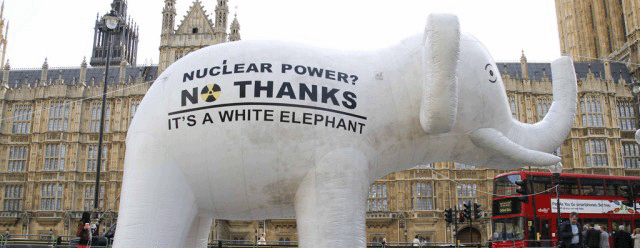
Jeremy Leggett: Why Are Nations Throwing Cash At Nuclear ‘White Elephants’? Impact4All.org, 14 June 18
In recent weeks we have seen evidence on the one hand of the fast advance of renewable energy, and on the other the incredible resilience of the energy-incumbency defence against that advance, including big oil and nuclear.
Celebrations of the fast growth of renewables I will leave to the inestimable REN21 report, published on 4 June. All clean-energy advocates should spend some time immersed in it, arming themselves with bullish ammunition. The point I want to make in this column is about the residual strength of the incumbency rearguard action.
In the last week of May and the first week of June the UK, US, and Canadian governments all tried to bail out uneconomic or stranded fossil fuel and nuclear projects with many billions in public funds. I have dubbed it “The Week of the White Elephants.”
First, the Canadian government bailed out a stranded Kinder Morgan oil pipeline system for US$3.5 bn. They hope to sell this, the Trans Mountain pipeline, in due course. Analysts doubt they can, so economically unattractive and risky is the proposition. In the interim, protestors have labelled Canadian
PM Justin Trudeau – who says he aspires to be a climate hero – a climate criminal.
Second, US President Donald Trump ordered emergency federal action to stem coal and nuclear plant shutdowns. Proposals in a leaked memo included forcing utilities to buy electricity from coal and nuclear operators for two years, despite the fact that renewables and gas are both better value. The Economist describes Trump’s gambit as follows: “The plan would benefit a handful of firms the president favours at the expense of consumers: it entails up to $12bn worth of ‘cash for cronies’.”
Third, in a remarkable U-turn, the UK government agreed to a £5bn injection of taxpayer money into a Welsh nuclear power station, Wylfa. The total cost, to be shared with Hitachi and Japanese government, is £16 bn. The price of power will be £75-77 MWh (they say). That is more than solar and wind.
These are all very strange things to do when you consider not just the economics but the general direction of travel in all relevant areas
……..As for the UK nuclear decision, in France nuclear regulators now fear an “epidemic” safety-culture collapse at Flamanville, the supposed precursor of the British Hinkley Point C reactor. 150 weld failures mean the nuclear plant scheduled online in 2012 at €3.5bn is now probably delayed to 2020, at €10.5bn and counting. This is not the same type of reactor that Hitachi intends for Wylfa, but the horror show at Flamanville shows how badly, and quickly, things can go wrong in modern nuclear.As the formerly pro-nuclear The Economist put it in 2016, in a analysis entitled “Hinkley Pointless”, “Britain should cancel its nuclear white elephant and spend the billions on making renewables work.”…….https://impact4all.org/jeremy-leggett-new-coal-and-nuclear-deals-show-power-of-incumbent-energy-players/
Federal Energy Regulatory Commission (FERC) rejected Trump Administration’s plan to rescue coal and nuclear industries
 Massive FERC Flop For Plan To Save Coal & Nuclear Power Plants, Clean Technica, June 13th, 2018 by Tina Casey
The Trump Administration has devised a new plan for saving the nation’s aging fleet of coal and nuclear power plants, but so far it has been going over like a lead balloon. At a Senate hearing yesterday, all five members of the Federal Energy Regulatory Commission gave it the thumbs down.
Wait — what? Did you really think there was a chance the plan get the seal of approval from any of the FERC commissioners? Come to think of it, maybe. After all, the FERC Chairman himself was appointed by President* Trump. So, what went wrong at yesterday’s hearing?
What’s The Plan, Stan?
The new plan leverages the Energy Department’s authority to keep the electricity flowing under the federal Power Act. Here’s an explainer from the agency (emphasis added because that’s the important bit):
Under FPA section 202(c) during the continuance of a war in which the United States is engaged or when an emergency exists by reason of a sudden increase in the demand for electric energy, or a shortage of electric energy, or of facilities for the generation or transmission of electric energy, or of the fuel or water for generating facilities, or other causes, the Secretary of Energy may require by order temporary connections of facilities, and generation, delivery, interchange, or transmission of electricity as the Secretary determines will best meet the emergency and serve the public interest.
Fair enough. The question is whether or not an emergency exists, and at yesterday’s hearing the FERC commissioners couldn’t find anything in that long list of section 202(c) emergencies that would apply to the nation’s fleet of coal and nuclear power plants.
Meet The New Plan, Same As The Old Plan
More to the point, November’s midterm Congressional elections are fast approaching, so anything that looks like a taxpayer bailout is doomed to fail.
CleanTechnica predicted as much in a piece published Monday morning, before yesterday’s Senate hearing got under way………https://cleantechnica.com/2018/06/13/massive-ferc-flop-for-plan-to-save-coal-nuclear-power-plants/
The nuclear power industry is dying under its own weight.New small nuclear reactors too costly, too late
 Nuclear Power Won’t Survive Without A Government Handout, Five Thirty Eight, By Maggie Koerth-Baker 14 June 18, Once upon a time, if you were an American who didn’t like nuclear energy, you had to stage sit-ins and marches and chain yourself to various inanimate objects in hopes of closing the nation’s nuclear power plants. Today … all you have to do is sit back and wait.
There are 99 nuclear reactors producing electricity in the United States today. Collectively, they’re responsible for producing about 20 percent of the electricity we use each year. But those reactors are, to put it delicately, of a certain age. The average age of a nuclear power plant in this country is 38 years old (compared with 24 years old for a natural gas power plant). Some are shutting down. New ones aren’t being built. And the ones still operational can’t compete with other sources of power on price. Just last week, several outlets reported on a leaked memo detailing a proposed Trump administration plan directing electric utilities to buy more from nuclear generators and coal plants in an effort to prop up the two struggling industries. The proposal is likely to butt up against political and legal opposition, even from within the electrical industry, in part because it would involve invoking Cold War-era emergency powers that constitute an unprecedented level of federal intervention in electricity markets. But without some type of public assistance, the nuclear industry is likely headed toward oblivion.
“Is [nuclear power] dying under its own weight? Yeah, probably,” said Granger Morgan, professor of engineering and public policy at Carnegie Mellon University.
……… it’s the cost of upkeep that’s prohibitive. Things do fall apart — especially things exposed to radiation on a daily basis. Maintenance and repair, upgrades and rejuvenation all take a lot of capital investment. And right now, that means spending lots of money on power plants that aren’t especially profitable…….
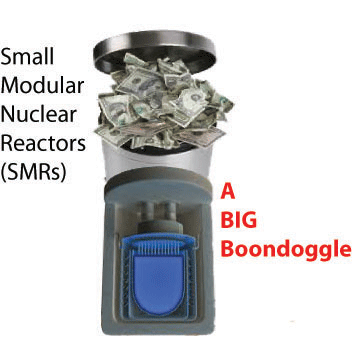 Morgan and other researchers are studying the economic feasibility of investment in newer kinds of nuclear power plants — including different ways of designing the mechanical systems of a reactor and building reactors that are smaller and could be put together on an assembly line. Currently, reactors must be custom-built to each site. Their research showed that new designs are unlikely to be commercially viable in time to seriously address climate change. And in a new study that has not yet been published, they found that the domestic U.S. market for nuclear power isn’t robust enough to justify the investments necessary to build a modular reactor industry. …….https://fivethirtyeight.com/features/nuclear-power-wont-survive-without-a-government-handout/
USA Federal nuclear weapons facilities are getting systems to disable drones
Federal nuclear weapons plants getting capability to disable drones,https://www.knoxnews.com/story/news/local/tennessee/2018/06/14/federal-nuclear-weapons-plants-getting-capability-disable-drones/702654002/
Economic realities point to a poor future for nuclear power
 High costs and renewables challenge the case for nuclear power, Economic risks of atomic plants threaten their place in future energy mix, Ft.com Sylvia Pfeifer, -14 June 18
The island of Anglesey, off the north-west coast of Wales, is famous for ancient sites and prehistoric ruins. If all goes to plan over the next few months, the island will make history again — this time as the scene of the next stage in the revival of the UK nuclear industry.
Britain has announced an outline agreement with Hitachi of Japan to build two reactors on the site. If a final deal is struck next year, the plant could be producing electricity by the mid-2020s.
The development, called Wylfa Newydd, would be only the second nuclear plant built in Britain for decades. Together with Hinkley Point C, the £20bn plant under construction in Somerset, in the south-west, by EDF of France, it would generate much-needed low-carbon electricity. They will help ensure the UK’s energy security as coal-fired power stations and ageing nuclear reactors close.
Their fate is also a wider test of the nuclear industry’s ability to compete at a time of rapid change in energy. The nuclear industry has been under threat since the disaster at the Fukushima plant in Japan in 2011 revived concerns about safety and prompted several developed countries, notably Germany, to phase out nuclear power.
The biggest danger to the industry however is that of spiralling costs. Given cheap and plentiful gas and the rise of renewable power whose costs are falling, many industry observers wonder how nuclear power can compete.
“We’ve seen a substantive decline in the share of nuclear of total electricity generation worldwide,” says Paul Dorfman, of the Energy Institute at University College London. “Increasing nuclear costs along with the technological advances and the plummeting price of renewables are the key dynamics, and there’s a clear trend emerging.”
……. competition from gas, wind and solar has grown, nuclear’s share of global electricity generation has declined to 11 per cent from a peak of 17 per cent in the mid-1990s. In its Energy Outlook report published in February, BP forecast that renewable energy would be the fastest-growing source of energy by 2040.
…… Rising costs remain the big challenge. A recent analysis of the history of reactors published in the journal Energy Policy concluded the following: nuclear power projects are more expensive than in the early 1980s; nuclear construction lead times have increased two-fold in the past 50 years; and the increase in complexity and risks of nuclear projects results in high financial costs.
“Nuclear projects are actually becoming more complex to carry out, inducing delays and higher costs,” says the study’s lead author, Joana Portugal Pereira, from the Centre for Environmental Policy at Imperial College London. “Safety and regulatory considerations play heavily into this, particularly in the wake of Fukushima.”
……. In the case of Wylfa Newydd, the government will consider attaching taxpayer funds to the construction of the site, but with the ambition of achieving a strike price for the electricity that will be about £15/MWh cheaper than for Hinkley.
Supporters of renewables point out that at about £77.50/MWh, this price is still higher than the £57.50/MWh allocated for UK offshore wind contracts last September. …….https://www.ft.com/content/21305834-5376-11e8-84f4-43d65af59d43
Centrica wants to sell its nuclear industry stake, but it’s hard to attract buyers
Centrica aims to sell UK nuclear stake by end of 2020 , Nasdaq, By Susanna Twidale, LONDON, June 14 (Reuters) – Centrica plans to sell its 20 percent stake in eight British power plants by the end of 2020, but has yet to start marketing the assets, the company’s CEO said on Thursday
France’s EDF owns the other 80 percent of the nuclear plants ……….
Analyst have said it could be difficult to attract buyers for the nuclear assets, with large financials shying away from nuclear investment and half of the plants expected to close in 2024.
Last week Britain said it would consider investing in a new plant to be built by Japanese company Hitachi in northern Wales, with private investors reluctant to take on the huge costs of new nuclear power infrastructure. https://www.nasdaq.com/article/centrica-aims-to-sell-uk-nuclear-stake-by-end-of-2020-20180614-00256
Fears in Isle of Man community over dangers of new Wylfa nuclear power station
Fears over new atomic plant Isle of Man Today, 14 June 18 The new secretary of the Mannin branch of the Celtic League is calling on the Manx government to oppose plans for a new nuclear power station on Anglesey.
Wylfa nuclear plant, located just 35 miles from the southern coast of the Isle of Man, closed in 2015 after more than 40 years of service.
Now the Westminster government has announced that public money will be invested into a multi-billion pound replacement…….
Allen Moore, who was appointed branch secretary of Celtic League Mannin last month and is also the organisation’s environmental officer, believes the Manx government should oppose the project.
He said: ’Opposition to the nuclear policies of the UK and French governments remains a core concern of the Celtic League. Those governments have built many of their nuclear power stations in or close to Celtic countries, and none more so than around the Irish Sea. It is to be hoped that the Manx Government does express concerns to the UK about the new Wylfa power station development. The MHKs were elected to represent us, after all.’
Mr Moore said we need to look after the environment to ensure that we survive, both here in the Isle of
Man and worldwide.
He explained: ’I was four months old at the time of the Windscale fire. If that had been even worse we wouldn’t have survived in the Isle of Man.
’At best, we would have had to be evacuated, and now the UK might be talking about the Windscale Generation as well as the Windrush Generation.
’There is a perception in some quarters that nuclear power produces clean energy and doesn’t cost much once the power station is built.
’However, as is being seen with the older generation nuclear power stations, decommissioning these plants is hugely expensive, including finding a safe way of disposing of and securing the radioactive material. What are we leaving future generations?’
The Manx government’s declared policy is to seek the complete closure of the Sellafield nuclear reprocessing plant and to oppose the operation of any nuclear facility which is the source of radioactive pollution.
The government laboratory conducts independent monitoring of environmental radioactivity levels in the Isle of Man.
Reports suggest estimated construction costs for Wylfa have risen from £10bn to as much as £20bn. The UK govt may cover a large proportion of that funding. http://www.iomtoday.co.im/article.cfm?id=41170&headline=Fears%20over%20new%20atomic%20plant§ionIs=NEWS&searchyear=2018
Natural Resources Defense Council warns against closing Hanford’s underground nuclear waste tanks
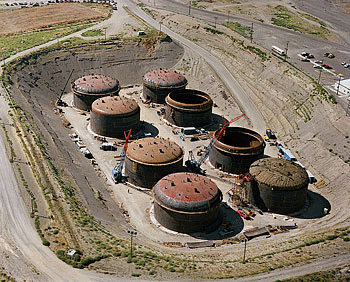 Hanford watchdog warns against closing underground tanks http://www.tri-cityherald.com/news/local/hanford/article212957659.html, BY ANNETTE CARY, acary@tricityherald.com, RICHLAND, WA , 14 June 18
A Hanford watchdog group is objecting as the Department of Energy takes the first step toward a plan to fill underground, radioactive waste storage tanks with concrete-like grout and leave them permanently in place. The C Tank Farm, which would be closed first, has not had enough radioactive waste removed to have tanks filled with grout, said Tom Carpenter, executive director of Seattle-based Hanford Challenge.
“This would be a serious setback for the cleanup at Hanford if the DOE is allowed to turn Hanford into the nation’s high-level nuclear waste dump,” Carpenter said. “This will be challenged.”
Geoffrey Fettus, a senior attorney at the Natural Resources Defense Council, said that “the people of the Pacific Northwest deserve better, and we’ll be there with them opposing this unsound and unsafe effort.”
Japan approves 70-year plan to scrap nuclear reprocessing plant
https://mainichi.jp/english/articles/20180613/p2g/00m/0dm/072000c
(Mainichi Japan) TOKYO (Kyodo) — Japan’s nuclear watchdog on Wednesday approved a plan to scrap a nuclear fuel reprocessing plant northeast of Tokyo over a 70-year period with the cost projected at 1 trillion yen ($9 billion).
The facility in Tokaimura, Ibaraki Prefecture went into operation in 1977. It was Japan’s first spent-fuel reprocessing plant built under the nation’s nuclear fuel cycle policy, which aims to reprocess all spent nuclear fuel in order to reuse the extracted plutonium and uranium as reactor fuel in the resource-scarce country.
But the policy has run into a dead end as the completion of a separate fuel reprocessing plant in Aomori Prefecture, built on the technological expertise of the Tokaimura plant, has been delayed by more than 20 years.
The decommissioning cost will be shouldered by taxpayers as the Japan Atomic Energy Agency operating the Tokaimura plant, is backed by the state. Where to store the waste accumulated at the plant is undecided.
In 2014, the agency decided to decommission the plant due to its aging and the huge cost to run it under stricter safety rules introduced after the 2011 Fukushima nuclear crisis.
According to the plan approved by the Nuclear Regulation Authority, around 310 canisters of highly radioactive vitrified waste and some 360 cubic meters of radioactive waste are currently stored at the facility.
About 770 billion yen is estimated for the disposal of such waste and decommissioning of the facility and roughly 217 billion yen for the 10-year preparation work.
1 This Month
Chernobyl: The Lost Tapes – A good documentary on Chernobyl on SBS available On Demand for the next 3 weeks– https://www.sbs.com.au/ondemand/tv-program/chernobyl-the-lost-tapes/2352741955560

of the week–London Campaign for Nuclear Disarmament

Tell the Ukrainian Government to Drop Prosecution of Peace Activist Yurii Sheliazhenko
To see nuclear-related stories in greater depth and intensity – go to https://nuclearinformation.wordpress.com
-
Archives
- April 2026 (139)
- March 2026 (251)
- February 2026 (268)
- January 2026 (308)
- December 2025 (358)
- November 2025 (359)
- October 2025 (376)
- September 2025 (257)
- August 2025 (319)
- July 2025 (230)
- June 2025 (348)
- May 2025 (261)
-
Categories
- 1
- 1 NUCLEAR ISSUES
- business and costs
- climate change
- culture and arts
- ENERGY
- environment
- health
- history
- indigenous issues
- Legal
- marketing of nuclear
- media
- opposition to nuclear
- PERSONAL STORIES
- politics
- politics international
- Religion and ethics
- safety
- secrets,lies and civil liberties
- spinbuster
- technology
- Uranium
- wastes
- weapons and war
- Women
- 2 WORLD
- ACTION
- AFRICA
- Atrocities
- AUSTRALIA
- Christina's notes
- Christina's themes
- culture and arts
- Events
- Fuk 2022
- Fuk 2023
- Fukushima 2017
- Fukushima 2018
- fukushima 2019
- Fukushima 2020
- Fukushima 2021
- general
- global warming
- Humour (God we need it)
- Nuclear
- RARE EARTHS
- Reference
- resources – print
- Resources -audiovicual
- Weekly Newsletter
- World
- World Nuclear
- YouTube
-
RSS
Entries RSS
Comments RSS
 nuclear-news