15th June Forum to discuss nuclear weapons travelling on A34 UK

http://www.oxfordmail.co.uk/news/16292903.Forum_to_discuss_nuclear_weapons_travelling_on_A34/
A FORUM to discuss nuclear transportation and how councils can deliver low carbon energy instead will be held in Oxford today.
The Nuclear Free Local Authorities organisation will hold its summer seminar on nuclear transports – as nuclear weapons currently travel up and down the A34 – nuclear transparency and promoting low carbon energy.
The local government voice on nuclear issues wants authorities to adopt anti-nuclear policies and encourage them to be part of a mixed energy supply over the next 40 years.
The city council’s NFLA representative, John Tanner, said: “I am thrilled that Nuclear Free Local Authorities are meeting in Oxford to discuss nuclear safety and local energy scheme.
“Lots of people don’t know that nuclear weapons regularly travel up and down the A34.”
He added: “It’s also important to remember that green energy, produced locally, can be a lot more economical than large-scale nuclear power.”
The forum will take place at Oxford Town Hall from 10.30am to 1pm.
Do Donald Trump and Rick Perry really know what they’re doing, with coal/nuclear bailout? It seems not
U.S. nuclear, coal plant bailout plan still being ‘fleshed out’: Perry, Reuters Staff BARILOCHE, Argentina (Reuters) 15 June 18 – A plan requested by U.S. President Donald Trump to prevent struggling nuclear and coal power plants from shutting is still being “fleshed out” by the U.S. Department of Energy (DOE) and the White House, Energy Secretary Rick Perry said on Friday.
Trump on June 1 directed Perry to take emergency steps to keep nuclear and coal plants running, in what would amount to an unprecedented intervention in U.S. power markets that has drawn backlash from environmentalists as well as oil, gas and renewable energy companies. ….He did not respond to questions on when the plan would be announced or its details. https://in.reuters.com/article/us-argentina-g20-energy-usa/u-s-nuclear-coal-plant-bailout-plan-still-being-fleshed-out-perry-idINKBN1JB23V?il=0
Robots the hope for cleaning up the world’s riskiest and massive nuclear waste storage pool, at Sellafield, UK.

Above – Sellafield’s massive Magnox nuclear waste storage pool
Only Cthulhu can solve Sellafield’s sludgy nuclear waste problem, Wired, , 14 June 18
Cleaning up Sellafield’s nuclear waste costs £1.9 billion a year. To help with the toxic task, robots are evolving fast. Sellafield has been called the most dangerous place in the UK, the most hazardous place in Europe and the world’s riskiest nuclear waste site. At its heart is a giant pond full of radioactive sludge, strewn with broken metal, dead animals and deadly nuclear rods. The solution to clearing up Sellafield’s nuclear waste and retrieving the missing nuclear fuel? Robots, of course. And to tackle this mammoth task, the robots are being forced to evolve.
Sellafield’s First-Generation Magnox Storage Pond is a giant outdoor body of water that’s the same size as two Olympic swimming pools. It was built in the 1960s to store used fuel rods from the early Magnox reactors – which had magnesium alloy cladding on the fuel rods – as part of Britain’s booming nuclear program. In 1974, there was a delay in reprocessing; fuel rods started corroding and the pond became murky. The pool was active for 26 years until 1992 and is now finally being decommissioned as part of the £1.9 billion spent each year on Sellafield’s mammoth cleanup operation.
The pond contains about six metres of radioactive water and half a metre of sludge, composed of wind-blown dirt, bird droppings and algae – the usual debris that builds up in any open body of water. Unlike other mud, it conceals everything from dropped tools and bird carcasses to corroded Magnox cladding and the remains of uranium fuel rods.
A number of robotic creations have bee used to get to the bottom of the pool’s sludge but struggle to break through the hostile environment. Tethered swimming robots do not have the sensors to find objects in the fine mud, and lack the leverage to lift chunks of metal. Experience at Fukushima has shown robots that are not well adapted to the environment are a waste of time.
Enter Cthulhu, a tracked robot that can drive along the pond bed, feeling its way with tactile sensors and sonar. The robot, which is currently in development, is approaching Sellafield’s problem differently. The robot will be able to identify nuclear rods and then pick them up. “Rather than trying to mimic a human, we’re building a robot that can do things humans can’t do with senses that humans don’t have,” says Bob Hicks of QinetiQ, which is leading the project.
The name stands for ‘Collaborative Technology Hardened for Underwater and Littoral Hazardous Environment,’ but it’s also a nod to Cthulhu, the godlike alien created by HP Lovecraft: both are amphibious, dwell in strange surroundings, and have sensory feelers. “Much like a walrus detecting molluscs, we hope to be able to detect and identify objects in the sludge with the whiskers,” says Plamen Angelov of Lancaster University’s School of Computing and Communications.
QinetiQ is supplying the tracked body, originally from a bomb disposal robot, and Bristol Maritime Robotics is developing the tactile sensors, while Angelov’s team is providing the neural network AI. It is planned the robot will use deep learning to fuse tactile and sonar data into a single picture of the world. Existing neural networks can handle video data, and ‘image classifiers’ to distinguish objects are well-established. But nobody has tried to fuse data from different types of sensor before.
Cthulhu’s classifier will learn to divide objects into ‘fuel rods’ and ‘everything else’………
The work at Sellafield is due to take several decades to complete fully. Nuclear waste is spread through several buildings in a variety of silos and pools. Each has its own challenges for cleaning-up. For the First Generation Magnox Pond, documents from the government show all the bulk fuel should be removed by the early 2030s. http://www.wired.co.uk/article/sellafield-nuclear-robots-cleanup-waste
U.S. Navy Will Retest Hunters Point Shipyard for Radiation
Navy Releases Plan to Retest Hunters Point Shipyard for Radiation
Officials encourage members of the public to comment on the first of its work plans to collect new radiological data at the shipyard. NBC Bay Area By Liz Wagner and Rachel Witte, 16 June 18
The Navy released the first of its work plans on Friday to retest the Hunters Point Naval Shipyard for radiation after it found workers from Tetra Tech, the contractor it hired to identify and remediate contamination, likely falsified part of the cleanup.
Earlier this year Navy officials determined they needed to redo Tetra Tech’s radiological work to be sure the shipyard is clean.
…….. San Francisco supervisor Malia Cohen announced Friday morning that the Navy has also agreed to test another parcel at Hunters Point, Parcel A, for hazardous material. Parcel A is a section of the shipyard where people are already living in new condos……….
Two former Tetra Tech employees were sentenced to prison last month for falsifying radiation data. The company acknowledged the falsification of those records, but stands by its work at the shipyard before and since that time. ……
Absent from any oversight plans are local community members. For years the environmental justice group Greenaction has been calling on a comprehensive community engaged cleanup. While the Navy plans to continue to hold community meetings on the status of the shipyard cleanup, officials said they have no plans for a community oversight board.
The Navy is encouraging members of the public to review and comment on the Parcel G work plan until August 14. The document is available to view online here, or in person at the San Francisco Main Library on the 5th Floor Government Center at 100 Larkin Street or at The Shipyard Site Trailer at 690 Hudson Avenue. Written comments can be emailed to Derek Robinson at derek.j.robinson1@navy.mil. https://www.nbcbayarea.com/news/local/Navy-Releases-Plan-to-Retest-Hunters-Point-Shipyard-for-Radiation-485617081.html
The Financial Times launching a new guide to the “energy transition
FT 15th June 2018 , The Financial Times has launched a new guide to the “energy transition” –
the long-term restructuring of the energy system away from fossil fuels and
towards renewables. In the first of six instalments, the FT delves into the
role of the energy producers, examining “how new technologies and
environmental concerns are transforming the energy mix across the world’.
The guide includes articles on how coal is fading in the developed world
but is far from dead in Asia, why renewables and high costs are challenging
the case for nuclear power, and how natural gas is vying for a big role in
the shift to low-carbon economy. The next instalment, on the role of
citizens, will be published on 31 July.
https://www.ft.com/reports/energy-transition-guide
Accelerating Sea Level Rise is Being Driven by Rapidly Increasing Melt From Greenland and Antarctica

From 1993 to the present day, global sea level rise has accelerated by 50 percent. And the primary cause, according to recent research, is that land glaciers such as the massive ice sheets of Greenland and Antarctica are melting far faster than they have in the past.
(Assessment of factors involved in the presently increasing rate of global sea level rise.)
Antarctica, in particular, is melting much more rapidly — with melt rates tripling in just the last ten years.
The primary factors contributing to global sea level rise include thermally expanding oceans and the melting of ice on land. During the decade of 1993 to 2004, the World Meteorological Organization notes that oceans rose by 2.7 mm per year. During this time, land ice sheets amounted to 47 percent of that rise — or about 1.35 mm. The same report found that from 2004 to 2015, oceans…
View original post 224 more words
Arctic Sea Ice at 4th Lowest Extent on Record
Warmer than normal conditions, abnormal wide areas of open water, large wildfires burning near Arctic Ocean shores, and Arctic sea ice extents at 4th lowest on record. That’s the present reality of a human-warmed Arctic environment.
(An assessment of present Arctic conditions)
With Arctic temperatures hovering around 1.6 degrees Celsius above average and focusing on a rather hot zone near Central Siberia, Arctic sea ice on the Siberian side is experiencing widespread melt ponding. In addition, a large area of open water is expanding through the Laptev Sea due to warm southerly winds and much warmer than normal temperatures.
Overall, temperatures in this Central Siberian zone will range as high as 25 degrees Celsius (45 F) above average today. With some areas hitting has high as 85-90 (F). Near these much warmer than normal temperatures, a series of large wildfires are burning. Fires so far north are historically…
View original post 112 more words
June 15 Energy News

Opinion:
¶ “NRDC, 19 Other Groups Challenge EU’s Mistaken Climate Decision” • EU policymakers agreed on a new Renewable Energy Directive that failed to fix Europe’s broken bioenergy policies. The decision to continue to label the indiscriminate burning of wood as “carbon neutral” undercuts the EU’s climate targets. [Natural Resources Defense Council]
 Clearcut forest (MO Stevens, Wikimedia Commons)
¶ “Nuclear Power Won’t Survive Without A Government Handout” • Once upon a time, if you were an American who didn’t like nuclear energy, you had to stage sit-ins and marches and chain yourself to various inanimate objects in hopes of closing the nation’s nuclear power plants. Today, all you have to do is sit back and wait. [FiveThirtyEight]
Science and Technology:
¶ The world’s system for allocating fish stocks is being outpaced by the movement of fish species in response to climate change, according to a…
View original post 736 more words
Bulletin of the Atomic Scientists hopes for some SUBSTANCE and scientific expertise in USA- North Korea nuclear negotiations
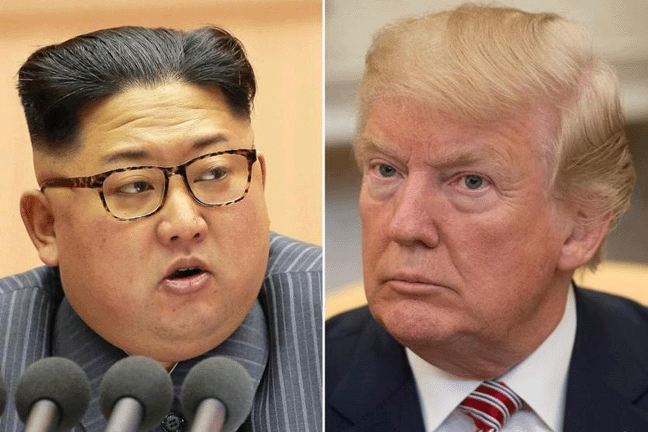 Now, it’s time to deliver https://thebulletin.org/now-its-time-deliver11916?utm_source=Bulletin%20Newsletter&utm_medium=iContact%20email&utm_campaign=June15 A Bulletin editorial
Tough sanctions will remain on North Korea until its complete denuclearisation – says USA
 Pompeo says North Korea sanctions to remain until complete denuclearisation, Reuters, Christine Kim, Michael Martina– 14 June 18, SEOUL/BEIJING – Tough sanctions will remain on North Korea until its complete denuclearisation, the U.S. secretary of state said on Thursday, apparently contradicting the North’s view that the process agreed at this week’s summit would be phased and reciprocal.
U.S. President Donald Trump and North Korean leader Kim Jong Un issued a joint statement after their meeting in Singapore this week that reaffirmed the North’s commitment to “work toward complete denuclearisation of the Korean peninsula”, while Trump “committed to provide security guarantees”.
Trump later told a news conference he would end joint U.S.-South Korean military exercises.
“President Trump has been incredibly clear about the sequencing of denuclearisation and relief from the sanctions,” Secretary of State Mike Pompeo told reporters after meeting South Korea’s president and Japan’s foreign minister in Seoul.
“We are going to get complete denuclearisation; only then will there be relief from the sanctions,” he said.
North Korean state media reported on Wednesday that Kim and Trump had recognized the principle of “step-by-step and simultaneous action” to achieve peace and denuclearisation on the Korean peninsula.
The summit statement provided no details on when North Korea would give up its nuclear weapons program or how the dismantling might be verified.
Skeptics of how much the meeting achieved pointed to the North Korean leadership’s long-held view that nuclear weapons are a bulwark against what it fears are U.S. plans to overthrow it and unite the Korean peninsula.
……. Kim understood getting rid of his nuclear arsenal needed to be done quickly and there would only be relief from stringent U.N. sanctions on North Korea after its “complete denuclearisation”, Pompeo said.
Moon later said South Korea would be flexible when it comes to military pressure on North Korea if it is sincere about denuclearisation.
Also on Thursday, North and South Korea held their first military talks in more than a decade. The talks followed on from an inter-Korean summit in April at which Moon and Kim agreed to defuse tension and cease “hostile acts”.
Speaking later in the day in Beijing, Pompeo said China, Japan and South Korea all acknowledged a corner had been turned on the Korean peninsula issue, but that all three had also acknowledged sanctions remain in place until denuclearisation is complete.
…… we have made very clear that the sanctions and the economic relief that North Korea will receive will only happen after the full denuclearisation, the complete denuclearisation of North Korea.” https://www.reuters.com/article/us-northkorea-usa/pompeo-says-north-korea-sanctions-to-remain-until-complete-denuclearization-idUSKBN1JA07O
Safety measure for World Cup – Russia halts nuclear waste transport
World Cup puts break on nuclear transport, A load of containers with spent nuclear fuel from Andreeva Bay on the Kola Peninsula will have to wait because of a general ban on transport of dangerous goods in Russia during the Football World Cup. https://thebarentsobserver.com/en/ecology/2018/06/world-cup-puts-break-nuclear-transport Thomas Nilsen, 14 June 18, June 14, 2018
Russia puts priority to safety and doesn’t want any potential lethal substances moving around during the four weeks with World Cup when tens of thousands of football fans are commuting by railway to different cities.
 In the north, the ban now delays a shipment of nuclear waste that otherwise would be on its way to Mayak north of Chelyabinsk in the South Urals.
Head of Rosatom State Nuclear Corporation’s international technical assistance project, Anatoly Grigoryev, says three railway sets already have departed to Mayak this year. «The fourth is ready, but we can’t send it because transport of dangerous goods during the World Cup is prohibited,» Grigoriyev says to Interfax in an interview reposted by Rosatom.
From Andreeva Bay near Russia’s border to Norway, the containers with old uranium fuel from Cold War submarines are shipped to Murmansk, where they are loaded over to a set of special rail-wagons. From Murmansk, the train follows Russia’s railway lines south through Karelia towards St. Petersburg and Yaroslav before heading east towards the Urals, a distance of more than 1,600 kilometers.
Mayak reprocessing plant is located between the cities of Chelyabinsk and Yekaterinburg. The last is one of the cities where football matches will be played.
Anatoly Grigoryev assures that the load of nuclear waste containers from the Murmansk region will be shipped to Mayak as soon as the World Cup is over by mid-July.
Last June, a top brass of Russian and Norwegian politicians, diplomates and nuclear safety experts cheered and waved as the first load of containers set out to sea from Andreeva Bay. Since the 1990s, Norway has spent tens of millions of euros to support preparing for the nuclear waste removal from the site to start.
In Murmansk, nuclear safety expert with the Bellona Foundation, Andrey Zolotkov, says this is the first time to his knowledge transport of nuclear waste has been put on break for such reason as a international tournament.
«I don’t recall any such thing. This is most likely due to keeping the railway routes free from such cargos because of all the [football] fans on the move,» Zolotkov says to the Barents Observer. Additional to Bellona, Zolotkov has for many years been working on board the Russian nuclear icebreaker fleet’s transport- and storage vessel «Imandra».
From Murmansk, the nuclear waste cargo-train follows the same tracks, and through the same big cities, as ordinary passenger trains.
«After all, we are just talking about a one month delay,» Andrey Zolotkov explains pointing to the many-years it will take to remove all spent nuclear fuel elements from Andreeva Bay.
A total of about 22,000 such uranium fuel elements where stored in three rundown concrete tanks. That is equal to about 100 submarine reactor cores.
Anatoly Grigoryev with Rosatom estimates it will take about 10 years to remove it all from the Kola Peninsula to the Mayak plant.
Completely ignored in nuclear summit talks – the forgotten North Korean victims of 1945 atomic bombs
 Trump–Kim: an agenda for forgotten nuclear victims, ps://www.lowyinstitute.org/the-interpreter/trump-kim-agenda-forgotten-nuclear-victimsThe Interpreter, BY Lauren Richardson, @Lauren_ANU 14 June 18
Like most Korea observers, in the lead-up to the Trump–Kim summit I have been inundated with questions from journalists and friends alike. Does Kim Jong-un have any actual intention to denuclearise? Would Donald Trump settle for anything less than complete, verifiable, irreversible disarmament (CVID) of North Korea’s nuclear program? Will North Korea’s human rights abuses be on the agenda? And, in that vein, will Trump raise the issue of North Korean abductions of Japanese citizens?
There is, however, one question that no one is asking. And it is a crucial one.
What about the North Korean A-bomb victims, the only survivors of the US nuclear attacks on Japan, who have never had recourse to monetary redress? Will they be on the summit agenda?
The absence of this question in the summit discussions is unsurprising. North Koreans are the forgotten victims of the atomic bombs and represent a gap in global memory of nuclear issues. It is not commonly known that when the US dropped atomic bombs over Nagasaki and Hiroshima in August 1945, roughly 10% of the victims of these attacks were of Korean descent.
Koreans were residing in the A-bomb target cities in large numbers under colonial auspices: in many cases they had been brought there against their will, forced to perform labour in Japan’s military industrial factories.
And it is a virtually unknown fact that when Koreans were repatriated to their newly divided homeland in the years following Japan’s surrender, approximately 2000 of the A-bomb survivors wound up north of the 38th parallel, suffering from the unrelenting effects of the radiation blast. Many of them are still alive and ailing today. In a further twist of fate, owing to the lack of diplomatic relations between Pyongyang and Tokyo, North Korean victims were precluded from financial assistance provided by the Japanese government to overseas A-bomb survivors, including South Koreans, in later decades. This was premised on a belief that “the money would likely never reach them”.
The plight of the North Koreans would never have come to light at all were it not for an activist named Lee Sil-gun. I have sat with Lee in Hiroshima on a number of occasions to interview him about his advocacy efforts. He was born in Japan in 1929 to Korean parents, and became an atomic bomb victim by virtue of exposure to residual radiation in Hiroshima.
In the post-war years, as the plight of A-bomb victims became politicised in Japan and the redress movement launched by South Korean victims gradually gained traction, he was dismayed to find that the voiceless North Koreans had been left out of the discourse:
I knew that there were victims in the North because I farewelled them at the port when they were shipped off from Japan after the Second World War.
Lee began embarking on annual visits to Pyongyang in the 1990s in an attempt to reach out to the victims there. He was supported in this endeavour by a small group of dedicated Japanese anti-nuclear activists.
They found the North Koreans in a terrible predicament: without recourse to adequate medical care, the victims were resorting to various primitive methods to treat their radiation-related maladies. They were burning sulphur, for instance, and using the smoke to sterilise recurrent wounds.
On discovering this, Lee and his supporters arranged a dispatch of Japanese medical practitioners to the DPRK to train local doctors in the treatment of A-bomb illness; they then organised a converse delegation of victims and doctors from North Korea to Japan, to respectively undergo treatment and be familiarised with advanced medical equipment.
North Korean officials were appreciative of and inspired by Lee’s efforts, and in 1997 issued him with an astonishing request. They asked Lee if he would organise a photo exhibition in North Korea depicting the destructive impact of nuclear weapons. Lee happily obliged, and this exhibit came to fruition two years later: 77 photos were displayed in the Grand People’s Study House in central Pyongyang from 13–18 August 1999.
I found a newspaper article about this event in an archive in Seoul. When I asked Lee how he managed to pull it off, he became choked with emotion. Through tears, he said:
I went to the Hiroshima Peace Memorial Museum and asked if I could borrow some of their posters and photos. At first they were reluctant, but eventually they let them have them for a month. I was so happy.
Four reasons make plain why this issue should be part of the Trump–Kim summit and any ongoing US–DPRK talks.
First, for Trump to acknowledge North Korea’s long-ailing A-bomb victims would be the best way to set the scene for talks on denuclearisation. Consider Barack Obama’s playbook, for instance. When he made an historic visit to the Hiroshima Peace Memorial in 2016, paying homage to the nuclear victims, it did wonders for US–Japan relations. Paying tribute to the North Korean victims at the summit would serve to frame the negotiations in such a way that Pyongyang was not the only party with adverse nuclear potential at the table.
Second, the issue of North Korean A-bomb victims would be a reminder that the devastating potential of nuclear weapons is embedded in the memory of North Korea. This should factor into Trump’s strategic calculus of Kim’s intentions for his nuclear program.
To be sure, Kim is young and did not experience first-hand the turmoil in Northeast in the aftermath of the US atomic bombings. But his grandfather did. And his own father permitted the efforts of activists from Japan to advocate on behalf of North Korean A-bomb victims – the same victims that live among Kim Jong-un’s populace today. Thus, if Trump does not manage to achieve the grand CVID bargain that he hopes for at the summit, he shouldn’t jump to the conclusion that Kim intends to use his nukes in the near future.
Third, any settlement regarding the “denuclearisation” of the Korean Peninsula should reasonably entail the establishment of a specialist treatment facility for A-bomb victims in the North. Two years ago, I visited a nursing home that offers round-the-clock treatment to the South Korean victims in Hapcheon County; the patients reported to me that they were still having tiny shards of glass surgically removed from their faces all these decades down the track.
While I don’t wish to suggest that the South Koreans are better off – in fact, they are still suffering immensely – the North Koreans have been left without any such facility. If the 1945 chapter of nuclear history has still not been settled, how can we expect to settle the current one with North Korea?
Lastly, raising the North Korean A-bomb victims issue would serve as a stark reminder at the summit that there is still only one government that has deployed nuclear weapons in conflict, and it is not Pyongyang. To the contrary, (the now) North and South Koreans were the collateral damage of that historic conflict, and many are still awaiting redress.
* This piece is based on a forthcoming journal article.
Huge USA weapons purchase by Saudi Arabia was on condition that USA would KILL THE IRAN NUCLEAR AGREEMENT!

 US Promised Saudis to ‘Kill Iran Nuclear Deal’ – Analyst Sputnik News, 14 June18 Saudi Arabia made its defense cooperation with the US conditional on Washington exiting the 2015 nuclear deal with Iran, the founder of the Ibero-Persia consultancy firm has said.
“The large-scale US arms supplies to Saudi Arabia in May 2017 made it perfectly clear that the sanctions against Iran were coming back and the nuclear deal was dead,” Sharoj Habibi claimed in an interview with Sputnik Mundo.
According to Habibi, the contract for the delivery of delivery of $350 billion worth of US-made THAAD air defense missile systems to Riyadh was negotiated, among others, by President Trump’s son-in-law Jared Kushner.
“Obviously, if you let your son-in-law clinch such a deal, this big-time operation is bound to offer very lucrative bonuses,” Habibi noted adding that the Trump family could have earned a very comfortable, though undisclosed, commission from the deal.
He alleged that as part of the contract, the US authorities “promised to do everything possible to kill the nuclear agreement with Tehran, which made it possible for Iran to economically outpace Saudi Arabia and develop its gas producing sector. Iranian gas would effectively sideline America’s Middle Eastern ally, Saudi Arabia,” the expert said.
He added that because Riyadh’s ultimate goal is to ”control everything that is happening in the Middle East,” it needs to bring the US into play. With Donald Trump’s arrival inat the White House, he continued, the Saudis jumped on the occasion.
“Therefore, instead of calling Trump crazy or dumb, I would say that he is an unscrupulous or ruthless businessman,” Habibi noted.
During his May 2016 official visit to Saudi Arabia, President Trump signed off on a historic arms delivery deal with Riyadh to the tune of up to $350 billion.
Washington sees the agreement as a means of boosting the Gulf kingdom’s defense capabilities and supporting its efforts to counter terrorist groups operating in the region
In North Korea, Kim Jong Un is seen as the tough winner, in Singapore nuclear summit
 North Korea’s view of negotiations with Trump: Kim was the tough one. SMH, By Kirsty Needham, 13 June 18, Singapore: A day after Donald Trump gave the world his version of the historic talks with Kim Jong-un, North Korean media has provided the view of the other person in the room.
Trump spoke casually at a press conference about ending US “war games” with South Korea, but the North Korean state news agency KCNA highlighted it as a win for Kim. The news agency said the halt to joint military exercises would continue while the US and North Korea undertook “goodwill dialogue”.
North Korea also highlighted Trump’s offer of security guarantees and a lifting of economic sanctions as negotiations advance and the mutual relationship improves.
Kim underlined Trump’s “bold decision on halting irritating and hostile military actions”, which, according to KCNA, came after Kim told Trump the two sides should stop antagonising one another.
An end to the “war games” was not in the letter signed by the two men after negotiations ended on Tuesday. The militaries of South Korea and the US also revealed they had not been informed of the move before Trump made his televised comments.
KCNA reported that Kim had won support from Trump for “the principle of step-by-step and simultaneous action in achieving peace”.
“Kim Jong-un clarified the stand that if the US side takes genuine measures for building trust in order to improve the DPRK-US relationship, the DPRK, too, can continue to take additional goodwill measures of the next stage commensurate with them,” said the KCNA report.
This means the US must offer concessions before it will see further steps from North Korea. The need for “simultaneous” action may be the reason nothing more concrete was signed at the summit, and why there was as yet no agreement for a peace treaty to end the Korean War, despite high expectations.
The version presented to the North Korean public in some ways presents a mirror image of US Secretary of State Mike Pompeo’s depiction of the US side as tough negotiators who were unwilling to budge on the demand for complete, verifiable and irreversible denuclearisation by North
Korea.
The North Korean media nonetheless trumpeted the improved rapport between the two sides and friendly atmospherics of the meeting.
…….China also welcomed the end of war games, with foreign ministry spokesman Geng Shuang saying the halt to military exercises was an endorsement of China’s roadmap for peace on the Korean Peninsula.
“The facts have proven that the China-proposed ‘suspension for suspension’ initiative has been materialised … The DPRK-US summit is what China has been looking forward to and striving for all along,” Geng said.https://www.smh.com.au/world/asia/kim-jong-un-the-tough-negotiator-with-trump-says-north-korean-media-20180613-p4zl8s.html
The huge danger to Americans of keeping hundreds of nuclear weapons on hair-trigger alert

The US still keeps hundreds of nuclear weapons on hair-trigger alert — here’s what it means and why it’s a huge risk https://www.businessinsider.com.au/trump-kim-nuclear-summit-hair-trigger-alert-2018-6?r=US&IR=T, LEANNA GARFIELD
1 This Month
Chernobyl: The Lost Tapes – A good documentary on Chernobyl on SBS available On Demand for the next 3 weeks– https://www.sbs.com.au/ondemand/tv-program/chernobyl-the-lost-tapes/2352741955560

of the week–London Campaign for Nuclear Disarmament

Tell the Ukrainian Government to Drop Prosecution of Peace Activist Yurii Sheliazhenko
To see nuclear-related stories in greater depth and intensity – go to https://nuclearinformation.wordpress.com
-
Archives
- April 2026 (139)
- March 2026 (251)
- February 2026 (268)
- January 2026 (308)
- December 2025 (358)
- November 2025 (359)
- October 2025 (376)
- September 2025 (257)
- August 2025 (319)
- July 2025 (230)
- June 2025 (348)
- May 2025 (261)
-
Categories
- 1
- 1 NUCLEAR ISSUES
- business and costs
- climate change
- culture and arts
- ENERGY
- environment
- health
- history
- indigenous issues
- Legal
- marketing of nuclear
- media
- opposition to nuclear
- PERSONAL STORIES
- politics
- politics international
- Religion and ethics
- safety
- secrets,lies and civil liberties
- spinbuster
- technology
- Uranium
- wastes
- weapons and war
- Women
- 2 WORLD
- ACTION
- AFRICA
- Atrocities
- AUSTRALIA
- Christina's notes
- Christina's themes
- culture and arts
- Events
- Fuk 2022
- Fuk 2023
- Fukushima 2017
- Fukushima 2018
- fukushima 2019
- Fukushima 2020
- Fukushima 2021
- general
- global warming
- Humour (God we need it)
- Nuclear
- RARE EARTHS
- Reference
- resources – print
- Resources -audiovicual
- Weekly Newsletter
- World
- World Nuclear
- YouTube
-
RSS
Entries RSS
Comments RSS
 nuclear-news
