Four nationally known scientists are recommending new testing at a popular Los Angeles-area Jewish camp to determine if contaminants at a nearby former nuclear testing site have posed health risks to past and current campers, NBC Los Angeles reported.
The scientists independently reached that conclusion after reviewing various reports of past testing at Camp Alonim and the land it sits on, the Brandeis-Bardin campus, owned by the American Jewish University. The camp is located just below Santa Susana Field Laboratory, which for decades hosted rocket and experimental nuclear reactor testing. The laboratory has long been closed but is still awaiting a full cleanup, according to NBC. Both AJU and state toxics regulators say the land is safe.
“If you looked at this historically and said, ‘Could being at the camp have led to radiation exposure’ the answer is yes,” said Dr. Jonathan Samet, an internationally known radiation expert and dean of the Colorado School of Public Health, one of the scientists interviewed.
Among the key findings from the two-year investigation are that the test results cited by the camp and state regulators are either too old or too inconclusive to definitely say whether children are safe from contamination from the Field Lab. The article also claimed a 2016 study paid for by the camp’s owner, to investigate concerns about contamination, is flawed. AJU also says the camp has no history of growing food for children to eat in the potentially toxic soil, a claim challenged by past staff.
The article originally was planned to appear in the Los Angeles Jewish Journal, but according to NBC, the Jewish Journal’s new publisher declined to publish the story.
‘Vague assurances’ on post-Brexit nuclear safety ‘not worth much’
Fianna Fáil expresses concerns about Britain’s capacity to maintain standards, Brian Hutton
Britain’s energy minister has written personally to Minister for Environment Denis Naughten offering “significant assurances” there would be no threat to Ireland from any changes in nuclear safety standards after Brexit.
The UK is planning to pull out of Euratom, the body which regulates the nuclear industry across Europe, including the safe transport of radioactive materials across borders, after it leaves the EU next March.
Although the watchdog is legally separate from the bloc, membership requires being subject to the jurisdiction of the European Court of Justice, which British prime minister Theresa May’s government is opposed to.
Leaked documents last month show Britain is missing deadlines for putting post-Brexit nuclear safeguards in place, including the delivery of an IT system to track nuclear material and the recruitment of qualified inspectors.
The UK’s Office for Nuclear Regulation has identified five “high-level risks” – categorised as “red” on a red, amber, green alert scale – that remain outstanding………
Earlier this year, Environmental Pillar, a coalition of 26 environmental organisations in Ireland, warned of “alarming deficiencies” in the UK’s approach to assessing impacts of plans to expand its nuclear power programme.
Australian mining companies have a poor track record operating in Africa. Australian uranium company Paladin Energy has now put two of its mines into ‘care-and-maintenance’ and bankruptcy looms. But who cleans up the company’s mess in Namibia and Malawi, asks JIM GREEN
Many Australian mining projects in Africa are outposts of good governance – this is what Julie Bishop, the country’s Foreign Minister, told the Africa Down Under mining conference in Western Australia in September 2017. The Australian government “encourages the people of Africa to see us as an open-cut mine for lessons-learned, for skills, for innovation and, I would like to think, inspiration,” the minister said.
But such claims sit uneasily with the highly critical findings arising from a detailed investigation by the International Consortium of Independent Journalists (ICIJ). The ICIJ noted in a 2015 report that since 2004, more than 380 people have died in mining accidents or in off-site skirmishes connected to Australian mining companies in Africa.
The ICIJ report further stated: “Multiple Australian mining companies are accused of negligence, unfair dismissal, violence and environmental law-breaking across Africa, according to legal filings and community petitions gathered from South Africa, Botswana, Tanzania, Zambia, Madagascar, Malawi, Mali, Cote d’Ivoire, Senegal and Ghana.”
Paladin Energy’s Kayelekera uranium mine in Malawi provides a case study of the problems with Australian mining companies in Africa. Western Australia-based Paladin exploited Malawi’s poverty to secure numerous reductions and exemptions from payments normally required by foreign investors.
United Nations’ Special Rapporteur Olivier De Schutter noted in a 2013 report that “revenue losses from special incentives given to Australian mining company Paladin Energy, which manages the Kayelekera uranium mine, are estimated to amount to at least US$205 million (MWK 67 billion) and could be up to US$281 million (MWK 92 billion) over the 13-year lifespan of the mine.”
Standards at Kayelekera fall a long way short of Australian standards ‒ and efforts to force Australian mining companies to meet Australian standards when operating abroad have been strongly resisted. The Kayelekera project would not be approved in Australia due to major flaws in the assessment and design proposals, independent consultants concluded.
Care-and-maintenance
Kayelekera was put into care-and-maintenance in May 2014, another victim of the uranium industry’s post-Fukushima meltdown. And just last month, Paladin announced that its only other operating mine ‒ the Langer Heinrich mine (LHM) in Namibia ‒ will be put into care-and-maintenance.
Perhaps the most striking aspect of the decision to mothball LHM is that Paladin claims it is the lowest cost open-pit uranium mine in the world. Moreover, the company wasn’t even paying to mine ore ‒ mining ceased in November 2016 and since then ore stockpiles have been processed. Thus a low-cost mine can’t even turn a profit processing mined stockpiles.
The cost of production was US$23.11 / lb uranium oxide in December 2017, and the average realised sale price in the second half of 2017 was $21.82.
Anticipating the decision to mothball LHM, Paladin Energy CEO Alex Molyneux said in late-April: “The uranium market has failed to recover since the Fukushima incident in 2011, with the average spot price so far in 2018 the lowest in 15 years. It’s deeply distressing to have to consider suspending operations at LHM because of the consequences for our employees, and the broader community. However, as there has yet to be a sustainable recovery in the uranium market, and with the aim of preserving maximum long-term value for all stakeholders, it is clearly prudent to consider these difficult actions.”
Paladin hopes to resume mining at LHM and Kayelekera following “normalization” of the uranium market, which it anticipates in the next few years. But with no operating mines, Paladin may not survive for long enough to witness a market upswing.
Paladin was placed into the hands of administrators in July 2017 as it was unable to pay French utility EDF a US$277 million debt.
In January 2018, Paladin’s administrator KPMG noted that an Independent Expert’s Report found that the company’s net debt materially exceeds the value of its assets, its shares have nil value, and if Paladin was placed into liquidation there would be no return to shareholders.
The company was restructured, with Deutsche Bank now the largest shareholder, and relisted on the Australian Securities Exchange in February 2018.
Perhaps LHM will be sold for a song, either before or after Paladin goes bankrupt. A subsidiary of China National Nuclear Corporation (CNNC) has held a 25 percent stake in LHM since January 2014. Last year, the CNNC subsidiary considered exercising its contractual right to buy Paladin’s 75 percent stake in LHM, but chose not to exercise that right following an independent valuation of US$162 million for Paladin’s stake.
Mine-site rehabilitation
Paladin hopes to resume mining following “normalization” of the uranium market ‒ but low prices could be the new normal. Former World Nuclear Association executive Steve Kidd said in May 2014 that the industry is set for “a long period of relatively low prices”. Prices were far higher in 2014 than over the past twelve months. Paladin’s CEO Alexander Molyneux said that “it has never been a worse time for uranium miners” in 2016 and the situation has worsened since then for the industry ‒ prices have fallen further still.
Sooner or later ‒ probably sooner ‒ both the LHM and Kayelekera mine-sites will need to be rehabilitated. Yet it is extremely doubtful whether Paladin has set aside adequate funds for rehabilitation. Paladin’s 2017 Annual Report lists a ‘rehabilitation provision‘ of US$86.93 million to cover both LHM and Kayelekera.
One problem is that the funds might not be available for rehabilitation if Paladin goes bankrupt. A second problem is that even if the funds are available, they are unlikely to be sufficient.
For comparison, Energy Resources of Australia’s provision for rehabilitation of the Ranger uranium mine in Australia ‒ also an open-pit uranium mine, like LHM and Kayelekera ‒ is US$403 million (A$526 million). That figure is additional to US$346 million (A$452 million) already spent on water and rehabilitation activities since 2012 ‒ thus total rehabilitation costs could amount to US$749 million (A$978 million) … and the current cost estimates could easily increase as they have in the past.
Rehabilitation of LHM and Kayelekera could be cheaper than rehabilitation of Ranger for several reasons, such as the relative size of the mine-sites. However it stretches credulity to believe that the cost of rehabilitating both LHM and Kayelekera would be an order of magnitude lower than the cost of rehabilitating one mine in Australia.
Paladin was required to lodge a US$10 million Environmental Performance Bond with Malawian banks and presumably that money can be tapped to rehabilitate Kayelekera. But US$10 million won’t scratch the surface. According to a Malawian NGO, the Kayelekera rehabilitation cost is estimated at US$100 million.
Paladin has ignored repeated requests to provide information on the estimated cost of rehabilitating Kayelekera (and also ignored an invitation to comment on a draft of this article), but the figure will be multiples of the US$10 million bond and it is extremely unlikely that Paladin’s provision of US$86.93 million for the rehabilitation of both LHM and Kayelekera is adequate.
If Paladin goes bankrupt, it seems likely that most of the costs associated with the rehabilitation of LHM and Kayelekera will be borne by the Namibian and Malawian governments (with a small fraction of the cost for Kayelekera coming from the bond) ‒ or the mine-sites will not be rehabilitated at all.
Even if Paladin is able to honour its US$86.93 million provision, additional costs necessary for rehabilitation will likely come from the Malawian and Namibian governments, or rehabilitation will be sub-standard.
Problems most acute for Kayelekera
The problem of inadequate provisioning for rehabilitation is most acute for Kayelekera ‒ it is a smaller deposit than LHM and more expensive to mine (Paladin has said that a uranium price of about US$75 per pound would be required for Kayelekera to become economically viable ‒well over twice the current long-term contract price). Thus the prospects for a restart of Kayelekera (and the accumulation of funds for rehabilitation) are especially grim.
Is it reasonable for Australia, a relatively wealthy country, to leave it to the overstretched, under-resourced government of an impoverished nation to clean up the mess left behind by an Australian mining company? Malawi is one of the poorest countries in the world. According to a 2013 UN report, more than half of the population live below the poverty line.
Australia’s Foreign Minister Julie Bishop should intervene to sort out the situation at Kayelekera and to prevent a repetition of this looming fiasco. The conservative Minister’s eyes might glaze over in response to a moral argument about the importance of Australia being a good global citizen. But there is also a hard-headed commercial argument for intervention to ensure that the Kayelekera mine-site is rehabilitated.
It does Australian companies investing in mining ventures abroad no good whatsoever to leave Kayelekera unrehabilitated, a permanent reminder of the untrustworthiness and unfulfilled promises of an Australian miner and the indifference of the Australian government.
Australia is set to become the biggest international miner on the African continent according to the Australia-Africa Minerals & Energy Group. But Australian companies can’t expect to be welcomed if problems such as Kayelekera remain unresolved.
Dr Jim Green is the national nuclear campaigner with Friends of the Earth Australia and editor of the Nuclear Monitor newsletter, where a version of this article was originally published. He is co-author of a new report titled ‘Undermining Africa: Paladin Energy’s Kayelekera Uranium Mine in Malawi’.
Trump Wants a New Low-Yield Nuclear Weapon. But the US Has Plenty Already. UCS
ERYN MACDONALD,ANALYST | JUNE 18, 2018, The Trump administration’s Nuclear Posture Review (NPR), released in February of this year, calls attention to the composition of the US nuclear arsenal and its adequacy as a deterrent. The NPRcalls for a new lower-yield submarine-launched nuclear warhead, arguing that it is needed to “counter any mistaken perception of an exploitable ‘gap’ in U.S. regional deterrence capabilities.” We decided to put together the chart in Fig. 1 to illustrate the range of nuclear weapons alreadyavailable in the US arsenal.
One thing that this visual immediately makes clear is that it would be difficult to perceive any real gap in US capabilities—the existing arsenal certainly does not lack for nuclear options for any occasion……….Labeling such deadly and destructive weapons “low-yield” may give leaders the dangerous impression that using them is not as serious as using a nuclear weapon with a larger yield, and that their use would not lead to full-scale nuclear war. But in reality, no one knows what would happen if a nuclear weapon—of any size—were once again used in war. As Defense Secretary James Mattis has said,
“I don’t think there’s any such thing as a tactical nuclear weapon. Any nuclear weapon used at any time is a strategic game changer.”
The administration’s choice of language in the NPR rationale for the new warhead is also interesting. It does not argue that such a gap actually exists, but that it is concerned that an adversary might mistakenly perceive one. While perceptions are always an important consideration in deterrence, it’s useful to keep in mind the fact that 1) we don’t actually know what our adversaries are thinking, and we’ve been dangerously wrong in past guesses; and 2) trying to ensure that no country could ever possibly perceive that it might have any type of military advantage is how arms races happen. Most relevant in the current situation, it is how the US and Soviet Union ended the Cold War with arsenals of tens of thousands of nuclear weapons each. This type of thinking is not about deterrence, but about “escalation dominance” and “nuclear warfighting,” both of which are even more unstable and dangerous.
Recognition of the particular dangers of low-yield nuclear weapons has, until recently, been widespread and bipartisan among US military and political leaders. Over the past several decades, the United States has eliminated much of its arsenal of low-yield nuclear weapons for this and other reasons. The Trump administration’s new move to develop more of these weapons is a step in the wrong direction that is both unnecessary and dangerous. https://allthingsnuclear.org/emacdonald/trump-wants-a-new-low-yield-nuclear-weapon
Lots of conservatives hate Trump’s coal and nuclear bailout — that’s a big political problem, The Hill, BY SILVIO MARCACCI, —06/19/18 Conservative opposition to EPA Administrator Scott Pruitthas dominated headlines — losing stalwarts like Sen. Jim Inhofe (R-Okla.) and Laura Ingraham stings. However, the Trump administration’s bigger political problem among conservatives could be its controversial proposal to spend billions on a coal and nuclear bailout.
After all, President Trump can simply fire Pruitt: problem solved. But enacting his bailout policy would roil U.S. power markets while alienating a growing number of conservatives and costing consumers billions during his re-election campaign — much tougher mistakes to fix.
It’s no surprise environmental groups and clean energy groups are fightingTrump’s bailout — it would keep coal, the dirtiest available electricity source, on life support. What’s shocking here is the withering fire his bailout proposal drew from conservative media outlets, conservative analysts, and even Trump’s conservative appointees.
“This has no intellectual basis by anybody beyond the third grade,” said Peter Van Doren of the Cato Institute. “If you can find anyone who’s market-oriented or says they’re conservative and supports this, they should turn in their badge.”
Conservatives are opposing the bailout’s economic impacts, which could cost U.S. consumers at least $11.8 billion annually according to Energy Innovation’s analysis, or up to $34 billion per year, according to theNuclear Information and Resource Service.
Trump’s bailout would hike consumer bills by guaranteeing payments to coal and nuclear plants that have either been shutting down or are in danger of closing because they cost more to run than renewable energy or natural gas, instead of letting utilities make their own decisions. Americans for Prosperity weighed in on that point via Twitter.
Those bailout billions would be unevenly distributed: In regional U.S. power markets, just five companies own the majority of uneconomic plants, and they’d get the overwhelming majority of federal subsidies.
”Mandating that grid operators buy more expensive coal and nuclear power would raise consumer prices and could reduce natural gas production that has been a boon to many states,” wrote the Wall Street Journal editorial board.
Hiking power costs for businesses and consumers could inflict a grievous political injury. These billions in higher electricity costs would hit consumer pocketbooks in battleground states (Iowa, Pennsylvania, Ohio, Wisconsin, Michigan, Virginia) located within the affected U.S. power markets.
“It is a ridiculously bad idea. Its consequences will be bad for Trump and, in the long run, bad for coal as well,” wrote the Washington Examiner editorial board. “This unprecedented government interference in energy markets will harm the economy under Trump’s watch.”……..
Proposing policies that risk wide-ranging lawsuits is problematic for any president, but this administration has shown it doesn’t care about those typical concerns. But when even conservative groups and conservative media outlets agree with their liberal counterparts, Trump has a bigger problem — and a potential re-election wedge issue — on his hands.
They advise people to contact the New Zealand Office of Radiation Safety or their doctor if they think they may have been exposed to radiation from the reactor used to power McMurdo Station, Antarctica, from 1962 to 1979.
The U.S. Department of Defense has assessed the risk of radiation exposure for those who worked near the power plant as low.
However, the Department of Veterans Affairs ruled in November that retired Navy veteran James Landy’s “esophageal, stomach, liver, and brain and spine cancers, [were] incurred in active duty service.”
Landy worked at McMurdo as a C-130 flight engineer from 1970 to 1974 and from 1977 to 1981 before dying at age 63 in 2012, said his widow, Pam Landy.
He had pain in his kidneys and went to the doctor and they sent him to an oncologist who said he had cancer from radiation exposure,” she said in a phone interview Monday from her home in Pensacola, Fla.
Veterans who served in Antarctica should have been warned about the radiation risk, Pam Landy said.
“The government knew that thing was there. If they had given people a heads up he could have been diagnosed early and might have a shot at being alive,” she said. “I got a payout from the VA, but it’s a pittance compared to a life.”
The McMurdo reactor had many malfunctions, but personnel might also have been exposed during its decommissioning when soil and rock from the site was trucked through the base to be shipped off the continent, she said.
Peter Breen, 64, was a New Zealand Army mechanic about 2 miles from McMurdo at Scott Base from 1981 to 1982. Rock and soil from the reactor site was taken to a wharf in open trucks, and Breen fears he could have been exposed to contaminated dust blown by the wind or on ice harvested from nearby cliffs.
He’s campaigning for New Zealand Antarctic veterans to be recognized with a medal and offered health checks.
“It is not compensation that guys are after,” he said in a phone interview from his home in Tauranga, New Zealand. “They want a health-check program.”
June 19 marks six years since the founder of WikiLeaks entered the building of the Ecuadorian Embassy in London. He hasn’t stepped foot outside it since.
Julian Assange has been residing at the Ecuadorian Embassy in London since 2012, where he sought refuge while facing sexual assault allegations in Sweden.
981 days have passed since the Metropolitan police removed dedicated 24/7 guards from outside the Ecuadorian Embassy on October 12, 2015.
“Like all public services, MPS resources are finite. With so many different criminal, and other, threats to the city it protects, the current deployment of officers is no longer believed proportionate,” a statement by the Met police said.
865 days since the UN Working Group on Arbitrary Detention (WGAD) ruled in a majority decision that Assange was being detained inside the Ecuadorian Embassy in London arbitrarily and was allowed to leave.
396 days since the allegations were dropped by Swedish prosecutors, but the Wikileaks founder would still get arrested if he left the embassy’s premises — by the UK police — for failing to surrender to the court in 2012.
158 days since Assange was granted Ecuadorian citizenship and subsequently the UK was asked to recognize the whistleblower as a diplomatic agent. Had the British agreed — it would have given Assange immunity to finally leave the embassy.
83 days since the whistleblower’s access to the Internet was cut off “in order to prevent any potential harm.”
“The government of Ecuador has suspended the systems that allows Julian Assange to communicate with the world outside of the Ecuadorian Embassy in London… The measure was adopted due to Assange not complying with a written promise which he made with the government in late 2017, whereby he was obliged not to send messages which entailed interference in relation to other states,” the government of Ecuador said in a statement.
Julian Assange fears extradition to the United States to be prosecuted for espionage after his website leaked classified US data.
Trump became the fourth U.S. president to uphold the decades-long pledge not to press Israel to give up its nuclear weapons, The New Yorker reports, Haaretz 19 June 18,
Israel wants to keep aging Dimona nuclear reactor operating until 2040, when it will be 80
Wylfa Newydd nuclear plant gets EU environmental backing BBC News, 19 June 18
The planned Wylfa Newydd nuclear power plant on Anglesey has been granted environmental approval by the European Commission.
Developer Horizon has been given a “positive” opinion by the commission.
The ruling means it was considered that it would not have health or environmental impacts on other member states.
Horizon will now need approval from Natural Resources Wales (NRW) and ultimately the UK Government.
The commission assessed that the application fully complied with European safety standards covering routine operations, decommissioning and spent fuel storage as well as the possibility of accidental release.
Nuclear power shutdowns won’t spike power prices, Science Daily
Date:
June 19, 2018
Source:
Penn State
Summary:
Despite economic woes that could shutter two of Pennsylvania’s nuclear power plants — which generate 6 percent of the state’s power — power prices will remain steady due to low natural gas prices, according to an associate professor of energy policy and economics.
Despite economic woes that could shutter two of Pennsylvania’s nuclear power plants — which generate 6 percent of the state’s power — power prices will remain steady due to low natural gas prices, according to Seth Blumsack, associate professor of energy policy and economics, Penn State.
Owners of both Three Mile Island, near Harrisburg, and Beaver Valley Nuclear Power Station, west of Pittsburgh, have cited financial troubles due to historically low electricity prices. Blumsack said rock-bottom power prices are expected to continue for years to come because energy use has plateaued and efficient natural gas power plants — which are nowhere near peak production — have recently come online. That situation is coupled with extremely low natural gas prices.
“There’s just so much extra generation capacity in this region,” Blumsack said. “These nuclear power plants are big, but even if you were to lose these big power plants there’s so much other generation capacity that can produce electricity at costs competitive with the nuclear plants that the market outcomes aren’t going to change and the reliability of the grid won’t be compromised.”
Blumsack studied the impact of the two nuclear power plants coming offline and found wholesale energy prices would rise between 4-10 percent each year over a three-year period if those plants were not replaced. When that lost nuclear capacity is replaced by natural gas, however, wholesale energy prices decline each year by between 9 percent and 24 percent. The more new generation capacity that enters the market, the larger the reduction in wholesale energy costs as long as market prices for natural gas remain low.
The research will be published in an upcoming issue of The Electricity Journal.
Natural gas prices, which are projected to increase only slightly for the next several years, according to the World Bank Natural Gas Price Forecast, would have to increase by 300 percent at Appalachian trading hubs for nuclear power to again be competitive, Blumsack said………
“Overall, electricity demand in the U.S. has not grown in the past decade so you have this combination of no growth in demand and excess power generation capacity,” Blumsack said. “That prompts the market to crash, which causes some players to lose and in this case that appears to be the nuclear power plants.” ….. https://www.sciencedaily.com/releases/2018/06/180619122409.htm
Bill for failed South Carolina nuclear project could climb by $421 million, By Thad Moore tmoore@postandcourier.com 19 June 18,The final tab for South Carolina’s failed nuclear power project could increase by $421 million after a state audit found the two utilities behind it owe sales tax on the materials they bought for the unfinished plant.
The bill, obtained by The Post and Courier, includes millions of dollars of interest tacked onto a staggering $410 million claim for back taxes. The assessment covers every item that South Carolina Electric & Gas and Santee Cooper bought for the massive construction project — every bolt, pipe and turbine.
Thorium Contamination for military use and more. The misinformation on thorium is highly promoted by the nuclear industry and various criminal companies that want investment dollars for thorium reactors and fuel that are conducting victorious wars in the mafious control of mines in the world and using slavery at very low cost of labor based on the bare-handed employment of rare earth miners .
Contrary to the widespread criminal propaganda on the web, thorium has a long historical tradition linked to the use for military purposes and weapons of mass destruction since the Second World War which has plagued large areas now returned to the chronicles for the almost impossible decontamination work starting from the United States. Thorium is NOT “green”, NOT “safe”, NOT “peaceful” and, overall, Thorium is NOT “the Nuclear Savior” claimed.
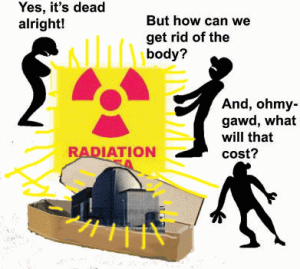
FES nuclear decommissioning funds inadequate, consumer groups tell NRC, Cleveland Business, When FirstEnergy Solutions closes the Perry nuclear power plant east of Cleveland, the Davis-Besse nuclear plant near Toledo and the Beaver Valley nuclear plant near Pittsburgh it will have up to 60 years to decommission the reactors and clean up the land at a cost of billions of dollars. A coalition of consumer and environment groups is arguing that the decommissioning trust funds are inadequate, that FES will not be able to begin decommissioning for years after the plants are closed and that parent company FirstEnergy Cop. must be held responsible to make up the funding deficit.(Plain Dealer file)
CLEVELAND, Ohio — The trust funds that FirstEnergy created years ago to pay for the demolition of its nuclear power plants and clean-up are no longer adequate, a coalition of consumer and environmental groups is arguing today at the Nuclear Regulatory Commission.
Nuclear supply chain fraud: The elephant in the room Lloyd’s Register 19 June 18, Our head of nuclear inspection discusses the fact topic few people want to acknowledge about CFSI in the nuclear industry.Simon Emeny
Our voice on nuclear regulatory and supply chain assurance
The subject of counterfeit, fraudulent and suspect items (CFSI from here on in) is a big topic in the nuclear industry in light of some high profile incidents in the past few years. Civil nuclear plant owners and operators mostly focus on detection to fight this; enhanced levels of inspection, supply chain audits, and repeat inspections are among their weapons.
These additional measures are implemented to prevent CFSI from happening again, and deep investigations and analyses are undertaken to find root causes.
A recent review at a long-time manufacturer of high integrity forgings found, among other items:
The ISO 9001 and ASME management systems may detract from a comprehensive management system, through focussing on compliance issues rather than a system for the management of regulatory and other aspects related to the production application.
There is a risk that the cumulative effect of a series of “minor” changes are considered acceptable without requalification, since revisions to qualification documents were not reviewed against original specifications and qualifications.
The metallurgical aspects of the process are well understood, but it is not clear if they are documented in a way that can be applied by those operating the processes and carrying out tests…………
An old management adage goes, “Culture eats strategy for breakfast.” In the world of nuclear supply chains, you could say, “Culture eats fraud detection systems for dinner.”
This could mean there is a culture of deliberate falsification. A culture of not caring. A culture of concentrating on cost or delivery without considering the wider, unintended consequences. A culture of assumption, or unconscious incompetence.
Bold statements? Yes, and certainly they don’t apply broadly across the industry. However, they should provoke thought and reflection, especially as the risk of CFSI increases as nuclear supply chains lengthen, become more diverse, and we move toward using standard items in facilities………https://www.lr.org/en/insights/articles/nuclear-supply-chain-fraud-the-elephant-in-the-room/






 nuclear-news