The nuclear weapons connection: Why Hinkley Point C nuclear station gets go-ahead, and Tidal Lagoon energy doesn’t
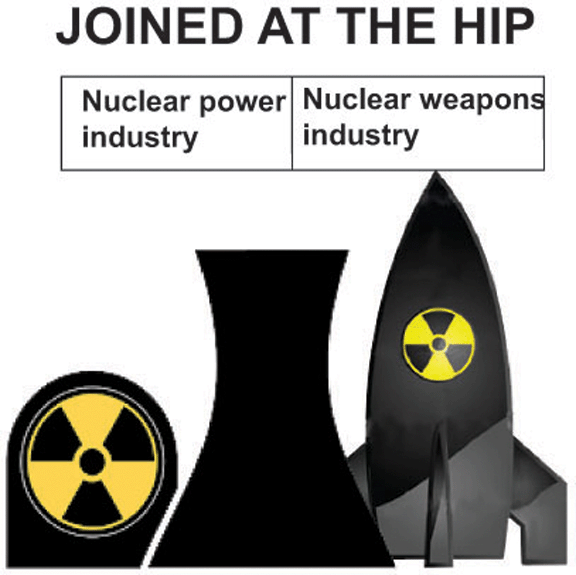
 David Lowry’s Blog 27th June 2018 , The question asked in the Guardian leader: “Hinkley Point C got the
go-ahead despite its cost. So why not Swansea Bay?” has a number of
credible answers.
Firstly, you cannot warheads for nuclear weapons of mass
destruction form any by-products of a tidal lagoon as you can from Hinkley
C’s plutonium.
Indeed, when Hinkley A was being developed in the late the
Ministry of Defence issued clear statement on: “the production of
plutonium suitable for weapons in the new [nuclear ] power stations
programme as an insurance against future defence needs…” (17 June 1958)
http://drdavidlowry.blogspot.com/2018/06/you-cannot-fuel-nuclear-proliferation.html
UK govt launches pro nuclear campaign, pushes for women in the nuclear industry
 UK government unveils £200m nuclear sector deal, The Engineer, Business secretary Greg Clark launches deal including commitment to new technology development and increased role for women in the nuclear industry ……. Details of the deal include up to £44m funding to develop advanced modular reactors, a commitment to reduce the cost of nuclear new build by 30 per cent by 2030, and to cut the cost of decommissioning old sites by 20 per cen% in the same period. There will be a new review into ways of accelerating the cleanup of old sites. Clark also signalled an increased commitment to fusion energy research, with the establishment of a national fusion technology centre at Culham in Oxfordshire, the site of the Joint European Torus (JET) fusion experiment and the home of Tokomak Technologies, which is developing fusion reactors based on the spherical tokomak principle. This fusion centre will be supported by £86m funding from the government.
“The UK is the home of civil nuclear technology and with this investment in innovation and our commitment to increasing diversity in an already highly-skilled workforce, I want to ensure we remain the world leader,” Clark said.
The NSD was announced at Trawsfynydd in Snowdonia, the site of a decommissioned nuclear reactor (the only one in the UK not on the coast) and a mooted site for the first small modular reactor project. “This site reflects both the past of our nuclear industry and an exciting future as the potential site for the new generation of small reactors, placing Wales at the centre of a UK arc of the nuclear industry,” said Alan Cairns, secretary of state for Wales.
The advanced modular reactor project will see eight designs go forward to detailed commercial and technical visibility studies. This phase 1, £4m has been allocated, and three or four of the designs will then go forward to a second phase for further development, with a possible £40m of further funding subject to a value for money approval from the Treasury. Up to £5m will be made available to regulators to support this, and up to £7m will fund capability and capacity to assess and licence small and novel reactor designs…..https://www.theengineer.co.uk/nuclear-industry-sector-deal/
Norway makes a choice for the environment – shuts down Halden nuclear research reactor
Bellona 27th June 2018 , In a major victory for radiation safety in Europe, the Norwegian government announced Wednesday that it would be permanently shutting down the financially and technically troubled Halden research reactor, which experienced a leak in 2016. The 25 megawatt installation, which is the world’s oldest heavy-water reactor, is located in a mountain cave in the southern Norwegian town of Halden, and has been under a temporary closure since March due to a valve failure. It is the second of Norway’s two reactors, the first of which is the Kjeller reactor, near Oslo, which began operations in 1951.
Bellona has for three decades questioned the Halden reactor’s sometimes hazardous operations, and demanded that the government stop subsiding its continued use.
http://bellona.org/news/nuclear-issues/2018-06-in-victory-for-the-environment-norway-will-shut-down-halden-reactor
Trumpocracy – analysed by Noam Chomsky
 The Anatomy of Trumpocracy: An Interview With Noam Chomsky C.J. Polychroniou, Truthout June 28, 2018
With its spate of right-wing rulings this week, the Supreme Court has paved the way for Donald Trump and the Republican-dominated Congress to intensify their attacks on human rights, workers and the country’s democratic institutions, dragging the US deeper into the abyss.
US political culture has long been dominated by oligarchical corporate and financial interests, militarism and jingoism, but the current Trumpocracy represents a new level of neoliberal cruelty. Indeed, the United States is turning into a pariah nation, a unique position among Western states in the second decade of the 21st century.
What factors and the forces produced this radical and dangerous shift? How did Trump manage to bring the Republican Party under his total control? Is Trumpocracy a temporary phenomenon, or the future of American politics? Is the Bernie Sanders phenomenon over? In the exclusive Truthout interview below, world-renowned scholar and public intellectual Noam Chomsky, Emeritus Professor of Linguistics at MIT and currently Laureate Professor of Linguistics at the University of Arizona, tackles these questions and offers his unique insights.
Qn. “…… how do we explain the fact that he has essentially taken over the Republican Party without any serious opposition?”
Noam Chomsky: Part of the solution to the puzzle is Obama’s performance in office. Many were seduced by the rhetoric of “hope” and “change,” and deeply disillusioned by the very early discovery that the words had little substance………
Quite apart from Obama’s disappointing policies, he and the [Democratic] Party were victims of the intense racism that is deeply rooted in large parts of American society. The visceral hatred of Obama cannot be explained in other terms.
But there is far more than that. For some time, candidates for Republican primaries who emerged from the base have been far off the traditional spectrum. The establishment was able to suppress them and gain their own candidate, but that didn’t change the basis for their support. For years, both parties have drifted to the right — the Republicans off the spectrum of normal parliamentary politics. Their dedication to wealth and corporate power is so extreme that they cannot get votes on their actual policies
…….. Trump has had overwhelming support among whites and less educated sectors, but for the most part, his mass voting base is relatively affluent and privileged. A recent Pew poll of Trump approvers found two-thirds are either college graduates, women or nonwhite, the last group apparently not many.
……. For the actual Republican constituency of wealth and corporate power, these are glory days, so why object, even if his antics sometimes cause some grimaces? The core constituency of Evangelicals is solidly in Trump’s pocket, thanks to the crumbs thrown their way. Many working people maintain the illusion that Trump cares about them and will bring back lost days of steady jobs in mining and manufacturing.
……… Trump himself seems to be having the time of his life. He’s constantly in the limelight, his loyal base worships his every move, he’s free to defy convention, to insult anyone he chooses, to disrupt the international economic and political order at will — whatever comes to mind next, knowing that he’s the biggest thug on the block and can probably get away with it — again, for a while, at least.
“….Qn: How do we explain the fact that Trump continues to cause chaos on all fronts, both domestically and internationally, and yet his popularity remains at quite high levels?
As I mentioned, Trump’s popularity among Republicans is unusually fervent and high, though not uniquely so. The affluent are doing fine. The economy is continuing the slow growth under Obama, though wages are barely rising and job security is low.
………. https://truthout.org/articles/the-anatomy-of-trumpocracy-an-interview-with-noam-chomsky/
Previously angry and aggressive, John Bolton, Trump’s national security adviser, now chummy with Putin and Kim Jong Un
The new John Bolton: Trump ally swaps fire and brimstone for a spoonful of sugar
Trump’s national security adviser seems to have abandoned his firebrand persona – and in Moscow the change of tone was striking, Guardian, Julian Borger, 28 June 18,
The trademark walrus moustache was still there, and the penetrating gaze was just the same, but in almost every other way the new John Bolton and the old John Bolton seemed very different.
The old Bolton was a firebrand pundit, raining derision from television talkshows and editorials on US diplomats promoting compromise with America’s enemies. Almost a year ago he wrote a commentary describing Vladimir Putin as a serial liar responsible for an “act of war” in the form of his interference in the US election and warned: “We negotiate with Russia at our peril.”
He described the nuclear deal with Iran, by which Tehran reduced its uranium stockpile by 98%, as an “American Munich” comparable to Neville Chamberlain’s short-lived agreement with Hitler, and he derided US diplomats as “appeasers” for pursuing contacts with adversaries for their own sake.
That was then, but this is now. And Bolton is now national security adviser to Donald Trump, whose defining diplomatic style is chumminess with dictators. In the past month, Bolton has shaken hands with Kim Jong-un and Vladimir Putin, with smiles all round. Face to face with Putin on Wednesday, Bolton replaced fire and brimstone with a large dose of honey………
The change in tone is even more evident in relation to North Korea. In January this year, Bolton said: “Talking to the North Koreans is a waste of time.” He repeatedly insisted that the only subject of discussion at a summit should be the details of how North Korean nuclear weapons would be dismantled and removed.
“I think it’s important if the president sees that they’re just looking for a way to waste time, that he make the point that he’s not there to waste time and that we expect real denuclearisation, not talks about talks about denuclearisation,” he wrote.
It is clear that Trump’s Singapore meeting with Kim Jong-un stopped very much short of that. The US failed in its effort to have its language insisting on “complete verifiable irreversible disarmament” and setting out a timetable.
Instead, Trump unilaterally suspended joint military exercises with South Korea, to the surprise of the government in Seoul and to the US military. In return, he claimed to have won a pledge from Kim to destroy a missile engine testing site. In terms of the overall North Korean weapons programme, the site was a small element, and there is no evidence so far that it has been dismantled.
…….Back in Moscow at a post-Putin press conference, the new Bolton had a one-line answer to a flurry of questions about what had become of the old Bolton.
“I don’t address what I have said before,” he said. https://www.theguardian.com/us-news/2018/jun/28/john-bolton-trump-adviser-new-style-putin
UK’s Tidal Lagoon energy project – would be costly to build, but very cheap for 120 years thereafter
 Times 28th June 2018 , Professor Chris Binnie: Greg Clark says that the Swansea tidal
lagoon was rejected as it is three times as expensive as Hinkley C, but his
calculations are suspect. The tidal lagoon would be expensive to build, but
once built it could go on for 120 years with minimal refurbishment cost.
And letter Prof Roger Kemp: The government’s rejection of the Swansea tidal
lagoon is extremely disappointing. Greg Clark says that wind energy is
cheaper, bu t it’s a false comparison: we can predict the tides years in
advance but it is difficult to look more than a week ahead with wind.
https://www.thetimes.co.uk/edition/comment/adhd-and-the-rise-in-the-use-of-medication-d2bjsnc6f
Theresa May’s UK govt rejects renewables, promotes nuclear – and cancels promising tidal energy project
 Bloomberg 27th June 2018 The U.K. government earmarked 200 million pounds ($262 million) to smooth
the way for the next nuclear power plants just two days after rejected the
case for an experimental project that would generate power from the tides.
The Department for Business, Energy and Industrial Strategy said its
Nuclear Sector Deal will fund technology and skills needed to maintain the
industry that the government is backing to be part of its future energy
mix. About 56 million pounds will go to help eight vendors of modular
reactors carry out technical studies.
The decision puts further distance
between Prime Minister Theresa May’s administration and the possibility
of government support for cutting-edge renewable technologies. May’s
government has scaled back subsidies for wind and solar, halted onshore
wind farms and declined to back Tidal Lagoon Power Ltd.’s proposal for a
1.3 billion pound project to demonstrate its technology.
https://www.bloomberg.com/news/articles/2018-06-27/u-k-earmarks-262-million-to-bolster-its-nuclear-power-industry
North Korea carrying out improvements at Yongbyon Nuclear Research Facility
North Korea improving nuclear facility despite Kim Jong-un’s pledge, satellite images show, ABC News , By Mary Lloyd , 28 June 18 Satellite images show improvements have continued at a North Korean nuclear facility, even though leader Kim Jong-un recently made commitments to dismantle the country’s nuclear program.
U.S. Secretary of State Mike Pompeo confident that North Korea understands what is expected in complete denuclearization
 North Korea understands U.S. on ‘complete denuclearization’: Pompeo, Patricia Zengerle, WASHINGTON (Reuters) – U.S. Secretary of State Mike Pompeo said on Wednesday he was confident that North Korea understood the scope of the U.S. desire for complete denuclearization as the two countries negotiate after President Donald Trump’s summit with North Korean leader Kim Jong Un.
“We’ve been pretty unambiguous in our conversations about what we mean when we say complete denuclearization,” Pompeo told a Senate Appropriations subcommittee hearing on funding for the State Department.
Trump has drawn some criticism from national security analysts for an agreement that emerged from his June 12 summit with Kim that had few details on how Pyongyang would surrender its nuclear weapons and ballistic missiles…… https://www.reuters.com/article/us-usa-pompeo-senate-northkorea/n-korea-understands-u-s-on-complete-denuclearization-pompeo-idUSKBN1JN2W3
Renewable energy thriving across Asia
Physics World 27th June 2018 Dave Elliott: Renewables are booming across Asia, but there are variations
in pace and rival options also play a role. An interesting paper by Indian
academic Nandakumar Janardhanan looks at competition in renewables in
developing countries in Asia, focusing on India and China.
Janardhana notes that “India and China, being major developing economies and having huge
energy appetite, focused heavily on strengthening their respective
alternative energy sector” so as to reduce their over-reliance on
conventional fossil fuels. He adds that “India depends on external oil
supplies to meet two thirds of its oil demand, one third of oil demand in
China is met by imports”.
As a result, the renewable energy sector has
gained great momentum in these two countries and “as innovation and
development began to lead the growth of alternative energy sector,
opportunities for expansion within their respective borders as well as
outside emerged as promising avenues for the industry from both
countries”.
https://physicsworld.com/a/asian-renewables-contest-china-versus-the-rest/
New Zealand could lead the way in getting nuclear weapons OFF the global agenda
 Hiroshima witness urges NZ to lead nuclear weapons elimination, Stuff, LAURA WALTERS , June 28 2018 “………Last month, former Green party candidate, and disarmament campaigner, Thomas Nash said “for technology that hasn’t been used in conflict since 1945, nuclear weapons sure have a knack of getting on to the global agenda”.
But it wasn’t surprising given they posed the greatest existential threat to humanity next to climate change, he said.
Nash also spoke to the select committee on Thursday, urging New Zealand to take a leadership role in eliminating nuclear weapons and global disarmament, in general.
“This treaty has a humanitarian purpose, this is rather distinct from previous international deliberations on nuclear weapons, which have tended to be about big power politics between countries weighing up the grand game and the balance,” he said.
Nash painted a picture of “Cambridge grads, strutting around in operations rooms, thinking about deterrents and game theory, missile silos and sleek nuclear submarines”.
“I think it’s important to think about bringing back this human element of the impact of nuclear weapons, because violence, militarism, relies on a dehumanisation of violence; abstracting it away from us.
“And I think if we’re going to move away from that, we have to acknowledge the human face.”
On behalf of New Zealand Alternative, Nash recommended New Zealand ratify the treaty next month, adding that early ratification would signal New Zealand’s commitment to eliminating nuclear weapons and to making genuine progress on international disarmament work.
Nash was part of the International Campaign to Abolish Nuclear Weapons, which was awarded a Nobel Peace Prize last year after the group of Geneva-based activists was recognised for its role in pushing for a United Nations treaty declaring the weapons illegal.
ABOUT THE TREATY
The Treaty on the Prohibition of Nuclear Weapons is a landmark legally-binding international instrument prohibiting the use of nuclear weapons and related activities.
In July last year, it was adopted by the United Nations Conference to Negotiate a Legally Binding Instrument to Prohibit Nuclear Weapons, Leading Towards their Total Elimination.
In September last year, New Zealand was one of the first countries to sign the treaty, at a ceremony during the United Nations General Assembly.
At the time, then-foreign minister Gerry Brownlee said it represented an important step towards a nuclear-free world, despite no countries that currently hold nuclear weapons signing the treaty.
New Zealand’s signing of the treaty was consistent with the country’s long-standing commitment to international nuclear disarmament efforts.
“It establishes the first global prohibition on nuclear weapons and provides the international legal framework for a world without these weapons,” Brownlee said at the time.
New Zealand joined over 120 other states in supporting the adoption of the treaty at a United Nations conference in July last year.
The treaty would come into force once 50 states have ratified it. At this stage 10 countries have ratified the treaty, according to the International Campaign to Abolish Nuclear Weapons. https://www.stuff.co.nz/national/politics/105072027/hiroshima-witness-urges-nz-to-lead-nuclear-weapons-elimination
Despite everything, Japan’s power companies are still loyal to nuclear power
Utilities reaffirm faith in nuclear power despite safety concerns http://www.asahi.com/ajw/articles/AJ201806280047.html, THE ASAHI SHIMBUN, June 28, 2018
Nine power companies said they are eager to restart their nuclear plants at their shareholder meetings on June 27, shunning calls to move toward renewables despite skepticism about the safety of relying on nuclear energy.
At the Kansai Electric Power Co. meeting, major shareholders such as the Kyoto and Osaka city governments called for nuclear power plants to be decommissioned.
“Kansai Electric should stop relying on nuclear power as soon as possible,” said Kyoto Mayor Daisaku Kadokawa.
In reply, Shigeki Iwane, president of Kansai Electric, said, “While giving top priority to the safety of nuclear plants, we intend to continue utilizing nuclear plants.”
He did not rule out the possibility of constructing new reactors.
Kyushu Electric Power Co., which is now operating four reactors, showed reluctance about a major shift to renewables.
A proposal to “significantly bolster” renewable energy was turned down at its shareholder meeting.
We cannot ensure the stability of frequency if we accept solar power more than at the current level,” said Michiaki Uriu, president of Kyushu Electric, noting the output of solar energy generated within the utility’s jurisdiction has reached the ceiling of 8.17 gigawatts.
At the Tokyo Electric Power Company Holdings Inc. meeting, a proposal was made to freeze preparatory work toward the planned resumption of its Kashiwazaki-Kariwa nuclear plant in Niigata Prefecture.
“Why does TEPCO bother to pursue nuclear power generation despite the Fukushima nuclear disaster?” said one shareholder. However, the proposal was rejected.
“The nuclear plant will continue to play an important role,” said Tomoaki Kobayakawa, president of TEPCO Holdings, referring to the Kashiwazaki-Kariwa plant, one of the largest in the world. “We will strive toward the restart by soul-searching and taking a lesson from the unprecedented accident.”
Some shareholders hailed the company’s decision to decommission the Fukushima No. 2 nuclear plant, announced by Kobayakawa, although they said the decision came belatedly.
But others voiced their regret over the decision, saying the plant is too good to be decommissioned.
The Fukushima No. 2 nuclear plant was damaged in the 2011 Great East Japan Earthquake and tsunami, but it managed to avert a meltdown, unlike the Fukushima No. 1 nuclear power plant nearby, where a triple meltdown occurred.
Another shareholder proposal concerned an end to providing financial support to Japan Atomic Power Co., which intends to resume operations at the Tokai No. 2 nuclear plant in Ibaraki Prefecture.
The same proposal was also made and rejected at a shareholder meeting of Tohoku Electric Power Co. the same day. Both TEPCO Holdings and Tohoku Electric fund Japan Atomic Power.
“We have offered debt guarantee to Japan Atomic Power due to the company’s efforts to ensure sustainability and cut fuel costs by restarting the nuclear plant,” said Jiro Masuko, vice president of Tohoku Electric.
All of Japan’s active nuclear power plants were shut down as part of precautionary measures after the 3/11 Fukushima disaster. Since then, nine have been restarted, and further 26 that remain idle could potentially be restarted.
Protesters rally in Pickering to decommission nuclear power plant
A group of protesters rallied outside the Pickering Recreation Complex on Tuesday afternoon.
THIS IS WHAT THE REAL FUKUSHIMA AND LARGE SURROUNDING AREA IS LIKE.
Ken 26 June 18 Only is it much much worse and, more insidious. There are multiple deadly cesium 137 like rdionuclides in Northern Japan. There are thousands of times more life extinguishing radionuclides as evil and potent as the 19 gms of cesium137 in brazil, that destroyed a community and several generations of families.
It is in the water, the soil, the food, the air, the people, their houses, the animals, the plants, their cars. It is everywhere.in Japan.
From the Beyond Nuclear story abput the cesium 137 tragedy in Brazil:
On September 13, 1987, Brazilian scrap metal dealer, Devair Ferreira, unwittingly opened Pandora’s box. Out spilled a bright blue crystalline powder that fell glowing to the floor. Fascinated by the magical iridescence, Ferreira invited family members to his home to see the mysterious substance for themselves. They were entranced. They touched it and passed it around to other friends and relatives.
What none of them knew was that they had just set in motion Latin America’s worst nuclear accident. The blue powder was cesium chloride, encased inside a cesium-137 teletherapy unit that had been left behind in an abandoned cancer treatment hospital in the City of Goiânia, the capital of the State of Goiás. Two jobless youngsters had picked it up, pulled out the heavy lead cylinder containing 19 grams of cesium-137, and sold it to Ferreira.
Ferreira, and his friends and family, soon became sick. His brother Ivo took some of the powder to his house where his six-year old daughter Leide played with the glowing radioactive crystals on the floor just before dinner. When she ate boiled eggs with her contaminated fingers, the deadly cesium-137 entered her body. Twenty two Ferreira family members had direct contact with the cesium-137. But they unwittingly went on to contaminate others.
It is amazing how much damage, 19 gr
Of this evil blue shit cesium 137 did in this town in Brazil. The shit, like cobalt 60, strontium 90, iridium is such a strong gamma emitter it has to be tightly contained in a thick lead box. Yet tons of it and other shit was blown all over japan by the reactor explosions.Decontamination of houses and streets in Goiânia
At least 40 people were hospitalized, and by October 28 four had died. They were Ivo’s daughter Leide and Devair Ferreira’s wife Gabriela — who had first sounded the alarm about the sudden mysterious sicknesses in her extended family — along with two of Devair’s employees.
All of those affected were at first treated at the local hospital like regular patients and were allowed to circulate freely through the city, contaminating others they met, as well as the doctors and nurses who cared for them. For 16 days, no one knew that the cause of their sickness was radiation exposure.
When it finally came to light, Brazil’s National Nuclear Energy Commission sent a team to Goiânia, to quarantine and isolate those contaminated and to start the clean-up.
A total of 112,800 people remained isolated in the Olympic Stadium of Goiânia until December 1987, and were examined there for radiation by the CNEN. Radiation technicians ultimately registered a total of 249 contaminated people, 129 of them with cesium-137 in their body, a man-made isotope produced in nuclear reactors that, when ingested, binds with muscle and irradiates people internally.
According to the government of Goiás and the International Atomic Energy Agency (IAEA), Goiânia’s cesium-137 accident claimed only four lives, but the Goiás Public Prosecutor’s Office and the Association of Cesium Victims (AVCesio) say that at least 1,400 people were contaminated and that 66 have died as of 2017.
After the Fukushima nuclear disaster in Japan,Time magazine produced a list of 12 of the Worst Nuclear Disasters. Goiânia was one of them. Yukiya Amano, director general of the IAEA,pointed out in a March 25, 2012 Washington Postcolumn, that the Goiânia incident “involved the unintended release of radioactivity, but it remains the best real-world indicator of what could happen on a larger scale if terrorists were to detonate a dirty bomb in a large city or at a major public event.”
On September 13, 1987, Brazilian scrap metal dealer, Devair Ferreira, unwittingly opened Pandora’s box. Out spilled a bright blue crystalline powder that fell glowing to the floor. Fascinated by the magical iridescence, Ferreira invited family members to his home to see the mysterious substance for themselves. They were entranced. They touched it and passed it around to other friends and relatives.
What none of them knew was that they had just set in motion Latin America’s worst nuclear accident. The blue powder was cesium chloride, encased inside a cesium-137 teletherapy unit that had been left behind in an abandoned cancer treatment hospital in the City of Goiânia, the capital of the State of Goiás. Two jobless youngsters had picked it up, pulled out the heavy lead cylinder containing 19 grams of cesium-137, and sold it to Ferreira.
Ferreira, and his friends and family, soon became sick. His brother Ivo took some of the powder to his house where his six-year old daughter Leide played with the glowing radioactive crystals on the floor just before dinner. When she ate boiled eggs with her contaminated fingers, the deadly cesium-137 entered her body. Twenty two Ferreira family members had direct contact with the cesium-137. But they unwittingly went on to contaminate others.
Decontamination of houses and streets in Goiânia
At least 40 people were hospitalized, and by October 28 four had died. They were Ivo’s daughter Leide and Devair Ferreira’s wife Gabriela — who had first sounded the alarm about the sudden mysterious sicknesses in her extended family — along with two of Devair’s employees.
All of those affected were at first treated at the local hospital like regular patients and were allowed to circulate freely through the city, contaminating others they met, as well as the doctors and nurses who cared for them. For 16 days, no one knew that the cause of their sickness was radiation exposure.
When it finally came to light, Brazil’s National Nuclear Energy Commission sent a team to Goiânia, to quarantine and isolate those contaminated and to start the clean-up.
A total of 112,800 people remained isolated in the Olympic Stadium of Goiânia until December 1987, and were examined there for radiation by the CNEN. Radiation technicians ultimately registered a total of 249 contaminated people, 129 of them with cesium-137 in their body, a man-made isotope produced in nuclear reactors that, when ingested, binds with muscle and irradiates people internally.
According to the government of Goiás and the International Atomic Energy Agency (IAEA), Goiânia’s cesium-137 accident claimed only four lives, but the Goiás Public Prosecutor’s Office and the Association of Cesium Victims (AVCesio) say that at least 1,400 people were contaminated and that 66 have died as of 2017.
After the Fukushima nuclear disaster in Japan,Time magazine produced a list of 12 of the Worst Nuclear Disasters. Goiânia was one of them. Yukiya Amano, director general of the IAEA,pointed out in a March 25, 2012 Washington Postcolumn, that the Goiânia incident “involved the unintended release of radioactivity, but it remains the best real-world indicator of what could happen on a larger scale if terrorists were to detonate a dirty bomb in a large city or at a major public event.”
Main article from beyond nuclearhttp://www.beyondnuclear.org/home/2018/6/20/one-of-the-worlds-worst-nuclear-accidents-was-in-brazil.html
1 This Month


Tell the Ukrainian Government to Drop Prosecution of Peace Activist Yurii Sheliazhenko

Petition to revoke the licensing of the Near Surface Nuclear Disposal Facility (NSDF) at Chalk River. https://www.ourcommons.ca/petitions/en/Petition/Details?Petition=e-7247


of the week – STOP SMALL MODULAR REACTORS IN CANADA
To see nuclear-related stories in greater depth and intensity – go to https://nuclearinformation.wordpress.com
-
Archives
- March 2026 (204)
- February 2026 (268)
- January 2026 (308)
- December 2025 (358)
- November 2025 (359)
- October 2025 (376)
- September 2025 (258)
- August 2025 (319)
- July 2025 (230)
- June 2025 (348)
- May 2025 (261)
- April 2025 (305)
-
Categories
- 1
- 1 NUCLEAR ISSUES
- business and costs
- climate change
- culture and arts
- ENERGY
- environment
- health
- history
- indigenous issues
- Legal
- marketing of nuclear
- media
- opposition to nuclear
- PERSONAL STORIES
- politics
- politics international
- Religion and ethics
- safety
- secrets,lies and civil liberties
- spinbuster
- technology
- Uranium
- wastes
- weapons and war
- Women
- 2 WORLD
- ACTION
- AFRICA
- Atrocities
- AUSTRALIA
- Christina's notes
- Christina's themes
- culture and arts
- Events
- Fuk 2022
- Fuk 2023
- Fukushima 2017
- Fukushima 2018
- fukushima 2019
- Fukushima 2020
- Fukushima 2021
- general
- global warming
- Humour (God we need it)
- Nuclear
- RARE EARTHS
- Reference
- resources – print
- Resources -audiovicual
- Weekly Newsletter
- World
- World Nuclear
- YouTube
-
RSS
Entries RSS
Comments RSS
 nuclear-news