The world needs now to recognise climate refugees
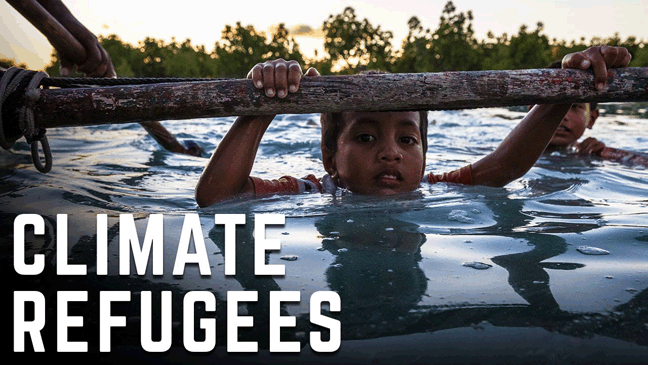
TIM MCDONNELL , This month, diplomats from around the world met in New York and Geneva to hash out a pair of new global agreements that aim to lay out new guidelines for how countries should deal with an unprecedented surge in the number of displaced people, which has now reached 65.6 million worldwide.
But there’s one emerging category that seems to be getting short shrift in the conversation: so-called “climate refugees,” who currently lack any formal definition, recognition or protection under international law even as the scope of their predicament becomes more clear.
Since 2008, an average of 24 million people have been displaced by catastrophic weather disasters each year. As climate change worsens storms and droughts, climate scientists and migration experts expect that number to rise.
Meanwhile, climate impacts that unravel over time, like desert expansion and sea level rise, are also forcing people from their homes: A World Bank report in March projects that within three of the most vulnerable regions — sub-Saharan Africa, South Asia and Latin America — 143 million people could be displaced by these impacts by 2050.
In Bangladesh, hundreds of thousands of people are routinely uprooted by coastal flooding, many making a treacherous journey to the slums of the capital, Dhaka. In West Africa, the almost total disappearance of Lake Chad because of desertification has empowered terrorists and forced more than four million people into camps.
It’s a problem in the United States as well. An estimated 2,300 Puerto Rican familiesdisplaced by Hurricane Maria are still looking for permanent housing, while government officials have spent years working to preemptively relocate more than a dozen small coastal communities in Alaska and Louisiana that are disappearing into the rising sea.
A December study by Columbia University climate researchers in the peer-reviewed journal Science projected that if global temperatures continue their upward march, applications for asylum to the European Union could increase 28 percent to nearly 450,000 per year by 2100.
No comments yet.
1 This Month

of the week – Shut Down Drone Warfare!


Tell the Ukrainian Government to Drop Prosecution of Peace Activist Yurii Sheliazhenko

Petition to revoke the licensing of the Near Surface Nuclear Disposal Facility (NSDF) at Chalk River. https://www.ourcommons.ca/petitions/en/Petition/Details?Petition=e-7247
To see nuclear-related stories in greater depth and intensity – go to https://nuclearinformation.wordpress.com
-
Archives
- April 2026 (103)
- March 2026 (251)
- February 2026 (268)
- January 2026 (308)
- December 2025 (358)
- November 2025 (359)
- October 2025 (376)
- September 2025 (257)
- August 2025 (319)
- July 2025 (230)
- June 2025 (348)
- May 2025 (261)
-
Categories
- 1
- 1 NUCLEAR ISSUES
- business and costs
- climate change
- culture and arts
- ENERGY
- environment
- health
- history
- indigenous issues
- Legal
- marketing of nuclear
- media
- opposition to nuclear
- PERSONAL STORIES
- politics
- politics international
- Religion and ethics
- safety
- secrets,lies and civil liberties
- spinbuster
- technology
- Uranium
- wastes
- weapons and war
- Women
- 2 WORLD
- ACTION
- AFRICA
- Atrocities
- AUSTRALIA
- Christina's notes
- Christina's themes
- culture and arts
- Events
- Fuk 2022
- Fuk 2023
- Fukushima 2017
- Fukushima 2018
- fukushima 2019
- Fukushima 2020
- Fukushima 2021
- general
- global warming
- Humour (God we need it)
- Nuclear
- RARE EARTHS
- Reference
- resources – print
- Resources -audiovicual
- Weekly Newsletter
- World
- World Nuclear
- YouTube
-
RSS
Entries RSS
Comments RSS
 nuclear-news
Leave a comment