Trump became the fourth U.S. president to uphold the decades-long pledge not to press Israel to give up its nuclear weapons, The New Yorker reports, Haaretz 19 June 18,
Israel wants to keep aging Dimona nuclear reactor operating until 2040, when it will be 80
Wylfa Newydd nuclear plant gets EU environmental backing BBC News, 19 June 18
The planned Wylfa Newydd nuclear power plant on Anglesey has been granted environmental approval by the European Commission.
Developer Horizon has been given a “positive” opinion by the commission.
The ruling means it was considered that it would not have health or environmental impacts on other member states.
Horizon will now need approval from Natural Resources Wales (NRW) and ultimately the UK Government.
The commission assessed that the application fully complied with European safety standards covering routine operations, decommissioning and spent fuel storage as well as the possibility of accidental release.
Nuclear power shutdowns won’t spike power prices, Science Daily
Date:
June 19, 2018
Source:
Penn State
Summary:
Despite economic woes that could shutter two of Pennsylvania’s nuclear power plants — which generate 6 percent of the state’s power — power prices will remain steady due to low natural gas prices, according to an associate professor of energy policy and economics.
Despite economic woes that could shutter two of Pennsylvania’s nuclear power plants — which generate 6 percent of the state’s power — power prices will remain steady due to low natural gas prices, according to Seth Blumsack, associate professor of energy policy and economics, Penn State.
Owners of both Three Mile Island, near Harrisburg, and Beaver Valley Nuclear Power Station, west of Pittsburgh, have cited financial troubles due to historically low electricity prices. Blumsack said rock-bottom power prices are expected to continue for years to come because energy use has plateaued and efficient natural gas power plants — which are nowhere near peak production — have recently come online. That situation is coupled with extremely low natural gas prices.
“There’s just so much extra generation capacity in this region,” Blumsack said. “These nuclear power plants are big, but even if you were to lose these big power plants there’s so much other generation capacity that can produce electricity at costs competitive with the nuclear plants that the market outcomes aren’t going to change and the reliability of the grid won’t be compromised.”
Blumsack studied the impact of the two nuclear power plants coming offline and found wholesale energy prices would rise between 4-10 percent each year over a three-year period if those plants were not replaced. When that lost nuclear capacity is replaced by natural gas, however, wholesale energy prices decline each year by between 9 percent and 24 percent. The more new generation capacity that enters the market, the larger the reduction in wholesale energy costs as long as market prices for natural gas remain low.
The research will be published in an upcoming issue of The Electricity Journal.
Natural gas prices, which are projected to increase only slightly for the next several years, according to the World Bank Natural Gas Price Forecast, would have to increase by 300 percent at Appalachian trading hubs for nuclear power to again be competitive, Blumsack said………
“Overall, electricity demand in the U.S. has not grown in the past decade so you have this combination of no growth in demand and excess power generation capacity,” Blumsack said. “That prompts the market to crash, which causes some players to lose and in this case that appears to be the nuclear power plants.” ….. https://www.sciencedaily.com/releases/2018/06/180619122409.htm
Bill for failed South Carolina nuclear project could climb by $421 million, By Thad Moore tmoore@postandcourier.com 19 June 18,The final tab for South Carolina’s failed nuclear power project could increase by $421 million after a state audit found the two utilities behind it owe sales tax on the materials they bought for the unfinished plant.
The bill, obtained by The Post and Courier, includes millions of dollars of interest tacked onto a staggering $410 million claim for back taxes. The assessment covers every item that South Carolina Electric & Gas and Santee Cooper bought for the massive construction project — every bolt, pipe and turbine.
Thorium Contamination for military use and more. The misinformation on thorium is highly promoted by the nuclear industry and various criminal companies that want investment dollars for thorium reactors and fuel that are conducting victorious wars in the mafious control of mines in the world and using slavery at very low cost of labor based on the bare-handed employment of rare earth miners .
Contrary to the widespread criminal propaganda on the web, thorium has a long historical tradition linked to the use for military purposes and weapons of mass destruction since the Second World War which has plagued large areas now returned to the chronicles for the almost impossible decontamination work starting from the United States. Thorium is NOT “green”, NOT “safe”, NOT “peaceful” and, overall, Thorium is NOT “the Nuclear Savior” claimed.
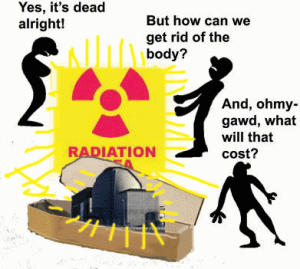
FES nuclear decommissioning funds inadequate, consumer groups tell NRC, Cleveland Business, When FirstEnergy Solutions closes the Perry nuclear power plant east of Cleveland, the Davis-Besse nuclear plant near Toledo and the Beaver Valley nuclear plant near Pittsburgh it will have up to 60 years to decommission the reactors and clean up the land at a cost of billions of dollars. A coalition of consumer and environment groups is arguing that the decommissioning trust funds are inadequate, that FES will not be able to begin decommissioning for years after the plants are closed and that parent company FirstEnergy Cop. must be held responsible to make up the funding deficit.(Plain Dealer file)
CLEVELAND, Ohio — The trust funds that FirstEnergy created years ago to pay for the demolition of its nuclear power plants and clean-up are no longer adequate, a coalition of consumer and environmental groups is arguing today at the Nuclear Regulatory Commission.
Nuclear supply chain fraud: The elephant in the room Lloyd’s Register 19 June 18, Our head of nuclear inspection discusses the fact topic few people want to acknowledge about CFSI in the nuclear industry.Simon Emeny
Our voice on nuclear regulatory and supply chain assurance
The subject of counterfeit, fraudulent and suspect items (CFSI from here on in) is a big topic in the nuclear industry in light of some high profile incidents in the past few years. Civil nuclear plant owners and operators mostly focus on detection to fight this; enhanced levels of inspection, supply chain audits, and repeat inspections are among their weapons.
These additional measures are implemented to prevent CFSI from happening again, and deep investigations and analyses are undertaken to find root causes.
A recent review at a long-time manufacturer of high integrity forgings found, among other items:
The ISO 9001 and ASME management systems may detract from a comprehensive management system, through focussing on compliance issues rather than a system for the management of regulatory and other aspects related to the production application.
There is a risk that the cumulative effect of a series of “minor” changes are considered acceptable without requalification, since revisions to qualification documents were not reviewed against original specifications and qualifications.
The metallurgical aspects of the process are well understood, but it is not clear if they are documented in a way that can be applied by those operating the processes and carrying out tests…………
An old management adage goes, “Culture eats strategy for breakfast.” In the world of nuclear supply chains, you could say, “Culture eats fraud detection systems for dinner.”
This could mean there is a culture of deliberate falsification. A culture of not caring. A culture of concentrating on cost or delivery without considering the wider, unintended consequences. A culture of assumption, or unconscious incompetence.
Bold statements? Yes, and certainly they don’t apply broadly across the industry. However, they should provoke thought and reflection, especially as the risk of CFSI increases as nuclear supply chains lengthen, become more diverse, and we move toward using standard items in facilities………https://www.lr.org/en/insights/articles/nuclear-supply-chain-fraud-the-elephant-in-the-room/
This satellite photo [on original] could show Russia is upgrading a key nuclear weapons storage site, a new report has revealed.
The report by the Federation of American Scientists highlights how Russia may has modernised a nuclear weapons storage bunker in Kaliningrad.
The site, located between Poland and the Baltics, has been renovated in the past two years and covered up again “presumably to return to operational status”, the report reads.
Director of the Nuclear Information Project at the Federation of American Scientists Hans M Kristensen writes in his blog how the area was last upgraded between 2002 and 2010.
His report said the upgrade raises questions about what Russia intends to use it for. He questions whether it will be used to store nuclear warheads or if it’s simply an upgrade of an aging facility for an existing capability.
“The features of the site suggest it could potentially serve Russian Air Force or Navy dual-capable forces. But it could also be a joint site, potentially servicing nuclear warheads for both Air Force, Navy, Army, air-defense, and coastal defense forces in the region,” he wrote.


 nuclear-news