Federal nuclear weapons facilities are getting systems to disable drones or any other unauthorized unmanned aircraft systems flying over restricted airspace.
Officials at the Los Alamos National Laboratory say they’re testing a new system that could serve as a model for other federal installations, the Los Alamos Monitor reported Wednesday.
The technology is coming to the federal government’s Y-12 National Security Complex in Oak Ridge, Tennessee, a spokesman said.
“The Y-12 National Security Complex and its sister site at the Pantex Plant near Amarillo, Texas, are among the national security facilities around the nation where this capability will be employed,” said Steve Wyatt, a spokesperson for the National Nuclear Security Administration (NNSA), told the USA TODAY NETWORK -Tennessee on Thursday.. “At this point, we have no further comment.”
The airspace over the New Mexico lab received an additional no drone zone designation by the Federal Aviation Administration.
All airspace over the laboratory is protected right now against unauthorized drone or UAS flights (unmanned aircraft systems),” said Michael Lansing, head of the lab’s security operations. “We can detect and track a UAS and if it poses a threat we have the ability to disrupt control of the system, seize or exercise control, confiscate, or use reasonable force to disable, damage or destroy the UAS.”
The lab worked with the National Nuclear Security Administration and the FAA to implement the system. The NNSA received authorization from Congress last year to implement enhanced security measures to protect its sites from drones.
“Implementation guidance by NNSA focuses on high-level actions to be taken to detect, identify, track and mitigate drones that pose a threat to NNSA covered facilities,” said Lewis Monroe, director of NNSA’s Office of Security Operations and Programmatic Planning.
The lab’s Counter-UAS program will serve as a blueprint for other programs planned for the Pantex Plant in Texas, the Y-12 facility in Tennessee and the National Nuclear Security Site in Nevada.
The NNSA has defined drone activity as threatening “if unabated, could inflict or otherwise cause physical harm to a person; inflict or otherwise cause damage to property or systems; interfere with the operational mission of a covered facility or asset; conduct unauthorized surveillance or reconnaissance; or result in unauthorized access to, or disclosure of, classified or otherwise lawfully protected information.”
High costs and renewables challenge the case for nuclear power, Economic risks of atomic plants threaten their place in future energy mix, Ft.com Sylvia Pfeifer, -14 June 18 The island of Anglesey, off the north-west coast of Wales, is famous for ancient sites and prehistoric ruins. If all goes to plan over the next few months, the island will make history again — this time as the scene of the next stage in the revival of the UK nuclear industry.
Britain has announced an outline agreement with Hitachi of Japan to build two reactors on the site. If a final deal is struck next year, the plant could be producing electricity by the mid-2020s.
The development, called Wylfa Newydd, would be only the second nuclear plant built in Britain for decades. Together with Hinkley Point C, the £20bn plant under construction in Somerset, in the south-west, by EDF of France, it would generate much-needed low-carbon electricity. They will help ensure the UK’s energy security as coal-fired power stations and ageing nuclear reactors close.
Their fate is also a wider test of the nuclear industry’s ability to compete at a time of rapid change in energy. The nuclear industry has been under threat since the disaster at the Fukushima plant in Japan in 2011 revived concerns about safety and prompted several developed countries, notably Germany, to phase out nuclear power.
The biggest danger to the industry however is that of spiralling costs. Given cheap and plentiful gas and the rise of renewable power whose costs are falling, many industry observers wonder how nuclear power can compete.
“We’ve seen a substantive decline in the share of nuclear of total electricity generation worldwide,” says Paul Dorfman, of the Energy Institute at University College London. “Increasing nuclear costs along with the technological advances and the plummeting price of renewables are the key dynamics, and there’s a clear trend emerging.”
……. competition from gas, wind and solar has grown, nuclear’s share of global electricity generation has declined to 11 per cent from a peak of 17 per cent in the mid-1990s. In its Energy Outlook report published in February, BP forecast that renewable energy would be the fastest-growing source of energy by 2040.
…… Rising costs remain the big challenge. A recent analysis of the history of reactors published in the journal Energy Policy concluded the following: nuclear power projects are more expensive than in the early 1980s; nuclear construction lead times have increased two-fold in the past 50 years; and the increase in complexity and risks of nuclear projects results in high financial costs.
“Nuclear projects are actually becoming more complex to carry out, inducing delays and higher costs,” says the study’s lead author, Joana Portugal Pereira, from the Centre for Environmental Policy at Imperial College London. “Safety and regulatory considerations play heavily into this, particularly in the wake of Fukushima.”
……. In the case of Wylfa Newydd, the government will consider attaching taxpayer funds to the construction of the site, but with the ambition of achieving a strike price for the electricity that will be about £15/MWh cheaper than for Hinkley.
Centrica aims to sell UK nuclear stake by end of 2020 , Nasdaq, By Susanna Twidale, LONDON, June 14 (Reuters) – Centrica plans to sell its 20 percent stake in eight British power plants by the end of 2020, but has yet to start marketing the assets, the company’s CEO said on Thursday
France’s EDF owns the other 80 percent of the nuclear plants ……….
Analyst have said it could be difficult to attract buyers for the nuclear assets, with large financials shying away from nuclear investment and half of the plants expected to close in 2024.
Fears over new atomic plant Isle of Man Today, 14 June 18The new secretary of the Mannin branch of the Celtic League is calling on the Manx government to oppose plans for a new nuclear power station on Anglesey.
Wylfa nuclear plant, located just 35 miles from the southern coast of the Isle of Man, closed in 2015 after more than 40 years of service.
Now the Westminster government has announced that public money will be invested into a multi-billion pound replacement…….
Allen Moore, who was appointed branch secretary of Celtic League Mannin last month and is also the organisation’s environmental officer, believes the Manx government should oppose the project.
He said: ’Opposition to the nuclear policies of the UK and French governments remains a core concern of the Celtic League. Those governments have built many of their nuclear power stations in or close to Celtic countries, and none more so than around the Irish Sea. It is to be hoped that the Manx Government does express concerns to the UK about the new Wylfa power station development. The MHKs were elected to represent us, after all.’
Mr Moore said we need to look after the environment to ensure that we survive, both here in the Isle of
Man and worldwide.
He explained: ’I was four months old at the time of the Windscale fire. If that had been even worse we wouldn’t have survived in the Isle of Man.
’At best, we would have had to be evacuated, and now the UK might be talking about the Windscale Generation as well as the Windrush Generation.
’There is a perception in some quarters that nuclear power produces clean energy and doesn’t cost much once the power station is built.
’However, as is being seen with the older generation nuclear power stations, decommissioning these plants is hugely expensive, including finding a safe way of disposing of and securing the radioactive material. What are we leaving future generations?’
The Manx government’s declared policy is to seek the complete closure of the Sellafield nuclear reprocessing plant and to oppose the operation of any nuclear facility which is the source of radioactive pollution.
The government laboratory conducts independent monitoring of environmental radioactivity levels in the Isle of Man.
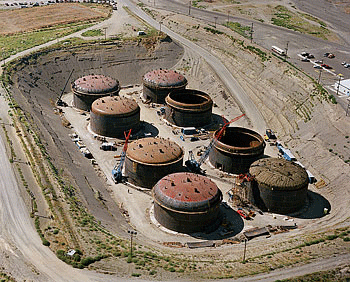
A Hanford watchdog group is objecting as the Department of Energy takes the first step toward a plan to fill underground, radioactive waste storage tanks with concrete-like grout and leave them permanently in place. The C Tank Farm, which would be closed first, has not had enough radioactive waste removed to have tanks filled with grout, said Tom Carpenter, executive director of Seattle-based Hanford Challenge.
“This would be a serious setback for the cleanup at Hanford if the DOE is allowed to turn Hanford into the nation’s high-level nuclear waste dump,” Carpenter said. “This will be challenged.”
Geoffrey Fettus, a senior attorney at the Natural Resources Defense Council, said that “the people of the Pacific Northwest deserve better, and we’ll be there with them opposing this unsound and unsafe effort.”
(Mainichi Japan) TOKYO (Kyodo) — Japan’s nuclear watchdog on Wednesday approved a plan to scrap a nuclear fuel reprocessing plant northeast of Tokyo over a 70-year period with the cost projected at 1 trillion yen ($9 billion).
The facility in Tokaimura, Ibaraki Prefecture went into operation in 1977. It was Japan’s first spent-fuel reprocessing plant built under the nation’s nuclear fuel cycle policy, which aims to reprocess all spent nuclear fuel in order to reuse the extracted plutonium and uranium as reactor fuel in the resource-scarce country.
But the policy has run into a dead end as the completion of a separate fuel reprocessing plant in Aomori Prefecture, built on the technological expertise of the Tokaimura plant, has been delayed by more than 20 years.
The decommissioning cost will be shouldered by taxpayers as the Japan Atomic Energy Agency operating the Tokaimura plant, is backed by the state. Where to store the waste accumulated at the plant is undecided.
In 2014, the agency decided to decommission the plant due to its aging and the huge cost to run it under stricter safety rules introduced after the 2011 Fukushima nuclear crisis.
According to the plan approved by the Nuclear Regulation Authority, around 310 canisters of highly radioactive vitrified waste and some 360 cubic meters of radioactive waste are currently stored at the facility.
About 770 billion yen is estimated for the disposal of such waste and decommissioning of the facility and roughly 217 billion yen for the 10-year preparation work.
FRENCHTOWN TOWNSHIP, Mich. (AP) — Southeastern Michigan officials say a nuclear plant’s move to slash its property taxes by 60 percent could be devastating to the community.
DTE Energy filed for a property tax reduction for its Fermi 2 nuclear plant with the Michigan Tax Tribunal last month, the Monroe News reported . The Detroit-based utility’s plant is located along Lake Erie in Monroe County’s Frenchtown Township.
The county could lose nearly $11.6 million in property taxes from the nuclear plant. That is in addition to an expected devaluation of the company’s Monroe Power Plant, which could result in a $12 million loss in property taxes.
Officials confirmed the Monroe coal plant filing was made at the same time as the Fermi request, but its details haven’t been made available.
Many community leaders were caught off guard by the decision, which will affect municipalities, schools, the Monroe County Library System and Lake Erie Transit, among others.
Frenchtown Township Supervisor James McDevitt said officials were working with the company and expected to continue to do so next year while settling the coal plant devaluation. He called the move a “letdown” that could cost the township a $1.5 million tax loss.
“We understood that there would be a gradual decline in the value of the power plant and we thought that was reasonable,” said Michael Bosanac, county administrator and chief financial officer. “This is not reasonable and it is not fair.”
Bosanac said the 60 percent cut to the nuclear plant’s taxes could have a more than $1 million impact on the county’s budget.
DTE Energy has said it’s seeking devaluation for the plants because of the market shift to clean energy, which is due in part to aging plants.
The company also filed for a property tax decrease at its Trenton Channel coal plant, as well as similar requests at its wind farms across Michigan.





 nuclear-news