Economic realities point to a poor future for nuclear power
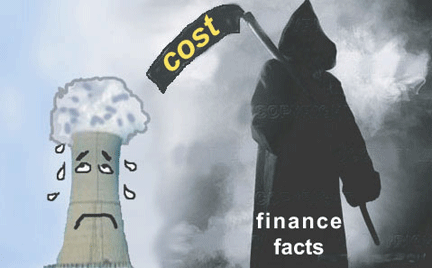 High costs and renewables challenge the case for nuclear power, Economic risks of atomic plants threaten their place in future energy mix, Ft.com Sylvia Pfeifer, -14 June 18
The island of Anglesey, off the north-west coast of Wales, is famous for ancient sites and prehistoric ruins. If all goes to plan over the next few months, the island will make history again — this time as the scene of the next stage in the revival of the UK nuclear industry.
Britain has announced an outline agreement with Hitachi of Japan to build two reactors on the site. If a final deal is struck next year, the plant could be producing electricity by the mid-2020s.
The development, called Wylfa Newydd, would be only the second nuclear plant built in Britain for decades. Together with Hinkley Point C, the £20bn plant under construction in Somerset, in the south-west, by EDF of France, it would generate much-needed low-carbon electricity. They will help ensure the UK’s energy security as coal-fired power stations and ageing nuclear reactors close.
Their fate is also a wider test of the nuclear industry’s ability to compete at a time of rapid change in energy. The nuclear industry has been under threat since the disaster at the Fukushima plant in Japan in 2011 revived concerns about safety and prompted several developed countries, notably Germany, to phase out nuclear power.
The biggest danger to the industry however is that of spiralling costs. Given cheap and plentiful gas and the rise of renewable power whose costs are falling, many industry observers wonder how nuclear power can compete.
“We’ve seen a substantive decline in the share of nuclear of total electricity generation worldwide,” says Paul Dorfman, of the Energy Institute at University College London. “Increasing nuclear costs along with the technological advances and the plummeting price of renewables are the key dynamics, and there’s a clear trend emerging.”
……. competition from gas, wind and solar has grown, nuclear’s share of global electricity generation has declined to 11 per cent from a peak of 17 per cent in the mid-1990s. In its Energy Outlook report published in February, BP forecast that renewable energy would be the fastest-growing source of energy by 2040.
…… Rising costs remain the big challenge. A recent analysis of the history of reactors published in the journal Energy Policy concluded the following: nuclear power projects are more expensive than in the early 1980s; nuclear construction lead times have increased two-fold in the past 50 years; and the increase in complexity and risks of nuclear projects results in high financial costs.
“Nuclear projects are actually becoming more complex to carry out, inducing delays and higher costs,” says the study’s lead author, Joana Portugal Pereira, from the Centre for Environmental Policy at Imperial College London. “Safety and regulatory considerations play heavily into this, particularly in the wake of Fukushima.”
……. In the case of Wylfa Newydd, the government will consider attaching taxpayer funds to the construction of the site, but with the ambition of achieving a strike price for the electricity that will be about £15/MWh cheaper than for Hinkley.
Supporters of renewables point out that at about £77.50/MWh, this price is still higher than the £57.50/MWh allocated for UK offshore wind contracts last September. …….https://www.ft.com/content/21305834-5376-11e8-84f4-43d65af59d43
No comments yet.
1 This Month

of the week – Shut Down Drone Warfare!


Tell the Ukrainian Government to Drop Prosecution of Peace Activist Yurii Sheliazhenko

Petition to revoke the licensing of the Near Surface Nuclear Disposal Facility (NSDF) at Chalk River. https://www.ourcommons.ca/petitions/en/Petition/Details?Petition=e-7247
To see nuclear-related stories in greater depth and intensity – go to https://nuclearinformation.wordpress.com
-
Archives
- March 2026 (237)
- February 2026 (268)
- January 2026 (308)
- December 2025 (358)
- November 2025 (359)
- October 2025 (376)
- September 2025 (257)
- August 2025 (319)
- July 2025 (230)
- June 2025 (348)
- May 2025 (261)
- April 2025 (305)
-
Categories
- 1
- 1 NUCLEAR ISSUES
- business and costs
- climate change
- culture and arts
- ENERGY
- environment
- health
- history
- indigenous issues
- Legal
- marketing of nuclear
- media
- opposition to nuclear
- PERSONAL STORIES
- politics
- politics international
- Religion and ethics
- safety
- secrets,lies and civil liberties
- spinbuster
- technology
- Uranium
- wastes
- weapons and war
- Women
- 2 WORLD
- ACTION
- AFRICA
- Atrocities
- AUSTRALIA
- Christina's notes
- Christina's themes
- culture and arts
- Events
- Fuk 2022
- Fuk 2023
- Fukushima 2017
- Fukushima 2018
- fukushima 2019
- Fukushima 2020
- Fukushima 2021
- general
- global warming
- Humour (God we need it)
- Nuclear
- RARE EARTHS
- Reference
- resources – print
- Resources -audiovicual
- Weekly Newsletter
- World
- World Nuclear
- YouTube
-
RSS
Entries RSS
Comments RSS
 nuclear-news
Leave a comment