In the Trump Administration, Science Is Unwelcome. So Is Advice.
As the president prepares for nuclear talks, he lacks a close adviser with nuclear expertise. It’s one example of a marginalization of science in shaping federal policy. NYT By Coral Davenport 9 June 18
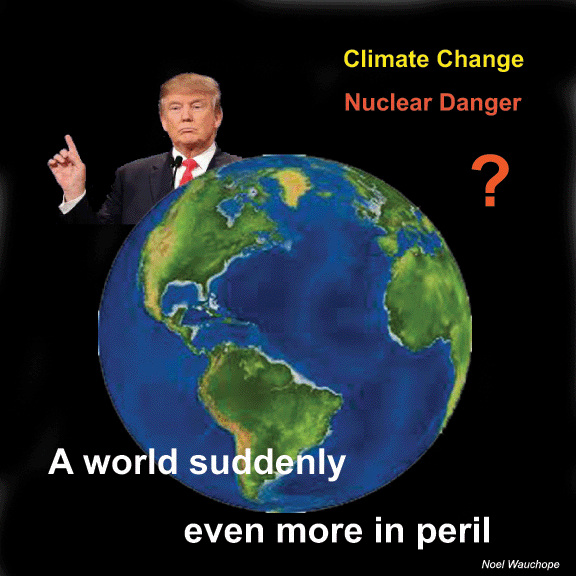
WASHINGTON — As President Trump prepares to meet Kim Jong-un of North Korea to negotiate denuclearization, a challenge that has bedeviled the world for years, he is doing so without the help of a White House science adviser or senior counselor trained in nuclear physics.
Mr. Trump is the first president since 1941 not to name a science adviser, a position created during World War II to guide the Oval Office on technical matters ranging from nuclear warfare to global pandemics. As a businessman and president, Mr. Trump has proudly been guided by his instincts. Nevertheless, people who have participated in past nuclear negotiations say the absence of such high-level expertise could put him at a tactical disadvantage in one of the weightiest diplomatic matters of his presidency.
“You need to have an empowered senior science adviser at the table,” said R. Nicholas Burns, who led negotiations with India over a civilian nuclear deal during the George W. Bush administration. “You can be sure the other side will have that.”
The lack of traditional scientific advisory leadership in the White House is one example of a significant change in the Trump administration: the marginalization of science in shaping United States policy.
There is no chief scientist at the State Department, where science is central to foreign policy matters such as cybersecurity and global warming. Nor is there a chief scientist at the Department of Agriculture: Mr. Trump last year nominated Sam Clovis, a former talk-show host with no scientific background, to the position, but he withdrew his name and no new nomination has been made.
These and other decisions have consequences for public health and safety and the economy. Both the Interior Department and the National Oceanic and Atmospheric Administration have disbanded climate science advisory committees. The Food and Drug Administration disbanded its Food Advisory Committee, which provided guidance on food safety.
Government-funded scientists said in interviews that they were seeing signs that their work was being suppressed, and that they were leaving their government jobs to work in the private sector, or for other countries.
After Mr. Trump last year withdrew from the Paris climate agreement, the international pact committing nations to tackle global warming, France started a program called “Make Our Planet Great Again” — named in reference to Mr. Trump’s slogan, “Make America Great Again” — to lure the best American scientists to France. The program has so far provided funding for 24 scientists from the United States and other countries to do their research in France…….https://www.nytimes.com/2018/06/09/climate/trump-administration-science.html
“CANADA, FRANCE, GERMANY, ITALY, JAPAN THE UK AND THE EUROPEAN UNIONREAFFIRM THEIR STRONG COMMITMENT TO IMPLEMENT THE PARIS AGREEMENT, THROUGH AMBITIOUS CLIMATE ACTION”
“PRESIDENT TRUMP’S WRECKING BALL APPROACH TO INTERNATIONAL DIPLOMACY LEFT HIM UTTERLY ISOLATED AT THE G7 SUMMIT,”
Trump skipped the formal climate discussions, had the U.S. negotiators promote fossil fuels instead, and then renounced the group’s official communique. BY STAFF, INSIDECLIMATE NEWS JUN 10, 2018
President Donald Trump’s disdain for action on climate change, along with his other demands and behavior, left the United States estranged from its closest allies following the weekend summit of the Group of Seven major industrial democracies.
Trump skipped the G7’s formal discussions on the global warming crisis. And in the summit’s communique, the United States refused to join in common statements by the other six nations reaffirming their commitment to the Paris climate agreement, which he wants to abandon. In turn, none of them signed onto unilateral U.S. language pushing development of fossil fuels. And in the end, Trump renounced the whole communique in a Twitter tirade.
“Let’s be serious and worthy of our people,” the French presidency said in a statement quoted by AFP. “International co-operation cannot be dictated by fits of anger and throwaway remarks.”
“WE HAVE SEEN THIS WITH THE CLIMATE AGREEMENT OR THE IRAN DEAL,” DEUTSCHE WELLE REPORTED GERMAN FOREIGN MINISTER HEIKO MAAS SAYING ON SUNDAY. “IN A MATTER OF SECONDS, YOU CAN DESTROY TRUST WITH 280 TWITTER CHARACTERS.”
THE RUPTURE ON CLIMATE CHANGE, WHICH HAS BEEN BUILDING EVER SINCE TRUMP DECLARED THAT THE UNITED STATES WOULD PULL OUT OF PARIS, WAS OVERSHADOWED IN THE MAINSTREAM PRESS BY CONFLICTS OVER INTERNATIONAL TRADE AND RELATED ISSUES, AND BY PERSONAL CLASHES, ESPECIALLY BETWEEN HIM AND PRIME MINISTER JUSTIN TRUDEAU, THE HOST OF THE GATHERING.
COMMITTED TO PARIS, CARBON-NEUTRAL ECONOMY
IN THE COMMUNIQUE’S SECTION ON CLIMATE CHANGE, EVERY MEMBER EXCEPT THE UNITED STATES STOOD TOGETHER IN SUPPORTING THE PARIS CLIMATE AGREEMENT AND PROMISING TO WORK WITH ONE ANOTHER, LOCAL GOVERNMENTS, BUSINESSES AND THE PUBLIC TO DEAL WITH GLOBAL WARMING.
“CANADA, FRANCE, GERMANY, ITALY, JAPAN THE UK AND THE EUROPEAN UNIONREAFFIRM THEIR STRONG COMMITMENT TO IMPLEMENT THE PARIS AGREEMENT, THROUGH AMBITIOUS CLIMATE ACTION; IN PARTICULAR THROUGH REDUCING EMISSIONS WHILE STIMULATING INNOVATION, ENHANCING ADAPTIVE CAPACITY, STRENGTHENING AND FINANCING RESILIENCE AND REDUCING VULNERABILITY; AS WELL AS ENSURING A JUST TRANSITION, INCLUDING INCREASING EFFORTS TO MOBILIZE CLIMATE FINANCE FROM A WIDE VARIETY OF SOURCES,” THE COMMUNIQUE STATES.
THE LEADERS, MINUS THE U.S., ALSO COMMITTED TO REDUCE AIR AND WATER POLLUTION AND GREENHOUSE GAS EMISSIONS TO REACH A GLOBAL CARBON-NEUTRAL ECONOMY DURING THE SECOND HALF OF THE CENTURY.
THE COMMUNIQUE SAYS THEY ALSO FOCUSED ON, AMONG OTHER THINGS:
ENERGY TRANSITIONS THROUGH MARKET-BASED CLEAN ENERGY TECHNOLOGIES;
“THE IMPORTANCE OF CARBON PRICING, TECHNOLOGY COLLABORATION AND INNOVATION TO CONTINUE ADVANCING ECONOMIC GROWTH AND PROTECT THE ENVIRONMENT AS PART OF SUSTAINABLE, RESILIENT AND LOW-CARBON ENERGY SYSTEMS”;
FINANCING TO IMPROVE ADAPTATION TO CLIMATE CHANGE; AND
CONCRETE ACTIONS TO PROTECT THE HEALTH OF THE WORLD’S OCEANS. THE SIX ENDORSED THE CHARLEVOIX BLUEPRINT FOR HEALTH OCEANS, SEAS AND RESILIENT COASTAL COMMUNITIES AND (WITH THE EXCEPTION OF JAPAN) THE G7 OCEAN PLASTICS CHARTER.
U.S. GOES ITS OWN WAY: PROMOTING FOSSIL FUELS
U.S. NEGOTIATORS WROTE THEIR OWN PARAGRAPH FOR THE CLIMATE SECTION THAT FOCUSED ON PROMOTING THE BURNING OF FOSSIL FUELS.
“THE UNITED STATES WILL ENDEAVOUR TO WORK CLOSELY WITH OTHER COUNTRIES TO HELP THEM ACCESS AND USE FOSSIL FUELS MORE CLEANLY AND EFFICIENTLY,” IT SAID. “THE UNITED STATES BELIEVES IN THE KEY ROLE OF ENERGY TRANSITIONS THROUGH THE DEVELOPMENT OF MARKET-BASED CLEAN ENERGY TECHNOLOGIES AND THE IMPORTANCE OF TECHNOLOGY COLLABORATION AND INNOVATION TO CONTINUE ADVANCING ECONOMIC GROWTH AND PROTECT THE ENVIRONMENT AS PART OF SUSTAINABLE, RESILIENT AND CLEAN ENERGY SYSTEMS.”
THIS RESEMBLES LANGUAGE THAT THE TRUMP ADMINISTRATION HAS OFFERED BEFORE, BUT THAT OTHER PARTIES TO THE PARIS AGREEMENT DON’T EMBRACE, AND NONE OF THE OTHER SIX NATIONS SIGNED ON TO IT.
IT’S MORE COMMON FOR OTHER NATIONS, WHETHER RICH OR POOR, TO CALL FOR ACHIEVING SUSTAINABLE DEVELOPMENT ON PATHWAYS THAT SIMULTANEOUSLY BRING DOWN CARBON DIOXIDE EMISSIONS RAPIDLY ENOUGH TO STAVE OFF THE WORST RISKS OF CLIMATE CHANGE, WHICH WILL HURT THE POOREST NATIONS THE MOST.
‘WRECKING BALL APPROACH TO DIPLOMACY’
PRESIDENT TRUMP’S WRECKING BALL APPROACH TO INTERNATIONAL DIPLOMACY LEFT HIM UTTERLY ISOLATED AT THE G7 SUMMIT,” WROTE ALDEN MEYER, DIRECTOR OF STRATEGY AND POLICY AT THE UNION OF CONCERNED SCIENTISTS. “LEADERS FROM THE OTHER SIX COUNTRIES DIDN’T EVEN TRY TO PAPER OVER THEIR STRONG DISAGREEMENTS WITH TRUMP ON TRADE, CLIMATE CHANGE AND OTHER IMPORTANT ISSUES.
THEY ARE JOINED BY THOUSANDS OF MAYORS, GOVERNORS, BUSINESS LEADERS AND OTHERS WHO ARE MOVING FORWARD WITH AMBITIOUS CLIMATE ACTION AND PURSUING THE TREMENDOUS ECONOMIC DEVELOPMENT AND JOB CREATION BENEFITS THAT CLEAN ENERGY TECHNOLOGIES PROVIDE. AS COMMUNITIES ACROSS THE U.S. CONFRONT THE COSTLY AND HARMFUL IMPACTS OF CLIMATE CHANGE, IT’S THESE LEADERS—NOT PRESIDENT TRUMP—WHO ARE ACTING IN THE TRUE ECONOMIC, ENVIRONMENTAL AND NATIONAL SECURITY INTERESTS OF THE AMERICAN PEOPLE.”
THIS YEAR’S G7 STATEMENT ON CLIMATE CHANGE WAS MORE EXTENSIVE THAN THE2017 COMMUNIQUE‘S. LAST YEAR, A SINGLE PARAGRAPH STATED THAT THE U.S. WAS REVIEWING ITS POLICIES AND WAS “NOT IN A POSITION TO JOIN THE CONSENSUS.” THE OTHER LEADERS SAID ONLY THAT THEY RECOGNIZED THE PROCESS UNDERWAY IN THE U.S. AND THAT THEY REAFFIRMED THEIR COMMITMENT TO THE PARIS AGREEMENT.
“AMERICA—UNTIL NOW—HAD LED ON CLIMATE,” EDF PRESIDENT FRED KRUPP WROTE AFTER THIS WEEK’S G7 MEETING. “TODAY OUR PRESIDENT DOESN’T EVEN CARE ENOUGH TO BE PRESENT. WE ALL MUST WORK TO RESTORE THE USA TO A LEADERSHIP POSITION.”
GREENPEACE, MEANWHILE, PUT PRESSURE ON THE OTHER NATIONS: “THE JOINT COMMITMENT TO CLIMATE ACTION FORGED IN PARIS REMAINS AT THE TOP OF THE GEOPOLITICAL AGENDA DESPITE THE U.S. ADMINISTRATION’S REPEATED ATTEMPTS TO DEMOLISH IT,” EXECUTIVE DIRECTOR JENNIFER MORGAN WROTE. “G6 LEADERS NOW HAVE TO DEMONSTRATE THEIR COMMITMENT IN PRACTICE.”
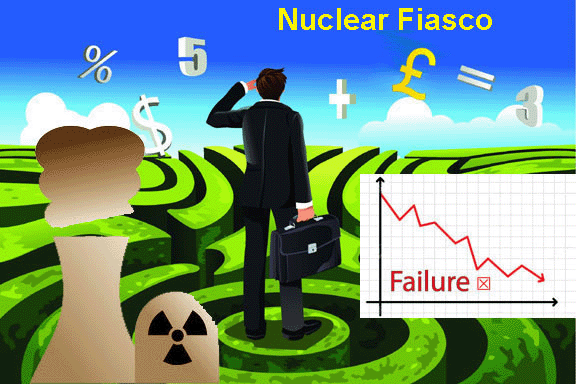
The nuclear accident at Tokyo Electric Power Company’s (TEPCO’s) Fukushima Daiichi Nuclear Power Station (FDNPS) has left TEPCO under a huge pile of debt. At the time, there were arguments in favor of dissolving TEPCO, the liable party, but due to the Japanese government’s generous support, the company continues to exist to this day. In this article, we attempt to throw light on the reasons why TEPCO was not bankrupted.
Act on Compensation for Nuclear Damage
Japan’s Act on Compensation for Nuclear Damage states in Section 3, “Where nuclear damage is caused as a result of reactor operation etc. during such operation, the nuclear operator who is engaged in the reactor operation etc. on this occasion shall be liable for the damage, except in the case where the damage is caused by a grave natural disaster of an exceptional character or by an insurrection.” In Section 4, the Act stipulates that “Where nuclear damage is covered by the preceding section, no person other than the nuclear operator who is liable for the damage pursuant to the preceding section shall be liable for the damage.” Thus while imposing on the nuclear power operator unlimited no-fault liability with liability concentrated in its hands, it also provides exemptions in the form of “a grave natural disaster of an exceptional character or by an insurrection.” At the same time, Section 16 provides for necessary government assistance to pay compensation, and Section 17 states that in the case of “a grave natural disaster of an exceptional character or by an insurrection” the government “shall take necessary measures to relieve victims and to prevent the damage from spreading.”
What became a problem at the time of the FNDPS accident was whether or not it had occurred due to a grave natural disaster of an exceptional character. From the outset, the government indicated the stance of not applying the exemption, stating, “As the nuclear power operator, TEPCO should bear liability for damage caused by this nuclear power plant accident.” TEPCO insisted that the accident was due to “a grave natural disaster of an exceptional character” and that “there is a margin for judging that an exemption be invoked,” but eventually accepted liability.
Financing immediately after the accident
Since the exemption was not invoked, TEPCO faced unlimited compensation for the damage caused by the FNDPS accident. In 2011, the government estimated that compensation alone would be of the order of 4.5 trillion yen.
TEPCO’s cash and deposits as the accounts were closed at the end of the third quarter of 2010 (December 31, 2010) were 366.5 billion yen. With company bond redemptions of 500 billion yen coming up in FY2011 and the need to procure fuel worth 800 billion yen, financing from the market was fraught with difficulties after the FNDPS nuclear accident, bringing TEPCO close to bankruptcy.
TEPCO’s cash and deposits leaped up to 2.2 trillion yen at the close of accounts for FY2010 (March 31, 2011). This was almost all in long-term loans. According to news reports at the time, 1.865 trillion yen was provided in loans of three to ten years, with no warranty and at the same interest as before the accident, by eight financial institutions, including the Sumitomo Mitsui Banking Corporation (600 billion yen), the Mizuho Corporate Bank (500 billion yen) and the Mitsubishi UFJ Bank (300 billion yen). It is said that in the background to this was the statement by the then deputy minister of the Ministry for the Economy, Trade and Industry (METI), Kazuo Matsunaga, that “We must also not shirk responsibility. I would also like to see support from financial institutions.”
TEPCO thus managed to overcome the problems of March 2011, but even after that, arguments insisting that TEPCO be declared bankrupt and go into legal liquidation continued. However, in the end, it was decided to allow the company to survive from the viewpoint that if TEPCO went into legal liquidation compensation to those affected by the nuclear accident would be delayed.
Especially problematical were the electric power bonds issued by TEPCO. The Electricity Business Act allows TEPCO and the other power business operators to issue company bonds with “general collateral” that make it possible to prioritize debt repayment to other creditors. In other words, if a company goes bankrupt, those financial institutions that originally stood to make profits from the purchase of the company bonds would receive first priority in debt repayment, whereas compensation for those affected by the nuclear accident would be on the same pecking order as repayment for other debts (e.g. loans, etc.).
TEPCO’s net assets as of March 31, 2011 were 1.6024 trillion yen. It was clear that the estimate for compensation at the time of 4.5 trillion yen would put TEPCO in a situation of net capital deficiency. The balance of company debt at this time was 4.4251 trillion yen. If TEPCO were to be declared bankrupt at that time, the company debt would first have to be repaid, after which other debts, including the liabilities to those affected by the nuclear accident, would be paid out.
There was also the option of allowing TEPCO to go bankrupt, and having discharged the debts the government would, in a separate deal, then pay out compensation from the national treasury to those affected by the nuclear accident. However, since the accident was still ongoing, liquidating TEPCO might pose obstacles to the work of the post-accident clean-up. Considering this, it is not unreasonable that the government at the time decided to allow TEPCO to continue to exist. However, by allowing TEPCO to survive, the stockholders who had invested in TEPCO and the financial institutions that had provided funds, i.e. the investors who bore a certain risk for the sake of profits, suffered no losses, and in their place the greater population of Japan overall would take on the burden. That was how the current TEPCO survival scheme was born.
The TEPCO survival scheme
In August 2011, the government enacted the Nuclear Damage Compensation Facilitation Corporation Act to avoid a TEPCO bankruptcy. The scheme inherent in the act is as follows:
1) The government shall establish the Nuclear Damage Compensation Facilitation Corporation (later reorganized as the Nuclear Damage Compensation and Decommissioning Facilitation Corporation in August 2014) as the facilitating organization handling compensation payments and so on in the case of nuclear damage, and nuclear power operators are to establish a reserve fund (general contributions) to provide compensation.
2) The Corporation shall levy a special contribution from the nuclear operator that caused the accident (in this case TEPCO).
3) The Corporation shall provide financial facilitation (granting of funds, acceptance of stocks, loans, purchase of company bonds, etc.) when the Corporation’s facilitation is required for compensation by the nuclear operator. To procure the funds necessary for financial facilitation, the Corporation can issue government-guaranteed compensation bonds to borrow money from financial institutions.
4) In the case that special support is required from the government, the Corporation and the nuclear operator shall determine the amount of compensation, prepare a “special business plan” that sets out the content and value of the financial support, policies for business management rationalization and so on, and receive approval from the relevant ministers (the Cabinet Office and METI). Following approval, the government will allocate government bonds to the Corporation, the necessary funds then being granted to the nuclear operator by the Corporation.
5) The Corporation shall pay into the national treasury money up to the amount of redemption of the government bonds.
Based on this scheme, TEPCO and the Corporation devised a Special Emergency Business Plan in November 2011, following up with a Comprehensive Special Business Plan in May 2012, a New Comprehensive Special Business Plan in January 2014 and a New-New Comprehensive Special Business Plan in May 2017. On the basis of these business plans, the government established a government bond allocation limit of 13.5 trillion yen (including decontamination and mid-term storage of radioactive wastes, etc. as well as compensation) for the Corporation and it was decided to provide a grant of 10.2006 trillion yen to TEPCO. In addition to this, the Corporation accepted one trillion yen in TEPCO stocks in July 2012 (making the Corporation the holder of 54% of TEPCO stocks, which would increase to 80% if class B priority stocks were converted to class A stocks).
Furthermore, besides the above, TEPCO also estimates that that 8 trillion yen will be needed for decommissioning and as countermeasures for contaminated water. As a result, the costs involved in dealing with the FNDPS nuclear accident are therefore currently estimated to be 21.5 trillion yen.
Of this, it is presumed that the 4 trillion yen estimated for decontamination costs will be eventually supplemented by profits accruing from the sale of TEPCO stocks, the 1.6 trillion yen costs for intermediate storage facilities will be paid from the national treasury, and that 3.7 trillion yen of the total compensations will be paid by nuclear power operators from the general contributions, while 0.24 trillion yen will be borne by imposing a power distribution consignment charge on power companies that have entered the market recently due to deregulation of the power market.
Mining.com 10 June 18 Valentina Ruiz Leotaud Spanish media are reporting that between 3,000 and 5,000 people hailing from different cities in Spain, as well as from Portugal and France, rallied this weekend in Salamanca to express their rejection to a uranium mine being built in the Retortillo municipality.
The Salamanca project is Berkeley Energia’s (ASX, LSE: BKY) flagship mine and is located on the Retortillo-Santidad uranium deposit, in the northwestern part of the country. The open-pit mine is expected to produce an average of 4.4 million pounds of uranium per year.
For months, however, the plan has been a target of numerous actions by environmentalist groups, the most recent one organized by the Iberian Antinuclear Movement, whose members advocate for the closure of all nuclear energy projects………
According to the demonstrators, uranium exploitation in Salamanca would have serious environmental impacts both in Spain and Portugal. They also said that the project does not make economic sense because of low uranium prices, because it would create very few job opportunities for the local people and because the trend in Europe is to shut down these types of mines due to the dangerous pollution they cause. …..http://www.mining.com/thousands-protest-uranium-mine-spain/
Both leaders land in Singapore as US seeks to manage expectations, Ft.com Bryan Harris and Stefania Palma in Singapore and Demetri Sevastopulo in Los Angeles
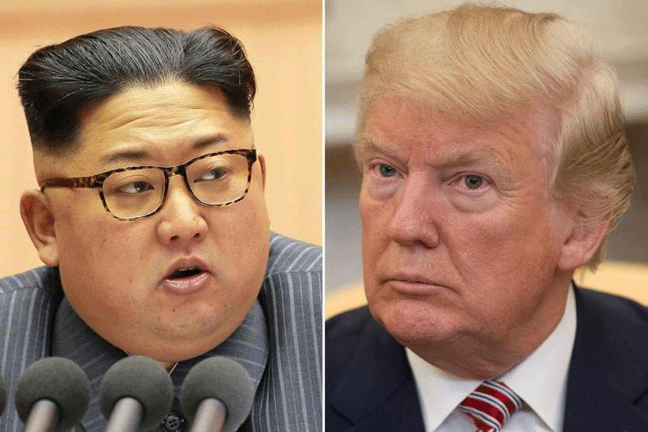
Kim Jong Un and Donald Trump landed in Singapore on Sunday in preparation for their historic summit, even as US officials sought to manage expectations for Tuesday’s much-heralded meeting. Once pitched as the final stage of a landmark denuclearisation deal, the meeting is increasingly being spun as just the beginning of a process of engagement between the two bitter adversaries. “I feel that Kim Jong Un wants to do something great for his people,” said Mr Trump as he departed Canada en route for the south-east Asian city state. “There’s a good chance it won’t work out. There’s probably an even better chance it will take a period of time.” The aim of the summit on Tuesday is to see if Mr Kim and Mr Trump could establish a level of chemistry and trust that would provide impetus for further negotiations between Washington and Pyongyang, according to one senior US official.
Joseph Yun, the state department’s former point-man on North Korea, echoed the sentiment, saying it was clear that high-level meetings between US and North Korean officials in recent days had reduced expectations on the American side. “Gone is the talk of all-in-one big bang and denuclearisation. The magic word seems to be process and progress,” said Mr Yun, adding that it would still be important to have a “substantive result” from the summit. Mr Trump said in advance of his arrival that he would know “within the first minute” of the meeting whether Mr Kim was “serious”. He added that he could make such a judgment based on “my touch, my feel — that’s what I do”……….
Washington is seeking CVID — the complete, verified and irreversible dismantlement of the North’s nuclear programme — a process that experts believe could take years, potentially even a decade. https://www.ft.com/content/99901e74-6c5b-11e8-92d3-6c13e5c92914
it is impermissible for the government, which is spending such an enormous amount of taxpayers’ money on TEPCO, to allow the utility to give financial support to another collapsed company
If the state is rich enough to permit TEPCO to spend massive funds for unnecessary purposes, it should force the utility to take responsibility for causing the Fukushima nuclear accident and reduce the financial burden borne by the Japanese public. There is no need for TEPCO to survive any longer, because it has abdicated its responsibility for the nuclear accident and continues to support a virtually failed company.
The utility should go bankrupt and be liquidated.
* TEPCO’s annual electricity sales for 2016 totaled 241.5 billion kWh, which means each household is paying 789 yen to the utility annually. (The average electricity consumption per household in 2016 was 4,432kWh.)
Citizens’ Nuclear Information Center Create No Nukes World With Us CNIC Statement, April 11, 2018 : Liquidate TEPCO! http://www.cnic.jp/english/?p=4130, BY CNIC_ENGLISH · JUNE 4, 2018 On April 5, 2018, the government’s Nuclear Damage Compensation Dispute Resolution Center notified residents of Namie Town, Fukushima Prefecture, and TEPCO of its decision to discontinue its efforts to achieve an Alternate Dispute Resolution (ADR) on the residents’ demand for additional compensation for mental anguish caused by the 2011 Fukushima nuclear accident. Continue reading →
FT 7th June 2018 Every government makes mistakes, but it takes a really special administration to make a massive blunder and then go on to make the same fundamental error again, just months later. The blunder is the £20bn
Hinkley Point nuclear power station, which Theresa May bottled out of scrapping, and which will force UK customers to buy some of the most expensive electricity on the planet — an inflation-linked £105 per MWh in today’s money.
Despite this fabulous, guaranteed price, the project is so financially toxic that it threatened to break EDF, its contractor. It
seems that Hitachi, which fancies building a £16bn nuclear power station at Wyfla in north Wales, has noticed and wants us to share the risk.
Ominously, it seems we are going to. The Hitachi design is said to be better than EDF’s, in that there is an actual working example, and the guaranteed price is rumoured to be about £15 per MWh less than Hinkley’s (though still wildlyexpensive).
Yet if even this is not attractive enough for Hitachi to go ahead unaided, is any big nuclear plant worth building?
While wind and solar costs are falling, ever-stricter safety rules continue to drive up those for nuclear. Changing patterns of use and advancing storage technology also undermine the “base load” case on which nuclear is built. Elsewhere in the land of white elephants, here’s the Swansea barrage, optimistically priced at £1.3bn and recently described by business secretary Greg Clark as “an untried technology with high capital costs and significant uncertainties”. Pulling the plug on that would at least avoid a hat-trick of terrible energy policy decisions.
a minimum requirement for any form of political consent to onsite storage would be a clear commitment by the government to phase out all nuclear power by a fixed date, so that the final amount of waste can be determined and will not just keep growing, along with the burden on local people.
CNIC Seminar report: The problems with Japan’s Plutonium: What are they and how do we deal with them? http://www.cnic.jp/english/?p=4135Caitlin Stronell, CNIC BY CNIC_ENGLISH · JUNE 4, 2018 On April 20, CNIC organized a seminar with guest speaker Prof. Frank von Hippel, a nuclear physicist from Princeton University’s Program on Science and Global Security, presenting alternative ways to dispose of spent fuel instead of reprocessing, as well as options for disposal of separated plutonium. After this presentation of technical solutions, a panel discussion took place. Prof. Eiji Oguma, a historical sociologist from Keio University’s Faculty of Policy Management and a well-known commentator on the post-Fukushima anti-nuclear movement in Japan, pointed out the political barriers that must be overcome if any of these technical solutions were to be actually implemented, no matter how much more reasonable they may seem from economic and safety perspectives. CNIC’s General Secretary, Hajime Matsukubo was also on the panel and brought into the discussion the international implications of Japan’s plutonium policy including the US-Japan Nuclear Agreement.
Prof. von Hippel explained that plutonium disposal is a global problem, with more than half of the existent separated plutonium being produced as a result of civilian reprocessing, the rest produced for military purposes. Disposing of the plutonium that had been produced for weapons during the cold war has been a huge headache for the United States with planned disposal by burning it as MOX fuel in commercial reactors proving hugely expensive. America has all but abandoned its half-built MOX plant and is now looking towards the ‘dilute and dispose’ option.
This process would use glove boxes to mix 300 grams of plutonium oxide into a can of ‘star dust’ (a secret ingredient from which plutonium would be difficult to separate again). This can would then be placed in a plastic bag and another ‘outer blend can.’ Another way of immobilizing plutonium is the Hot Isostatic Pressing method, which is being developed in the UK and utilizes radiation-resistant, low-solubility ceramic. After plutonium has been immobilized, it is safer to bury it underground than keep it on the surface and Prof. von Hippel mentioned the deep borehole disposal method which uses techniques developed for drilling oil and geothermal wells that can bore five kilometers into the earth. In the US, however, plans for a demonstration project of this method of radioactive waste disposal were rejected by local governments.
Prof. von Hippel stressed that the main lesson for Japan is that separated plutonium is extremely difficult to dispose of and that it is definitely better not to separate any more than is already stockpiled. Instead of sending spent fuel from the nation’s nuclear power plants to Rokkasho for reprocessing, it would be safer and much cheaper and more efficient to set up dry cask storage for the spent fuel onsite at the plant. Prof. von Hippel showed us successful examples of this method in the US and suggested that there were moves in this direction in Japan as well.
Prof. von Hippel’s detailed technical solutions were very convincing. Yet despite the dangers of holding such a large plutonium stockpile (47 metric tons, enough for approximately 6,000 nuclear weapons), despite the massive costs involved and despite having no concrete viable plans as to how to actually use the separated plutonium, official Japanese government policy is to continue to separate even more plutonium at the Rokkasho Reprocessing Plant, which is currently due to commence operations in 2021.
In the panel discussion which followed Prof. von Hippel’s presentation, Prof. Oguma agreed that reprocessing was most certainly problematic, but, he pointed out, it will be extremely difficult to just put up onsite storage of spent fuel, no matter how reasonable a technical solution it is. Political consent must be gained from the people in communities, which will not just be hosting the nuclear power plant, but will be asked to store its radioactive waste as well. As Prof. Oguma pointed out, especially post-Fukushima Daiichi, no one trusts the Japanese Government’s nuclear policy and the likelihood that they will agree to yet another imposition that can be perceived to be long-term and dangerous, is very low. Much of the Japanese public also believes that onsite storage is merely an excuse for the nuclear industry to keep afloat. If spent fuel pools fill up, utilities will not be able to operate their plants. For many activists this is one way of closing them down, which is their main aim. Prof. Oguma argued that a minimum requirement for any form of political consent to onsite storage would be a clear commitment by the government to phase out all nuclear power by a fixed date, so that the final amount of waste can be determined and will not just keep growing, along with the burden on local people.
This is a significant difference in perspective. Prof. von Hippel’s main aim is to stop reprocessing and reduce stocks of separated plutonium, even if nuclear power generation continues, but Prof. Oguma claims that without an overall reassessment of the entire nuclear power policy it will be impossible to gain political consent for Prof. von Hippel’s proposed onsite storage.
The economics is not as straightforward as it sounds either. While it is undoubtedly cheaper, in a purely mathematical sense, to simply dispose of spent fuel as waste, instead of reprocess it and fabricate MOX fuel, the accounting systems of utilities make the more efficient alternative of direct disposal very difficult. At the moment, spent fuel is counted as an asset on utility balance sheets under the premise that it will become MOX fuel. If reprocessing is officially abandoned, all of the spent fuel ‘assets’ will become ‘liabilities’ and many utilities will be facing possible bankruptcy. Prof. Oguma suggested that the only way to overcome all these political and economic barriers is for the government to disclose all information on nuclear power and reprocessing and to conduct an open public debate on how to proceed. If a public consensus is reached, based on all the scientific, technical and economic data available, then reprocessing should be stopped.
CNIC’s Hajime Matsukubo pointed out that the Japanese government’s accountability crisis was not just domestic, but international. Building up such large stocks of plutonium at huge cost and with no credible purpose inevitably makes neighboring countries suspect Japan’s intentions. Indeed documents recently revealed show that the present Vice Minister of the Ministry of Foreign Affairs has long been an advocate of Japan becoming a nuclear weapons state. Japan’s opposition to President Obama’s proposal that the US adopt a no first-use of nuclear weapons policy, was reported in the Japanese media. Thus Japan’s credibility as a strong advocator of non-proliferation is already failing and the plan to separate even more plutonium at Rokkasho could easily provoke a regional nuclear arms race, destabilizing the region, just as hopes rise that the situation in North Korea may improve.
Mr. Matsukubo also pointed out that Japan is the only non-nuclear weapons state that is permitted to separate plutonium under the US-Japan Nuclear Cooperation (123) Agreement. This creates double standards which weaken the entire global non-proliferation regime. For example, Saudi Arabia is negotiating a 123 Agreement with the US and demands that it also be allowed to reprocess spent fuel ‘like Japan.’
For all of the above safety, economic and non-proliferation reasons, it would seem that there is plenty of ammunition for the movement against reprocessing. Indeed, Mr. Matsukubo said that in many ways it should be easier to stop reprocessing than stop nuclear power generation. Why hasn’t this happened? As well as the difficulties mentioned by Prof. Oguma, there is also the factor that the movement against reprocessing in Japan has not been as strong as the movement against nuclear power. Reprocessing seems like a more convoluted, more removed issue, perhaps difficult for people to grasp and focus on. All speakers agreed that the movement against reprocessing must be strengthened. The first thing that must be done to achieve this is to raise awareness and understanding regarding this issue within the broader anti-nuclear movement (both power generation and weapons) and the general public. Providing accurate information on the nuclear fuel cycle in a format that people can understand is the vital first step. As many people as possible must be informed about the costs, the dangers and the alternatives. The movement must be strong enough to demand that governments and utilities disclose all data, engage in an open debate and commit to implementing the consensus which emerges.
Prof. Oguma said that he and many other activists in Japan were committed to conveying the messages of Fukushima to the larger world, and to contributing to international solidarity on ending nuclear power. This also includes understanding how other countries see Japan. The plutonium issue is one that has particularly strong international impacts and implications and by pursuing this present policy the Japanese government is only damaging Japan’s international credibility, especially regarding non-proliferation.
The seminar concluded that, whether on an international level or a domestic one, the Japanese government must restore accountability and democracy, it must formulate a responsible nuclear policy that is demonstrably safe, economic and realistic and which has the consent of the people. Viable technical alternatives to reprocessing spent fuel are available but can only be implemented through raising awareness and a change in political will, which as a movement, we must focus on with added strength.
A major wildfire is sweeping through the Chernobyl nuclear disaster area. The authorities have deployed dozens of fire trucks as firefighting aircraft bombard the radioactive exclusion zone with massive amounts of water.
The fire inside the Chernobyl ‘dead zone,’ which is now part of Ukraine, started on Tuesday morning, when dry grass was ignited, local emergency services said in a statement. The wildfire subsequently reached a forest, where up to 10 hectares (24 acres) are now in flames.
Some 29 vehicles and 126 personnel have been dispatched at the scene, with several planes and helicopters dropping water from the sky on the area engulfed by wildfire.
The zone saw another large blaze last year, which scorched 25 hectares (60 acres) of land.
Chernobyl became the site of one of the biggest nuclear disasters in history, when a local power reactor blew up in 1986, leading to massive contamination of the surrounding area. The severely damaged reactor was sealed off by a protective ‘sarcophagus’ of steel and concrete, while the nearby town of Pripyat had its 50,000 population evacuated. Today, Pripayt is a ghost town. The so-called ‘exclusion zone’ was imposed around the site of the disaster, banning visitors.
Current winds are not blowing residual pollution towards the country’s capital Kiev, local authorities said, noting that radiation levels remain normal.
Trump’s nuclear bailout could cost consumers up to $17 billion each year https://inhabitat.com/trumps-nuclear-bailout-could-cost-consumers-up-to-17-billion-each-year/ The Trump Administration is taking unprecedented steps to bail out failing nuclear and coal power plants, effectively nationalizing the American energy market with potentially drastic consequences for the renewable energy industry and the American consumer. According to an updated report from the Nuclear Information and Resource Service (NIRS), the Trump Administration’s plan could result in artificially high electricity prices. The planned subsidies for nuclear power plants alone could increase the overall cost of electricity in the U.S. by up to $17 billion each year; the subsidies for coal plants would add even more. This skewing of the American energy market, which has recently seen significant progress made by wind and solar energy, could also result in the decline of renewable energy in the U.S.
“By pushing for a nationwide bailout for nuclear power and coal, the Trump administration is rushing headlong into an energy buzz saw, and they don’t even seem to know it,” NIRS executive director Tim Judson said in a statement. It should come as no surprise to those who have followed President Trump that he would take steps to support coal and nuclear power at the expense of renewable energy. What is surprising is the heavy-handedness with which his administration is attempting to directly subsidize failing businesses, thereby ignoring the Republican Party’s long-held belief in the supremacy of a market free from government intrusion. By doing so, Trump could decimate the renewable energy industry, which employs more American workers than coal and nuclear combined.
The administration claims that it must act to save failing coal and nuclear plants in the interest of national security. Not everyone is buying that excuse. “The Administration’s warnings of dire effects from power shortages caused by shortages of reliable and resilient generation are contradicted by all of the bodies with actual responsibility for assuring adequate supplies,” said former member of the U.S. Nuclear Regulatory Commission Peter A. Bradford. “There are no state or federal energy regulators petitioning DOE for these measures. Indeed, those who have spoken clearly have said that such steps are unnecessary. … As was said in the run-up to the 2003 invasion of Iraq, the facts are being fixed around the desired end result.”
In order to enact its bailout policies, the Trump Administration has three options: Congressional action, review and approval by the Federal Energy Regulatory Commission or a formal National Security Council assessment. While the bailouts are likely to be delayed for the foreseeable future, if they even occur, the Trump Administration’s decision to subsidize failing power plants at the expense of American industry and consumer well-being makes its priorities quite cle
For all the attention North Korea is getting, there’s a web of nuclear threats around the world that risk setting off an arms race all on their own — even if the North Korean threat goes away.
The big picture: It’s worth taking the time to focus on the other standoffs. Heightened risk is not a certainty that nuclear conflict breaks out, but the web is tangled enough that a spark of conflict could have wide-ranging global consequences.
Iran
Iran began increasing its uranium enrichment following the U.S. withdrawal from the nuclear deal, and it may not remain in the deal with other countries much longer. Most of the incentive to remain in the deal came from economic benefits of doing business with the United States — and Europe alone will have trouble enticing Iran to stay in the deal.
Saudi Arabia
The Saudis have said they would consider making nuclear weapons if Iran restarts its nuclear weapons program. And Saudi Arabia has been seeking U.S. help in starting a nuclear program, even though Riyadh hasn’t accepted terms of uranium enrichment that would prevent the program from escalating beyond peaceful aims. Israel has gotten involved in the conversation in an attempt to prevent a potential arms race in the region.
China
Its nuclear policy states that it would only use nuclear weapons in response to an attack — but analysts close to the Chinese government fear that the U.S. National Security Strategy and Nuclear Posture Review frame China as a potential target for the U.S. as a primary rival on the world stage. And China has been working to catch up to the U.S. in the meantime.
India, Israel, and Pakistan
These three countries never signed the nuclear Nonproliferation Treaty (NPT), which was drawn up as a way to stop the spread of nuclear weapons. And they each have nuclear arsenals.
Pakistan and India’s nuclear tension and arms race goes all the way back to the signing of the NPT in 1968‚ and their rivalry goes back even farther, to the partition of British India in 1947. According to the Brookings Institution, the cascade of geopolitical influence is dizzying in this case, too: Pakistan responds to India’s moves in the nuclear realm, and India responds to both Pakistan and China. And China in turn, responds to India and the U.S. This circle of tension has kept the region nearly on the brink of nuclear conflict since the 1960s.
Israel has maintained its nuclear weapons arsenal to keep up with the possibility that Saudi Arabia and Iran could become nuclear states, although it has kept a “strategic ambiguity” about it, neither confirming nor denying its existence. It’s believed that Israel began its program in the 1950s and that its weapons can reach Libya, Iran, and Russia, creating potential flash points there.
The U.K. is viewed as adept at building a nuclear weapons state while using a minimal deterrent — although it does not rule out using nuclear weapons in a first strike, per the Nuclear Threat Initiative.
Countries that had nuclear weapons/programs
Libya gave up its nuclear weapons in 2003. Many analysts believe Libya’s experience giving up nuclear weapons and Muammar Gadhafi’s downfall following the abandonment is scaring North Korea’s Kim Jong-un away from denuclearization.
Belarus, Kazakhstan, and Ukraine had nuclear weapons at one time following the collapse of the Soviet Union, but returned them to Russia.
Argentina, Brazil, South Korea, and Taiwan all also abandoned nuclear weapons programs.
South Africa developed nuclear warheads but dismantled them before joining the NPT in the 1990s.
Iraq dismantled its nuclear weapons program for UN inspectors after the Persian Gulf War.
Baseload power is not the answer to the variability of renewable energy, a German energy official said Friday, and energy storage may not be the answer either.
Germany has achieved moments in its Energiewende, or Energy Transition, in which renewables met 100 percent of demand without the aid of baseload power or batteries, said Thorsten Herdan, a director general for energy policy at the German Federal Ministry for Economic Affairs and Energy. Germany was able to do that, he argued, because of its system’s flexibility.
1. Flexibility Trumps Baseload
“What we need for this fluctuating renewable energy in the electricity mix is not baseload. Baseload is poison for our electricity transition in Germany,” Herdan said in a briefing at the Dirksen Senate Office Building in Washington, D.C. “What you need is flexibility, because the sun is shining and then you have PV production, wind is blowing and you have wind production. So it’s not according to demand, it’s according to weather conditions, which means they are there in any case and then you need to have flexibility to fill the gap.”
Baseload power was traditionally supplied by coal and nuclear plants, with peaks in demand met by natural-gas plants.
But flexibility can displace the old notion of baseload and peak, Herdan said, and flexibility can take many forms, including gas peaker plants, batteries, demand management or regional exchanges. It’s most important to keep in mind, he argued, that flexiblity is the goal, not any one of the forms it takes.
2. Flexibility Trumps Storage
Herdan appeared in a briefing on Germany’s Energy Transition hosted by the Environmental and Energy Study Institute. Asked whether an energy transition like Germany’s will increase the demand for energy storage, Herdan said, “I don’t know whether the demand for storage will increase. What I know is the demand for flexibility will increase, will increase dramatically… and if storage proves to be the cheapest flexibility, and the market chooses storage, then of course storage will increase.
“It’s always coming down to flexibility. That’s what we need and storage is one sort of that.”
But other sorts may prove cheaper:
3. Flexibility Can Be Geographic
Energy storage is not necessarily the cheapest form of flexibility. Germany is building transmission lines into Norway so the two countries can exchange electricity between Germany’s northern wind farms and Norway’s 937 hydropower stations.
“That’s the cheapest flexibility you can think of. We don’t need to build, for that, storage facilities which are much more expensive,” he said. “If you integrate yourself the various states in the U.S. you can see that you can help each other.”
4. Markets Should Be Transparent
To manage flexibility, electricity providers need real-time information about electricity production and demand, Herdan said, and that information should also include the price for the various forms of flexibility.
“All you have to do is create a market, an electricity market, where prices tell the truth,” he said.
“I’m talking to everyone in the world about transparency, I tell them, try to get your data on electricity production real-time. We didn’t have that for a long time, and all the various lobby groups told us a lot of interesting stories. So we decided we needed to have in real time the electricity produced in every second from every source so that we know what’s going on.”
5. Flexibility Provides Reliability
Germany moved from almost no renewable energy in the 1990s to 37 percent today—its single largest block of power, almost all of it generated from wind and solar photovoltaic. Anxieties about a loss of grid reliability have not materialized, Herdan said:
“The grid is extremely stable. We have grid disruption in a year of about 12 minutes. So, 12 minutes a year is effectively nothing,” he said, citing Germany’s average duration of electric supply disruption. The comparable number in the U.S., where power producers boast of their reliability, is 114 minutes.
“So we could cope with the question of whether we can adopt a high share of renewables, the volatile ones in our grid, and we would like to talk with you about how we achieved that, what we did right, what we did wrong, and how can we perhaps achieve that in the States.”
6. Powerful Price Signals Help
Germany has more than 100 Gigawatts of renewable capacity, more than enough to meet a demand that fluctuates between 40 and 85GW. One day in May, renewables were meeting 100 percent of demand, Herdan said, and the price of electricity dropped below zero.
“At the time the renewables were at 100 percent, the price went down and it was negative, so we had a negative price, and what we say is, fine, there is nothing bad in negative prices because that very clearly tells the other generators how to behave,” he said. “That forced the generators, specifically the coal generators, to change their behavior, shut them down or reduce them or whatever is possible.”
Market transparency and real-time data allow prices to send such immediate signals to power producers.
“That is something that we established last year and that we heavily use in order to not be told by lobby groups that offshore wind power is the best one, or coal generators are the most flexible ones, we can see what happens, and we can tell them how they should behave or the market tells them how they should behave.”
Herdan cautioned that Germany’s example is not a model for every country. Germany has decided not to use nuclear power, for example, and few countries share that commitment. But he contends that Germany’s example reveals an underlying principle about the importance of flexiblity.
“Of course as I said in the beginning it’s different in the various countries around the world and also in the U.S., but this principle—that if you create renewable energy you need to have flexibility and no baseload—that is valid for each and every country in the world.”
Despite a lengthy record of safety violations, the University of California will continue its 75-year legacy of running Los Alamos National Laboratory, the U.S. Department of Energy and National Nuclear Security Administration announced Friday.
A management partnership that includes the university, research and development nonprofit Battelle Memorial Institute and Texas A&M University, the alma mater of Energy Secretary Rick Perry, will be paid $2.5 billion annually to run Los Alamos, the birthplace of the atomic bomb. They’re calling their partnership Triad National Security LLC.
The contract could be worth upward of $25 billion over the next decade, with hundreds of millions of dollars more in performance-based bonus fees. Six other corporations will join the team in support roles……..
This is the second time the University of California has effectively maintained control over the laboratory despite concerns about serious mismanagement. In 2003, and again in 2015, the National Nuclear Security Administration said it would seek a new management contractor for the New Mexico lab following significant security breaches, costlyaccidents and injured employees.
The current management team, which also includes defense contractor Bechtel, amassed more than $110 million in fines and withheld bonuses because of health and safety issues. An electrical accident in 2015 left a worker hospitalized for over a month, and waste packaging errors led to a drum burst in 2014 at the Waste Isolation Pilot Plant in Carlsbad, exposing workers to radiation. The accident caused the storage facility to shut down for nearly three years…….
This is a pivotal time for the lab. Los Alamos is expected to take on new nuclear work, building up to 30 plutonium pits per year. Producing the softball-sized plutonium metal cores, which trigger a reaction inside a nuclear weapon, is dangerous work, and Los Alamos has struggled to safely build even a single stockpile-ready pit in recent years.
Critics of the lab questioned how the university emerged as a winner once again and how any serious overhaul of the lab’s problems can occur if part of the existing leadership remains in place. Even the federal government called for a “culture change” at Los Alamos when it solicited bidders for the new lab contract last year.
John Boothman, June 10 2018, The Sunday Times Scotland’s ability to safeguard nuclear sites will be compromised by Brexit, say government advisers who are concerned that EU oversight of inspections and monitoring of atomic facilities will be lost.
An expert group led by Professor Anne Glover, president of the Royal Society of Edinburgh, said Westminster will need to establish a system of policing the country’s nuclear power plants, which include Torness in East Lothian and Hunterston B in North Ayrshire, when the UK is forced to leave Euratom, the European nuclear regulator.
The UK’s Office for Nuclear Regulation (ONR) must take on extra duties after the UK leaves the EU, including the “safeguards” regime required under international rules to prevent misuse of fissile materials, the panel said.
Parliamentary group opposes Iran joining FATF as fate of nuclear deal is in disarray http://www.tehrantimes.com/news/424284/Parliamentary-group-opposes-Iran-joining-FATF-as-fate-of-nuclear,June 9, 2018 TEHRAN– A number of conservative Iranian lawmakers, who are members of the Velayat (Jurisprudence) faction, issued a statement on Saturday calling on other fellow parliamentarians not to approve the legislation on joining the Financial Action Task Force (FATF) as the U.S. pullout from the nuclear agreement has put the fate of the accord in disarray.
The statement said since the U.S. intends to impose “crippling” sanctions on Iran an approval of the FATF will pave the way for the U.S. to get access to all the economic and banking transactions by Iran.
“Now that the future of the JCPOA [the 2015 nuclear deal] has become vague after the withdrawal of the U.S. and the order to return the sanctions, it is illogical to join the FATF,” the statement said.
On May 8, U.S. President Donald Trump withdrew from the UN-endorsed nuclear agreement and ordered a return of sanctions on Iran.
U.S. Secretary of State Mike Pompeo announced on May 21 that the U.S. will apply economic and military pressure against Iran and will impose “the strongest sanctions in history” on the Islamic Republic.
The FATF is a set of measures designed to make financial affairs transparent and verifiable.










 nuclear-news