Nuclear power at a huge disadvantage in Middle East – but do they want it for nuclear weapons?
Nuclear Power’s Fading Moment in the Middle East, Stratfor, 7 June 18,
Highlights
- Demographic, climatic, economic and technological pressures over the next several decades will force key countries in the Middle East and North Africa to gradually expand and diversify their electric power grids.
- Advances in competing technologies and high costs will put nuclear power at a disadvantage compared with other electricity-generating options. Even so, countries in the region will continue to pursue nuclear power given its accompanying political prestige.
- The window for regional powers to develop unrestricted nuclear programs is closing fast. Economic realities will weaken their arguments for civilian nuclear power, allowing global powers to justify asserting more control over the expansion of nuclear programs in the region.
 …… A Tale of Two Uses
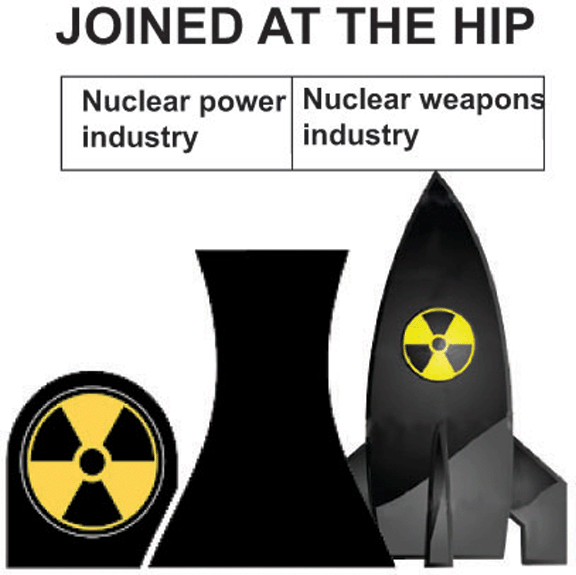
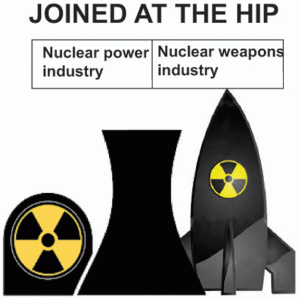
Nuclear technology has always had a civilian side and a military side. Clearly, there’s a difference between a peaceful, civilian-led nuclear energy program and one used to develop nuclear weapons. But the civilian and military sides share processes that inextricably link them and that have profound security and proliferation implications. Countries with end-to-end nuclear programs — that is, programs that include processing, enrichment and reprocessing capabilities — may insist their intentions are peaceful, but the dual-use nature of the technology puts them closer to producing enough nuclear material to build a weapon should they decide to take that route.
Throughout much of the world, nuclear power is struggling to compete economically; the capital costs are high, and lengthy construction delays plague most ongoing nuclear projects. As storage technologies improve, and as the use of smart and distributed power grids increases, the argument countries make for why they want to develop a civilian nuclear program becomes weaker, raising questions about motives and making it even more difficult for them to justify to global powers the need for them to develop an end-to-end nuclear program. Political control over nuclear proliferation may be slipping as the Nuclear Nonproliferation Treaty weakens, but economic realities will help limit nuclear expansion just the same.
………While natural gas will remain the largest fuel source for electricity in the region, generation powered by renewables and nuclear is poised to play a more prominent role. Those two modes of power production don’t directly compete in a traditional electrical grid, but advancing technology and changes in grid makeup will bring them into closer proximity.
When both capital costs and variable costs such as fuel are factored in, nuclear power generally struggles to compete economically with natural gas, wind and solar power — though it might make sense in some cases. Nuclear power’s advantage is its ability to provide baseload power — it produces electricity at a constant, continuous level. Some other forms of generation — renewables, in particular — would need to be paired with storage or a baseload plant to meet demand on a constant basis.
Improvements in efficiency technologies, the declining cost of energy storage, the development of smart grids and the increased use of decentralized grids (especially in the developing world) will combine to minimize baseload requirements, leaving traditional nuclear power behind. While new technology, such as small, modular reactors, could play a role in making nuclear energy more competitive, the industry likely will be forced to play catch-up to some degree.
And though nuclear power’s contribution to regional electrical grids is expected to rise over the next 20 years, its declining economic competitiveness means there is a narrow window for countries to exploit nuclear power’s role in diversifying energy grids to support the development of domestic nuclear programs that may have a more nefarious dual use. https://worldview.stratfor.com/article/nuclear-powers-fading-moment-middle-east
No comments yet.
1 This Month

of the week – Shut Down Drone Warfare!


Tell the Ukrainian Government to Drop Prosecution of Peace Activist Yurii Sheliazhenko

Petition to revoke the licensing of the Near Surface Nuclear Disposal Facility (NSDF) at Chalk River. https://www.ourcommons.ca/petitions/en/Petition/Details?Petition=e-7247
To see nuclear-related stories in greater depth and intensity – go to https://nuclearinformation.wordpress.com
-
Archives
- April 2026 (57)
- March 2026 (251)
- February 2026 (268)
- January 2026 (308)
- December 2025 (358)
- November 2025 (359)
- October 2025 (376)
- September 2025 (257)
- August 2025 (319)
- July 2025 (230)
- June 2025 (348)
- May 2025 (261)
-
Categories
- 1
- 1 NUCLEAR ISSUES
- business and costs
- climate change
- culture and arts
- ENERGY
- environment
- health
- history
- indigenous issues
- Legal
- marketing of nuclear
- media
- opposition to nuclear
- PERSONAL STORIES
- politics
- politics international
- Religion and ethics
- safety
- secrets,lies and civil liberties
- spinbuster
- technology
- Uranium
- wastes
- weapons and war
- Women
- 2 WORLD
- ACTION
- AFRICA
- Atrocities
- AUSTRALIA
- Christina's notes
- Christina's themes
- culture and arts
- Events
- Fuk 2022
- Fuk 2023
- Fukushima 2017
- Fukushima 2018
- fukushima 2019
- Fukushima 2020
- Fukushima 2021
- general
- global warming
- Humour (God we need it)
- Nuclear
- RARE EARTHS
- Reference
- resources – print
- Resources -audiovicual
- Weekly Newsletter
- World
- World Nuclear
- YouTube
-
RSS
Entries RSS
Comments RSS
 nuclear-news
Leave a comment