Trump: ‘I don’t think I have to prepare very much’ for North Korea nuclear summit
It’s about ‘attitude’ not ‘preparation,’ the president said of upcoming talks on Tuesday with North Korean leader Kim Jong Un in Singapore. by Jonathan Allen and Dartunorro Clark / Jun.08.2018
WASHINGTON — President Donald Trump said Thursday that he doesn’t need to study for his upcoming nuclear summit with North Korean leader Kim Jong Un.
“I think I’m very well prepared. I don’t think I have to prepare very much,” Trump told reporters at the White House Thursday as he posed for photos with Japanese Prime Minister Shinzo Abe. “This isn’t a question of preparation. It’s a question of whether or not people want it to happen, and we’ll know that very quickly.”
Trump is planning to travel to Canada on Friday for a two-day meeting with the Group of Seven industrial nations that is likely to focus heavily on trade issues before heading to Singapore for his historic sit-down with Kim…….
the president said he has not removed the U.S. sanctions against North Korea going into the meeting and is willing to walk out of the talks if they aren’t going well.
“All I can say is I’m totally prepared to walk away,” Trump said. “If you hear me saying we’re going to use maximum pressure, you’ll know the negotiation did not do well.”
Trump added that he is also prepared to ramp up sanctions on North Korea if the negotiations fall apart.
……..Pompeo downplayed comments made by Trump’s personal lawyer, Rudy Giuliani, earlier this week, that Kim had gotten “on his hands and knees and begged” for the summit after Trump abruptly canceled it last month. “I think it was a bit in jest,” Pompeo said of those remarks. “We’re moving forward and focused on the serious issues…Rudy doesn’t speak for the administration when it comes to this negotiation.”
Milk in parts of Ukraine has radioactivity levels up to five times over the country’s official safe limit, new research shows.
Scientists from the Greenpeace Research Laboratories at the University of Exeter and the Ukrainian Institute of Agricultural Radiology sampled cow’s milk from private farms and homes in the Rivne region, about 200km from the site of the Chernobyl Nuclear Power Plant explosion in 1986. They found levels of radioactive caesium in milk above Ukraine’s safe limit for adults of 100 Becquerel per litre (Bq/L) at six of 14 settlements studied, and above the children’s limit of 40 Bq/L at eight sites.
The highest levels found were about 500 Bq/L – five times over the limit for adults and more than 12 times that for children.
“More than 30 years after the Chernobyl disaster, people are still routinely exposed to radioactive caesium when consuming locally produced staple foods, including milk, in Chernobyl-affected areas of Ukraine,” said Dr Iryna Labunska, of Greenpeace Research Laboratories at the University of Exeter.
“Many people in the area we studied keep cows for milk, and children are the main consumers of that milk.
“Though the level of soil contamination in the studied areas is not extremely high, radioactive caesium continues to accumulate in milk and other foods, such that the residents of these villages are chronically exposed to radioactivity that presents health risks to almost every system in the body – especially among children.”
The researchers say that some simple protective measures could be taken to bring radiation exposure levels below limits at a cost of less than 10 euros per person per year for the 8,300 people living in the six villages with the highest contamination.
Such measures include applying a caesium binder, called Ferrocyn, to cows, mineral fertilisation of potato fields and feeding pigs with uncontaminated fodder.
The cost of this would decrease each year as radiation levels fall – but if no action is taken, the experts warn that milk contamination will continue to exceed the 100?Bq/L adult limit in parts of Ukraine until at least 2040.
“The Ukrainian government has taken some of these measures in the past, but that stopped in 2009,” Dr Labunska said.
“Government and international monitoring needs to take place, along with help for people affected by this radiation.
“This situation should also act as a warning and a reminder of just how long the legacy of nuclear accidents can be.
“Without adequate countermeasures, what may now seem a purely historical event will remain a daily reality for those communities most impacted.”
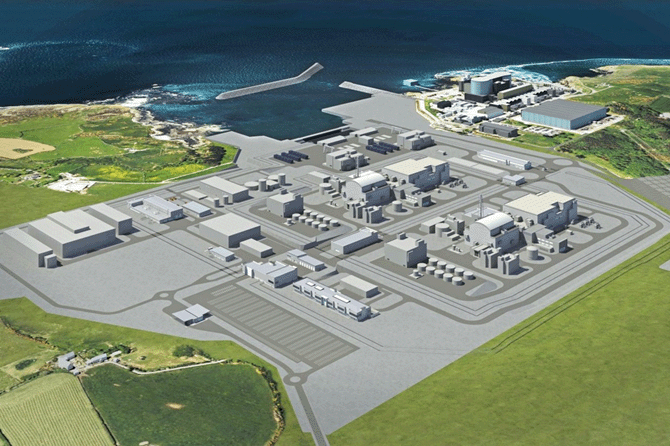
Unearthed 5th June 2018 Hitachi is seeking billions of pounds from the British government to help build a new nuclear power plant at Anglesey in Wales – but experts say the technology being used is far from proven.
Last week Hitachi-rival Toshiba confirmed that they are pulling out of a major nuclear power project in the USA which planned to use a similar reactor type to the one planned for Wylfa. Toshiba said in a press release that the South Texas
Project had “ceased to be financially viable” due to prevailing economic conditions.
The announcement leaves the UK as one of the last countries looking to build this technology, called the Advanced Boiling
Water Reactor (ABWR). Steve Thomas, Professor of Energy Policy at the University of Greenwich, said that while there are some small differences between the European reactor led by Hitachi and the abandoned US reactor
from Toshiba, the “perception that this is proven technology is not supported by the facts”.
Although there are four similar reactors that have been built in Japan, plans for construction elsewhere have seen a
series of failures. And because of the long lead-in times for developing and building nuclear reactors, power plants built today may have been designed decades ago, Thomas said
“The technology that has been built already is actually 30 year old technology, which has been updated twice
over. So the plants that are operating do not really represent what we would build, and also the performance of the plants in terms of their reliability has actually been very poor.” https://unearthed.greenpeace.org/2018/06/05/wylfa-hitachi-nuclear-reactor-type-awbr/
Here’s why Trump’s new strategy to keep ailing coal and nuclear plants open makes no sense The Conversation. James Van Nostrand, Director, Center for Energy and Sustainable Development; Professor of Law, West Virginia University,
President Donald Trump recently ordered Energy Secretary Rick Perry to take “immediate steps” to stop the closure of coal and nuclear power plants.
And according to a draft memo that surfaced the same day, the federal government may establish a “Strategic Electric Generation Reserve” to purchase electricity from coal and nuclear plants for two years.
Both proposals, which have garnered little support, are premised on these power plants being essential to national security. If implemented, the government would be activating emergency powers rarely tapped before for any purpose.
Based on my four decades of experience as a utility regulatory attorney and law professor, I can see why this proposal has caused much controversy, partly because of how energy markets work.
No credible evidence
To be sure, these industries are in trouble.
The share of U.S. power derived from coal has fallen from about one-half in 2000 to less than one-third in 2017. ……
The share of power generated by nuclear reactors, despite holding steady at about one-fifth of the national grid since 2000, is about to slide. More than 1 in 10 of the nation’s nuclear reactors are likely to be decommissioned by 2025. If completed, the only two large-scale ones under construction will cost far more than originally planned.
But are experts worried about any electricity shortages or outages between now and 2025? Well, no. Other alternatives, mainly natural gas, wind and solar energy are poised to keep filling the gaps created in recent years by other coal plant closures.
Disregarding the findings of its own study, the agency proceeded to ask the Federal Energy Regulatory Commission, an independent federal agency known as FERC that regulates energy rates and policies, for permission to subsidize coal and nuclear plants. The agency unanimously rejected that proposal.
More recently, PJM Interconnection – the nation’s biggest grid operator – declared that its power supply is not in jeopardy and that there is no reason to take this anticipated policy move.
The North American Reliability Corporation, the federal entity responsible for power reliability, has reached similar conclusions.
Unprecedented intrusion
In short, there is no emergency that justifies this unprecedented intrusion into the electricity markets that would warrant forcing taxpayers and utilities to pay a premium to keep coal and nuclear plants online.
But the Trump administration appears to be arguing that a provision known as Section 202(c) of the Federal Power Act and the Defense Production Act grant the secretary of energy the power to nationalize parts of the power sector during wartime or amid other emergencies.
I believe that the sole rationale for this new policy is as a way for Trump to keep his campaign promise to revive the ailing coal industry.
Most likely, nuclear reactors are included in the proposal because that industry is increasingly unable to compete. Also, some companies, on the brink of bankruptcy, have stepped up their lobbying.
In many cases, the power generated by coal andnuclear power plantssells at prices that are too low to cover operating costs. The federal government does not typically intervene in wholesale electricity markets, other than to enforce rules intended to ensure that the competition is fair.
Because it would override the results of competition, I have no doubt that the Trump administration’s proposals would mark a radical intervention by the government into the electricity markets.
Winners and losers
Shareholders of the energy companies that own money-losing coal and nuclear plants stand to gain if this policy gets implemented because they are unable to compete in the wholesale power markets without this kind of assist.
Another nuclear safety scare at Pelindaba as management fumbles, amaBhungane, 7 June 18
Whistleblowers have accused the South African Nuclear Energy Corporation of sidelining qualified staff in favour of inexperienced technicians.
Another safety incident has shaken the Pelindaba nuclear facility outside Johannesburg, resulting in the total shutdown of the NTP Radioisotopes plant which produces vital supplies of nuclear medicine and radiation-based products.
Senior NTP staff point fingers at parent company the South African Nuclear Energy Corporation (Necsa).
The sudden halt in production, which can be lifted only once the National Nuclear Regulator gives the all-clear, threatens global medicine supply.
AmaBhungane understands that the NTP facility was shut down after a dangerous spike in hydrogen gas levels was detected last Thursday (May 31). This, according to a senior technical employee, “could have resulted in an explosion”.
Necsa group chief executive Phumzile Tshelane, speaking on behalf of Necsa and NTP, ignored most questions put to him, saying: “We cannot disclose classified information.”
He did, however, attempt to downplay the incident. “This was a minor incident followed by vigilant safety protocols which ensured that there is no danger as alleged by your source.”
Tshelane cautioned against what he called “dangerous and alarmist allegations”.
This is the latest in a string of setbacks for NTP, the owner of the plant. In November last year, the plant was shuttered by the nuclear regulator after faulty calibrations in an instrument for analysing hydrogen levels.
Several employees claimed that since the November incident the new acting management brought in to get the plant restarted has bungled the recovery process and created unsafe work conditions.
……. AmaBhungane is in possession of correspondence between the regulator and Necsa/NTP from February to May that suggests the recovery process has been far from smooth.
The correspondence paints a picture of a breakdown of safety culture at the plant, where those working on returning the facility to full production are out of their depth.
In their communications with Necsa/NTP, the regulator flags among other things: the submission of falsified results; inaccuracies in tables submitted; the failure to demonstrate repeatability of tests; the unsuitability of a particular individual to provide theoretical training to NTP staff; a lack of due diligence in calibration; failure to submit hydrogen calibration schedules; and a repeated failure to address the poor quality of graphs.
In a letter from March, the regulator writes: “Noting the falsification of information, highlighted by the regulator… and recognising that that similar issue (sic) was previously raised by the regulator… Necsa/NTP Management is required to confirm what action(s) have been taken with regard to this matter.”
The protected disclosure also notes two separate incidents that were incorrectly handled by Necsa deployees.
The Bulgarian parliament has approved a plan to revive the Belene nuclear power plant five years after the Russian project was suspended due to financing problems and concerns about relying too heavily on Russian energy.
The parliament on June 7 approved by 172 to 14 Prime Minister Boyko Borisov’s proposal to develop a plan to resume construction of the plant on the Danube River by the end of October.
Bulgaria had already spent around $1.8 billion on the plant when the government in 2012 put a moratorium on further workunder pressure from the United States and European Union to limit its energy dependence on Russia.
Bulgaria also suspended the joint project with Russian company Atomstroyexport because it failed to find any foreign investors prepared to shoulder its spiralling costs, estimated at about $11.8 billion in total.
The suspension angered Russia, which had hoped to use Belene as an EU showcase for its new generation of pressurized water reactors.
Sofia had to pay more than 620 million euros to Russia’s Rosatom for scrapping the project, but it also received nuclear parts for two 1,000 megawatt reactors, which were conserved and maintained.
Last week, Energy Minister Temenujka Petkova said that a campaign to pick a strategic investor for the project would be launched by the end of 2018.
Russia’s Rosatom has said it will make another bid to complete the project. Also in the running are Chinese state nuclear company CNNC and France’s Framatome, which is majority controlled by EDF.
Petkova said the government does not want to commit more public funds, extend state guarantees for any loan, or sign any long-term electricity supply deals to make the project viable.
Vadim Titov, director of Rosatom Central Europe, told a Bulgarian energy conference on June 7 that the Russian company is ready to start talks with the Bulgarian authorities on reviving the project.
The Belene plant’s two 1,000 megawatt reactors were intended to replace four old Soviet-built units that were shut down more than a decade ago amid security concerns at the only existing nuclear plant in Bulgaria, at Kozloduy.
There are still two Soviet-built operational reactors at Kozloduy, dating back to 1987 and 1991, which provide about 30 percent of the country’s electricity.
Dozens of Bulgarians protested outside parliament against the government’s plans for Belene on June 7, saying the project’s benefits were not enough to justify its costs and contending that it has been a source of corrupt practices for decades.
Officials at the Waste Isolation Pilot Plant in southern New Mexico confirmed this week that processing and handling resumed June 2.
In disposing the waste, seven 55-gallon (208-liter) drums are wrapped together in a tight formation to go deep inside the ancient salt formation where the repository is located. The idea is that the shifting salt will eventually entomb the waste.
Work was halted when employees found one drum wasn’t aligned with the others that made up the waste package. The package was eventually repacked and disposed of underground.
Officials say no radiation was released and no injuries were reported.
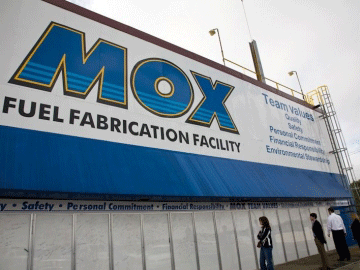
At the Savannah River Site, the future of the Mixed Oxide Fuel Fabrication Facility is in jeopardy after a report last month by the National Nuclear Safety Administration recommended the facility be repurposed to produce plutonium pits while also maximizing pit production activities at Los Alamos National Laboratory in New Mexico.
Fifty pits per year would be produced at SRS and 30 per year at Los Alamos, the report said, and “is the best way to manage the cost, schedule, and risk of such a vital undertaking.”
The MOX project arose from an agreement between the U.S. and Russia to dispose of 68 metric tons of weapons-grade plutonium. The material would be enough to create about 17,000 nuclear weapons. But the project has been beset by years of delays and cost overruns, over which the state has several times sued the federal government.
South Carolina’s legislators said the plan to re-purpose the MOX facility is premature considering shipment of diluted plutonium to the Waste Isolation Pilot Plant hasn’t been fully vetted.
Judge’s ruling keeps over-budget nuclear project from being shut down, BY SAMMY FRETWELL sfretwell@thestate.com June 07, 2018
A judge on Thursday stopped the federal government from suspending construction of a nuclear fuel factory at the Savannah River Site atomic weapons complex near Aiken.
The ruling by U.S. District Judge Michelle Childs damages federal efforts to walk away from the over-budget and behind-schedule mixed oxide fuel project, which has been on the drawing boards for more than two decades and is currently under construction. The mixed oxide fuel plant would turn excess weapons grade plutonium into fuel for commercial nuclear reactors.
The U.S. Department of Energy has been trying in recent years to suspend the project, saying it is expensive and no longer necessary to dispose of the plutonium. The latest federal plan is to ship excess plutonium, a key ingredient in nuclear bombs, to a New Mexico site for disposal.
Childs’ order temporarily halts the federal shutdown process until arguments can be heard in court over whether to keep the effort going. ……..
Savannah River Site Watch’s Tom Clements, an opponent of the MOX project, said he was disappointed in the judge’s ruling Thursday. Clements says the project isn’t necessary.
“The judge doesn’t understand what deep trouble the project is in,’’ he said, noting that building the MOX project doesn’t necessarily mean South Carolina will get rid of all surplus plutonium at SRS.
The project is about $12 billion over budget and years behind schedule, but employs hundreds of people who would be out of work if the project shuts down, boosters say. It has been touted as a way to provide new missions for SRS.
The Lobbying Bills Attached to FirstEnergy’s Coal and Nuclear Emergency Action
The bankrupt business has spent hundreds of thousands of dollars on lobbying so far this year. GTM, EMMA FOEHRINGER MERCHANTJUNE 05, 2018
In the month following its declaration of bankruptcy and its request for an emergency orderto support coal and nuclear plants, FirstEnergy Solutions spent hundreds of thousands of dollars on lobbying, documents show.
Lobbying filings show a bill of $230,000 for FirstEnergy Solutions with top lobbying firm Akin Gump Strauss Hauer & Feld so far in 2018. In total, FirstEnergy spent about $750,000 on activities with the firm, billed under work on “energy regulation” as well as federal and state government affairs. FirstEnergy did not work with Akin Gump in 2017.
“The court filing includes fees for all services provided to FirstEnergy Solutions, including restructuring advice, corporate advice, regulatory advice, etc. The lobbying report includes only fees for lobbying services,” said a FirstEnergy Solutions spokersperson. “FirstEnergy Solutions has not engaged Akin Gump in connection with the 202(c) application or with advocating for relief under any other federal statute.”
Akin Gump’s invoice for May 30 through April 30, which it filed as part of FirstEnergy Solutions’ bankruptcy proceeding, shows that the firm billed for time spent in communication with members of Congress and in calls with the Department of Energy and the White House regarding FirstEnergy’s Section 202(c) request.
The lawmakers Akin Gump contacted hail from coal states including Pennsylvania, Ohio and West Virginia. Among those lobbying for FirstEnergy on behalf of the firm Sam Olswanger, a former staff member for Republican Representative Daniel Webster of Florida, who has roots in West Virginia.
The Energy and Policy Institute, a renewable energy advocacy organization, annotated the recent filing and argued it showed the “high-priced campaign” FirstEnergy has waged to secure emergency assistance for coal and nuclear. It’s a market intervention that many in the energy industry, particularly the clean energy space, vehemently oppose.
……Between 2008 and 2017, FirstEnergy Corp. spent an annual average of about $2.05 million on lobbying. Its spending hasn’t dipped below $1.8 million since 2011.
This year, Akin Gump seems to have found an audience with the administration. On Thursday, Bloomberg reported that the administration is preparing to use Section 202 of the Federal Power Act and the Defense Production Act to “stop the further premature retirements of fuel-secure generation capacity” from coal and nuclear.
And Akin Gump isn’t the only one working on the coal and nuclear bailout. Jeff Miller, a former adviser to Rick Perry who maintains close ties to the Trump administration, has signed clients including FirstEnergy Solutions parent company FirstEnergy Corp. since moving to Washington and founding his lobbying firm Miller Strategies last year.
In a Q1 2018 filing, Miller noted that his firm was lobbying the Energy Department, the Executive Office of the President and the U.S. House of Representatives on “issues related to grid resilience” for FirstEnergy.
In addition to the $330,000 FirstEnergy paid Miller in 2017 and so far in 2018, according to filings, the firm has also received $60,000 each from the Nuclear Energy Institute and Southern Company. A $110,000 lobbying filing for Pacific Electric & Gas mentions issues such as “climate resilience” that Miller’s firm brought before the Department of Energy, Executive Office of the President, and the U.S. House of Representatives.
While it’s not unusual for a company to hire lobbyists to pursue its interests in the halls of influence, Miller’s previous ties to the Trump administration are worth noting. As the Associated Press has reported, Miller ran Perry’s presidential campaign just two years ago and helped him through his confirmation process as Energy Secretary……. https://www.greentechmedia.com/articles/read/firstenergy-coal-and-nuclear-request-lobbying#gs.1Yq=Pus
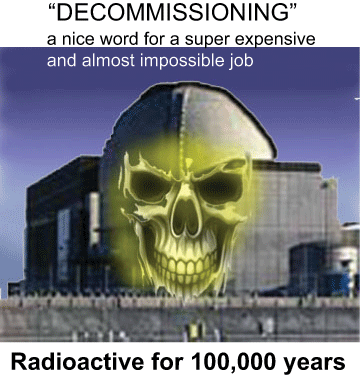
Oyster Creek, the oldest of New Jersey’s four nuclear power plants, will shut down Sept. 17, but some of its main buildings will remain standing for nearly six decades at the Ocean County site.
The company also said it had chosen a method that will span 60 years to complete the dismantling of the plant, versus beginning immediately.
Exelon had originally planned to shutter Oyster Creek in 2019 then, this past February, moved the date up to this October. That’s now going to be mid-September at the end of the station’s current fuel cycle, according to Suzanne D’Ambrosio, spokeswoman for Oyster Creek said Tuesday.
According to the report Exelon filed with the NRC, it has chosen to put the plant into long-term storage — a method known as SAFSTOR — and take advantage of the NRC’s rules on decommissioning plants which allow a company up to 60 years to raze a facility. “The SAFSTOR option is the most economical and radiologically safe plan for decommissioning,” D’Ambrosio said. “It allows for normal radioactive decay, produces less waste and exposes our workers to lower levels of radiation.”
Once it stops producing electricity Sept. 17, the process of moving the radioactive fuel from the reactor core to a spent fuel storage pool begins, something Exelon says should be done by Sept. 30.
In the coming years work will begin to remove some smaller buildings at the site, according to the report. The radioactive spent fuel rods will eventually be removed from the fuel pool and be placed in dry storage casks, a task Exelon says will be done by 2024.
The site will be maintained for 50-plus years until Exelon begins removing the larger components at the site beginning in June 2075 and wrapping up by December 2077, according to its report.
Some of the larger sections of the plant may actually be barged from near the site, according to the report.
The decommissioning is expected to cost the utility about $1.4 billion, Exelon says.
Environmentalists who have long been critical of the 620-megawatt plant, said they are glad to see it close.
“Oyster Creek has been a safety threat to Ocean County, polluting Barnegat Bay, and killing thousands of fish over the years,” said Jeff Tittel, director of the New Jersey Sierra Club. “Shutting down the Oyster Creek plant will reduce the algae blooms, improve fish populations and help restore the overall ecosystem of the Barnegat Bay.”
World’s Biggest Nuclear Plant Is Center Stage in Rural Election, Stephen Stapczynski– 8 June 2018 (Bloomberg) — The fate of the world’s largest atomic plant may be decided by a local election this weekend in a rural Japanese prefecture better known for its skiing and sake.
The top two candidates running in the June 10 Niigata gubernatorial race are opposed to the speedy restart of Tokyo Electric Power Co. Holding Inc.’s nuclear reactors — which the utility, known as Tepco, aims to fire-up as soon as 2019. But the degree to which the candidates oppose atomic power is being watched closely by investors, voters and local media.
……..While candidates backed by Prime Minister Shinzo Abe’s Liberal Democratic Party and the opposition both want to finish investigations into atomic safety before the Kashiwazaki-Kariwa reactors restart, their views diverge after that.
Chikako Ikeda, a member of the prefecture’s assembly and backed by a coalition of opposition parties, has said she doesn’t support Tepco restarting the facility. She is also calling for a local referendum to decide the fate of the units after the prefecture finishes its investigations, which could take another three years.
Hideyo Hanazumi, a former vice-governor of Niigata backed by Abe’s LDP party, has refused to say whether he supports the restart but has insisted that the prefecture’s investigations be completed before a decision is made. Tepco shares have lost almost 14 percent since the day before May 9 when he said the nation should rid itself of nuclear power in the long-term and continue the prefecture’s investigation.
US SECRETARY of State Mike Pompeo has declared the US will not allow Iran to develop a nuclear weapon following reports Iran intends to increase its uranium enrichment capacity. By MATTHEW ROBINSON Jun 7 2018
Iran’s nuclear chief, Ali Akbar Salehi, said Iran intends to complete the construction of a facility in its Natanz nuclear plant to produce advanced centrifuges within a month.
Mr Salehi’s threats come in response to the US’s withdrawal from the Joint Comprehensive Plan of Action (JCPOA), also known as the Iran nuclear deal, and their threats to reintroduce stringent sanctions against the Middle East nation.
Nuclear Power’s Fading Moment in the Middle East,Stratfor, 7 June 18,
Highlights
Demographic, climatic, economic and technological pressures over the next several decades will force key countries in the Middle East and North Africa to gradually expand and diversify their electric power grids.
Advances in competing technologies and high costs will put nuclear power at a disadvantage compared with other electricity-generating options. Even so, countries in the region will continue to pursue nuclear power given its accompanying political prestige.
The window for regional powers to develop unrestricted nuclear programs is closing fast. Economic realities will weaken their arguments for civilian nuclear power, allowing global powers to justify asserting more control over the expansion of nuclear programs in the region.
…… A Tale of Two Uses
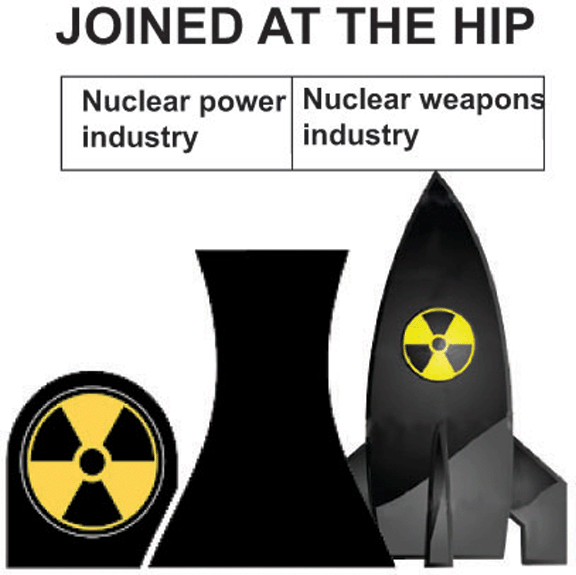
Nuclear technology has always had a civilian side and a military side. Clearly, there’s a difference between a peaceful, civilian-led nuclear energy program and one used to develop nuclear weapons. But the civilian and military sides share processes that inextricably link them and that have profound security and proliferation implications. Countries with end-to-end nuclear programs — that is, programs that include processing, enrichment and reprocessing capabilities — may insist their intentions are peaceful, but the dual-use nature of the technology puts them closer to producing enough nuclear material to build a weapon should they decide to take that route.
Throughout much of the world, nuclear power is struggling to compete economically; the capital costs are high, and lengthy construction delays plague most ongoing nuclear projects. As storage technologies improve, and as the use of smart and distributed power grids increases, the argument countries make for why they want to develop a civilian nuclear program becomes weaker, raising questions about motives and making it even more difficult for them to justify to global powers the need for them to develop an end-to-end nuclear program. Political control over nuclear proliferation may be slipping as the Nuclear Nonproliferation Treaty weakens, but economic realities will help limit nuclear expansion just the same.
………While natural gas will remain the largest fuel source for electricity in the region, generation powered by renewables and nuclear is poised to play a more prominent role. Those two modes of power production don’t directly compete in a traditional electrical grid, but advancing technology and changes in grid makeup will bring them into closer proximity.
When both capital costs and variable costs such as fuel are factored in, nuclear power generally struggles to compete economically with natural gas, wind and solar power — though it might make sense in some cases. Nuclear power’s advantage is its ability to provide baseload power — it produces electricity at a constant, continuous level. Some other forms of generation — renewables, in particular — would need to be paired with storage or a baseload plant to meet demand on a constant basis.
Improvements in efficiency technologies, the declining cost of energy storage, the development of smart grids and the increased use of decentralized grids (especially in the developing world) will combine to minimize baseload requirements, leaving traditional nuclear power behind. While new technology, such as small, modular reactors, could play a role in making nuclear energy more competitive, the industry likely will be forced to play catch-up to some degree.
And though nuclear power’s contribution to regional electrical grids is expected to rise over the next 20 years, its declining economic competitiveness means there is a narrow window for countries to exploit nuclear power’s role in diversifying energy grids to support the development of domestic nuclear programs that may have a more nefarious dual use. https://worldview.stratfor.com/article/nuclear-powers-fading-moment-middle-east
Nikkei Asian Review 6th June 2018 Britain’s move to finance much of a Hitachi nuclear power plant underscores
how such projects have grown too costly for the private sector to bear
alone, raising further questions about a key component of Japan’s ambitious
plans to export infrastructure worldwide.
The threat of electricity shortages spurred by factors including aging power plants drove London’s
pledge to loan a full 2 trillion yen ($18.2 billion) for the Japanese
industrial group’s plan to build two nuclear reactors in Wales, a project
slated to cost over 3 trillion yen.
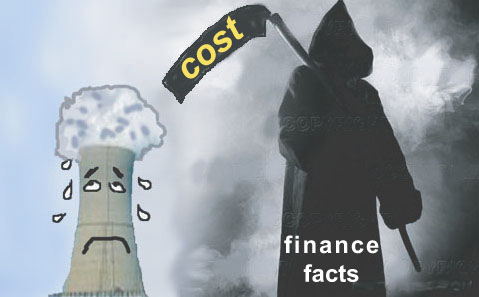
The Wylfa saga illustrates how the expense of building nuclear power plants has become a deterrent to their
construction. Estimates for the Wales reactors have roughly doubled from
the initial outlook, owing to snowballing costs for safety and other
provisions. apart from Hitachi’s U.K. project, most of Japan’s overseas
nuclear efforts face an uncertain future at best.
Plans for new reactors are stalling around the world as countries get caught between the need for
energy security and the risks associated with nuclear energy. A Mitsubishi
Heavy Industries plan to build four reactors in Turkey’s Black Sea coastal
city of Sinop has doubled in cost to around 5 trillion yen, owing mainly to
additional precautions against earthquakes. Now the project “will not turn
a profit unless the Turkish government more than doubles the price at which
it buys electricity,” said a source affiliated with Mitsubishi Heavy.
Trading house Itochu has pulled out of the business alliance behind the
project. Toshiba’s former nuclear unit Westinghouse Electric, which was
building four reactors in the U.S., filed for bankruptcHitachi still faces
other hurdles on the Wylfa project. Lining up investors is proving
difficult on the Japanese side.
The U.K. government likely will drive a
hard bargain on power purchase prices, having drawn criticism for agreeing
to pay far above market rates for electricity from Hinkley Point C, a
nuclear power plant being built by France’s EDF and state-owned China
General Nuclear Power Group. Clarifying liability for accidents will be
another issue. https://asia.nikkei.com/Business/Business-Trends/Hitachi-s-UK-nuclear-project-shows-heavy-risks-for-private-sector
Huffington Post 5th June 2018, Behind its shiny green veneer, this government has overseen
the funding stream for clean energy fall to its lowest levels in a decade.
The context for this public payout for new nuclear is an energy market
that’s making it blindingly obvious that renewables are the future. Solar
and wind are now the cheapest forms of new electricity generation, and new
technology means that power from the sun, sea and wind, balanced with
batteries and interconnection, are able to be the backbone of British
energy in the future.
Onshore wind – which the Government has all but
banned – could have a strike price a whopping £37.50 lower than Wylfa’s.
The frequent retort to those of us who oppose nuclear is centred on the
need for ‘baseload’ power – but such arguments are increasingly weak.
We know that battery technology is coming on leaps and bounds – and even
the ex-head of National Grid, Steve Holliday, has said that “the idea of
large power stations for baseload is outdated”, and noted that “from a
consumer’s point of view, the solar on the rooftop is going to be the
baseload”.
But it’s not just the government’s skewed financial
priorities that make Wylfa the wrong move at the wrong time. At the heart
of the problems with nuclear energy is the stark fact that there is still
no solution to the nuclear waste problem. https://www.huffingtonpost.co.uk/entry/wylfa_uk_5b164eafe4b093ac33a17a41











 nuclear-news