British government used pilots like ‘GUINEA PIGS’ during Cold War nuclear experiments

 MoD used British pilots like ‘GUINEA PIGS’ during Cold War nuclear experiments https://www.express.co.uk/news/uk/967466/cold-war-nuclear-experiments-MoD-radiation-RAF
THE Ministry of Defence (MoD) used British nuclear test pilots like “guinea pigs” during the Cold War, deliberately exposing them to radiation, it has been claimed By ALICE SCARSI, May 31, 2018
The shocking allegation was made by the widow of a pilot who obtained secret documents suggesting her husband took part in a life-threatening experiment.
Shirley Denson, 83, said the documentation shows her husband, Flight Lieutenant Eric Denson, was ordered to fly through the cloud of a thermonuclear explosion at Christmas Island in the Pacific.
The test exposed him to so much radiation he was left with unbearable headaches which eventually brought him to kill himself to make the pain stop, she added.
And the experiment may have affected two of the couple’s four daughters, as Mrs Denson claimed they were born with abnormalities.
The widow, who was handed the papers by the MoD while conducting research about her husband’s service, described the situation “wicked” and “evil”.
“It makes me furious to think it was done on purpose, that my Eric mattered so little to them.”
The documents revealed Fl Lt Denson had flown his Canberra B6 bomber into the mushroom cloud of a 2.8 megaton nuclear explosion on April 28 1958, with X-ray badges on the seat to measure radiation, the Mirror reported.
During the flight, the pilot would have been exposed to 65 years’ worth of normal background radiation during the six-minute flight.
British Nuclear Test Veterans’ Association chairman Alan Owen said: “This is the first time in all our years of campaigning we have ever found evidence this strong.
“Our members always believed they were guinea pigs and this appears to prove some of them were, at best, collateral damage in horrifying experiments.
“We need to know everything – now.”
The MoD denied Fl Lt Denson was purposely exposed to radiation.
The allegations caused outrage among politicians, who urged the MoD to answer the claim.
Deputy Labour leader Tom Watson described the documents as “shocking”, and said the Defence Secretary should issue an unqualified apology to Mrs Denson in the Commons.
He said: “This is a shocking document the MoD cannot wriggle out of.
“We need answers about what experiments were conducted, and how many of the 22,000 nuke vets were involved in them.”
Shadow defence secretary Nia Griffiths said the papers brought to light “deeply worrying revelations” and called for them to be investigated by the MoD.
And Shadow Health Secretary Jonathan Ashworth added: “This is an absolute scandal.”
A spokesman for the MoD rejected the claims saying: “It is not true to say these men were subject to an experiment to look at the effects of radiation.
“The British nuclear testing programme contributed towards keeping our country secure during the Cold War and regular health checks were conducted throughout.
“The National Radiological Protection Board has carried out three studies of nuclear test veterans and found no valid evidence to link this programme to ill health.”
And he exclusively revealed to Express.co.uk: “According to the information available in the Operational Record Books for the squadron, Fl Lt Denson did not fly the same aircraft in the week after his sampling sortie.
“The ‘experiments’ referred to were to determine the best possible arrangement on the body of dosemeters (devices that measure radiation) so that these mens’ exposure could be measured as accurately as possible.”
Hitachi ‘won’t pay’ for nuclear accidents at proposed Wylfa plant on Anglesey
 Times 30th May 2018 Hitachi ‘won’t pay’ for nuclear accidents at proposed Wylfa plant on Anglesey. Hitachi could seek to absolve itself of financial responsibility for any accidents at its proposed new nuclear power station in north Wales.
The Japanese conglomerate has decided to continue with work developing the planned Wylfa plant on Anglesey after progress in financing talks with the government, which Hitachi is already relying on for a package of loan guarantees, subsidies and potential direct investment to make the project viable.
However, the company wants further concessions to reduce its risks, the Japanese newspaper Nikkei reported. Reports in several Japanese media outlets have claimed that the Wylfa plant could cost as much as three trillion yen, or almost £21 billion — making it even more expensive than Hinkley Point C.
EDF decided to build Hinkley Point only thanks to a 35-year subsidy contract from the government, which locks consumers into paying a fixed price for the power it generates and has been criticised for its high cost.
The Nikkei reported that some of Hitachi’s directors also wanted “safeguards that reduce or eliminate Hitachi’s financial
responsibility for accidents at the plant”. Nuclear operators are already obliged to take out insurance to cover their liabilities in case of an accident. If they are unable to secure insurance from the market, the government is obliged to step in and provide it instead. It is unclear what alternative arrangement or safeguards Hitachi might be seeking.
https://www.thetimes.co.uk/edition/business/hitachi-wont-pay-for-nuclear-accidents-at-proposed-wylfa-plant-on-anglesey-gtm28q0k3
Persisting with the European Pressurized Reactor (EPR) has brought Franc e to a costly nuclear crisis
 Liberation 30th May 2018 [Machine Translation] “The impasse”, how the EPR sank French nuclear.
France 5 broadcasts this Wednesday night “Nuclear, the French impasse”, a documentary against the declining reign of the atom. This film investigates EDF’s crazy gamble: risking its survival on the EPR, a reactor that accumulates trouble.
Will the EPR be the Titanic of French nuclear power? This is the shocking question posed by a film investigated by director Patrick Benquet broadcast tonight on France 5 which points to the “impasse”
in which the “most nuclearized country in the world” has locked up by equipping itself with 58 reactors. the 70s-80s. A fleet of 19 aging plants, which still produces 75% of French electricity, and which EDF wants to keep at all costs by launching a new generation of pressurized water reactor:
the EPR, “the most powerful never built, able to supply electricity to a metropolis like Paris. It must have been the deadly weapon of the nuclear lobby to defend the reign of the atom undermined by the Fukushima disaster and the rise of green energies.
EDF dreamed of exporting it all over the world by selling this “new nuclear” as the best lever against global warming. But things did not go at all as planned. And today EDF is going through a crisis that threatens the very existence of the “public service preferred by the French,” says the documentary.
There are these hidden costs of the atom, put under the carpet for decades, which rise to the surface: the enormous costs of reprocessing radioactive waste, is added the bill of the “great refit”: these works of Hercules designed to extend the lifespan of aging plants from 40 to 50 years. ”
EDF promised cheap electricity, but the real cost of nuclear energy today is in the tens and tens of billions. And ultimately it is the taxpayer who will pay, announces the implacable voice off. Yet, EDF, the nuclear state in the state, will launch the EPR at all costs. By assigning a strategic mission: take over
the old reactors that will gradually retire by 2035.
http://www.liberation.fr/france/2018/05/30/l-impasse-comment-l-epr-a-coule-le-nucleaire-francais_1655363
Further research on how ionising radiation causes cancer
 Ionizing radiation can cause cells to turn cancerous, Pakistan Observer Islamabad : It is well established that exposure to ionizing radiation can result in mutations or other genetic damage that cause cells to turn cancerous.
Tough times for uranium company Cameco – and no improvement in sight
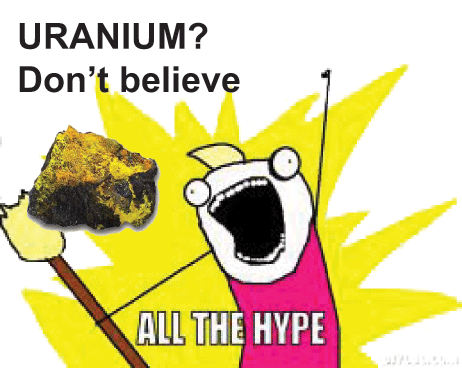 Motley Fool 28th May 2018 , It has been a tough few years for one-time high-flying uranium miner Cameco Corp.. Over the last five years, its value has plummeted by 38% after nuclear power fell into disfavour after the 2011 Fukushima disaster in Japan, which caused the price of uranium to collapse.
Since then, uranium has remained caught in a protracted slump, despite claims by industry insiders and analysts that it is poised to rebound because of a combination of growing demand and emerging supply constraints. Nonetheless, despite these claims, there has been no sign of a sustained rally, and an upturn in the fortunes of the radioactive metal may never occur.
This is because the outlook for uranium is not as bright as claimed, and there is every indication that nuclear power will remain in disfavour. That will continue to weight on Cameco’s market value.
https://www.fool.ca/2018/05/28/despite-an-improved-1st-quarter-2018-the-outlook-for-cameco-corp-remains-poor/
Ontario could save $1.2B by closing Pickering plant, buying power from Quebec – Greens
 Ontario Greens would close nuclear plant this summer
Province could save $1.2B by closing Pickering plant, buying power from Quebec, leader says CBC News
Energy politics – why renewables are winning over nuclear power
 Why are renewables suddenly trouncing nuclear energy? City Metric, By David Toke, 31 May 18
If recent trends continue for another two years, the global share of electricity from renewables excluding hydropower will overtake nuclear for the first time. Even 20 years ago, this nuclear decline would have greatly surprised many people – particularly now that reducing carbon emissions is at the top of the political agenda.
On one level this is a story about changes in relative costs. The costs of solar and wind have plunged while nuclear has become almost astoundingly expensive. But this raises the question of why this came about. As I argue in my new book, Low Carbon Politics, it helps to dip into cultural theory.
Culture wars
The seminal text in this field, Risk and Culture (1982), by the British anthropologist Mary Douglas and American political scientist Aaron Wildavsky, argues the behaviour of individuals and institutions can be explained by four different biases:
- Individualists: people biased towards outcomes that result from competitive arrangements;
- Hierarchists: those who prefer ordered decisions being made by leaders and followed by others;
- Egalitarians: people who favour equality and grassroots decision-making and pursue a common cause;
- Fatalists: those who see decision-making as capricious and feel unable to influence outcomes.
The first three categories help explain different actors in the electricity industry. For governments and centralised monopolies often owned by the state, read hierarchists. For green campaigning organisations, read egalitarians, while free-market-minded private companies fit the individualist bias.
The priorities of these groups have not greatly changed in recent years. Hierarchists tend to favour nuclear power, since big power stations make for more straightforward grid planning, and nuclear power complements nuclear weapons capabilities considered important for national security.Egalitarians like Greenpeace and Friends of the Earth usually oppose new nuclear power plant and favour renewables. Traditionally they have worried about radioactive environmental damage and nuclear proliferation. Individualists, meanwhile, favour whichever technologies reduce costs.
These cultural realities lie behind the problems experienced by nuclear power. To compound green opposition, many of nuclear power’s strongest supporters are conservative hierarchists who are either sceptical about the need to reduce carbon emissions or treat it as a low priority. Hence they are often unable or unwilling to mobilise climate change arguments to support nuclear, which has made it harder to persuade egalitarians to get on board. ………..
even hierarchists cannot ignore economic reality entirely. The South Carolina project has been abandoned and the Georgia project only survives through a very large federal loan bailout.
Contrast this with casino complexes in Nevada like MGM Resorts not only installing their own solar photovoltaic arrays but paying many millions of dollars to opt out from the local monopoly electricity supplier. They have campaigned successfully to win a state referendum supporting electricity liberalisation.
The UK, meanwhile, is an example of how different biases can compete. Policy has traditionally been formed in hierarchical style, with big companies producing policy proposals which go out to wider consultation. It’s a cultural bias that favours nuclear power, but this conflicts with a key priority dating back to Thatcher that technological winners are chosen by the market.
This has led policymakers in Whitehall to favour both renewables and nuclear, but the private electricity companies have mostly refused to invest in nuclear, seeing it as too risky and expensive. The only companies prepared to plug the gap have been more hierarchists – EDF, which is majority-owned by France, and Chinese state nuclear corporations.
Even then, getting Hinkley C in south-west England underway – the first new nuclear plant since the 1990s – required an extensive commitment by the UK treasury to underwrite bank loans. There is also an embarrassingly high price to be paid for the electricity over a very long 35-year period. Such has been the bad publicity that it’s hard to imagine a politician agreeing to more plant on such terms.
Where does this reality leave hierarchists? Increasingly having to explain prohibitive nuclear costs to their electorates – at least in democracies. The alternative, as renewable energy becomes the new orthodoxy, is to embrace it.
In Australia, for example, a big utility company called AGL is trying to seduce homeowners to agree to link their solar panels to the company’s systems to centralise power dispatch in a so-called a “virtual power plant”.
 When the facts change, to misquote John Maynard Keynes, you can always change your mind.
David Toke, Reader in Energy Policy, University of Aberdeen.
This article was originally published on The Conversation. Read the original article. https://www.citymetric.com/horizons/why-are-renewables-suddenly-trouncing-nuclear-energy-3779
As long as UK tax-payer coughs up, £20bn Hitachi nuclear plant looks set to be built in Wales
New £20bn Hitachi nuclear plant looks set to be built in Wales – with taxpayer funding, Compelo.comBy Felix Todd, 31 May 18,
Japanese multinational conglomerate Hitachi has been in talks with UK Government concerning the construction of its nuclear plant in Anglesey, Wales – which, despite local protesters, appears to have been given the go ahead at the cost of the taxpayer
UK Government ministers are reportedly planning to pay £15bn worth of taxes to aid the construction cost of Japanese multinational Hitachi’s proposed nuclear power plant in north Wales.
The news comes as a hammer blow to those opposed to the plant’s construction in Wylfa Newydd, including Welsh protesters from the group Pawb (People against Wylfa B), who went to Japan earlier this week to voice their opposition.
Toshiba walks away from involvement in USA nuclear energy project

 Toshiba exits US nuclear project https://www3.nhk.or.jp/nhkworld/en/news/20180531_37/ 31 May 18 Japanese electronics maker Toshiba is walking away from a nuclear energy project in the US. The firm says it won’t take part in building or operating the nuclear plant.
There are 2 reactors on the drawing board. Toshiba executives say the project is no longer financially viable.
They say an increase in shale production has caused a fall in electricity sales.
They also point to stricter regulations introduced after the 2011 nuclear accident in Fukushima. Toshiba joined the South Texas Project in 2008. Executives were hoping to start operating the reactors around 2016 or 2017.
But the power company that’s heading up the project hasn’t started building them.
Toshiba is cutting its ties to the nuclear power business overseas.
The firm incurred massive losses through its former American nuclear subsidiary, Westinghouse.
British scientists distressed at loss of funding as Britain leaves the nuclear safety agency Euratom
 Nature 29th May 2018 , Prime Minister Theresa May conceded on 21 May that a post-Brexit Britain
was willing to pay to “fully associate” with Euratom, Europe’s nuclear agency. The details of the arrangement, similar to many that surround the controversial exit of the United Kingdom from the European Union, still have to be ironed out.
And among those watching the negotiations with mounting concern are scientists at the Joint European Torus (JET) near Oxford, UK, who currently benefit greatly from Britain’s membership of the agency. The hundreds of researchers at JET receive annual funding of around €60 million (US$70 million), because Britain is part of Euratom. As it stands, that funding will cease at the end of this year.
https://www.nature.com/articles/d41586-018-05283-x
Margaret Atwood: women will bear brunt of dystopian climate future
Booker prize-winning author predicts climate reality will not be far from scenarios imagined in her post-apocalyptic fiction, Guardian, Fiona Harvey Environment correspondent, 31 May 2018
The Federal Energy Regulatory Commission and Department of Justice support Illinois nuclear subsidies
FERC, DOJ support Illinois nuclear subsidies in court filing UTILITY DIVE,31 May 18
Dive Brief:
- The Federal Energy Regulatory Commission and Department of Justice filed a joint legal brief in support of Illinois nuclear subsidies on Tuesday.
- Lawyers for the two agencies wrote the zero emission credits (ZECs) for Illinois nuclear plants do not interfere with FERC’s authority to regulate wholesale power markets, as generators claimed. If the subsidies disrupt market operations, “the solution lies with the Commission, not the courts,” the agencies wrote.
- The legal opinion will likely also apply to a pending court challenge against New York nuclear subsidies, as well as a New Jersey subsidy program enacted last week. The FERC opinion could also make a Supreme Court case over the subsidies less likely, analysts say.
Dive Insight:
The Tuesday amicus brief from FERC and DOJ is a blow for opponents of nuclear subsidies, who hoped the courts would throw out the recent state programs designed to keep uneconomic plants from retiring.
In their brief, filed with the U.S. Court of Appeals for the Seventh Circuit, FERC and DOJ write the Illinois program does not suffer from the “fatal defect” that doomed other state subsidy programs in the courts.
In 2016, the Supreme Court ruled that a Maryland policy to support gas generation interfered with FERC’s authority because it made receipt of a subsidy contingent on wholesale market participation, which FERC regulates.
………Evaluating methods to integrate state energy policies into wholesale markets has been a focus at FERC in recent years — and also a point of contention. In March, the commission approved an ISO-New England plan to change its capacity market auctions to handle subsidized resources, but the 3-2 vote exposed divides between regulators on how to handle future cases.
Those issues are likely to come to a head next month, when FERC is scheduled to rule on two market reform options submitted by the PJM Interconnection — both of which could diminish the market impact of nuclear and renewable energy subsidies.
In the meantime, analysts say the FERC-DOJ brief makes it more likely the nuclear subsidies will be upheld by the courts — not just the Seventh Circuit, but also the U.S. Court of Appeals for the Second Circuit, which is hearing a similar challenge against the New York program……..https://www.utilitydive.com/news/ferc-doj-support-illinois-nuclear-subsidies-in-court-filing/524580/
Tennessee Valley Authority was overcharged nearly $4.4 million by contractor at Watts Bar Nuclear Power Plant
Contractor at Watts Bar Nuclear Power Plant overcharged TVA nearly $4.4 million http://www.wrcbtv.com/story/38316846/contractor-at-watts-bar-nuclear-power-plant-overcharged-tva-nearly-44-million
TVA spokesman Scott Brooks said the federal utility is pursuing action to collect for the overcharges by the contractor. May 31st 2018, by
The Tennessee Valley Authority was overcharged nearly $4.4 million by a contractor at the Watts Bar Nuclear Power Plant for construction of the Unit 2 reactor from 2013 to 2015, according to an audit released Wednesday.
Japanese Buddhist priest joins movement to divest from fossil fuels and nuclear power
Lions Roar, BY HALEIGH ATWOOD|
In a drill, fake terrorists take over Russia’s Arctic radioactive waste storage site
In a drill, fake terrorists take over Arctic radioactive waste storage site
Russian officials have said they thwarted a terrorist attack at a facility storing old radioactive components from nuclear vessels located in the Arctic — but don’t worry. It was just a drill. Bellona, by Anna Kireeva
Russian officials have said they thwarted a terrorist attack at a facility storing old radioactive components from nuclear vessels located in the Arctic — but don’t worry. It was just a drill.
The simulated siege was part of a large-scale exercise called Atom-2018, and was meant to prepare workers at the Sayda Bay for the worst – an armed incursion into a sensitive facility within Russia’s vast but fragile nuclear waste storage industry, complete with bombs, hostages and political demands.
According to reports, staff at the facility were alerted to the fact that the exercise was a drill. The purpose of the fake crisis, rather than scaring workers at a radioactive materials storage site, was to prepare officials from Russia’s security services to map out countermeasures specifically designed for the Sayda Bay site.
Sayda Bay is a part of the Murmansk branch of RosRAO, the state operator responsible for the management and storage and handling of non-nuclear radioactive waste, as well as decommissioning nuclear vessels, especially submarines.
Located 60 kilometers from Murmansk, Sayda Bay is itself an old Soviet-era military base. Since 2004, it has been tasked with storing reactor compartments from the dismantled submarines of Russia’s once overwhelming Northern Fleet of nuclear submarines.
Later, facilities were built at Sayda Bay to handle and condition radioactive waste. Currently it houses about 80 single unit reactor blocks and has space for 40 more. Eventually, the site will hold the irradiated remains of the Lepse, a nuclear icebreaker refueling vessels that is carefully being pulled apart at the Nerpa Shipyard near Murmansk.
It was the radioactive waste storage facility at Sayda Bay that was targeted by the would be terrorists. According to a release on the exercise, the assailants seized the facility, took hostages from among its workers, and put forth a demand for regime change. Unless their demands were met, said the insurgents, they would detonate a bomb…….http://bellona.org/news/nuclear-issues/2018-05-in-a-drill-fake-terrorists-take-over-arctic-radioactive-waste-storage-site
1 This Month

Petition to revoke the licensing of the Near Surface Nuclear Disposal Facility (NSDF) at Chalk River. https://www.ourcommons.ca/petitions/en/Petition/Details?Petition=e-7247


of the week – STOP SMALL MODULAR REACTORS IN CANADA
To see nuclear-related stories in greater depth and intensity – go to https://nuclearinformation.wordpress.com
-
Archives
- March 2026 (153)
- February 2026 (268)
- January 2026 (308)
- December 2025 (358)
- November 2025 (359)
- October 2025 (376)
- September 2025 (258)
- August 2025 (319)
- July 2025 (230)
- June 2025 (348)
- May 2025 (261)
- April 2025 (305)
-
Categories
- 1
- 1 NUCLEAR ISSUES
- business and costs
- climate change
- culture and arts
- ENERGY
- environment
- health
- history
- indigenous issues
- Legal
- marketing of nuclear
- media
- opposition to nuclear
- PERSONAL STORIES
- politics
- politics international
- Religion and ethics
- safety
- secrets,lies and civil liberties
- spinbuster
- technology
- Uranium
- wastes
- weapons and war
- Women
- 2 WORLD
- ACTION
- AFRICA
- Atrocities
- AUSTRALIA
- Christina's notes
- Christina's themes
- culture and arts
- Events
- Fuk 2022
- Fuk 2023
- Fukushima 2017
- Fukushima 2018
- fukushima 2019
- Fukushima 2020
- Fukushima 2021
- general
- global warming
- Humour (God we need it)
- Nuclear
- RARE EARTHS
- Reference
- resources – print
- Resources -audiovicual
- Weekly Newsletter
- World
- World Nuclear
- YouTube
-
RSS
Entries RSS
Comments RSS
 nuclear-news