
We Now Have A Working Nuclear Reactor for Other Planets — But No Plan For Its Waste,
Futurism, Claudia Geib, 23 May 18 If the power goes out in your home, you can usually settle in with some candles, a flashlight, and a good book. You wait it out, because the lights will probably be back on soon.
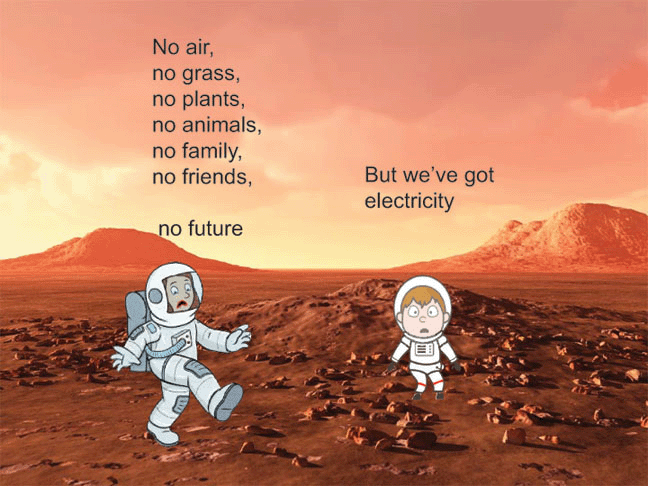
But if you’re on Mars, your electricity isn’t just keeping the lights on — it’s literally keeping you alive. In that case, a power outage becomes a much bigger problem.
NASA scientists think they’ve found a way to avoid that possibility altogether: creating a nuclear reactor. This nuclear reactor, known as Kilopower, is about the size of a refrigerator and can be safely launched into space alongside any celestial voyagers; astronauts can start it up either while they’re still in space, or after landing on an extraterrestrial body.
The Kilopower prototype just aced a series of major tests in Nevada that simulated an actual mission, including failures that could have compromised its safety (but didn’t).
………. Nuclear reactors are not an unusual feature in space; the Voyager 1 and 2 spacecraft, now whizzing through deep space after departing our solar system, have been running on nuclear energy since they launched in the 1970s. The same is true for the Mars rover Curiosity since it landed on the Red Planet in 2012.
But we’d need a lot more reactors to colonize planets. And that could pose a problem of what to do with the waste.
If the power goes out in your home, you can usually settle in with some candles, a flashlight, and a good book. You wait it out, because the lights will probably be back on soon.
But if you’re on Mars, your electricity isn’t just keeping the lights on — it’s literally keeping you alive. In that case, a power outage becomes a much bigger problem.
NASA scientists think they’ve found a way to avoid that possibility altogether: creating a nuclear reactor. This nuclear reactor, known as Kilopower, is about the size of a refrigerator and can be safely launched into space alongside any celestial voyagers; astronauts can start it up either while they’re still in space, or after landing on an extraterrestrial body.
The Kilopower prototype
just aced a series of major tests in Nevada that simulated an actual mission, including failures that could have compromised its safety (but didn’t)
But we’d need a lot more reactors to colonize planets. And that could pose a problem of what to do with the waste.
According to Popular Mechanics, Kilopower reactors create electricity through active nuclear fission — in which atoms are cleaved apart to release energy. You need solid uranium-235 to do it, which is housed in a reactor core about the size of a roll of paper towels. Eventually, that uranium-235 is going to be “spent,” just like fuel rods in Earth-based reactors, and put nearby humans at risk.
When that happens, the uranium core will have to be stored somewhere safe; spent reactor fuel is still dangerously radioactive, and releases lots of heat. On Earth, most spent fuel rods stored in pools of water that keep the rods cool, preventing them from catching fire and blocking radiating radioactivity. But on another planet, we’d need any available water to, you know, keep humans alive.
…….Right now, all we can do is speculate — as far as we know, NASA doesn’t have any publicly available plan for what to do with spent nuclear fuel on extraterrestrial missions. That could be because the Kilopower prototype just proved itself actually feasible. But not knowing what to do with the waste from it seems like an unusual oversight, since NASA is planning to go back to the Moon, and then to Mars, by the early 2030s.
And in case you were wondering, no, you can’t just shoot the nuclear waste off into deep space or into the sun; NASA studied that way back in the 1970s and determined it was a pretty terrible idea. Back to the drawing board. https://futurism.com/nuclear-reactor-space-waste/
May 4, 2018
Posted by Christina Macpherson |
technology, USA, wastes |
1 Comment
NASA demos little nuclear power plant to help find little green men, Kilopower experiment looks good for 10 kilowatts on the Moon, Mars or beyond By Simon Sharwood, APAC Editor 3 May 2018 NASA has announced successful tests of a small fission reactor capable of producing about 10 kilowatts of power, and hopes the technology will prove suitable for use on the Moon or Mars.
May 4, 2018
Posted by Christina Macpherson |
technology, USA |
2 Comments
Electricity generation to fall by 40% after nuclear plant cracks find, BBC News, 3 May 2018
May 4, 2018
Posted by Christina Macpherson |
incidents, UK |
Leave a comment
Foreign Minister Wang Yi backs plans announced by Kim Jong-un as China expresses wish for cooperation, despite its support of UN sanctions Laura ZhouSCMP, 03 May, 2018 Beijing will support North Korea’s efforts to rebuild its economy, China’s foreign minister has said as the North pledged to suspend nuclear testing and prioritise economic growth.
Wang Yi said in his meeting with North Korean counterpart Ri Yong-ho that the two allies would strengthen strategic communications and China would “continue to play a due and positive role in the political process for political settlement of the peninsula issues”, a statement by the Chinese foreign ministry said.
On the first day of his two-day visit to Pyongyang on Wednesday, Wang reaffirmed the pledge to deepen traditional relations between the neighbours, made by President Xi Jinping and North Korean leader Kim Jong-un during Kim’s visit to Beijing in March.
“Traditional friendship between China and North Korea is the mutual good fortune of the two sides, and it is a strategic choice to inherit and develop the traditional friendly relations,” Wang was quoted as saying.
“China would work together with North Korea … to enhance communications and coordination between the political and diplomatic departments of the two sides, and push forward practical cooperation on economy and trade.”
Ri told Wang that Kim values the traditional friendship with China, and that North Korea would like to keep close communication with China on denuclearisation and the peace process on the peninsula, according to the statement by the Chinese foreign ministry.
The visit by Wang has come at a time when Beijing and Pyongyang have been working to repair the relations that were strained by Kim’s repeated nuclear tests and Beijing’s support for a series of stringent UN sanctions.
…….
Lu Chao, a Korean affairs expert at Liaoning Academy of Social Sciences, said that China’s support of economic development in North Korea was in response to Kim’s pledge to give up nuclear weapons and shift to economic development.
“This is not contradicting the UN sanctions, because the support, as well as the recent improvement in the bilateral relations between China and North Korea, only came on condition that North Korea agrees to give up its nuclear weapon programme and move to develop its economy,” Lu said.
“So far, the bans remain effective and China would follow the sanctions.” http://www.scmp.com/news/china/diplomacy-defence/article/2144485/china-supports-north-korean-shift-nuclear-economy
May 4, 2018
Posted by Christina Macpherson |
China, politics international |
Leave a comment
Scientists raise alarm over Turkish nuclear reactors http://www.ekathimerini.com/228268/article/ekathimerini/news/scientists-raise-alarm-over-turkish-nuclear-reactors
A team of Greek scientists have called on the government, the European Union, the International Atomic Energy Agency, NATO and other international organizations to take measures that will halt the creation of nuclear power facilities in the seismically active region of Akkuyu in neighboring Turkey.
The 18 scientists made their appeal in a letter against the backdrop of an agreement struck by Moscow and Ankara for the installation of four nuclear reactors in Turkey.
Listing a series of possible consequences, the scientists raised the alarm, saying that “Turkey plans to obtain 10 nuclear reactors by 2030.”
May 4, 2018
Posted by Christina Macpherson |
safety, Turkey |
Leave a comment
The scientists say their research is the first to use a human bone to precisely measure the radiation absorbed by an atomic bombing victim, Smithsonian, By Julissa Treviño , 3 May 18, “…….
evidence of the atomic bomb lives on in the bones of victims of the blast. A recent study published in the journal PLOS ONE used the jawbone of one person who was less than a mile from the bomb’s hypocenter to reveal exactly how much radiation was absorbed by the city’s population.
As Laura Geggel reports for Live Science, the research team used a technique called Electron Spin Resonance spectroscopy to learn the jawbone contained 9.46 grays, or Gy (the unit to measure absorbed radiation), double the amount it would take to kill someone if their entire body is exposed.
The researchers say their work is the first to use human bones to precisely measure the radiation absorbed by atomic bombing victims. However, as the Washington Post’s Kristine Phillips points out, in the late 1990s, a team of scientists from Japan were able to measure the radiation dose that nasopharyngeal cancer patients had absorbed from radiotherapy by studying their jawbones.
The new research is thanks to advances in technology. According to the study, in the 1970s, co-author Brazilian scientist Sérgio Mascarenhas discovered that X-Ray and gamma-ray radiation exposure caused human bones to become weakly magnetic. While his initial idea was to use his observation toward the archaeological dating of bones of prehistoric animals and humans in Brazil, he soon decided to test his methodology on nuclear bombing victims.
So, he traveled to Japan, where he was given the jawbone featured in the latest stduy from a Hiroshima victim. But the technology was not advanced enough, nor were there computers that could process the results in a precise manner. Making use of the instruments at hand, Mascarenhas presented evidence that the blast radiation aborbed by the jawbone sample could be observed at a meeting of the American Physical Society in 1973.
The jawbone was brought to Brazil, where it waited until science was ready for then-postdoctoral student Angela Kinoshita to continue Mascarenhas’ research with co-author Oswaldo Baffa, her former professor at the University of São Paulo.
Kinoshita, who is now a professor at University of the Sacred Heart in Brazil, was able to use ESR to identify direct blast radiation in the jawbone from so-called background signal, which the press release explains as “a kind of noise…[that] may have resulted from
from the superheating of the material during the explosion.”
To conduct their research, the team removed a small piece of the jawbone used in the previous study and then exposed it to radiation in a lab. This process is known as the additive dose method. Their result was similar to the dose found in physical objects taken from the site, including bricks and house tiles.
The scientists are currently looking into even more sensitive methodology, which they predict in the press release to be “about a thousand times more sensitive than spin resonance.” They see their research becoming increasingly relevant in future events like in the case of a terrorism attack.
“Imagine someone in New York planting an ordinary bomb with a small amount of radioactive material stuck to the explosive,” Baffa tell Agência FAPESP. “Techniques like this can help identify who has been exposed to radioactive fallout and needs treatment.”https://www.smithsonianmag.com/smart-news/researchers-study-human-bone-find-out-how-much-radiation-hiroshima-victims-experienced-180968932/
May 4, 2018
Posted by Christina Macpherson |
general |
Leave a comment
 Why does this article not mention the difference in vulnerability between children and adults?
What is mobile phone radiation and how safe is it? ABC Science,By science reporter Belinda Smith
“…. What is electromagnetic radiation?

We are surrounded by all sorts of different types of electromagnetic radiation every day: your eyes pick up visible light, your bag is scanned by X-rays at airport security, microwaves heat your lunch and too much ultraviolet light gives you sunburn.
At its essence, electromagnetic radiation is energy comprising an electric field and magnetic field, which travel together, but perpendicularly, in waves.
Sometimes the length of these waves (or wavelength) is very short — a few nanometres for X-rays — while others are much longer — a few centimetres up to kilometres.
It’s these long wavelengths, called radio waves, that are the electromagnetic radiation of choice for mobile phones and base stations.
Unlike shorter wavelengths, such as visible light, radio waves can pass through walls. The longer the wavelength, the better it can penetrate solid stuff.
Another term you might see is frequency, which is the number of times a wave makes a full oscillation each second.
Frequency and wavelength are closely related. Wavelength is the speed of light divided by the frequency, so long wavelengths also have low frequency.
What are ionising and non-ionising radiation?

The radio frequency end of the electromagnetic spectrum is home to what’s known as “non-ionising radiation”, said Rodney Croft, from the University of Wollongong and director of the Australian Centre of Electromagnetic Bioeffects Research.
It’s the high-frequency, short wavelength radiation, such as X-rays, that can tinker with your DNA and are linked to cancer.
These waves are small enough and carry enough energy to knock electrons off atoms, ionising them.
Radio frequency used in mobile communications simply doesn’t have the energy to do that. But that’s not to say it doesn’t exert any effects on the matter it travels through.
“It’s an oscillating wave, which swings between positive and negative,” Professor Croft said
“If you have a bunch of molecules rotating, that causes friction, and energy is given off as heat. It’s how a microwave oven works.”
Does anyone regulate radio frequency limits?
In Australia, mobile phone and base station exposure limits are set by the Australian Radiation Protection and Nuclear Safety Agency (ARPANSA) and regulated by the Australian Communications and Media Authority.
The ARPANSA standard looks at how much energy a user absorbs from a mobile phone over time.
The maximum limit is currently 2 watts per kilogram of tissue. Phone manufacturers usually specify their maximum absorption rate in their manual.
You can find how much radio frequency is emitted by base stations at the Radio Frequency National Site Archive.
According to ARPANSA, it’s “typically hundreds of times below the [ARPANSA] limits”.
What are the effects of mobile radio frequency on tissues?
So are we microwaving our head whenever we answer the phone? A tiny bit, but not enough to be worried about, Professor Croft said.
He and his team found mobile phone radiation exposure increases the temperature of the outer grey, wrinkled layer of the brain called the cortex, but it’s only “maybe about 0.1 degree, which is very small compared to the temperature variation the body normally has to contend with”, he said.
“We do find that we get a slight change to thermoregulation, so the body, even with that small change, is sending a bit more blood out to the periphery to cool it, so your body doesn’t end up warming up.”
……...What about cancer in rodents?
Mobile phones are classed as “possibly carcinogenic” by the International Agency for Research on Cancer, putting them in the same category as aloe vera, bracken fern and Asian pickled vegetables.
And while radio frequency is non-ionising radiation — remember, it can’t knock electrons off atoms, fiddle with genetic material and trigger tumour growth like ionising radiation can — studies still investigate possible links.
Research published in February this year by the US National Toxicology Program found tumours grew in the nerves around the heart of male rats if they were bathed in extremely high levels of mobile radiation.
But, Professor Croft said, “there were so many difficulties with that study.
………Risks and benefits
Despite research showing no link between safe levels of radio frequency and cancer, telecommunications companies and other organisations do offer suggestions if you want to reduce exposure.
The obvious action, Dr Halgamuge said, is to limit mobile phone use: “You have no control over base stations, because that radiation is around you all the time, but you do have control over your mobile phone.”
The ARPANSA also recommends using hands-free or texting instead of calling, “but none of those things are actually based on any health effects”, Professor Croft said.
………So: does radio frequency have any effect on human tissue, apart from heating it a fraction of a degree?
That question is still open, Professor Wood said.
“Even though some of the evidence [that radio frequency causes damage] on the face of it looks quite compelling, there’s still a question of consistency…….http://www.abc.net.au/news/science/2018-04-30/mobile-phone-radiation-health-explainer-biophysics/9702630
May 4, 2018
Posted by Christina Macpherson |
2 WORLD, radiation |
Leave a comment
With 250 babies born each minute, how many people can the Earth sustain? UN data suggests that the world’s population will hit 11 billion by 2100, with the fastest rises being recorded in Africa and Asia, Guardian, by Lucy Lamble 24 Apr 2018
May 4, 2018
Posted by Christina Macpherson |
2 WORLD, ENERGY |
Leave a comment
 Off the map: the secret cities behind the atom bomb In 1943, three ordinary-looking US cities were constructed at record speed – but left off all maps. They had an extraordinary purpose: to create nuclear weapons as part of the Manhattan project, Guardian, by David Smith in Washington , 3 May 18
Something strange happened in the US state of Tennessee in 1943. Thousands of young workers poured into a 59,000-acre site about 25 miles west of Knoxville. Vast quantities of materials followed, never to re-emerge. Houses and other facilities were built with record speed. Yet officially Oak Ridge did not exist during the war and could not be found on any map.
What was going on there? Very few people knew at the time, even among the residents. The answer was that this was the starting block in a race against Adolf Hitler to build the atom bomb.
Oak Ridge was one of three “secret cities” of the Manhattan Project, along with Los Alamos in New Mexico and Hanford/Richland in Washington state.
More than 125,000 scientists, technicians and support staff occupied the three cities by the end of the war. There is a photo of a Santa Claus being frisked at the gates of Oak Ridge and a local newsletter stamped “restricted”. Anyone aged 12 or over had to wear an ID badge. The use of words such as “atomic” or “uranium” was taboo lest it tip off the enemy.
Yet some social aspects were all too familiar: even these planned communities, which tried to offer residents an idyllic lifestyle and would influence postwar urban construction and design in America, replicated the racial segregation of the era.
More than 125,000 scientists, technicians and support staff occupied the three cities by the end of the war. There is a photo of a Santa Claus being frisked at the gates of Oak Ridge and a local newsletter stamped “restricted”. Anyone aged 12 or over had to wear an ID badge. The use of words such as “atomic” or “uranium” was taboo lest it tip off the enemy.
Yet some social aspects were all too familiar: even these planned communities, which tried to offer residents an idyllic lifestyle and would influence postwar urban construction and design in America, replicated the racial segregation of the era.
It was late 1942, less than a year after the US had entered the second world war, when the US Army Corps of Engineers quietly began acquiring vast tracts of land in remote areas of three states. The few residents of these areas were summarily evicted and their houses demolished.
Soon thousands of young workers arrived from far and wide, initially occupying tents and other makeshift shelters within the newly designated military reservations. Shielded from public view by natural barriers and security fences, the workers quickly erected hundreds of buildings, ranging from prefabricated houses to industrial structures of unprecedented scale.
…….. Built from scratch in half a year to produce fuel for atomic bombs, Oak Ridge was initially conceived as a town for 13,000 people but grew to 75,000 by the end of the war, the biggest of the secret cities.
……. When the US dropped the atom bomb on Hiroshima, Japan, in 1945, killing tens of thousands of people to force an end to the war, the city’s secret was out. Many residents celebrated. One local newspaper declared: “Atomic super-bomb, made at Oak Ridge, strikes Japan.” Another said: “Oak Ridge Attacks Japanese … Workers thrill as atomic bomb secret breaks; press and radio stories describe ‘fantastically powerful’ weapon; expected to save many lives.”
Not everyone was jubilant, however. Mary Lowe Michel, a typist in Oak Ridge, is quoted in the exhibition as saying: “The night that the news broke that the bombs had been dropped, there was [sic] joyous occasions in the streets, hugging and kissing and dancing and live music and singing that went on for hours and hours. But it bothered me to know that I, in my very small way, had participated in such a thing, and I sat in my dorm room and cried.”……https://www.theguardian.com/cities/2018/may/03/off-the-map-the-secret-cities-behind-the-atom-bomb-manhattan-project
May 4, 2018
Posted by Christina Macpherson |
history, USA |
Leave a comment
 Earth’s atmosphere just crossed another troubling climate change threshold, By Chris Mooney May 3 For the first time since humans have been monitoring, atmospheric concentrations of carbon dioxide have exceeded 410 parts per million averaged across an entire month, a threshold that pushes the planet ever closer to warming beyond levels that scientists and the international community have deemed “safe.”
The reading from the Mauna Loa Observatory in Hawaii finds that concentrations of the climate-warming gas averaged above 410 parts per million throughout April. The first time readings crossed 410 at all occurred on April 18, 2017, or just about a year ago.
Carbon dioxide concentrations — whose “greenhouse gas effect” traps heat and drives climate change — were around 280 parts per million circa 1880, at the dawn of the industrial revolution. They’re now 46 percent higher…….
The rate of growth is about 2.5 parts per million per year, said Ralph Keeling, who directs the CO2 program at the Scripps Institution of Oceanography, which monitors the readings. The rate has been increasing, with the decade of the 2010s rising faster than the 2000s. ……
“As a scientist, what concerns me the most is not that we have passed yet another round-number threshold but what this continued rise actually means: that we are continuing full speed ahead with an unprecedented experiment with our planet, the only home we have,” Katharine Hayhoe, a climate scientist at Texas Tech University, said in a statement on the milestone.
Planetary carbon dioxide levels have been this high or even higher in the planet’s history — but it has been a long time. And scientists are concerned that the rate of change now is far faster than what Earth has previously been used to.
In the mid-Pliocene warm period more than 3 million years ago, they were also around 400 parts per million — but Earth’s sea level is known to have been 66 feet or more higher, and the planet was still warmer than now.
As a recent federal climate science report (co-authored by Hahyoe) noted, the 400 parts per million carbon dioxide level in the Pliocene “was sustained over long periods of time, whereas today the global CO2 concentration is increasing rapidly.” In other words, Earth’s movement toward Pliocene-like conditions may play out in the decades and centuries ahead of us.
……Keeling said that the planet, currently at 1 degree Celsius (1.8 degrees Fahrenheit) above preindustrial levels, is probably not yet committed to a warming of 1.5 or 2 degrees Celsius, but it’s getting closer all the time — particularly for 1.5 C. “We don’t have a lot of headroom,” he said.“It’s not going to be a sudden breakthrough, either,” Keeling continued. “We’re just moving further and further into dangerous territory.”https://www.washingtonpost.com/news/energy-environment/wp/2018/05/03/earths-atmosphere-just-crossed-another-troubling-climate-change-threshold/?noredirect=on&utm_source=rss_energy-environment&utm_term=.650775eb0646
,WP
May 4, 2018
Posted by Christina Macpherson |
2 WORLD, climate change |
Leave a comment
 Safety concerns plague key sites proposed for nuclear bomb production, USA Today , Patrick Malone, Center for Public Integrity . ET May 3, 2018
Decision due soon on where plutonium parts for the next generation of nuclear weapons are to be made
The Department of Energy is scheduled to decide within days where plutonium parts for the next generation of nuclear weapons are to be made, but recent internal government reports indicate serious and persistent safety issues plague both of the two candidate sites.
Some experts are worried about the safety records of either choice: Los Alamos National Laboratory in New Mexico, where plutonium parts have historically been assembled, and the Savannah River Site in South Carolina, where other nuclear materials for America’s bombs have been made since in the 1950s.
An announcement by the Trump administration about the location is expected by May 11 in preparation for the ramped-up production of nuclear warheads called for by the Defense Department’s recent review of America’s nuclear weapons policy.
Recent internal government reports obtained by the Center for Public Integrity have warned that workers at these plants have been handling nuclear materials sloppily or have failed to monitor safety issues aggressively.
……….The continued mistakes at Los Alamos follow a three-year period of stasis in the U.S. plutonium production program forced by the lab’s inability to meet safety standards for plutonium operations. Los Alamos’ plutonium facility shelved all the nation’s high-hazard plutonium work, including the production of nuclear weapons cores or “pits,” in the summer of 2013, and has recently resumed most but not all of the wor
The prolonged shutdown at Los Alamos — the birthplace of the nuclear bomb — provoked National Nuclear Security Administration’s principal assistant deputy administrator for defense, Philip Calbos, to remark during a panel discussion at National Defense University in February that nuclear rivals are noticing America’s missteps.
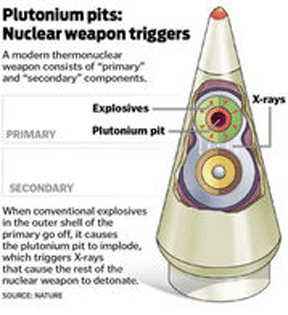
………..Plutonium pits are the shiny metallic, softball-size orbs that hold the most potent destructive force man has ever harnessed in a weapon. During the Cold War, the Rocky Flats production site in Colorado made as many as 2,000 a year. Decades of poor disposal of nuclear wastes and other dangerous environmental practices culminated in a dramatic FBI raid in 1989 that led to the site’s closure in 1992.
Nuclear criticality safety, the craft of avoiding a self-starting, potentially lethal, nuclear chain reaction merely from positioning too much plutonium too closely together, is an ever-present concern during such production……..https://www.usatoday.com/story/news/nation/2018/05/02/safety-concerns-nuclear-bomb-manufacture-sites/572697002/
May 4, 2018
Posted by Christina Macpherson |
- plutonium, safety, USA |
Leave a comment
 FoE Japan 2nd May 2018, Urgent Joint Statement: Hitachi’s nuclear export transfers risks to both
Japanese and British people while companies get profits. Hitachi’s
Chairman Nakanishi is reportedly going to visit British Prime Minister
Teresa May on 3rd May to ask the U.K. government to take a direct stake in
Wylfa Newydd nuclear power project in Anglesey, Wales.
Hitachi’s struggle just shows the risks of the nuclear power project is simply huge. While
putting huge risks and cost onto both Japanese and British people, it is
unacceptable that companies and banks take profit. Friends of the Earth
Japan jointly with People Against Wylfa B released an urgent statement.
The report says Hitachi is going to ask not only for direct investment but also
an assurance for a power purchase agreement. Hitachi’s struggle just
shows the risks of the nuclear power project is simply huge. In February,
Mr. Nakanishi already expressed the view that the project would not happen
without government commitment and stated “Both UK and Japanese
governments understand that the project would not go on without the
commitment by the governments”.
To reduce the risk of the project, the project is said to be insured by Nippon Export and Investment Insurance
(NEXI), 100 percent Japanese government owned export credit agency. In
addition to huge construction cost, nuclear projects are associated with
various risks such as accidents, increased cost for tougher regulations,
opposition from local people, radioactive waste management and so on.
Risks are too huge to manage. Thus, it is clear that companies should decide to
retreat from the project. While transferring risks of the project to
people, it is unacceptable that the companies and banks take profits.
The Spokesperson from People Against Wylfa B, Dylan Morgan says; “Don’t pour
good money in to the bottomless black hole of nuclear power. This is an old
fashioned, dirty, dangerous and extortionately expensive technology. The
Fukushima triple explosions and meltdowns has and will continue to cost the
people of Japan greatly. There is no end in sight for this continuing
tragedy, which means that no new nuclear reactors are going to be built in
Japan. It is unacceptable that Japan wish to export this deadly technology
to another state in order to keep Japan in the nuclear club.”
http://www.foejapan.org/en/energy/doc/180502.html
May 4, 2018
Posted by Christina Macpherson |
business and costs, Japan, UK |
Leave a comment
 Liberation 2nd May 2018 , The practice of ” revolving doors” consisting of going back and forth
between public and private, without worrying too much about conflicts of
interest, is not the prerogative of the French elite and concerns all
sectors of the world. activity in Europe.
But according to a report to be published Wednesday by the group of Greens in the European Parliament, it
is particularly developed in France in the fossil and nuclear energy
industries. What explain a certain lack of voluntarism in terms of
ecological transition. This 82-page document entitled “Revolving Doors and
the Fossil Fuel Industry” , which Libération has procured, reviews the
“warm relations” that have developed in the main countries of the Union
between policy makers and large companies energy through these famous
revolving doors.
http://www.liberation.fr/france/2018/05/02/energie-les-portes-du-pouvoir-ouvertes-a-tous-les-vents-du-lobbying_1646907
May 4, 2018
Posted by Christina Macpherson |
France, secrets,lies and civil liberties |
Leave a comment
 Bulletin of Atomic Scientists 4th May 2018 , In 1965, the US Atomic Energy Commission made a fateful decision to license
nuclear power plants that, top safety experts believed, had containment structures that were inadequate to contain dangerous releases of
radioactivity in the case of core-melting accidents.
It was a critical turning point in reactor safety. The AEC’s downgrading of the containment’s role opened the door to smaller, cheaper, “dynamic”
containments, which offered significantly less protection in case of a fuel melt accident. Buyers of nearly four dozen large US power reactors opted
for the most vulnerable of such containments, of which 30 remain in
operation.
Because of their inadequate containments, they should all be retired. All but one have exceeded their original 40-year license
durations. New plants shouldn’t be licensed unless they include containments that actually do what they were originally supposed to do –
contain all radioactive material, even in a worst-case melt-down of a nuclear reactor core.
https://thebulletin.org/2018/may/containment-failure-how-american-nuclear-regulators-undercut-power-plant-safety-beginning11770
May 4, 2018
Posted by Christina Macpherson |
safety, USA |
Leave a comment
Climate Change Turns Coastal Property Into a Junk Bond, The returns can be great, unless the investment winds up under water. Bloomberg, By Noah Smith, May 3, 2018 “……… Even in the worst-case scenario, sea level rise will be moderate by 2050 — perhaps 1 or 2 feet along most U.S. east coast locations. And there’s a good chance it will be much less.
A rise of that magnitude doesn’t sound like a lot. But it would inundate a number of low-lying coastal areas. The National Oceanic and Atmospheric Administration’s sea level rise viewer app lets you play around with the data and look at maps. Even a moderately bad climate-change scenario could swamp some pieces of coastal real estate within a few decades.
But sea level rise isn’t a gradual, steady thing. The ocean is not a still bowl of water, but a roiling mass tossed around by winds and tides. Long before coastal areas are permanently underwater, they’ll experience increased risk of catastrophic flooding. Hurricane Harvey, which last year flooded much of the city of Houston and became the second most expensive natural disaster in U.S. history (behind another wind-induced coastal flood, 2005’s Hurricane Katrina), is probably a harbinger of more frequent storm-driven disasters.
So for the next few decades, climate change probably won’t send coastal real estate prices crashing, but it does create a tail risk for buyers. Increased probability of coastal flooding makes waterfront real estate a bit like a junk bond — something that will probably go up in value, but has a small to moderate chance of going to zero. Junk bonds generally don’t have a value of zero, but the risk of devastation definitely does depress their selling price.
Recent research confirms that the climate threat is already showing up in prices. Economists Asaf Bernstein, Matthew Gustafson and Ryan Lewis have a recent paper showing that houses exposed to sea-level rise of between 0 and 6 feet have been selling at a 7 percent discount relative to houses a similar distance from the beach that aren’t exposed. The time period they look at is 2007-2016 — before the damage from Harvey. They also confirm that the discount is higher in locations where people report more worry about climate change.
Another recent study, by environmental researchers Jesse Keenan Thomas Hill and Anurag Gumber, shows something similar. Focusing on Miami-Dade County, they show that higher-elevation locations have risen in price faster than similar locations at low elevations. That’s consistent with the theory that wealthy buyers pay a premium to escape flooding risk. High-elevation areas could also have other benefits, of course, such as increased safety from crime — but with crime down dramatically in Miami, this is a less convincing explanation of the increased elevation premium.
In fact, the price differences these economists find may be understating people’s worries about climate change, because of flood insurance. The U.S. government insures many coastal properties against floods, mostly in Texas and Florida. The National Flood Insurance Program charges below-market premiums to many of the riskiest houses, effectively subsidizing owners of the properties most vulnerable to coastal flooding.
So evidence shows that landlords, homeowners and real estate investors are now taking climate change seriously. Polls still find a big partisan gap in concern about climate change, with 67 percent of Republicans claiming that they worry only a little or not at all. But in financial markets, the reality of the phenomenon is starting to be felt. Noah Smith at nsmith150@bloomberg.net https://www.bloomberg.com/view/articles/2018-05-03/flood-risk-makes-coastal-real-estate-look-like-a-junk-bond
May 4, 2018
Posted by Christina Macpherson |
business and costs, climate change, USA |
Leave a comment











 nuclear-news